
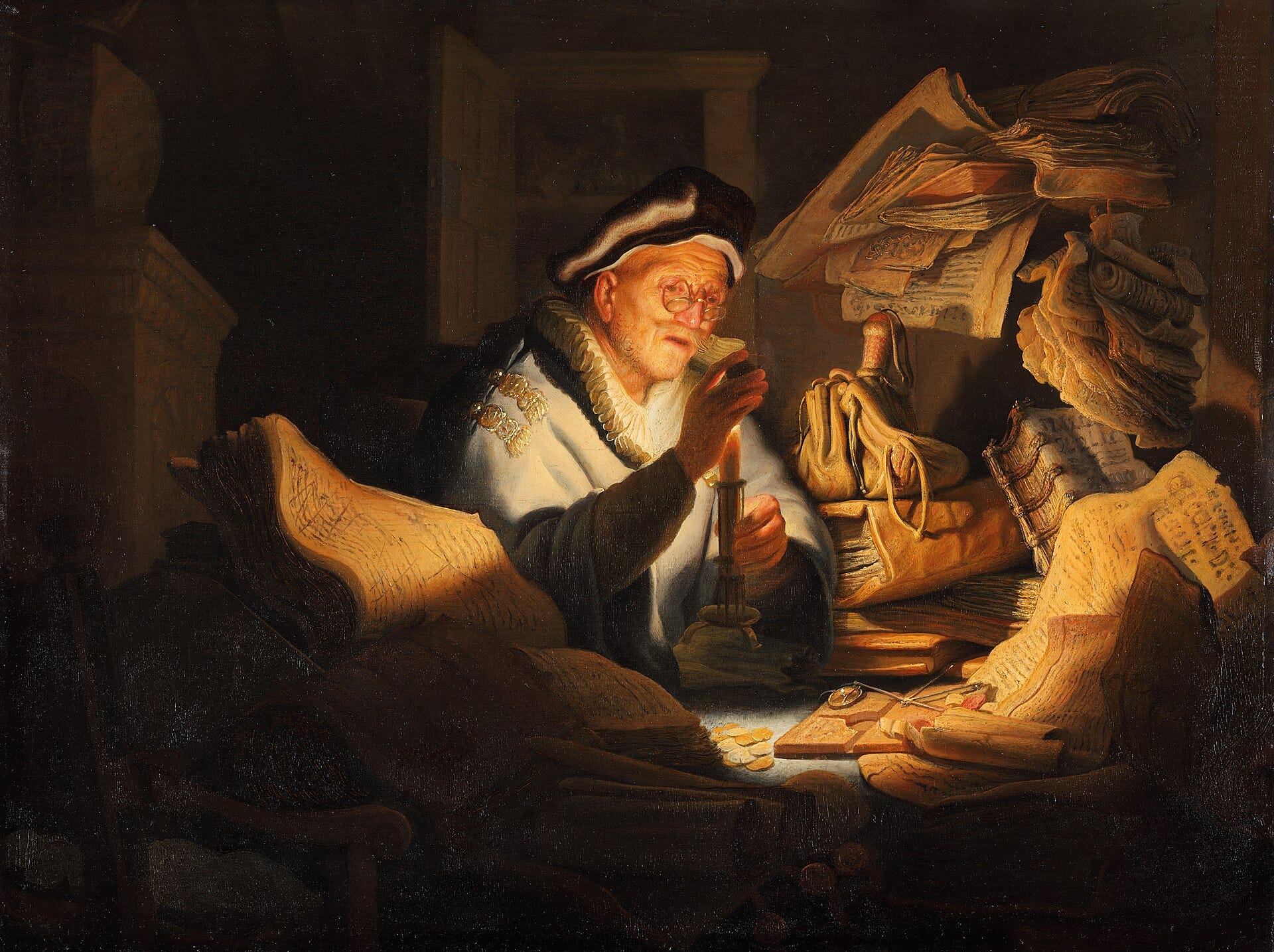
Painters have rarely been gentle with the people who handle other people's money, yet for six centuries they drew the tax man's tools with almost loving care: the ledger, the scales, the coin raised to the light. One panel renders an account book so faithfully that a historian has read in it seven months of taxes on wine and beer.
Cool Stories About Art is a newsletter to learn art the fun way.
Join 200,000+ readers and get:
10 new art stories / month
The entire archive of content (140+ articles)
Comment, ask questions, and chat with other readers
Why Painters Kept Returning to the Tax Office
The first reason came from the Gospels. Christ called a tax collector away from his table to make him an apostle, and because that scene could not be painted without a tax office, the office itself entered churches and stayed there for centuries.
Once inside the picture, the trade brought its own equipment, and painters found plenty to describe. A counting room lays out the whole working method: a ledger ruled into columns, a coin tested on the scales, a written loan, a strongbox, and sometimes a payment brought in as eggs.
Every work chosen here shows someone who takes, changes or lends money, whether collector, money changer or lender, with those tools in view. Pictures of wealth alone were left out, and each scene places the job at a desk, a gate or a table.
12. Juan de Pareja, The Calling of Saint Matthew (1661)
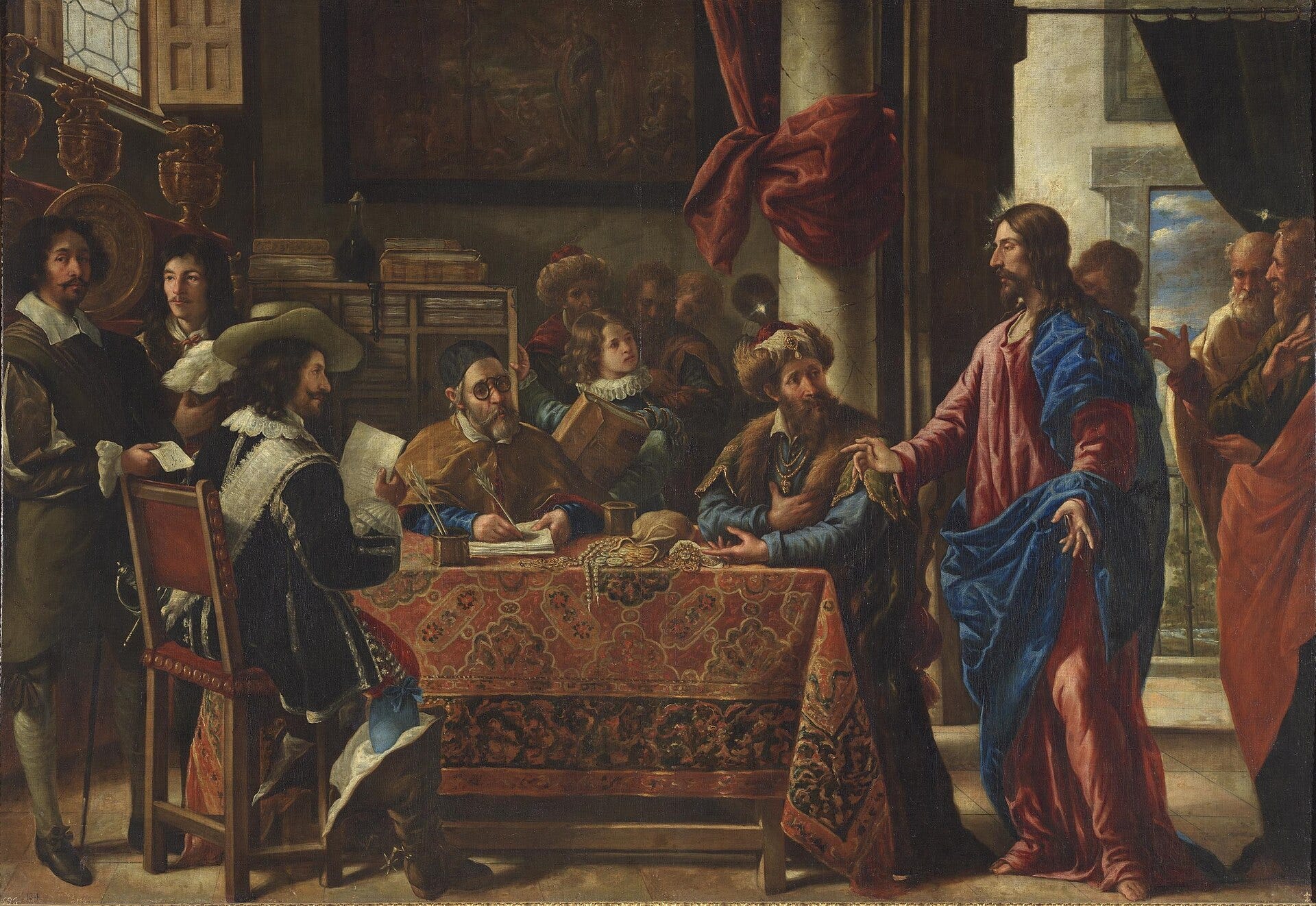
The painter's own name, Juan de Pareja, and the year 1661 are written on a slip of paper held by a man dressed in black, off to one side of the crowd. He turns his eyes toward the viewer.
That signature means more than most. Pareja had spent some twenty years enslaved in the household of the Spanish king's painter, Diego Velázquez. In 1650, in Rome, Velázquez painted his portrait, and within months he drew up a deed of freedom that still bound Pareja to four more years of service. Pareja was fully free in 1654 and worked as a painter in Madrid until his death in 1670.
Seven years into that freedom, he took a subject from the Gospels, Christ calling a tax collector away from his work. A column splits the room in two. Christ and his barefoot apostles stand on the right. On the left, richly dressed men crowd around a table heaped with coins and papers, and the business of the tax office carries on.
Pareja put himself on that left side, among the money rather than among the apostles. He holds his paper as a clerk might hold a receipt, and his pose and clothes are close to those of the portrait Velázquez had made of him eleven years before. The canvas is the best known of his works, though no record tells who ordered it.
Long after Pareja's death, Arturo Schomburg, a Harlem collector who devoted his life to gathering books and documents on Black history, traveled to Spain to see his paintings. He wrote that he had "journeyed thousands of miles to look upon the work of this coloured slave who had succeeded by courageous persistence in the face of every discouragement."
At a Glance
Artist: Juan de Pareja (about 1608 to 1670)
Painted: 1661
Medium: Oil on canvas
Size: 225 × 325 cm (88.6 × 128 in)
Where to see it: Museo del Prado, Madrid
About This Painting
Is I, Juan de Pareja a true story?
It is a novel for young readers by Elizabeth Borton de Treviño, which won the Newbery Medal in 1966. It follows the real Pareja through his years with Velázquez, but its dialogue and much of his inner life are invented.
11. Henri Rousseau, The Toll Gate (about 1890)
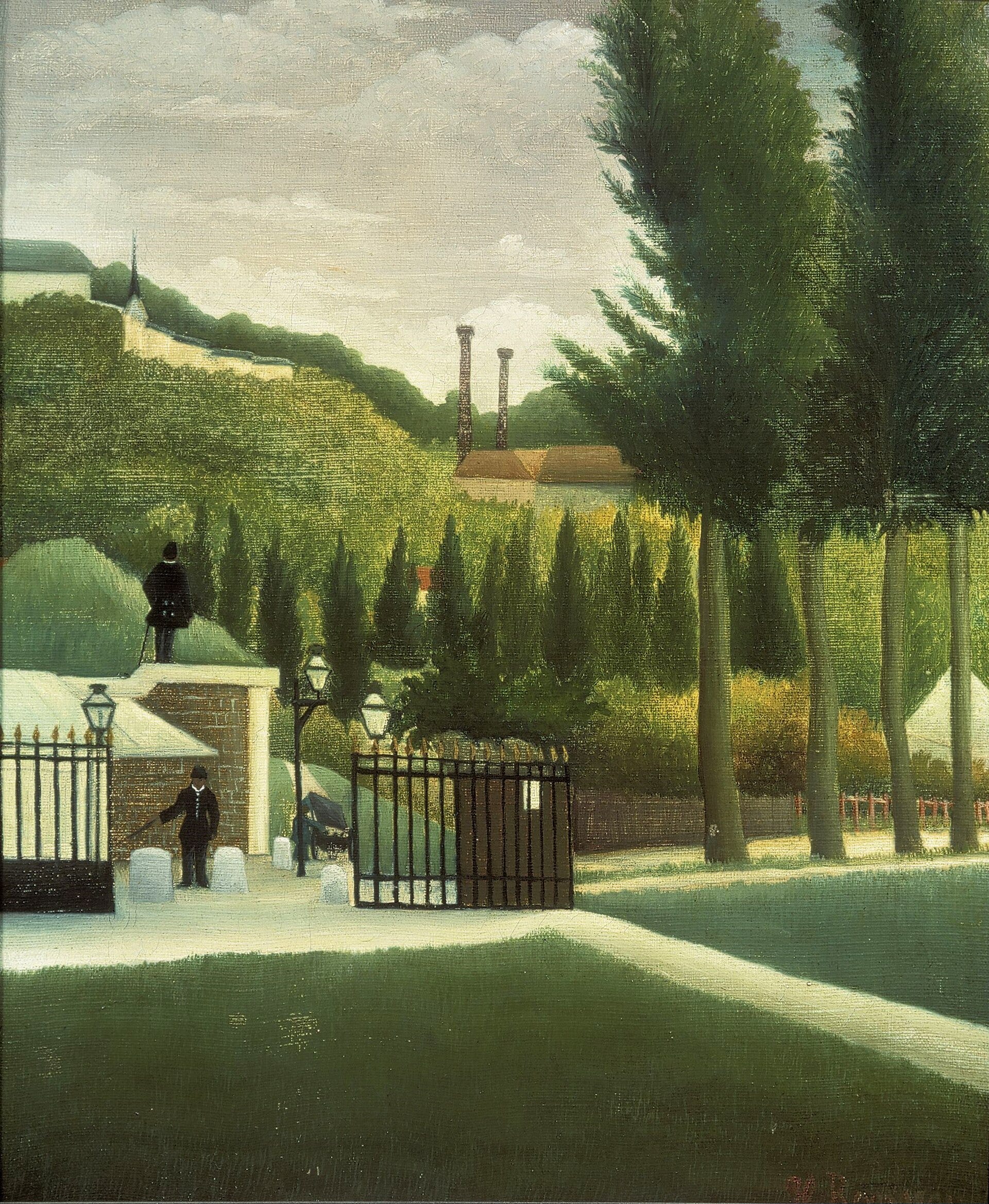
A wrought iron gate closes a road where a city ends. Beside a small toll house two uniformed men keep watch, one of them perched high on the wall, while beyond the bars a man pushes a cart toward the trees. The painter knew this post from the inside. For more than twenty years, his job was to stop carts like that one and tax whatever they carried.