
For a long time, painting a saint was one of the safest ways to fill a sacred picture with monsters. The license came from the life of an Egyptian hermit who spent years alone in the desert, harassed by demons and visions. Nearly sixteen centuries after his death, the same story handed a Hollywood studio the subject of a painting contest.
Cool Stories About Art is a newsletter to learn art the fun way.
Join 200,000+ readers and get:
10 new art stories / month
The entire archive of content (140+ articles)
Comment, ask questions, and chat with other readers
A Hermit, His Demons and His Visions
Anthony was an Egyptian hermit who died in 356. Around 360, Athanasius, bishop of Alexandria, wrote his life, and the book made him the model of the monk who lives alone in prayer. It tells how, during his retreat in the desert, demons attacked him and sent him visions.
From that book, painters took two scenes. The first is the assault, with the saint pulled about by creatures nobody had ever seen. The second is the visions, women, food or gold set before a man who turns them away. In both, an artist could invent freely while staying inside a sacred subject.
Every work in the selection is built on that temptation. Taken in order, they follow the story as it traveled, from prints passed between workshops to altarpieces, then to pictures made after a French novel of 1874, and at last to a film studio in California.
12. Joos van Craesbeeck, The Temptation of Saint Anthony (about 1650)
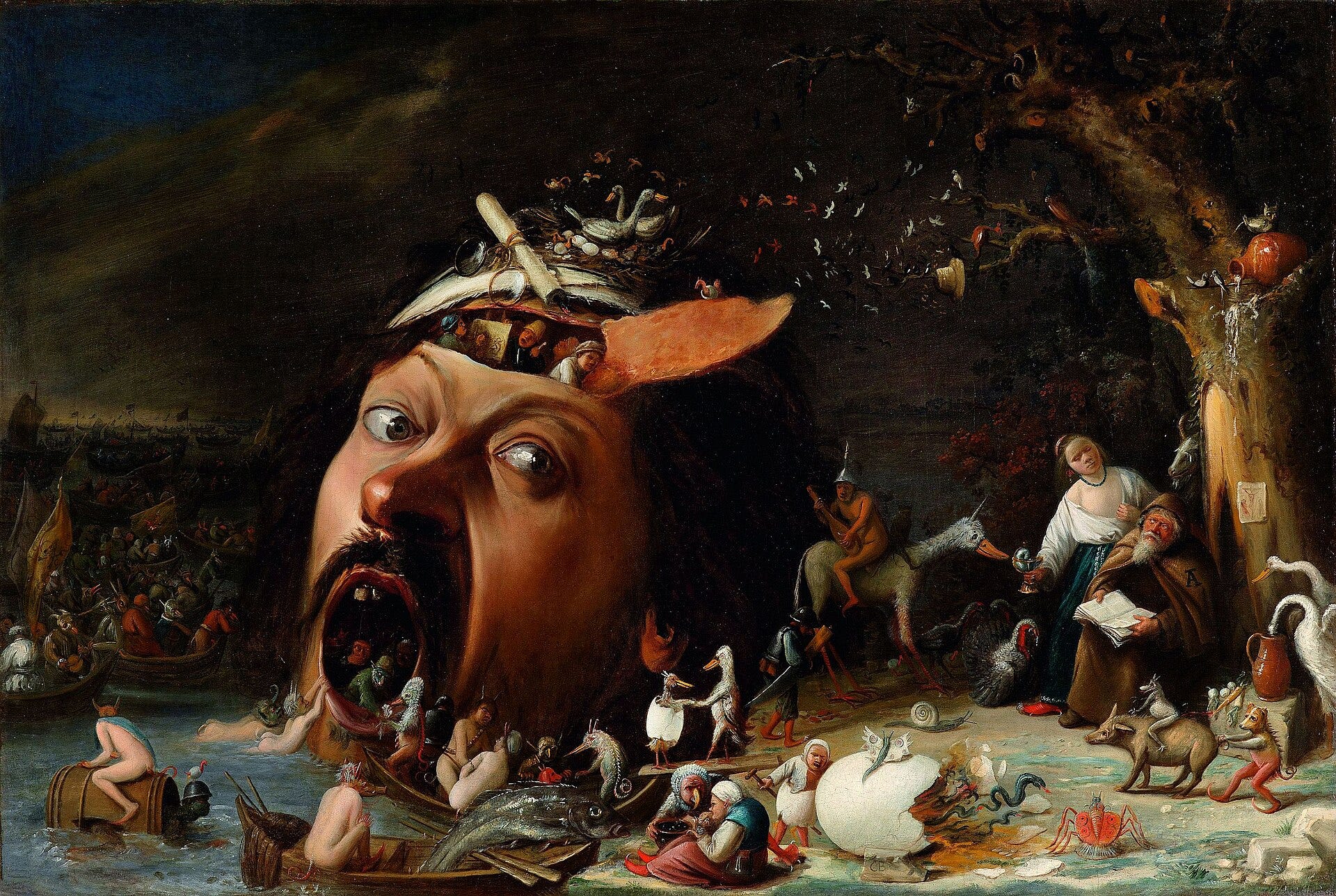
On a shore lies a giant man's head, its mouth wide open and the top of its skull lifted like a lid. Small devils pour out through an opening in its forehead. On the right, an old hermit holds his book while a young woman offers him a cup.
The hermit is Saint Anthony, and the picture is The Temptation of Saint Anthony, painted about 1650 by Joos van Craesbeeck. The giant head was not a new idea. About a century earlier, Pieter Bruegel the Elder had designed a print with one floating in the water.
Craesbeeck opened his head up. In the reading usually given, the devils leaving the forehead are its bad thoughts. In the space they leave behind, a tiny painter, a pair of spectacles and a bird's nest have moved in.
The man who put that tiny painter there had not started out in the trade. Born around 1605 in Brabant, probably a baker's son, Craesbeeck married into the family that ran the bakery of the citadel of Antwerp, a fortress that also held prisoners. In 1633 or 1634, the Antwerp guild of Saint Luke made him a master twice over, as a baker and as a painter.
The fortress may also have given him his teacher. In 1633, the painter Adriaen Brouwer was locked up there, probably for debt. No document records a meeting, but in 1661 Cornelis de Bie, author of a book of Flemish painters' lives, called Craesbeeck Brouwer's pupil and best friend.
After his wife died in 1637, Craesbeeck gave all his time to painting.
At a Glance
Artist: Joos van Craesbeeck (about 1605 to 1660 or 1661)
Painted: About 1650
Medium: Oil on canvas
Size: 78 x 116 cm (30.7 x 45.7 in)
Where to see it: Staatliche Kunsthalle Karlsruhe, Karlsruhe, Germany
11. Odilon Redon, The Temptation of Saint Anthony (1888)
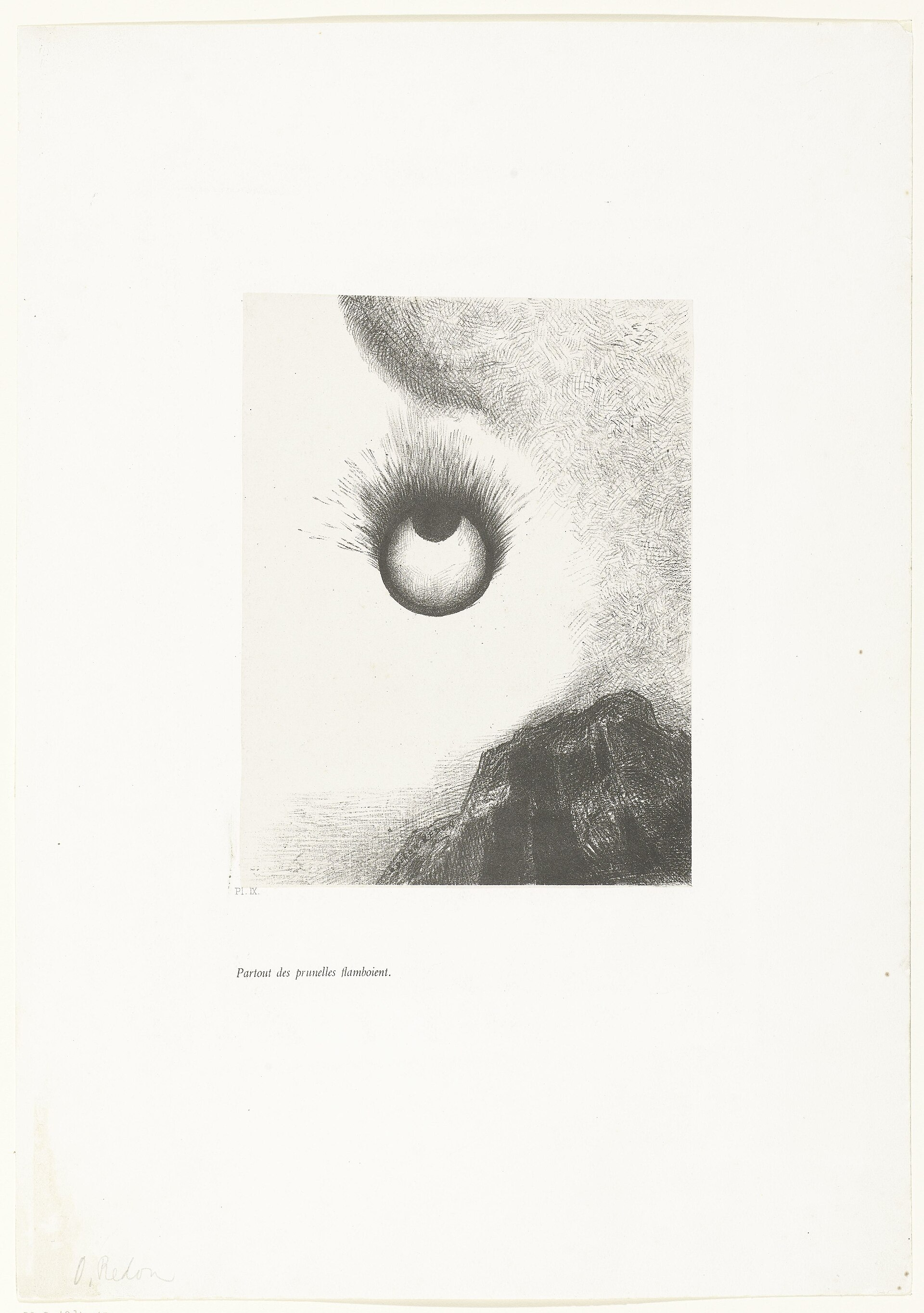
One round eye, its lashes bristling, hangs in a pale sky above a dark rock. Under the image runs a line of French: "Partout des prunelles flamboient," everywhere eyeballs are aflame. Of the hermit whose temptation the sheet illustrates, there is no trace.