
In the fall of 1621, at the meal now called the first Thanksgiving, the Wampanoag outnumbered the English settlers almost two to one: at least ninety men against fifty-three colonists. Few of the famous pictures of the holiday show it that way. Most were made long afterward, for magazines, calendars and a war, and each tells more about its own year than about 1621.
Cool Stories About Art is a newsletter to learn art the fun way.
Join 200,000+ readers and get:
10 new art stories / month
The entire archive of content (140+ articles)
Comment, ask questions, and chat with other readers
A Feast Described in One Letter
Painters had almost nothing to copy. The only account of the 1621 meal is one paragraph in a letter written by a settler: three days of feasting, wild fowl, and five deer brought by the Wampanoag. The paragraph names no turkey, and it never uses the word thanks.
That silence left each period free to fill the gaps with its own wishes. Once Lincoln made the holiday national in 1863, it needed images, and artists supplied them, from feather bonnets borrowed from the Plains peoples to settlers dressed all in black.
The twelve works below show the holiday, the two peoples behind its story, or the bird and the grace at its center, and a few were made far from America. Almost none shows what happened in 1621, and each entry says where its image invents.
12. Pieter Claesz, Still Life with a Turkey Pie (1627)
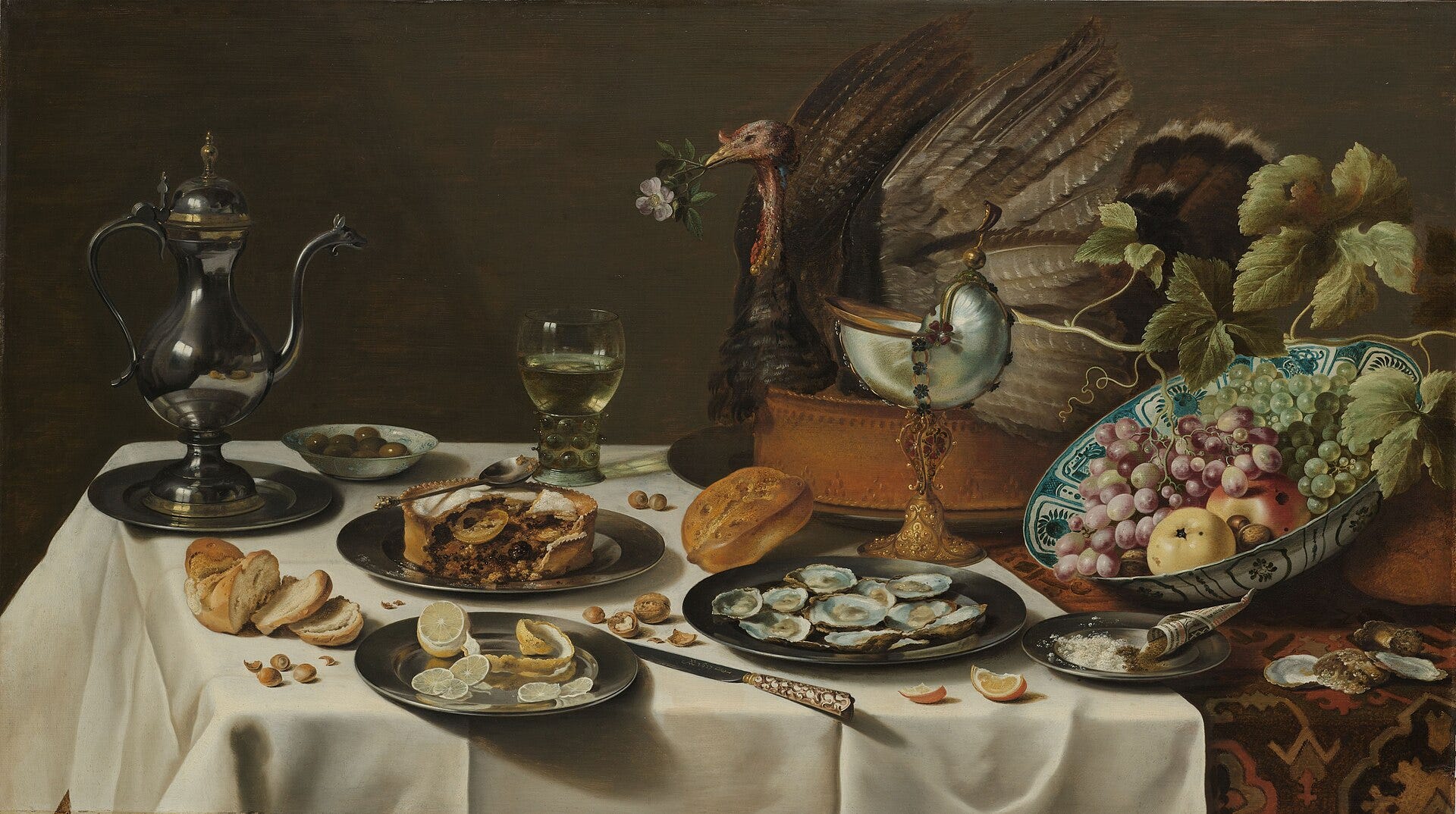
A whole turkey, its head and feathers set back in place and a sprig in its beak, crowns the pie at the back of this table. In front of it lie silver, glass, a Chinese porcelain bowl and a cup made from a nautilus shell.
Pieter Claesz painted this feast in 1627, and few of his still lifes are as large or as ambitious. Much of what covers the table had crossed oceans: the porcelain from China, the nutmeg from the Moluccas, the spice islands of present-day Indonesia, where enslaved workers grew it.
The bird on the pie had made its own journey. The peoples of Mexico had domesticated the turkey long before the conquest, the Spanish brought it back to Europe around 1519, and English farmers were raising it by 1541. By the time this pie was baked, a turkey was a showpiece for wealthy European tables.
So the bird now tied to an American holiday was already a European luxury when the Pilgrims crossed the Atlantic, after living in the Dutch city of Leiden from 1609 to 1620. In the only letter that describes their harvest feast of 1621, it is not even named.
At a Glance
Artist: Pieter Claesz (about 1597 to 1660)
Painted: 1627
Medium: Oil on panel
Size: 76.5 × 135 cm (30 × 53 in)
Where to see it: Rijksmuseum, Amsterdam
11. Thomas Nast, Uncle Sam's Thanksgiving Dinner (1869)
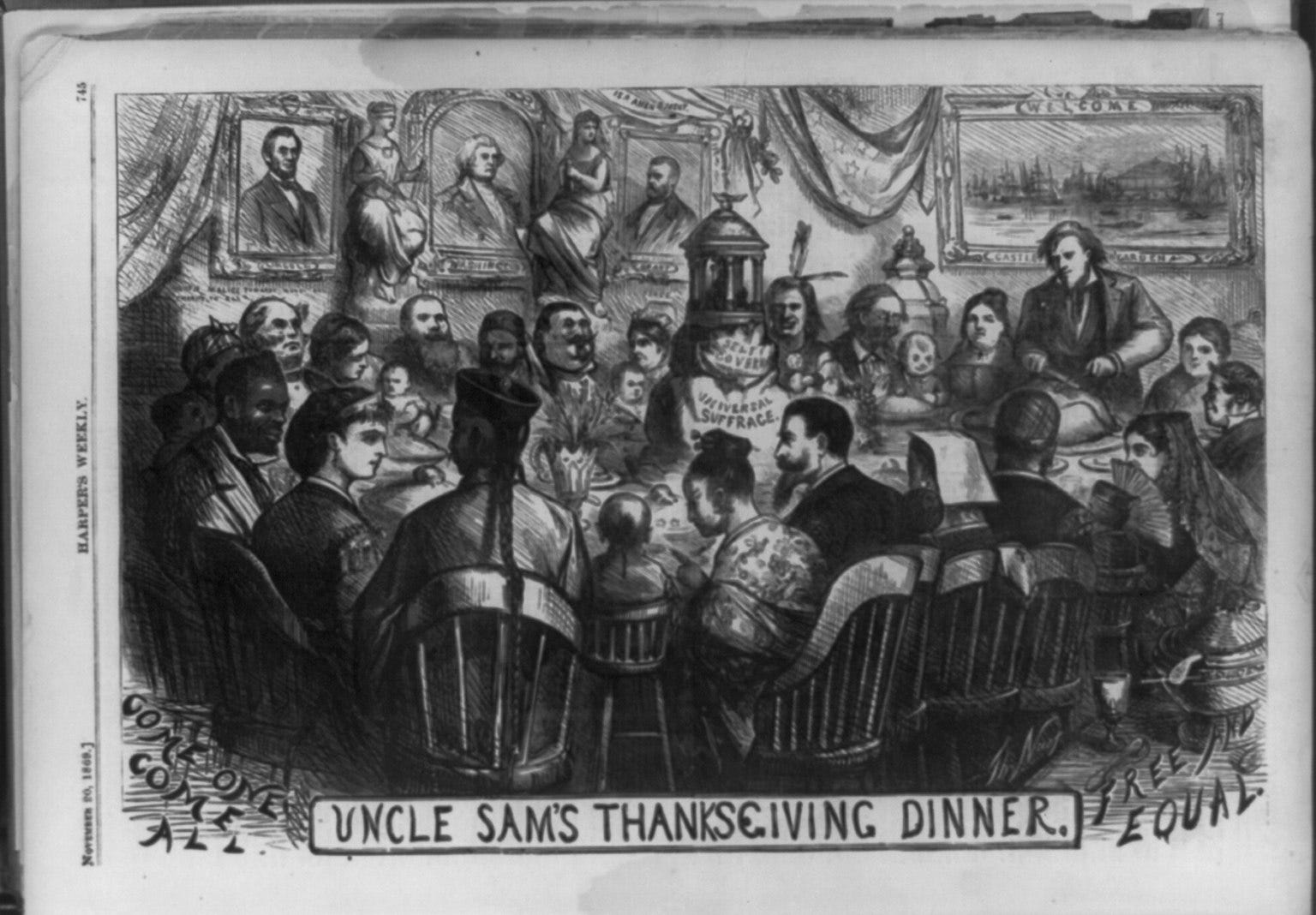
Carving the turkey at the head of a long table is Uncle Sam, the bearded figure who stands for the United States. Around him sit Chinese, Native, Black and white Americans, men and women side by side, under portraits of Washington, Lincoln and Grant. In November 1869, four years after the Civil War, not all of these guests had the right to vote, and the cartoonist drew the table as an argument.