

170 000+ readers. Learn art the fun way.
This is a preview. Paid subscribers get the full story.
You’ll also get:
10 new stories every month
The full archive (130+ Art stories)
Your personal art guide. Comment, ask questions, DM me anytime
iPhone user? Subscribe at coolstoriesabout.art, not via the app. Apple adds 30% to the price.
If you’ve ever been to the National Gallery in London, you may have seen the scene. Room 4. A painting over six feet on each side. Two men, life size, standing, surrounded by instruments and books. In front of them, a small crowd.
But the visitors are doing something strange.
Instead of standing in front of the canvas, they shuffle to the right. They lean in. They press themselves almost flat against the wall. And they squint, looking at the painting from a sharp angle.
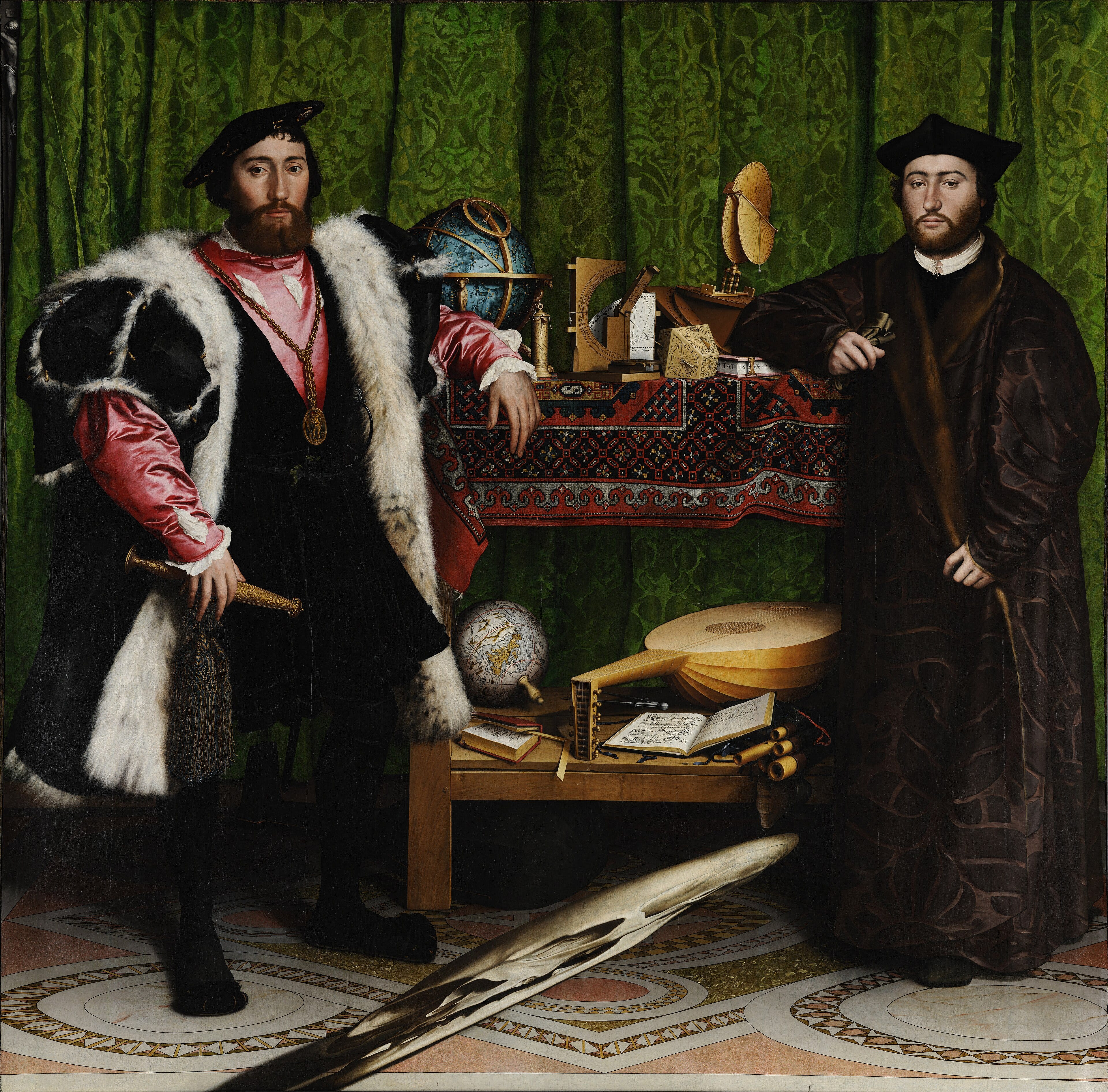
The painting is called The Ambassadors. It was painted in 1533 by Hans Holbein the Younger, a German painter born in Augsburg, living in London where he worked for the English court. And this painting probably contains more codes, symbols and hidden messages than any other from the Renaissance.
A single number, buried throughout the canvas, is the key to all of it.
Two Men at the Top
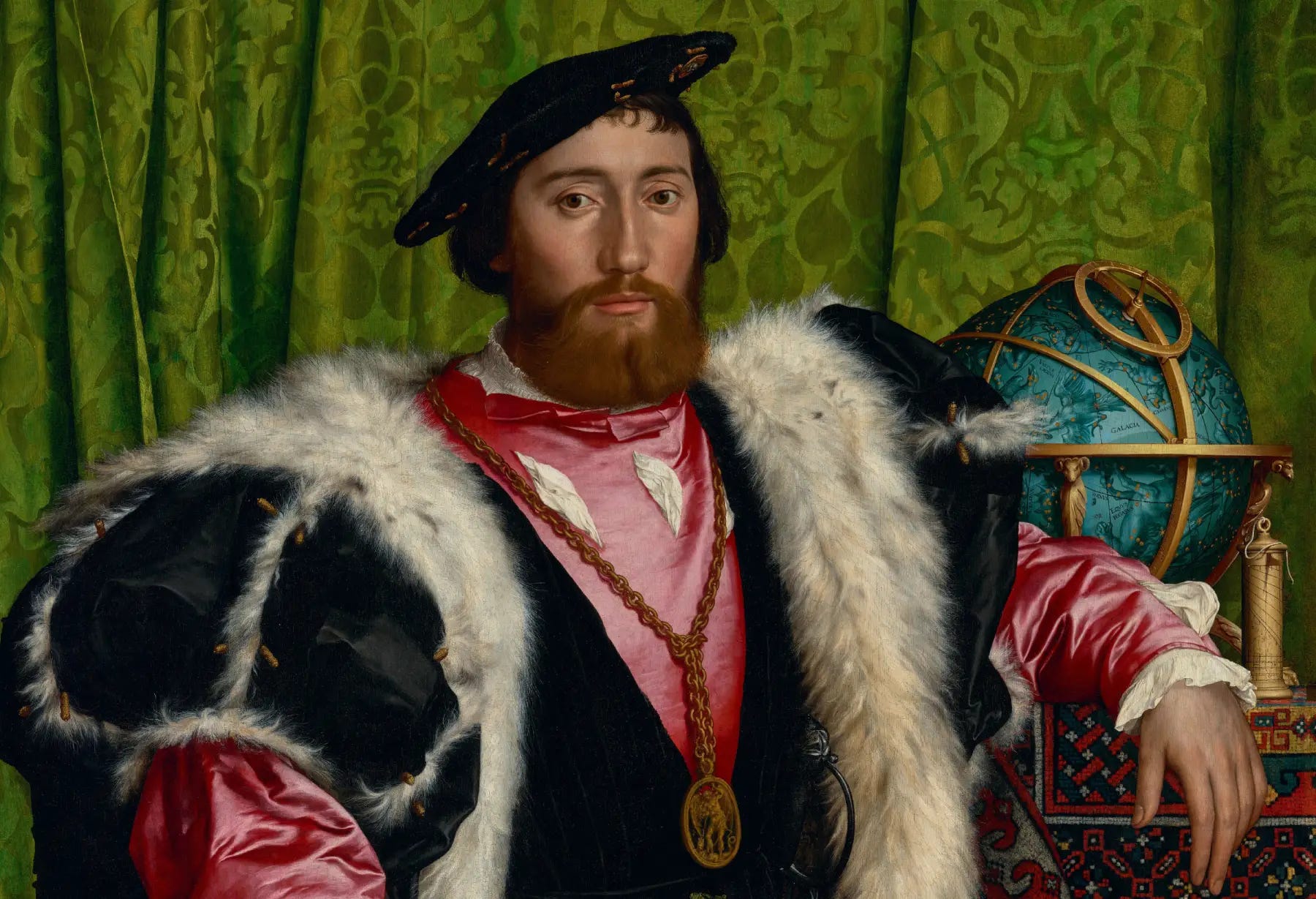
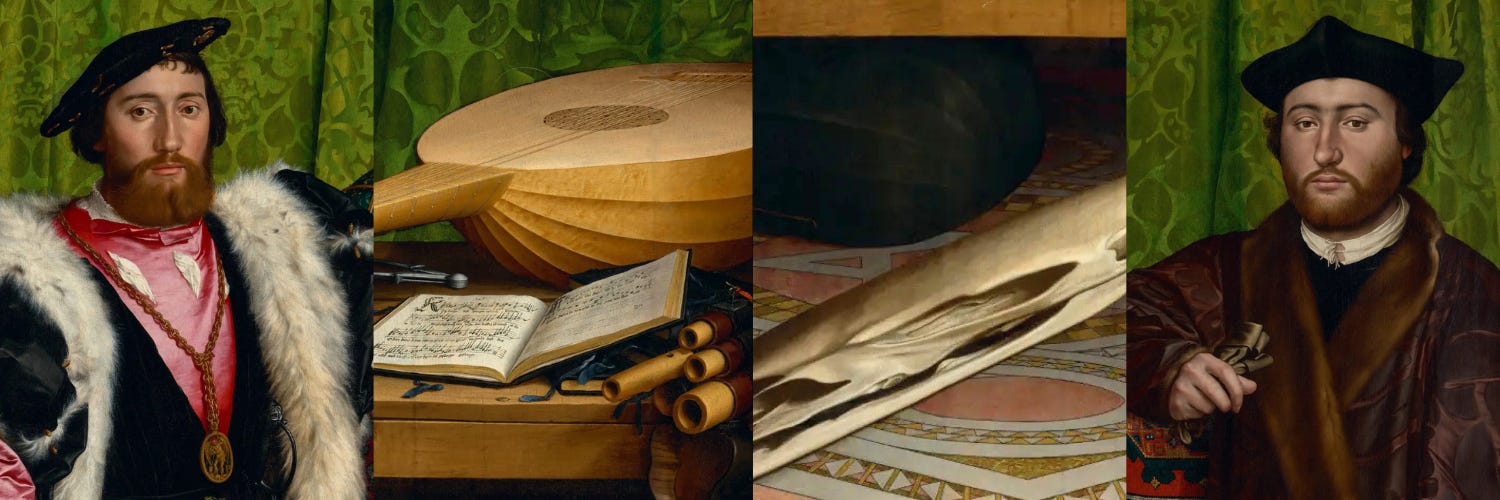
Let’s start with the man on the left. He wears a coat lined with lynx fur, one of the most expensive in sixteenth century Europe, reserved for the highest nobility. Underneath, a pink satin doublet: a rare, costly dye that only the wealthiest could afford.
Around his neck, a heavy gold chain. This is not just jewelry. It is the insignia of the Order of Saint Michael, the highest distinction the King of France could bestow. This man is therefore a close associate of Francis I, King of France.


At his side, a dagger. The sheath bears an inscription in Latin: “AET. SVÆ 29.” His age.
And on the terrestrial globe placed between the two men, Holbein slipped in another clue, hidden among the place names, written backwards: the name of a village, Polisy. It is the estate of a family from Champagne, the Dintevilles.
The man is Jean de Dinteville, ambassador of Francis I to the English court.
The man on the right is dressed very differently. A long, dark robe, almost black. Some fur underneath, but discreet, contained. No gold chain. No insignia. In 1533, this outfit says one thing: he is a man of the Church.
His elbow rests on a book whose edge also bears a number: 25. His age.
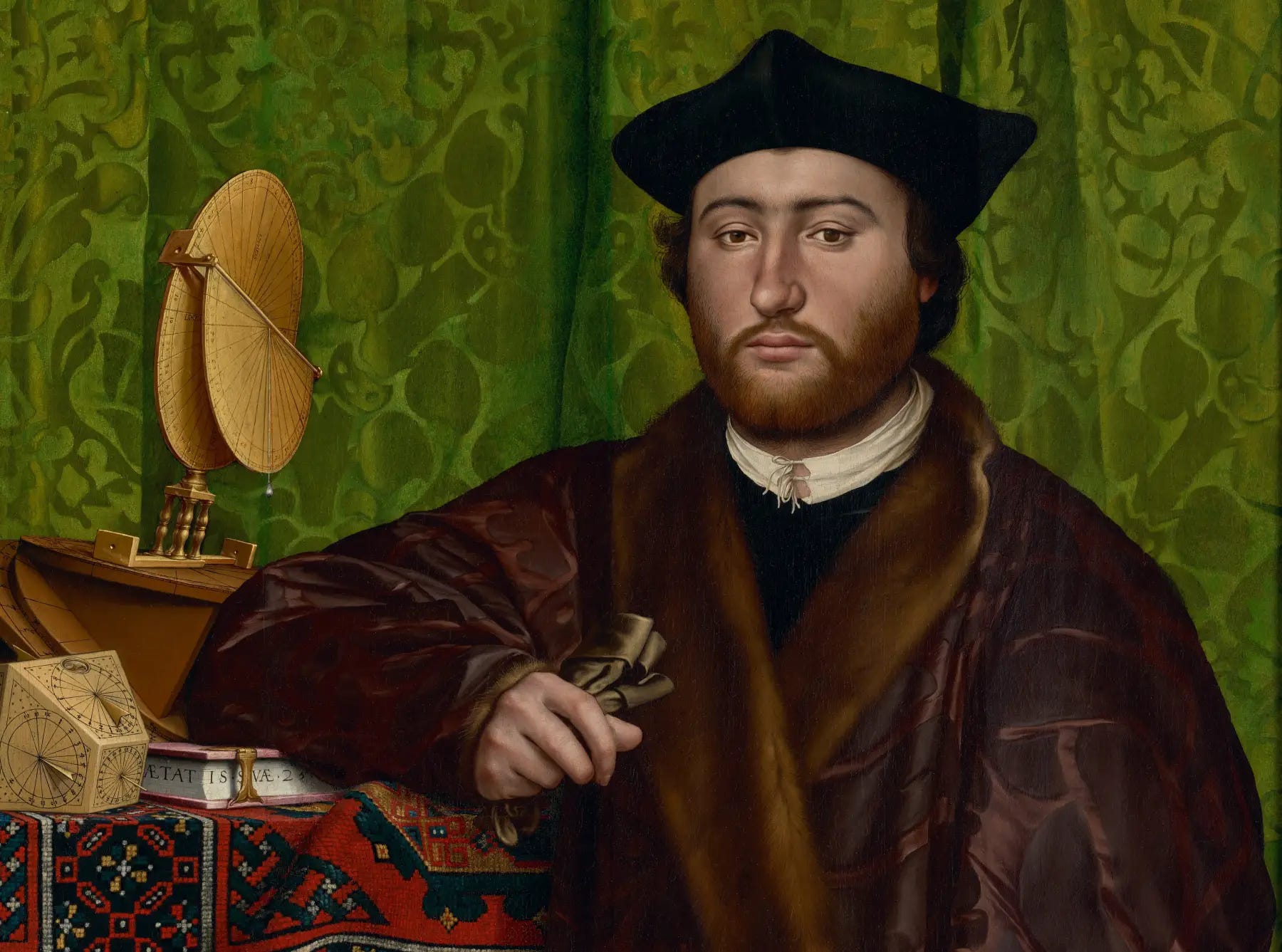
His name is Georges de Selve. Appointed Bishop of Lavaur by the King of France at the age of 18, sent as a diplomat to Venice, to Rome, to Spain.
Between them, two shelves covered with an Oriental rug, loaded with scientific instruments, books and tools for measuring the sky. Their feet rest on a marble mosaic floor, strangely detailed.
Everything in this image speaks of mastery and confidence. Two brilliant young men, at the height of their time, perfectly in their place.
You have to step closer to the shelf to see that something in this image is wrong.
Discover my new newsletter !

Keep learning art the fun way


The Broken String
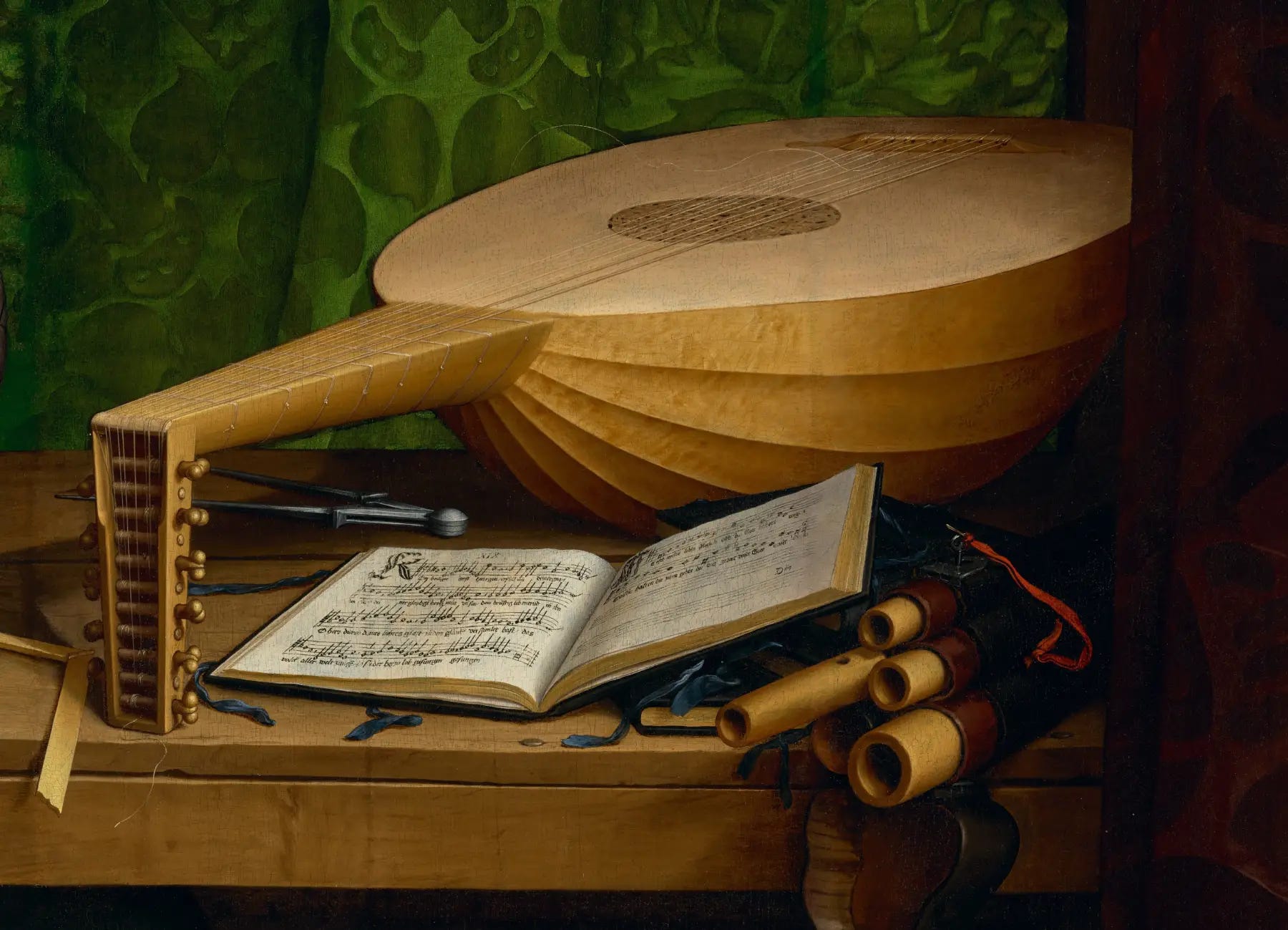
On the lower shelf, a lute is laid on its side. Holbein rendered it with extraordinary care. Every string, every grain of the wood.
But one of the strings is broken.
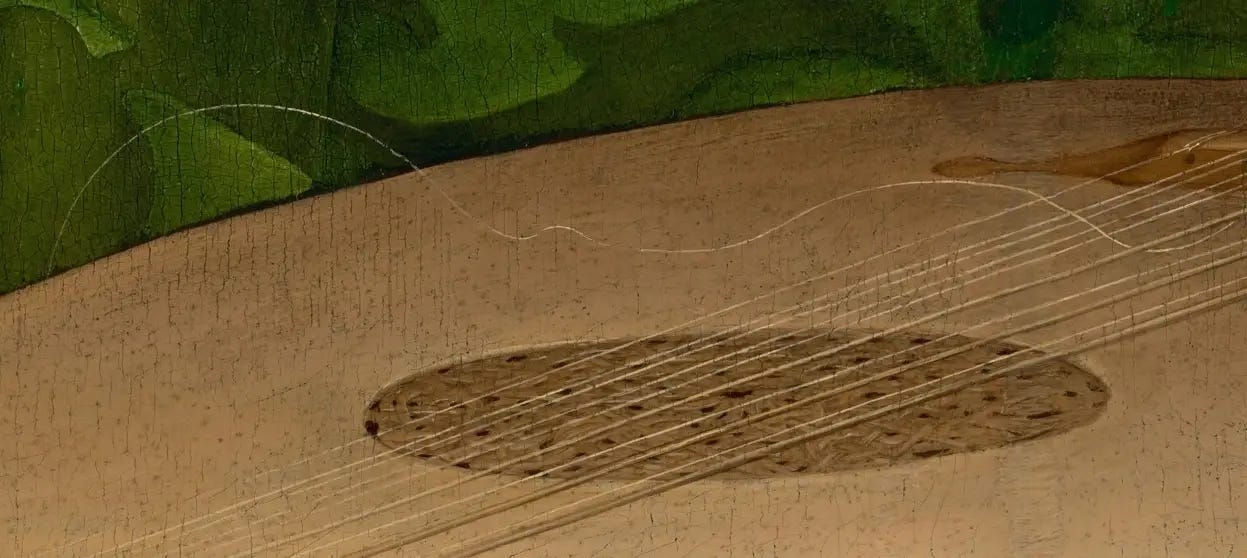
It has unraveled and trails limply across the body of the instrument.
In the sixteenth century, the image spoke for itself. A well tuned lute meant harmony: between people, between nations, between believers. When a string breaks, harmony is broken.
Right next to the lute, a leather flute case where four instruments sit neatly in their compartments.
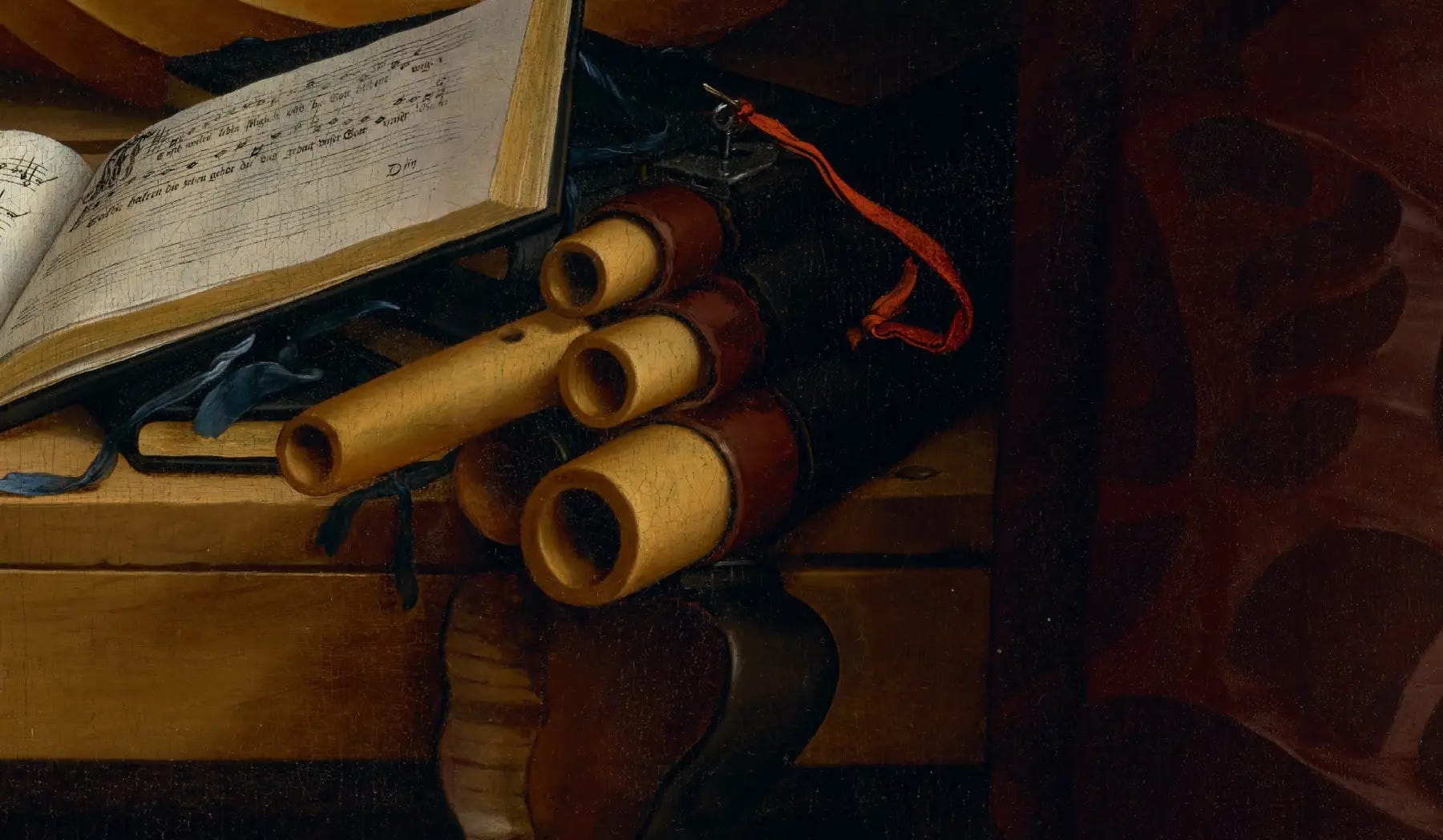
The fifth slot is empty.
Harmony is shattered. The ensemble is incomplete. And Holbein still does not say why.
The Book Between Them
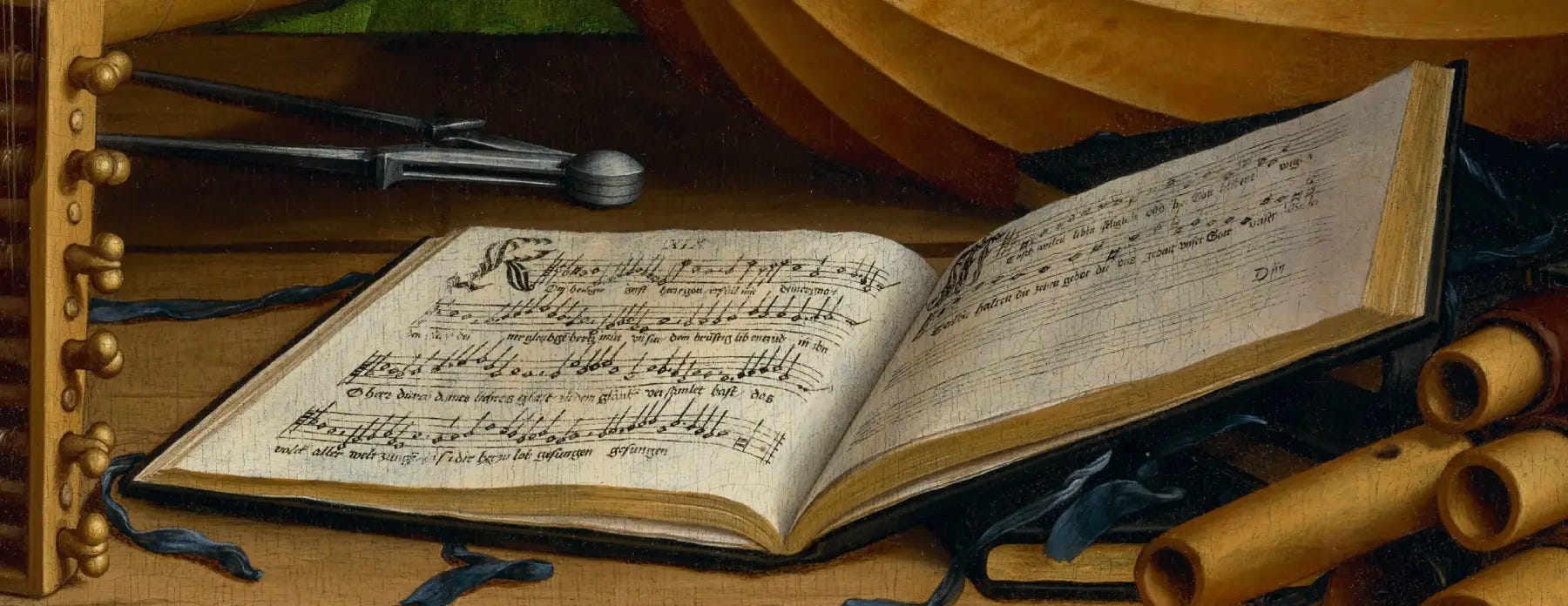
Leaning against the lute, there is a small open music book. The staves are legible. So is the text. It is in German.
When you decipher it, it turns out to be the first hymnal of the Lutheran Reformation, published in 1524 with a preface by Martin Luther himself. The monk who defied the Pope and split Christendom in two.
His book is placed open between a Catholic ambassador and a Catholic bishop.
On the left page: “Come, Holy Spirit, Lord God,” a plea for unity. On the right page: the Ten Commandments according to Luther.
The two pages do not follow each other in the original edition. Holbein chose them and placed them side by side.
Why those two?
“Dividirt”
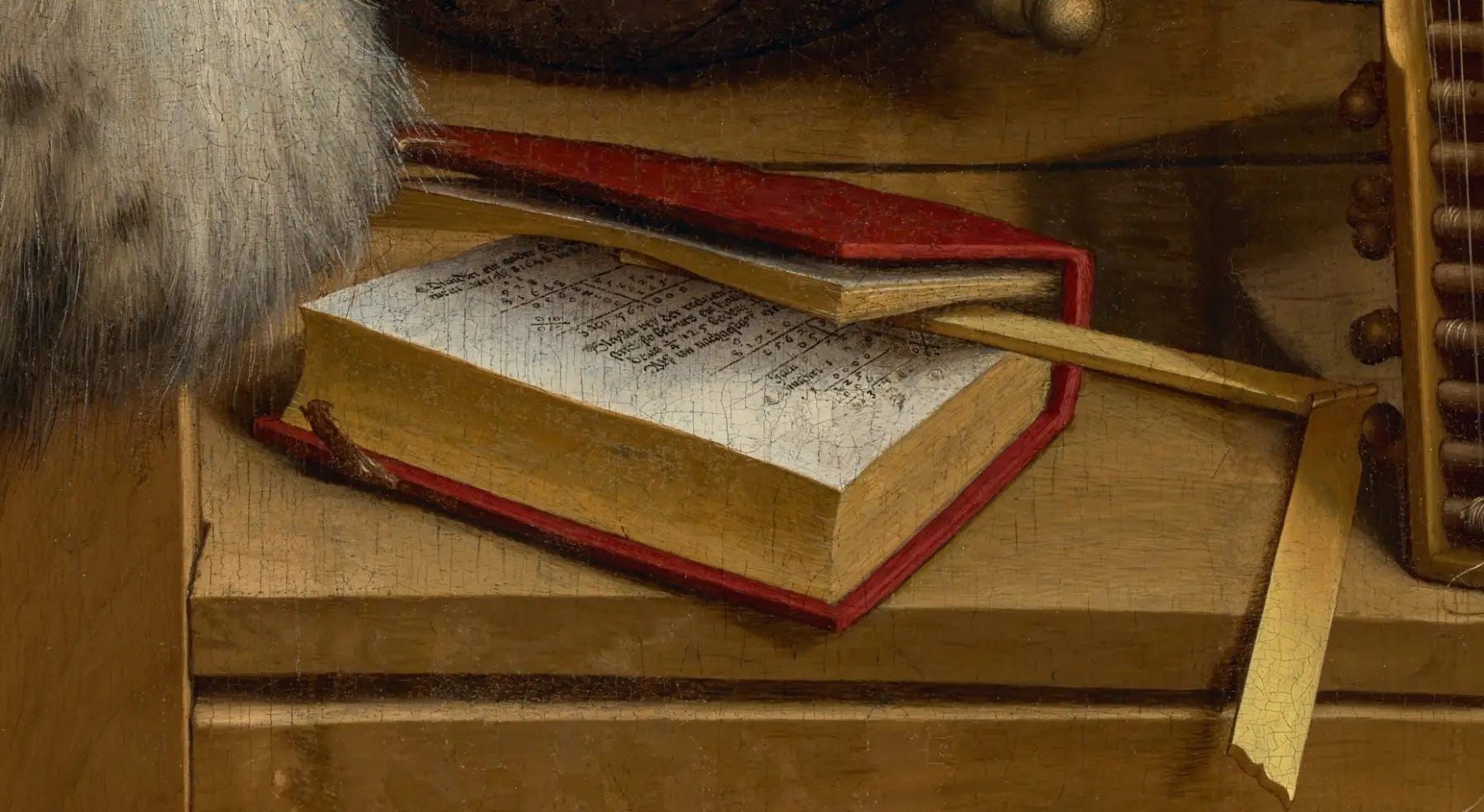
A second book sits on the same shelf, held open by a wooden set square. It is an arithmetic manual for merchants. Columns of numbers. Division exercises.
The first word on the page, in large type: “Dividirt.”

Let it be divided.
And a little further down, the fraction ½.
The broken string. The missing flute. Luther between two Catholics. And the word “divided” spelled out in plain sight.
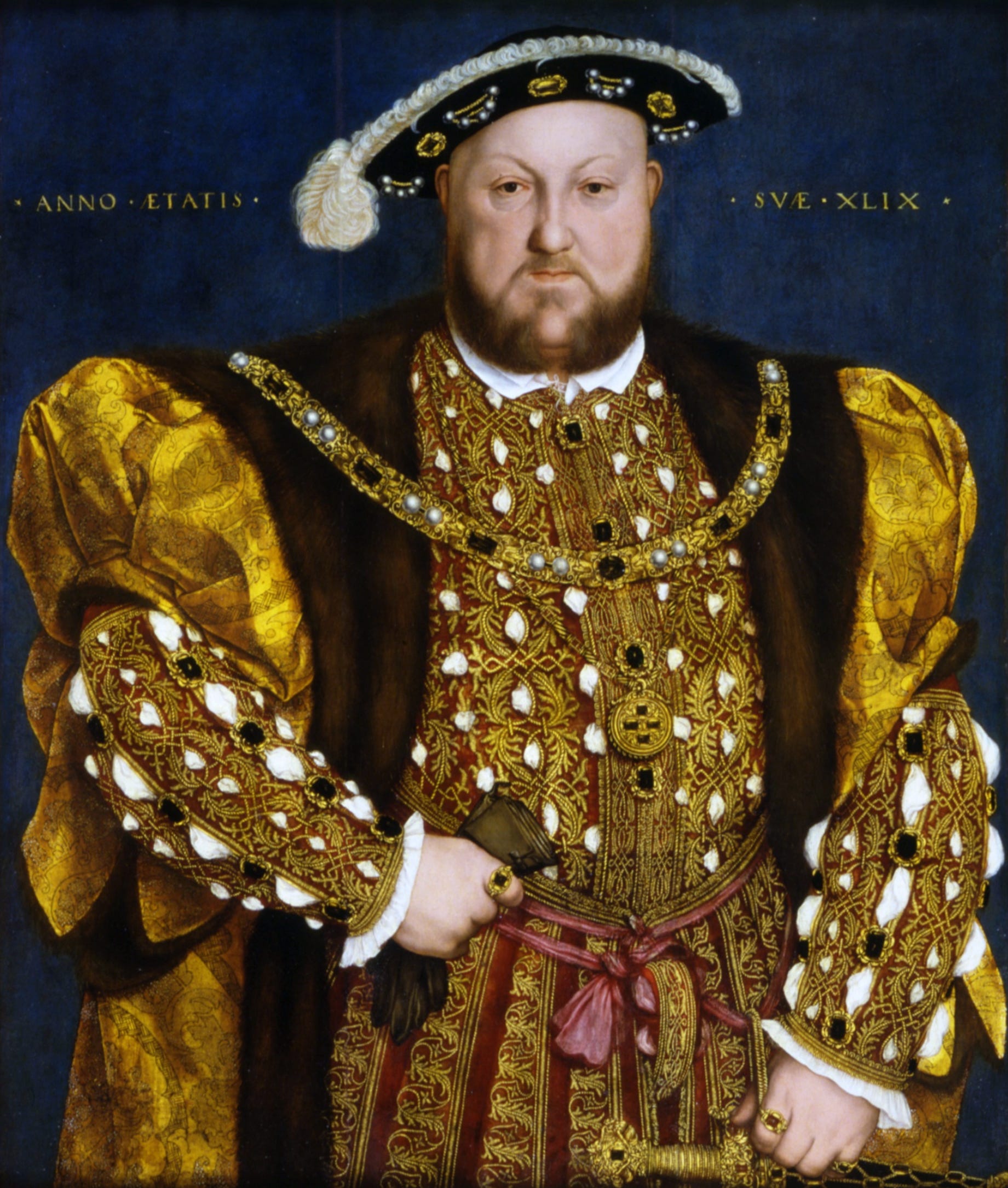
In 1533, the King of England, Henry VIII, wants to divorce Catherine of Aragon. The Pope refuses. So Henry VIII does something no English king has ever done: he breaks with Rome. His Parliament passes a law that severs England from the Catholic Church.
The Pope excommunicates the King.
Christian Europe, united for centuries, splits in two.
It is in the middle of this crisis that Dinteville and de Selve find themselves in London. And it is in the middle of this crisis that Holbein paints them.
Everything falls into place.
The string that breaks is the harmony of Christendom coming apart. The missing flute is an incomplete ensemble.
Luther placed between two Catholics is the fracture laid bare between the two men sent to prevent the schism. And the two hymn pages placed side by side, grace and law: a silent plea for reconciliation.
27
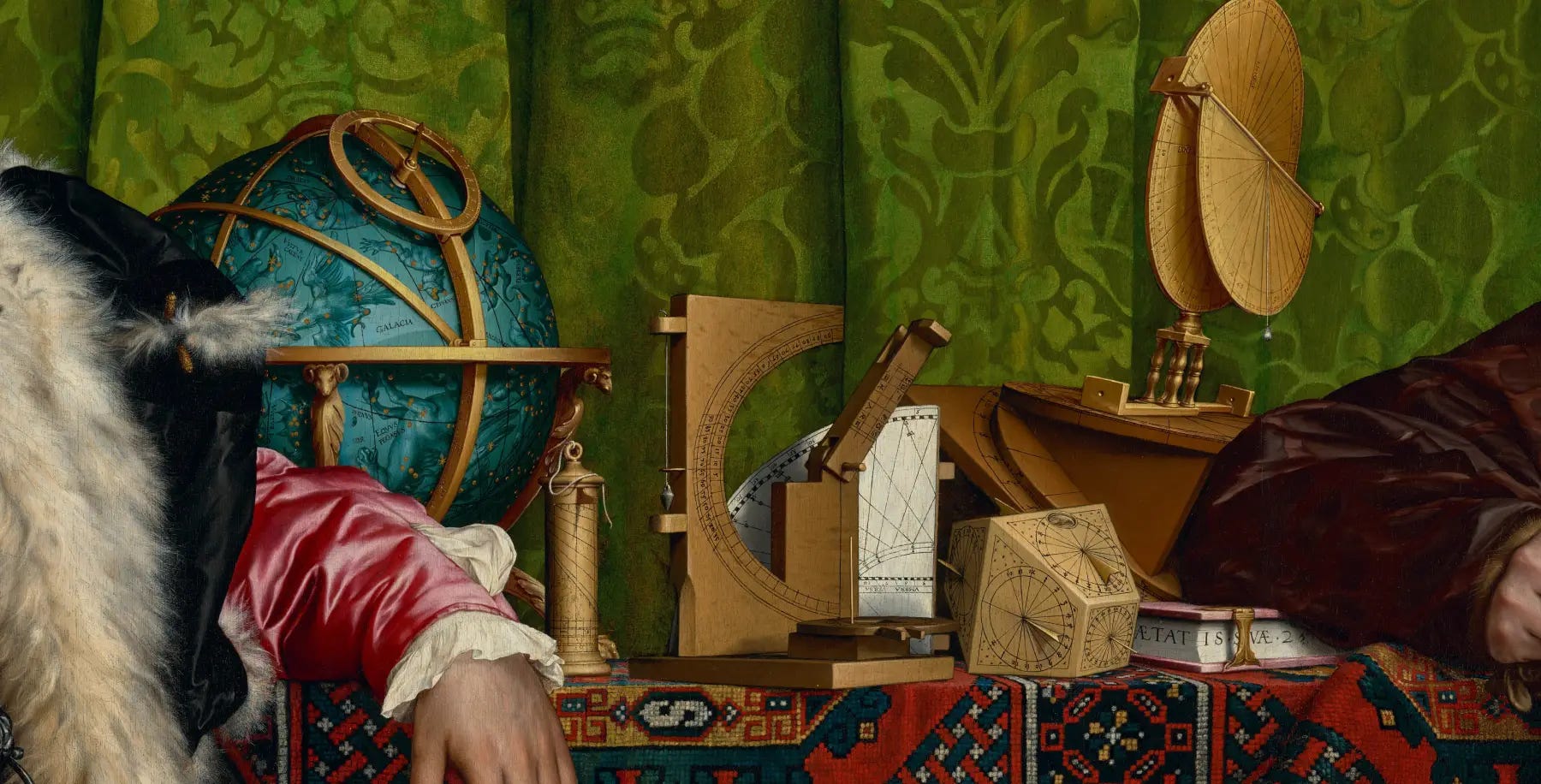
But Holbein painted two shelves. And the second one hides something even more unsettling.
The upper shelf is covered with astronomical instruments: a celestial globe, several sundials, instruments for measuring the sky. None of them show the same time. One dial reads 9:30, another 10:30. One is calibrated for a latitude that corresponds to North Africa, not England.
These are precision instruments. And they are all deliberately set wrong.
On the first sundial, the altitude of the sun is set to 27 degrees. On the instrument right next to it, an angle is marked: 27 degrees. A third instrument, the one that measures the position of the stars: 27 degrees.
Go back to the arithmetic book, the one that says “Dividirt.” The results of the exercises on the page are all multiples of 27.
The Luther hymnal: the angle formed by its two open pages is 27 degrees.
The number is everywhere. Hidden in every instrument, coded into the calculations, buried in the angles. Holbein planted it across the entire painting.
27 degrees is the exact altitude of the sun at four in the afternoon on April 11, 1533. That day was Good Friday. Four in the afternoon is the hour that follows the death of Christ on the cross.
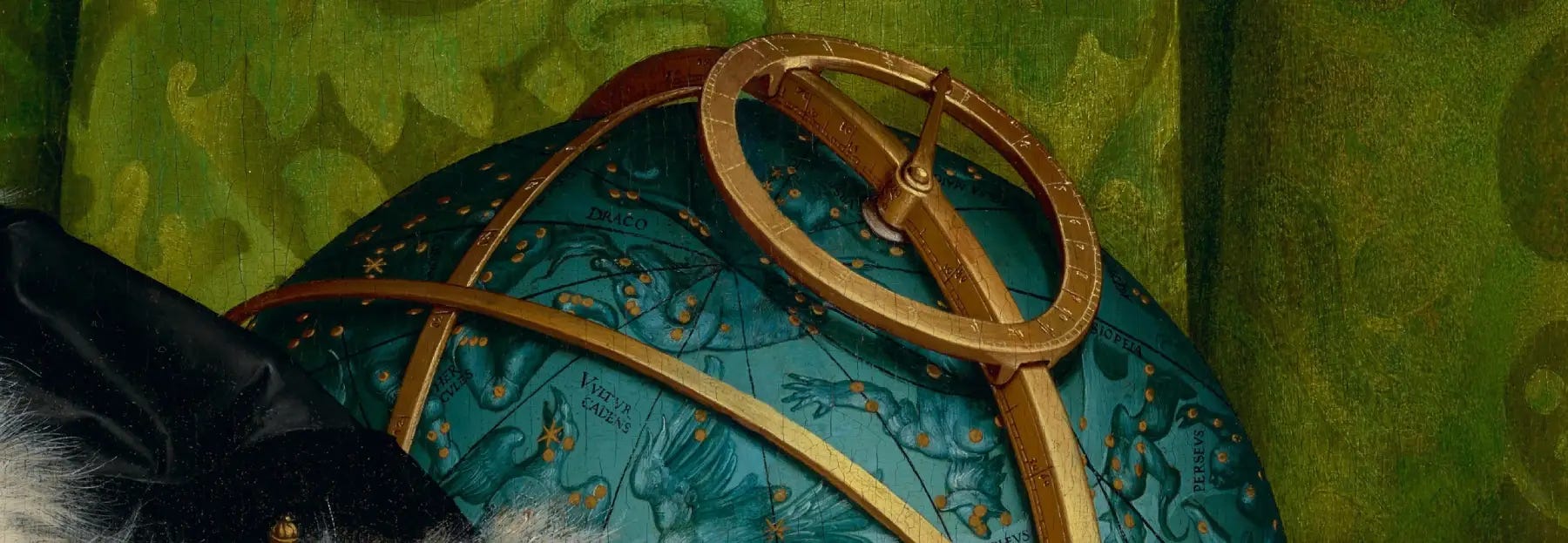
The celestial globe confirms it: it shows the sky of April 11, 1533. But its latitude is not that of London, where the painting was made.
It is the latitude of Rome.
The city of the Pope. At the moment it loses control of Christendom.
The lower shelf tells the story of the fracture. The upper shelf points to a date and a place.
And everything directs the eye toward a spot on the canvas that no one understands: a large grayish shape, stretched diagonally across the floor in the foreground.