
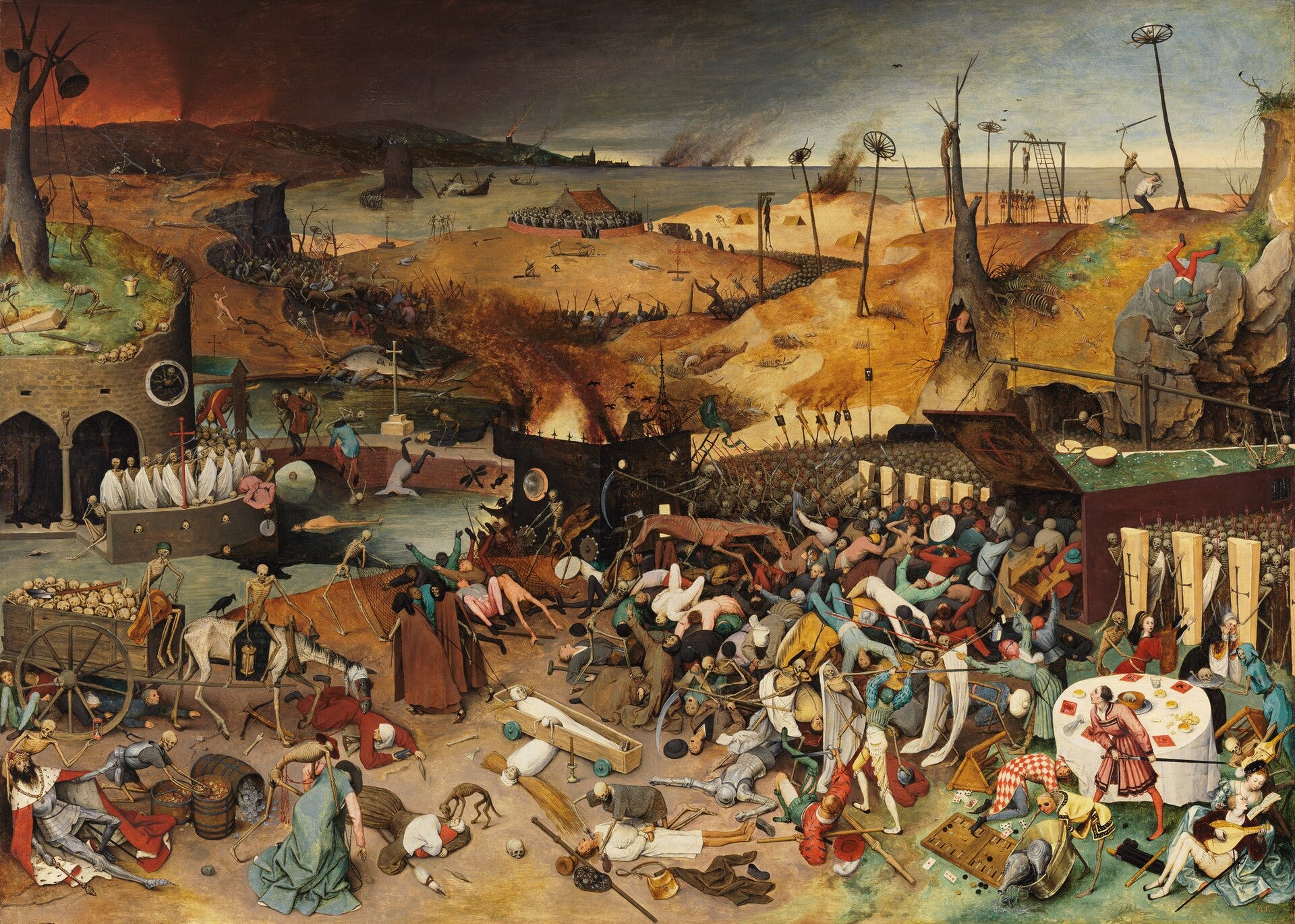
The Bible sends an angel to strike down the first-born of Egypt and a whole Assyrian army, yet never says what he looks like. Painters had to decide for themselves.
The twelve works gathered here, paintings, manuscript pages and prints made between about 1412 and 1915, show how far apart their answers fall. Death comes as a galloping skeleton, as a gentle angel who has come to comfort a frail young woman, and once with the painter's own face.
Cool Stories About Art is a newsletter to learn art the fun way.
Join 200,000+ readers and get:
10 new art stories / month
The entire archive of content (140+ articles)
Comment, ask questions, and chat with other readers
How These Were Chosen
In the Hebrew Bible, the killer goes by "the angel of the LORD" or "the destroyer," names that give him no face, no body and often no weapon. Nothing says how close he stands to the living, or whether he comes to punish, to warn or to comfort.
The skeleton came from elsewhere, from the last book of the Christian Bible. In the Book of Revelation, a rider appears on a pale horse, and "his name that sat on him was Death." This rider is no angel sent by God. He is Death himself.
In the late Middle Ages, after the Black Death had emptied towns all over Europe, painters gave him the body of the dead he leaves behind, first a rotting corpse, then a bare skeleton. Each of the twelve works shows Death as a figure one can point to, in one of these two shapes or in a new one.
12. Limbourg brothers, The Procession of Saint Gregory (about 1412 to 1416)
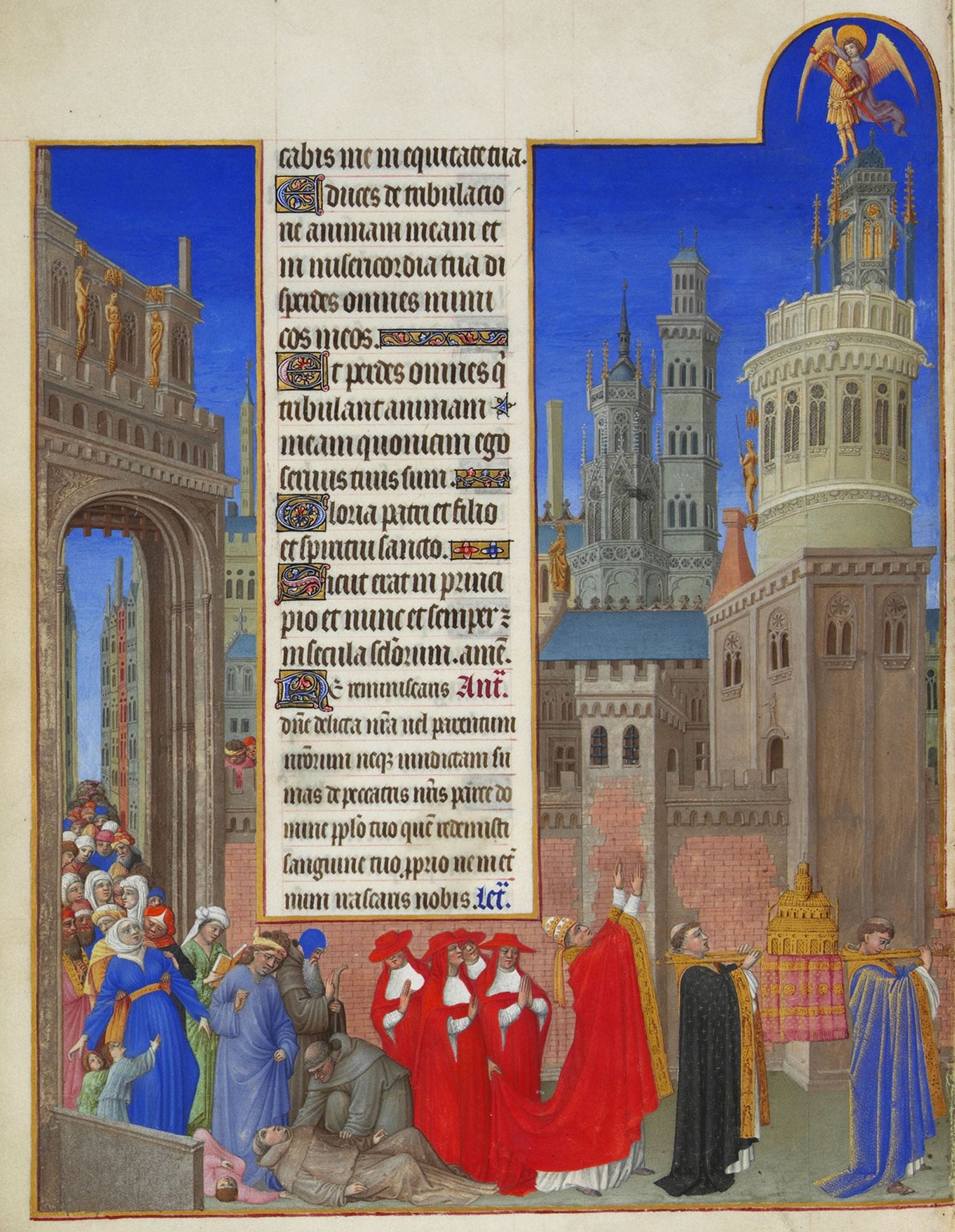
In 590, a plague was killing Rome, and it had already carried off the pope, Pelagius. Around 1412 to 1416, the Limbourg brothers painted the day it ended, in The Procession of Saint Gregory, a page of a prayer book.
High on a round tower at the right edge of the page, a tiny angel stands against a blue sky. He is the angel of death, and his work in Rome is done. Below him, clergy carry a golden shrine on poles through the streets, under a column of Latin prayers, the text of the book.
Among the cardinals, the princes of the Church, walks Gregory, dressed in red as pope. Chosen to replace Pelagius, he has led the whole city out to beg God to stop the dying.
The three brothers, Paul, Herman and Jean, were illuminators, painters of manuscript pages. They made this one for the Très Riches Heures, the prayer book of Jean, duke of Berry, son and brother of French kings.
The procession had a witness, a different Gregory. Gregory of Tours, a bishop in Gaul, as France was then called, wrote down what his deacon saw in Rome that day.
Choirs chanted the Kyrie eleison, the Greek plea "Lord, have mercy," and eighty people fell dead while the city prayed. The Limbourgs did not paint eighty bodies. A single monk in a brown robe, collapsed at the lower left of the page, stands for all of them.
That witness says nothing of a heavenly messenger. The figure on the tower was added much later, in the Golden Legend, the lives of the saints compiled in the thirteenth century by Jacobus de Voragine, a Dominican friar.
In that telling, Gregory sees an angel on top of a castle above Rome, wiping a bloody sword clean and sliding it back into its sheath. A sword put away means the killing is over, and Gregory understands that the epidemic has ended.
The book never names this messenger, yet the castle took its name from him and "was called the Castle Angel." It is still Castel Sant'Angelo, the round fortress on the Tiber, the river of Rome.
On the page, the Limbourgs set the angel and the fallen monk as far apart as possible. The angel stands on a piece of the painted frame that juts up into the blank margin above the picture, and the monk lies in the opposite corner, far below him.
At a Glance
Artist: Paul, Herman and Jean Limbourg (all three died in 1416)
Made: About 1412 to 1416
Medium: Illumination on vellum, a double page of the Très Riches Heures du duc de Berry
Size: 30 × 21 cm (11.8 × 8.3 in), the size of each leaf
Where to see it: Musée Condé, Château de Chantilly, France
11. Unknown painter, The Triumph of Death (about 1446)
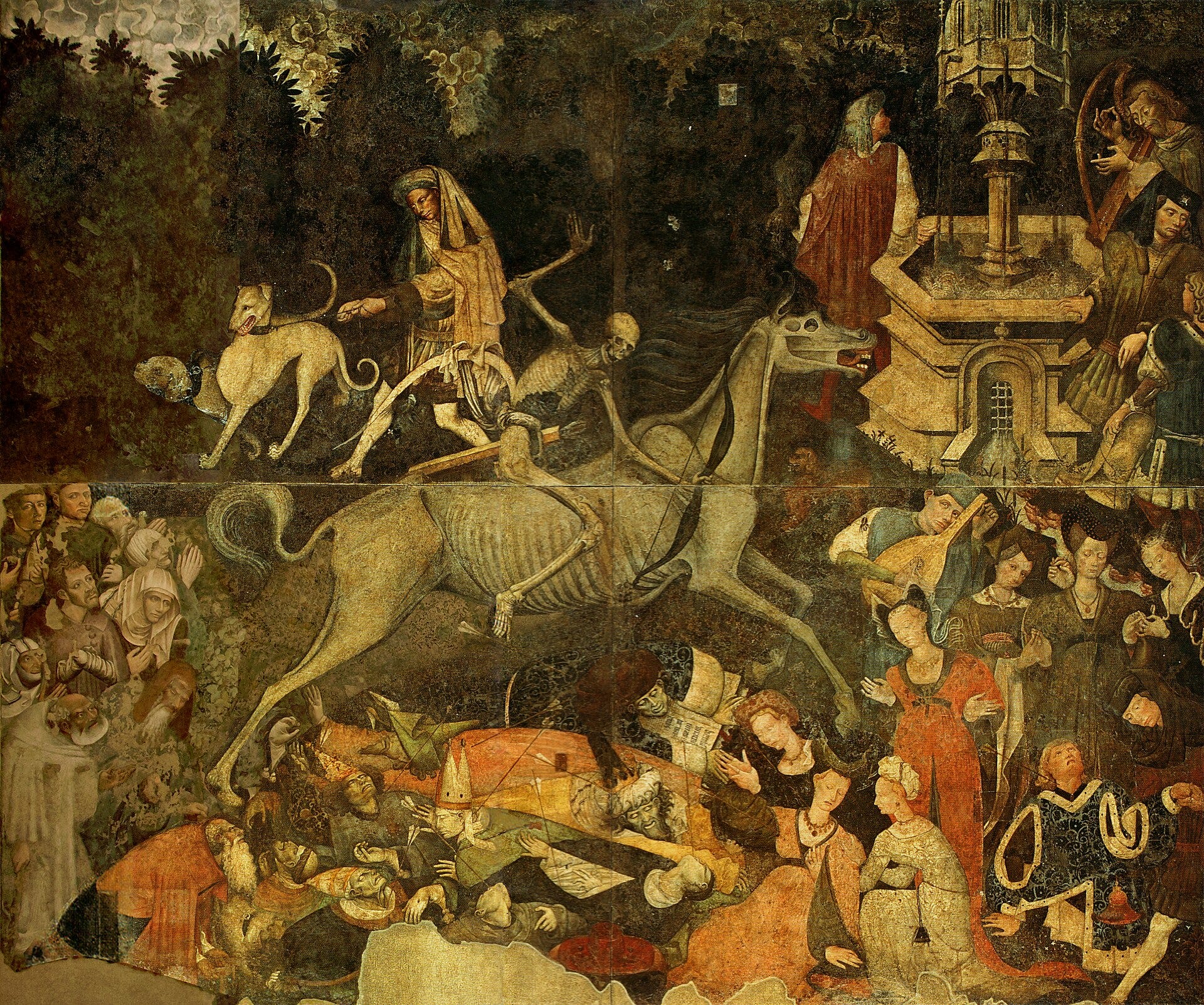
A generation later, on a wall in Sicily, Death has become a skeleton. In The Triumph of Death, by an unknown painter, he gallops across the plaster on a gigantic, starving horse, bow in hand. In the crowd the horse has just left behind, two men stare straight out of the wall, and one of them is holding a brush.