

170 000+ readers. Learn art the fun way.
This is a preview. Paid subscribers get the full story.
You’ll also get:
10 new stories every month
The full archive (130+ Art stories)
Your personal art guide. Comment, ask questions, DM me anytime
iPhone user? Subscribe at coolstoriesabout.art, not via the app. Apple adds 30% to the price.
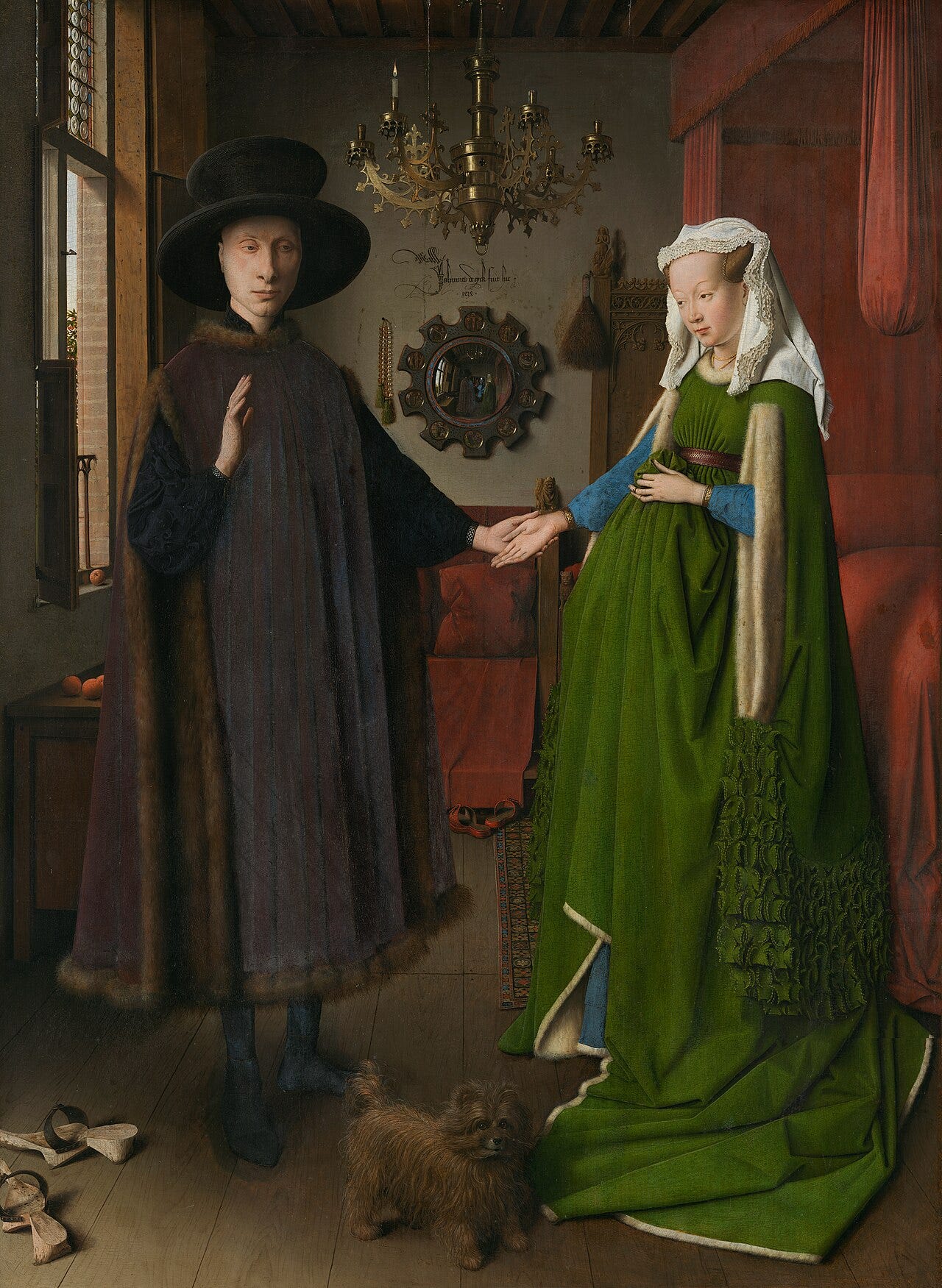
If you’ve ever been to the National Gallery in London, you’ve seen it happen. A small crowd, five or six people huddled in front of a not-very-large painting, phones raised, trying to capture the reflection in a tiny convex mirror.
The painting is 82 by 60 centimeters. It dates from 1434. And it is probably the most clue-packed painting in the entire history of Western art.
This is the Arnolfini Portrait, painted by Jan van Eyck. Van Eyck was the personal painter of Philip the Good, Duke of Burgundy, the most powerful man in Europe at the time.
An artist so respected that when his treasurers once forgot to pay him, the Duke sent them a furious letter saying he would never find another painter this good.
He was also entrusted with secret diplomatic missions. He was as much a spy as he was a painter. (I tell his incredible story here.)
And in this painting, he hid clues everywhere. Let’s look at them one by one.
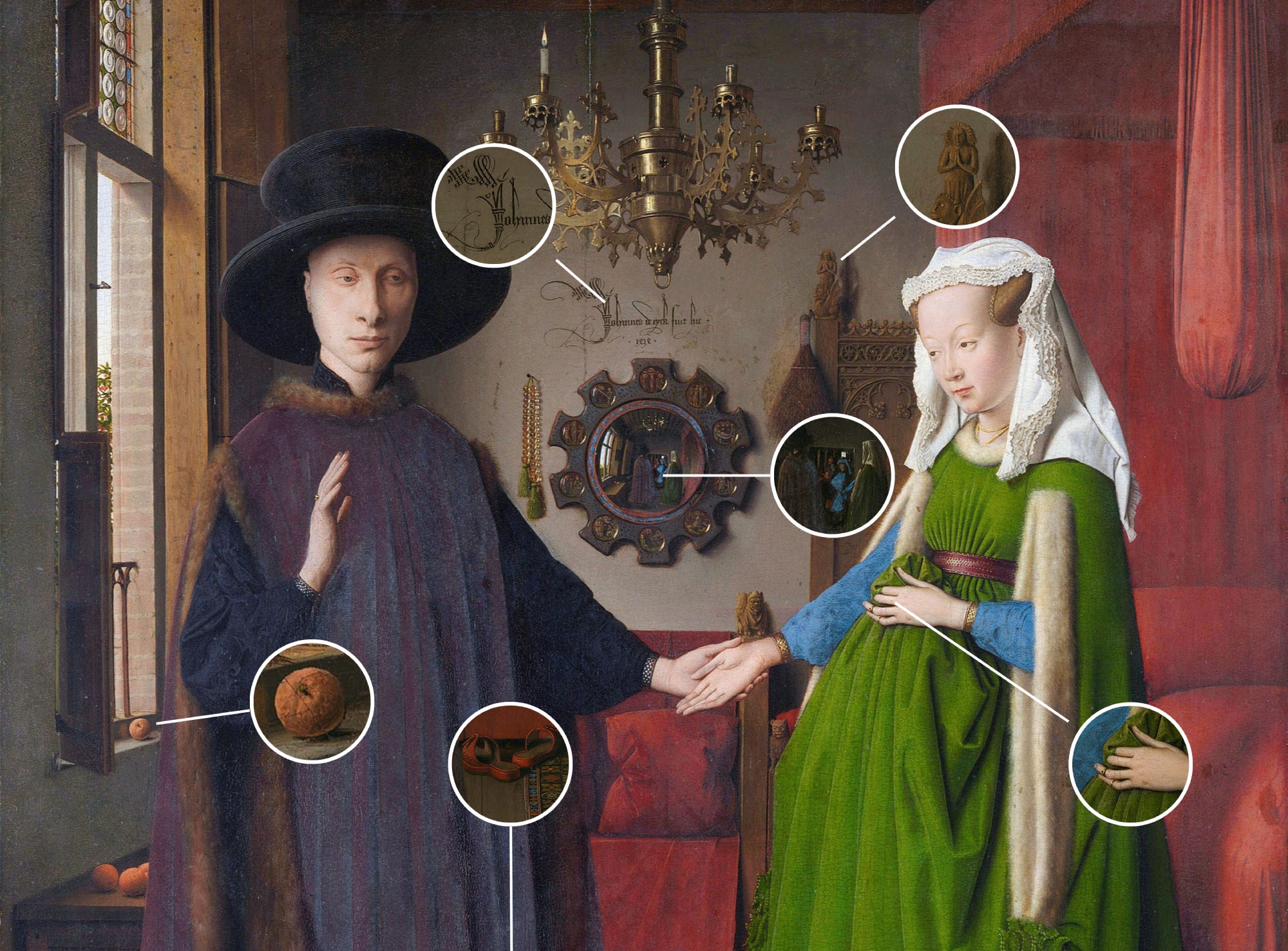
The oranges


Let’s start with a detail most visitors don’t even notice. On the windowsill and on the chest below it, there are oranges. Three, maybe four.
It looks unremarkable. It’s anything but.
This is Bruges, 1434, northern Europe. Oranges come from the Iberian Peninsula, by ship. They cost an absolute fortune. Placing oranges in plain sight in a portrait sends a very clear message: we can afford this.
Bruges is the commercial capital of Europe at this point. Italian, Spanish, and Hanseatic merchants all cross paths here. The Arnolfini are silk traders from Lucca, Italy, who supply the court of the Duke of Burgundy directly.
Every object in this room says something about their wealth. The oranges are the first clue. The carpet on the floor is another: it’s an Oriental rug with geometric Anatolian patterns. In Bruges, a rug like this was so precious that people placed them on tables, not on the ground. Here, it’s being walked on.
But the oranges also carry a religious meaning. In Flemish painting, the orange often replaces the apple of original sin. They evoke the Garden of Eden. The Fall. Here, they sit in the light from the window, and if you look very, very closely, you can see that Van Eyck painted their reflection in the polished wood.
The reflection of a piece of fruit in a piece of furniture. On a panel 82 centimeters wide.
The shoes


In the foreground, a pair of wooden pattens tossed on the floor. These are the man’s street shoes, still caked with mud from the roads. The woman’s red shoes are placed further back, near the bed.
They are both barefoot indoors.
In the Bible, when God speaks to Moses at the burning bush, he says: “Remove your sandals, for the place where you stand is holy ground.” It’s a reference any fifteenth-century viewer would have understood immediately. Whatever is happening in this room is sacred. This is consecrated ground.
Discover my new newsletter !

Keep learning art the fun way


The rosary
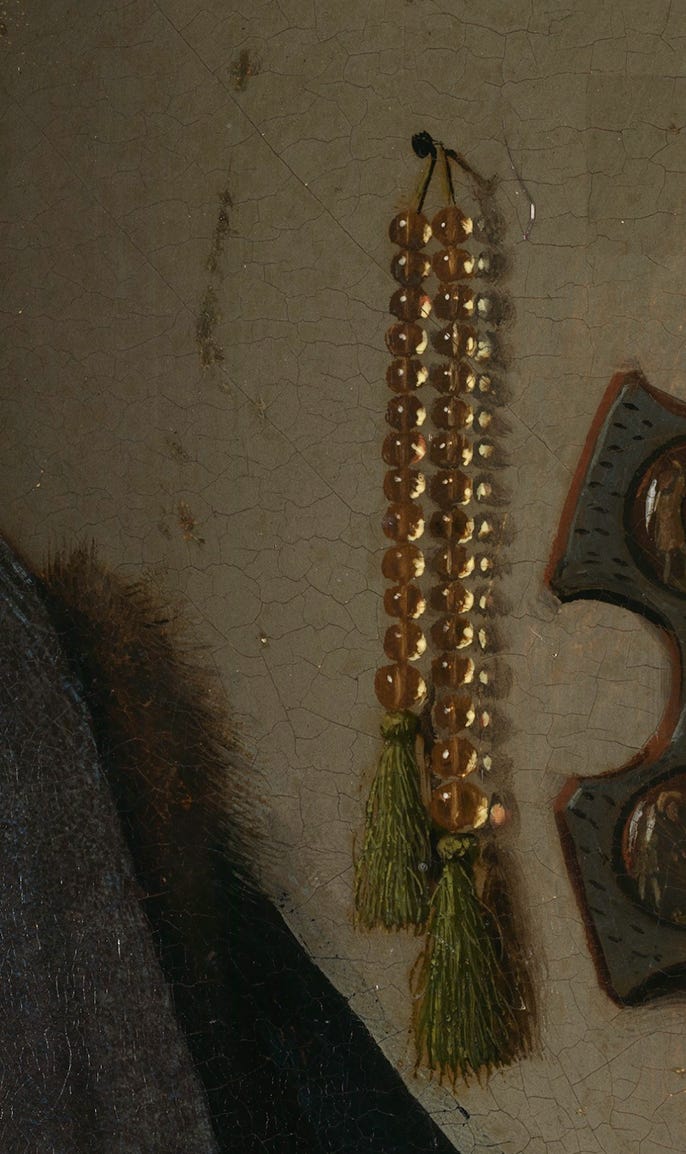
To the left of the mirror, hanging from a nail in the wall, is a rosary made of amber beads. In Flanders, this was a traditional engagement gift.
But what’s extraordinary is the way Van Eyck painted it. Light enters through the window, catches the upper left edge of each bead as a bright white dot, passes through the translucent amber, and comes out the other side as a small orange crescent.
Each bead works like a tiny lens. On top of that, Van Eyck painted the shadow of the cord on the wall and the reflections the beads cast onto the plaster.
These beads are a few millimeters across in the actual painting. He probably worked with a single-hair brush.
The green dress (and no, she’s not pregnant)
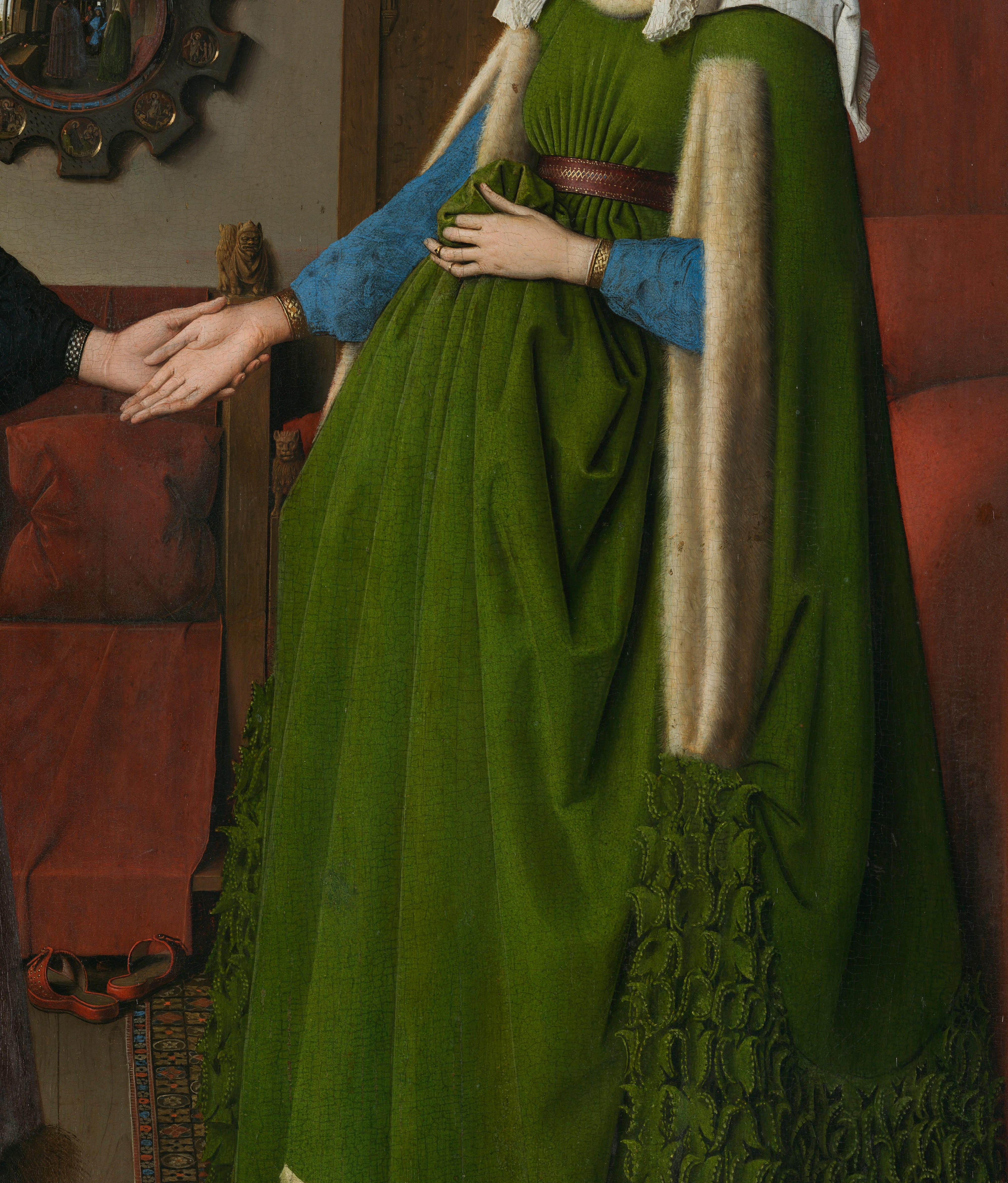
The woman wears a voluminous green dress lined with white ermine. The amount of fabric is enormous. This type of dyed wool could cost more than silk. Green symbolizes fertility and hope.
And yes, she looks pregnant. People have believed it for centuries. A Spanish inventory from 1700 actually describes the painting as “a pregnant German woman in green.”
Except she’s not. The protruding belly is simply the fashion of the time. Every elegant woman in the fifteenth century is depicted this way. The dress is so heavy it has to be gathered up in front to walk, which naturally creates this rounded silhouette.
In the Ghent Altarpiece, Van Eyck’s great masterpiece, he paints Eve completely naked with exactly the same belly. It’s a beauty standard, not a pregnancy.
The mirror
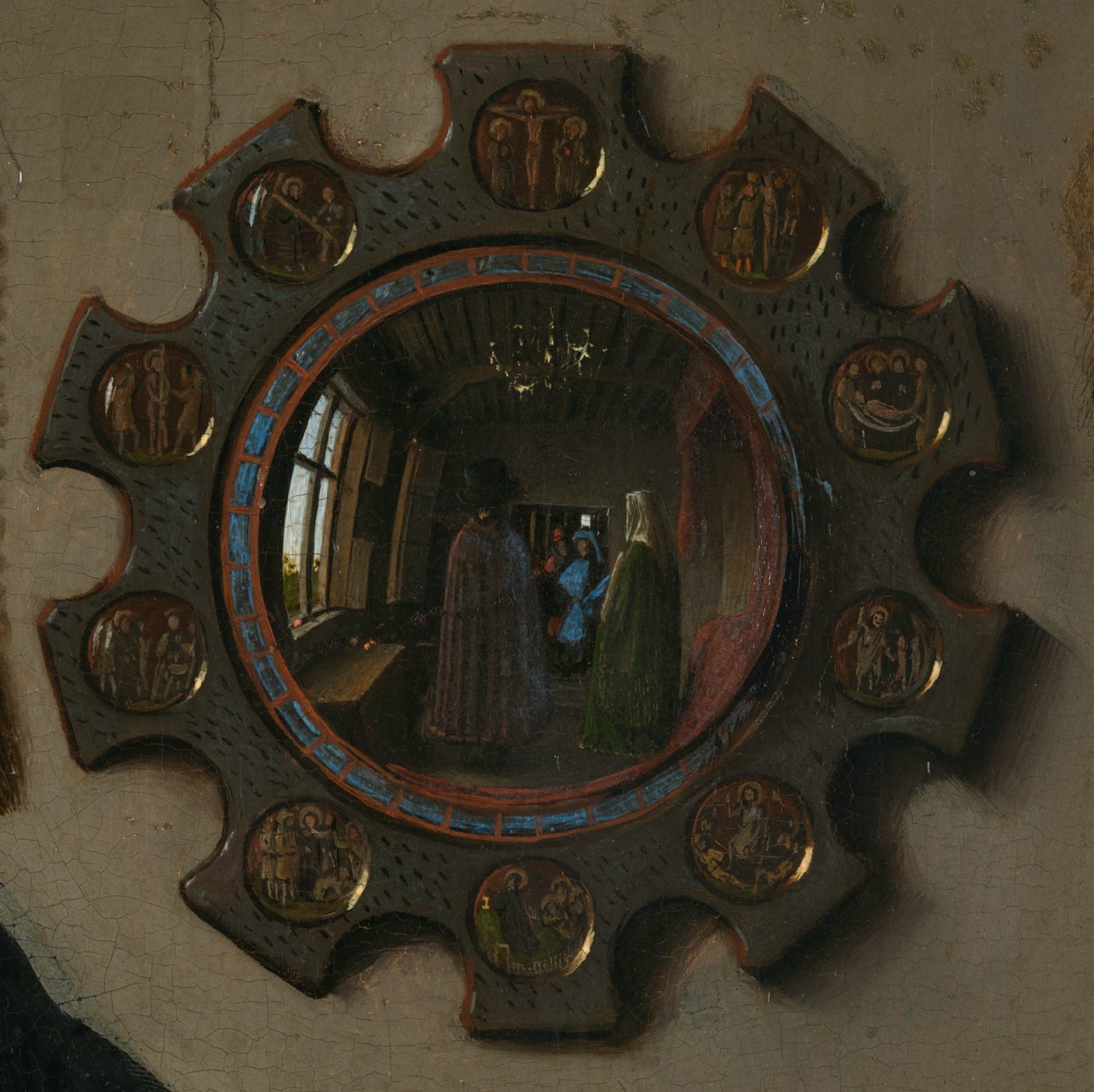
This is the center of the painting. Literally. Van Eyck placed it exactly between the two figures, at the central point of the composition.
It’s a convex mirror, curved outward. In its distorted reflection, you can see the entire room in reverse, the backs of the couple, and two small figures stepping through the doorway. One in red, one in blue.
The figure in red is almost certainly Van Eyck himself. He’s recognizable by the red chaperon he wears in his self-portrait from 1433. The painter placed himself inside his own painting, in a reflection, two centuries before Velázquez did the same thing in Las Meninas.
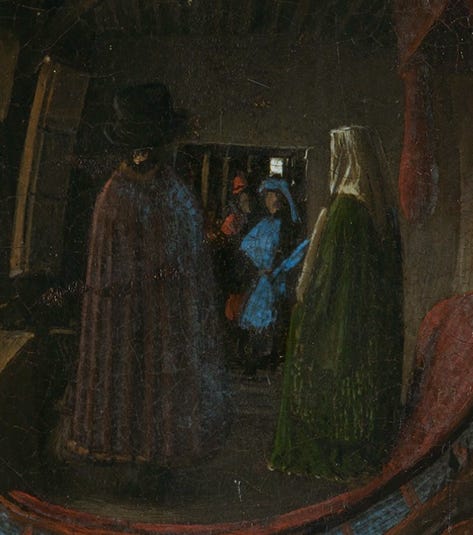
But the truly mind-blowing part is the frame of the mirror. It’s decorated with ten tiny medallions. Each one measures just a few millimeters in the actual painting. And each one depicts a scene from the Passion of Christ, from the Agony in the Garden of Gethsemane through to the Resurrection.
The figures inside them are identifiable. Van Eyck probably used a magnifying glass to paint them.
And the scenes are not arranged randomly. All the ones before Christ’s death are on the man’s side. All the ones showing the death, the entombment, and the resurrection are on the woman’s side.
Keep that in mind.
The chandelier and the candle
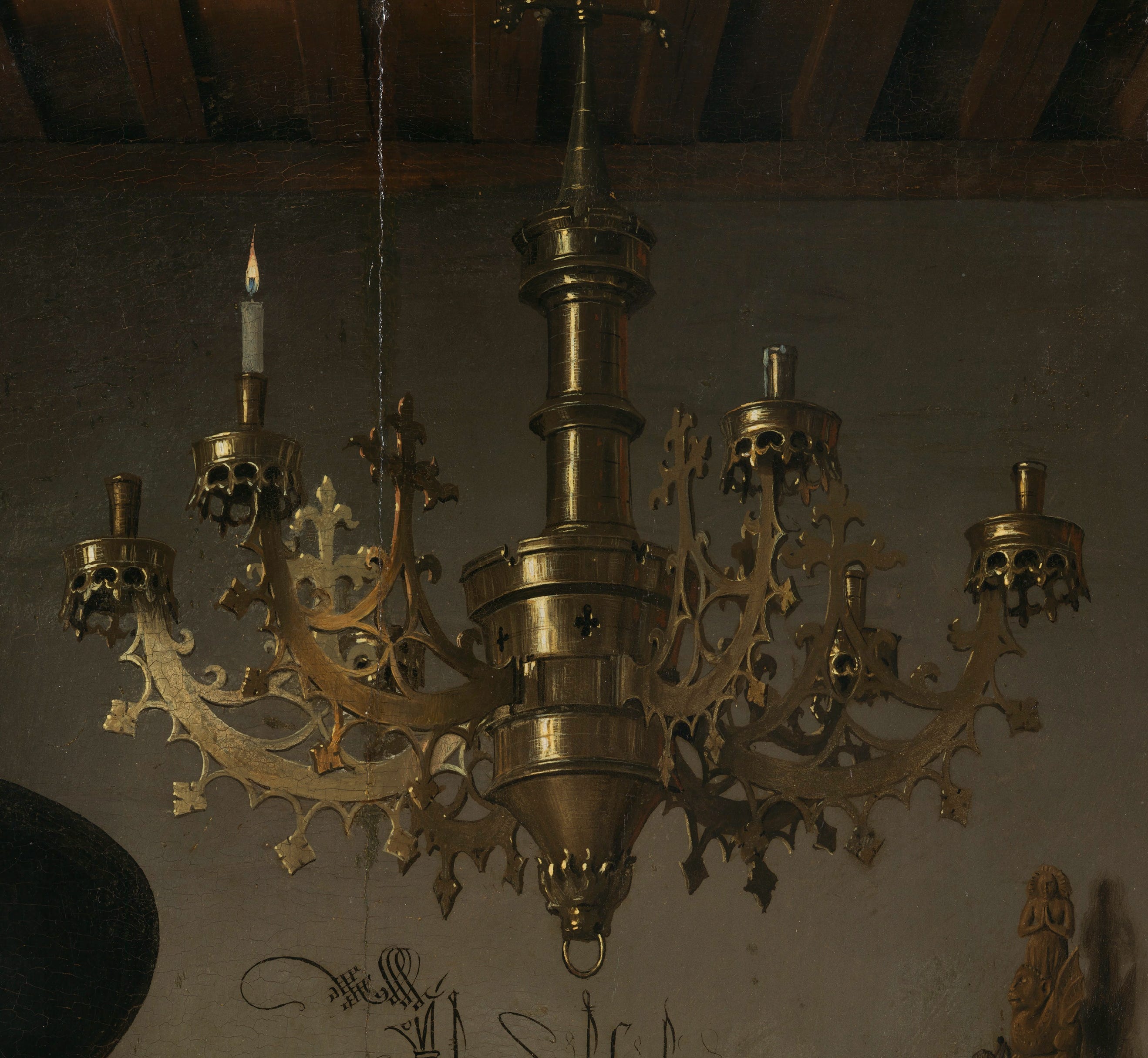
On the ceiling, a brass chandelier with six branches. Six spots for candles, but only one is lit.
It’s above the man.
Above the woman: nothing. Just melted wax, still dripping, where a candle once burned.
Candle lit, candle out. Alive, dead? Hold that thought too.
The signature
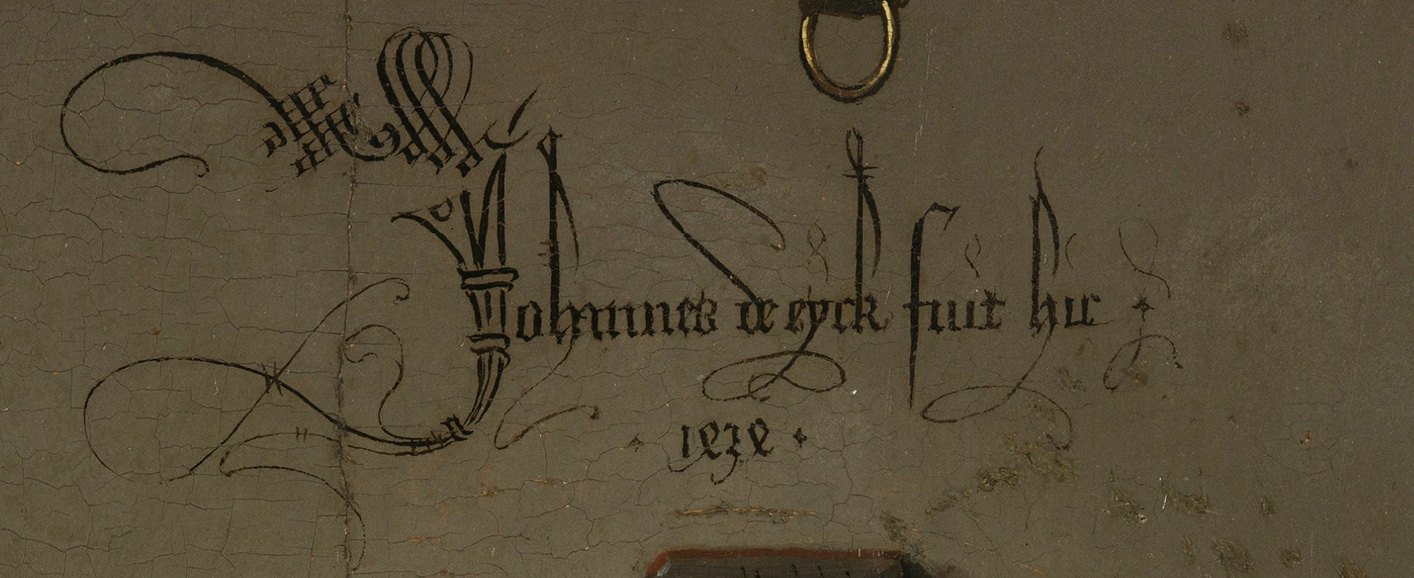
Just above the mirror, Van Eyck wrote on the wall in very careful Gothic lettering: “Johannes de eyck fuit hic 1434.” Jan van Eyck was here, 1434.
Normally, when a painter signs a painting, they write “made this” or “painted this.” Van Eyck wrote “was here.” He doesn’t claim to have created this image. He says he was present. Like a witness. Like a notary signing a legal document.
And the lettering itself imitates the calligraphy used in legal documents of the time. It’s the only time in his entire career that he placed his signature directly on the painted surface.
A witness to what?