
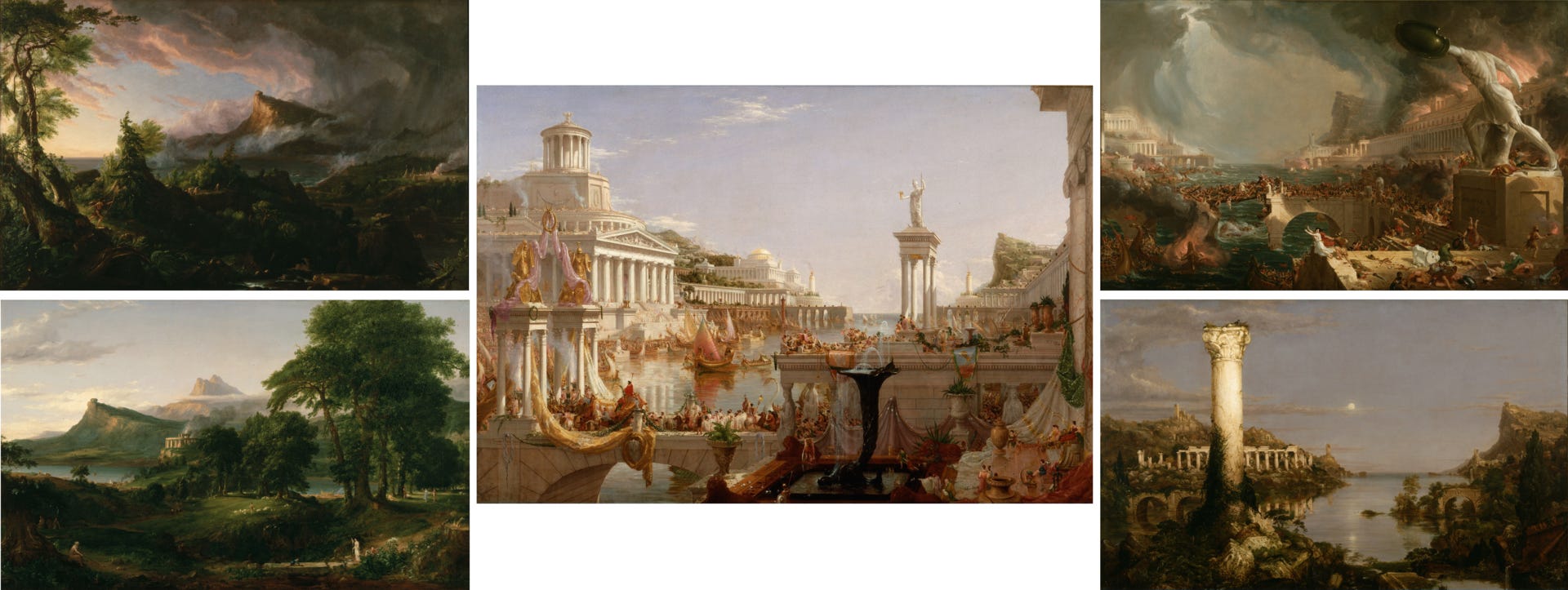
The Course of Empire is a series of five paintings by the American landscape painter Thomas Cole, made between 1834 and 1836 for the New York merchant Luman Reed. All five return to one bay and one valley, recognizable by a boulder balanced on top of a steep crag.
In order, the paintings are The Savage State, The Arcadian or Pastoral State, The Consummation of Empire, Destruction and Desolation. Across them, a wilderness at dawn becomes farmland, then a marble city at noon, then a city in flames, and at last a field of ruins under the rising moon.
Cole meant the cycle as a warning about how civilizations rise and fall, and it made him famous when New Yorkers first saw it in 1836. The five canvases are kept together today at the New York Historical, the museum on Central Park West in Manhattan.
Cool Stories About Art is a newsletter to learn art the fun way.
Join 200,000+ readers and get:
10 new art stories / month
The entire archive of content (140+ articles)
Comment, ask questions, and chat with other readers
What are The Course of Empire paintings in order?
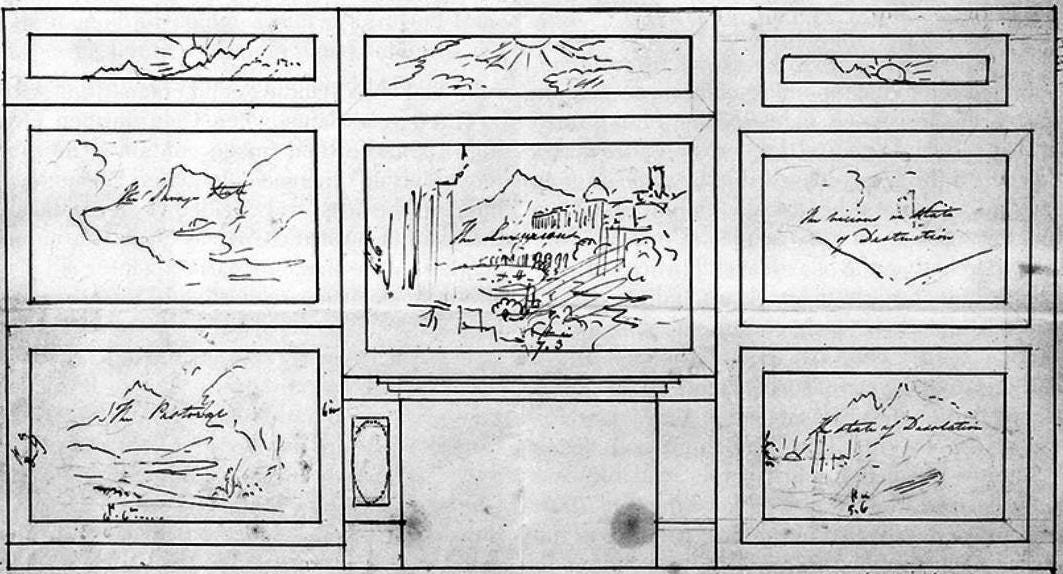
In 1833, Thomas Cole drew a small ink sketch of a single wall for a New York merchant, with a fireplace in the middle and five frames arranged around it…
What You'll Discover
Why one boulder appears in all five paintings
The hidden hunter coming back through the paint
Who some historians see in the red cloak
Why Cole cut a skeleton from the last scene
What the patron never lived to see