The Creation of Adam: Meaning, the Hands, the Hidden Brain

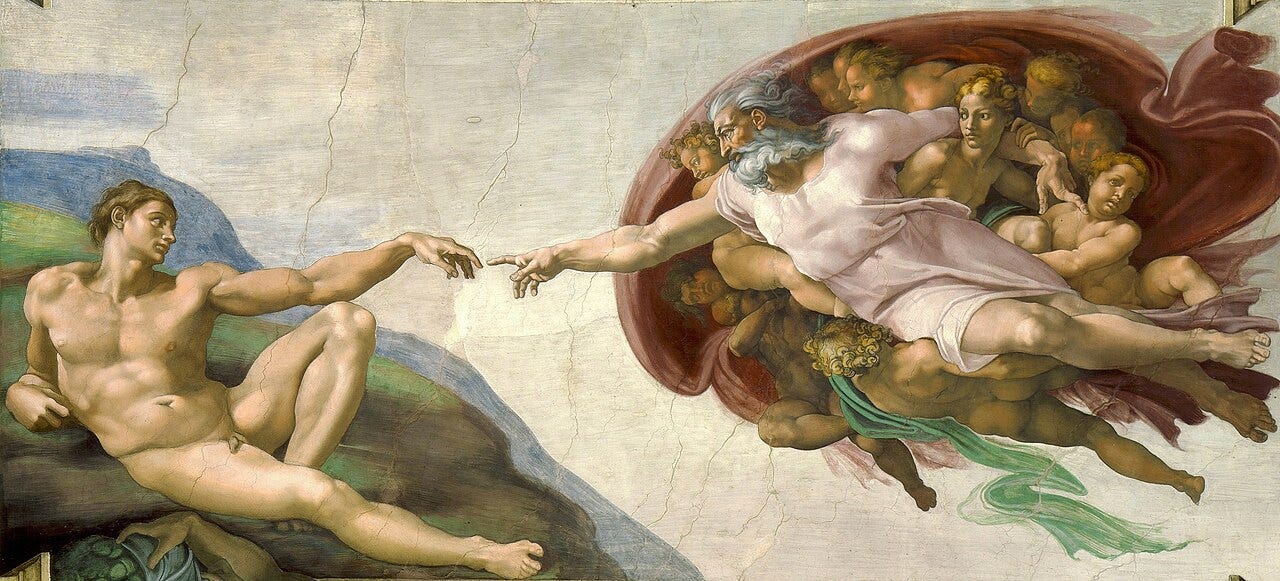
The Creation of Adam is a fresco painted around 1512 by Michelangelo, on the ceiling of the Sistine Chapel in the Vatican. God reaches toward Adam, their fingers almost meeting.

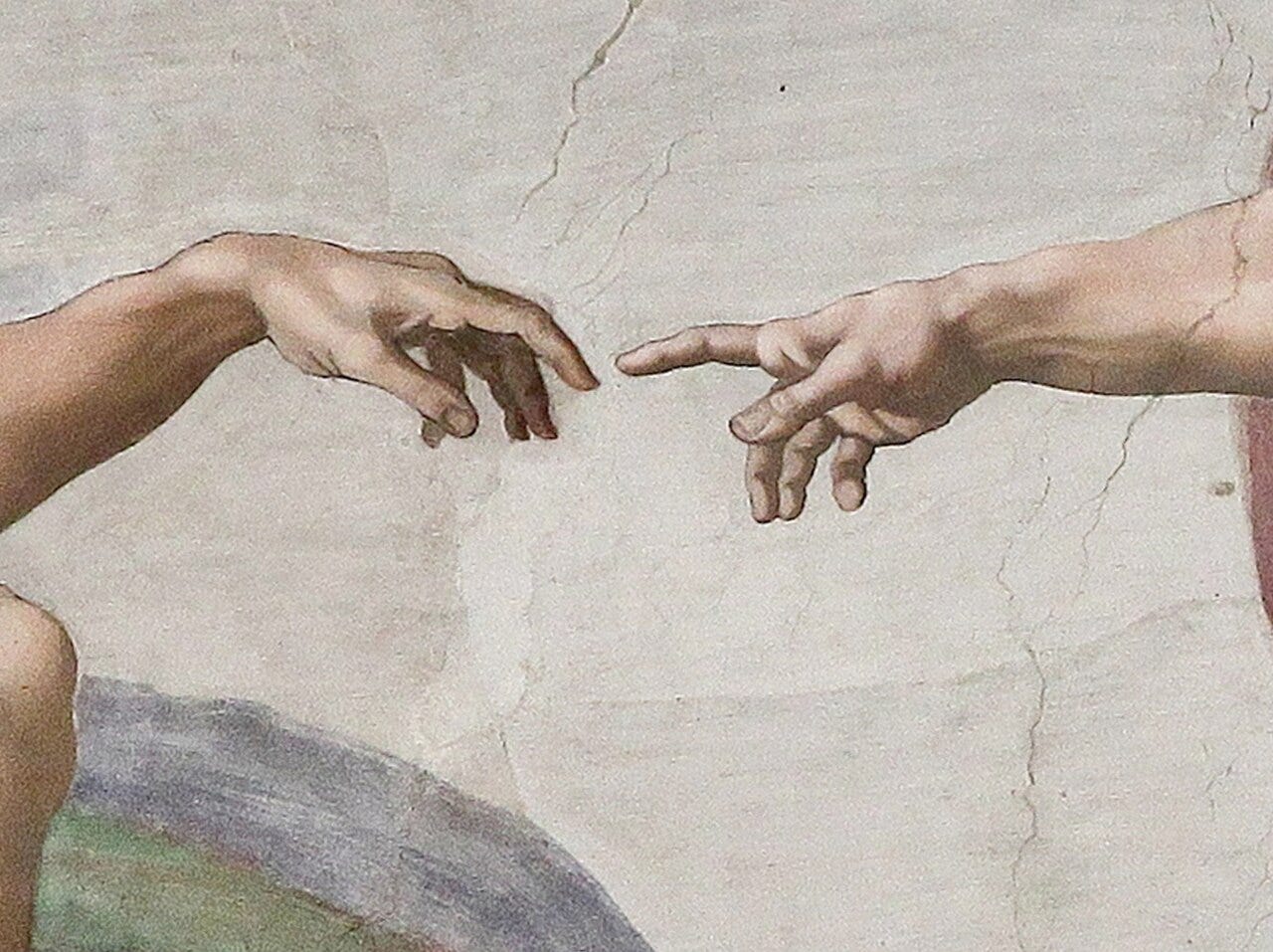
The gap between them is the whole point: the spark of life is about to jump, and has not jumped yet.

God reaching toward Adam, their fingers almost touching
Michelangelo, The Creation of Adam, about 1512

It is the most reproduced pair of hands in the world. Here is what it means, who the mysterious woman under God's arm is, and the anatomy hidden in the shape of the cloud behind him.


Learn art the fun way. Free stories every week, no boring lectures.


The gap that carries the meaning

Look at the center and the two fingers do not touch. There is a small space between the hand of God, charged and outstretched, and the hand of Adam, limp and not yet awake.

Michelangelo froze the instant before contact, the moment life is given but not yet received.

That reversal, to me, is why it works. God strains toward man with effort; Adam reclines, barely lifting his arm, as if he does not know what is coming.

The energy runs the wrong way, from creator to creature, and the entire drama sits in a gap of a couple of centimeters that the whole world now recognises.

Who is the woman under God's arm

God does not float alone. He is carried on a swirling red cloak, wrapped around a crowd of figures, and tucked under his left arm is a woman looking out toward Adam. For centuries people have argued about her.

The oldest reading, from the Victorian critic Walter Pater, is that she is Eve, not yet created, already present in God's mind. Others call her the Virgin Mary, or Sophia, divine wisdom, or the human soul itself.

Michelangelo left no key, so all of these stay guesses. What is certain is that she is watching Adam with unusual attention, as if she already knows she is coming next.

The brain in the cloud

Here is the detail that turned a Bible scene into a puzzle. In 1990 an American physician, Frank Meshberger, published a note in a medical journal pointing out that the red cloak and the figures around God trace, almost exactly, a cross section of the human brain: the stem, the folds, an artery.

If he is right, Michelangelo hid a brain behind the figure of God, suggesting that what is passing to Adam is not just life but intellect.

Later writers have found a womb in the same shape, and even the outline of a hidden Eve. None of this is proven, and Michelangelo never explained it.

But he had dissected human corpses as a teenager, in secret, at the monastery of Santo Spirito in Florence, in exchange for carving the friars a wooden crucifix.

He knew what was under the skin better than any painter alive.


Join 130,000 readers who get the secrets behind the paintings. Free.


The pose the legend gets wrong

Michelangelo thought of himself as a sculptor and did not want this job. Pope Julius the Second forced it on him, and between 1508 and 1512 he covered the whole ceiling, more than three hundred figures, working on scaffolding with his head tipped back and paint dripping into his face.

The Creation of Adam is one panel in that vast scheme, and it is not even in the center. He painted the ceiling in fresco, pigment laid into wet plaster that has to be finished before it dries, so each day's work was a race.

He did not paint lying down, as the legend has it, but standing, bent backwards, which was punishing enough that he wrote a poem complaining that his beard pointed at heaven and his brush dripped on his face.

The ceiling you have to crane to see

The Creation of Adam is on the ceiling of the Sistine Chapel in the Vatican Museums, Rome, where it was painted and where it will stay: it is plaster fused to the vault and cannot be moved, which is why it carries no price.

You crane your neck to see it at the end of the long museum route, in a chapel where photography is banned and guards ask for silence.

Most people are surprised how high up and how small the famous hands actually are.

The cleaning that changed the colors

Between 1980 and 1994 the Vatican cleaned the whole ceiling, lifting centuries of candle smoke, glue and grime. What came back shocked people.

Instead of the sombre, shadowed Michelangelo everyone knew, the colors returned acid bright, pinks, limes and oranges nobody expected.

Some scholars protested. They argued the restorers had scrubbed away a last layer of shadow that Michelangelo had brushed on dry, over the fresco, to deepen his modeling, and that the cleaning had flattened him into a decorator.

The Vatican held that the darkness was only dirt. The debate has never fully closed, and to me it is worth knowing that the Adam you photograph today is far brighter than the one your grandparents saw.

Painted in reverse, and getting bolder

The Creation of Adam is one of nine scenes from Genesis running down the spine of the ceiling. Michelangelo painted them in reverse order, starting over the entrance with the drunkenness of Noah and working back toward the altar and the first days of creation.

You can watch him grow across the four years. The early panels are crowded with small, careful figures; the later ones, Adam among them, are stripped to a few enormous bodies against almost empty sky.

By the time he reached the Creation he had taught himself to fill a vast ceiling with next to nothing, and it is that hard won simplicity that makes the reaching hands land.

The gesture that escaped the chapel

No other detail in art has travelled so far from home. The two reaching hands have been lifted onto the poster for the film E.T., where a human finger and an alien one meet in the same way, into cigarette and phone advertising, onto banknotes, tattoos and a thousand memes.

The reason it works as shorthand is the same reason it works on the ceiling: the gap. A touch is closure, but a hand reaching for a hand that has not yet answered is pure suspense, and it reads at any size, from a forty foot vault to a phone screen.

Michelangelo built the most portable image in the history of painting without meaning to.


The Creation of Adam, quick answers

  • What is the real meaning behind The Creation of Adam? God giving life to the first man, Adam. The fingers do not touch, catching the instant before the spark passes, life given but not yet received.

  • What does the two hands almost touching mean? The gap holds the tension. Life is about to pass from God to Adam. Michelangelo froze the moment just before contact.

  • Who is the woman under God's arm? Debated. Often read as Eve, present in God's mind before her creation, or as the Virgin Mary, or divine wisdom. Michelangelo never said.

  • Who painted it and when? Michelangelo, around 1512, as part of the Sistine Chapel ceiling painted from 1508 to 1512.

  • Where is The Creation of Adam? On the ceiling of the Sistine Chapel, Vatican Museums, Rome.


If this fresco pulled you in, you will love these too:


The finger that had to be repaired

For all its fame, the most important inch of the picture is not entirely Michelangelo's. Adam's hand, including the pointing finger, was damaged over the centuries and partly restored by a later artist, so the exact tip that has launched a million parodies is a repair.

The gesture the whole world copies, God and man reaching across the void, is half Renaissance genius and half careful patching, and almost nobody looking up in the chapel knows the difference.

You can see The Creation of Adam in person at the Vatican Museums. For more by the artist, browse the Metropolitan Museum collection.

The gap everyone asks about

  • Where is The Creation of Adam? On the ceiling of the Sistine Chapel in the Vatican, painted by Michelangelo around 1512.

  • What does it show? God, borne by angels, reaches out to give life to the first man, Adam, who lies on the earth and lifts his own hand toward him.

  • Do their fingers actually touch? No. There is a small gap between the two hands. The spark of life is shown in the instant before contact, which is part of why the image is so tense.

  • What is the shape behind God? Some modern scholars point out that the red cloak around God and the angels echoes the outline of a human brain. It is a theory, not a proven intention.

  • Is it a fresco? Yes. It is one scene in the fresco ceiling Michelangelo painted between 1508 and 1512.


Two new stories a week, 130+ secrets unlocked. Start free.