The Death of Marat: Meaning, the Murder, the Propaganda

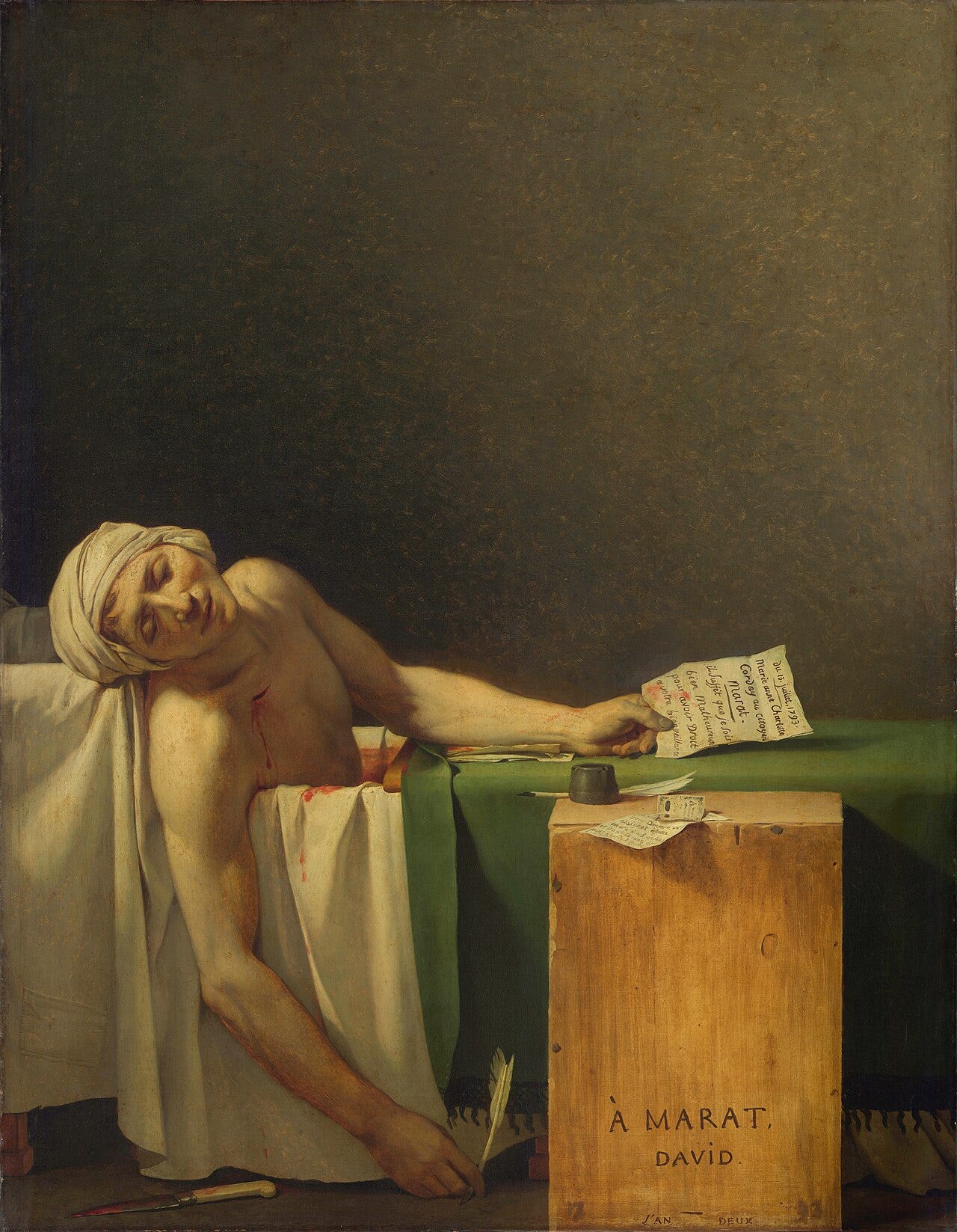
The Death of Marat is a 1793 painting by Jacques Louis David, in the Royal Museums of Fine Arts of Belgium in Brussels. It shows the murdered Jacobin leader Jean Paul Marat slumped dead in his bath, a knife wound under his collarbone.

It is one of the most powerful pieces of political propaganda ever painted, made by a man who was Marat's friend.

Marat dead in his bath, one arm hanging, holding a letter
Jacques Louis David, The Death of Marat, 1793

David turned a grubby real murder into a secular altarpiece. Here is who killed Marat, why he was in the bath, and how David edited the scene to make a martyr.


Learn art the fun way. Free stories every week, no boring lectures.


The murder in the bath

On 13 July 1793, at the height of the French Revolution, a young woman named Charlotte Corday talked her way into Marat's home. She sympathised with the more moderate Girondins, who blamed Marat, a firebrand journalist whose paper called for the blood of the Revolution's enemies, for the killings tearing France apart.

She talked her way in by promising news of traitors gathering in Caen, and once she was beside the tub she named them while Marat wrote the names down.

Then she drew a kitchen knife and stabbed him once, through the chest. He died within minutes. Corday made no attempt to flee and was guillotined four days later.

David finished this painting in about four months and presented it to the National Convention that November.

Why he was working in the tub

The bath is not a strange artistic choice. Marat suffered from a severe skin disease, probably a chronic form of dermatitis, that covered him in painful sores and blisters.

The only relief was to soak for hours in a medicinal bath, so he had a desk fitted across the tub and ran the Revolution from the water, reading, writing, receiving visitors.

That is why Corday found him there, and why the murder weapon met bare skin. In David's picture you see the green cloth over the tub, the wooden writing box beside it, the quill still in his hand.

What you do not see is the disease. His skin is smooth, pale and unblemished, the first of David's careful edits.

The letter that got her in, the note that damns her

Marat still holds a paper in his left hand. It is the note Corday had written him, and David makes sure you can read it: a plea from an unfortunate woman asking for his help.

On the wooden box below lies a second note in which the dying Marat, in David's version, was generously arranging money for a war widow.

Neither detail is neutral. The painting insists that Marat was murdered mid act of kindness, betrayed by the very compassion Corday exploited.

Whether the real Marat was quite so saintly did not concern David. He was building a case, in paint, for a martyr.


Join 130,000 readers who get the secrets behind the paintings. Free.


A dead Jacobin painted as Christ

Look at the pose. Marat's arm hangs down over the side of the tub exactly as the dead Christ's arm hangs in old paintings of the Deposition and the Pieta.

The wound is under the collarbone, like a saint's. The upper half of the picture is empty, plain and dark, a void that lifts the body into something sacred.

This was deliberate, and I think it is the most daring thing David ever did. The Revolution had abolished the old religion and needed new saints, and David, its official artist and a member of the Neoclassical movement that prized this cool gravity, gave it one.

He inscribed the wooden box simply, to Marat, David, turning a signature into a dedication on a tomb.

How it ended up in Brussels

The Death of Marat hangs in the Royal Museums of Fine Arts of Belgium in Brussels, not in France. When David fell from power after the Revolution turned on its own, the painting became dangerous to own, and it eventually followed him into exile in Brussels, where it stayed.

It carries no market price. For decades it was thought crude and was largely ignored; the modern view, that it is a founding image of modern political art, took more than a century to arrive.

The trilogy of murdered martyrs

Marat was not meant to hang alone. David planned a set of three painted martyrs of the Revolution. The second was Lepeletier de Saint Fargeau, a nobleman stabbed for voting the king's death, whose portrait the family later bought and destroyed, so it survives only in copies.

The third was Joseph Bara, a teenage drummer boy killed by royalists, left unfinished.

Only Marat came through whole. The Revolution built a cult around these secular saints, and David was its image maker, painting the men it needed to mourn in the exact poses the old church had used for its own dead.

The picture that had to be hidden

When the Jacobins fell in 1794 and the cult of Marat collapsed, the painting became dangerous. Marat's remains, which had been carried in triumph to the Pantheon, were quietly removed in early 1795.

David, imprisoned after his faction lost, eventually took the canvas back, and it disappeared from public view for decades, too raw a relic of a discredited moment to show.

How modern it looks

Strip away the history and the design is startling for 1793. The whole upper half is empty, a plain dark void with nothing in it, and the body and box sit in the lower half like a still life.

That bareness, closer to abstraction than to a history painting, is why later artists kept returning to it, and why the poet Charles Baudelaire, writing decades on, called it one of art's great and moving things.

It looks less like the past than like a rehearsal for modern painting.


The Death of Marat, quick answers

  • Who killed Marat? Charlotte Corday, a young woman from a rival political faction, stabbed him in his bath on 13 July 1793. She was guillotined four days later.

  • Why was Marat in a bath? He had a painful skin disease and soaked for hours to ease it, working from a desk fitted across the tub.

  • What does the painting mean? It is a piece of Jacobin propaganda, presenting Marat as a martyr killed while helping others. David idealised him, removing his disease and posing him like the dead Christ.

  • Who painted it and when? Jacques Louis David, in 1793, the year of the murder.

  • Where is The Death of Marat? The Royal Museums of Fine Arts of Belgium in Brussels.


If this painting pulled you in, you will love these too:


The painter who voted for death

David was not a bystander to the Revolution he painted. He sat in the Convention, he was a friend and ally of Marat, and months before this murder he had voted for the execution of King Louis the Sixteenth.

When his faction fell he was imprisoned and nearly guillotined himself, then reinvented as Napoleon's court painter. The most moving image of the Revolution's dead was made by one of the men who had signed off on the killing.

You can see The Death of Marat in person at the Royal Museums of Fine Arts of Belgium. For more by the artist, browse the Metropolitan Museum collection.

Questions about the death of Marat

  • Who was Marat? Jean Paul Marat, a radical journalist and leader of the French Revolution, admired by the poor and feared by his enemies.

  • How did he die? He was stabbed in his bath on 13 July 1793 by Charlotte Corday, a young woman who blamed him for the bloodshed of the Terror.

  • Why was he in a bath? A painful skin disease forced Marat to spend hours in a medicinal bath, where he kept working, which is why the murder happened there.

  • Where is the painting? It hangs in the Royal Museums of Fine Arts of Belgium in Brussels.

  • Who painted it? Jacques Louis David, a friend of Marat and a history painter of the Revolution, who turned the scene into a secular image of martyrdom.


Two new stories a week, 130+ secrets unlocked. Start free.