Find Icarus Before You Read Another Word

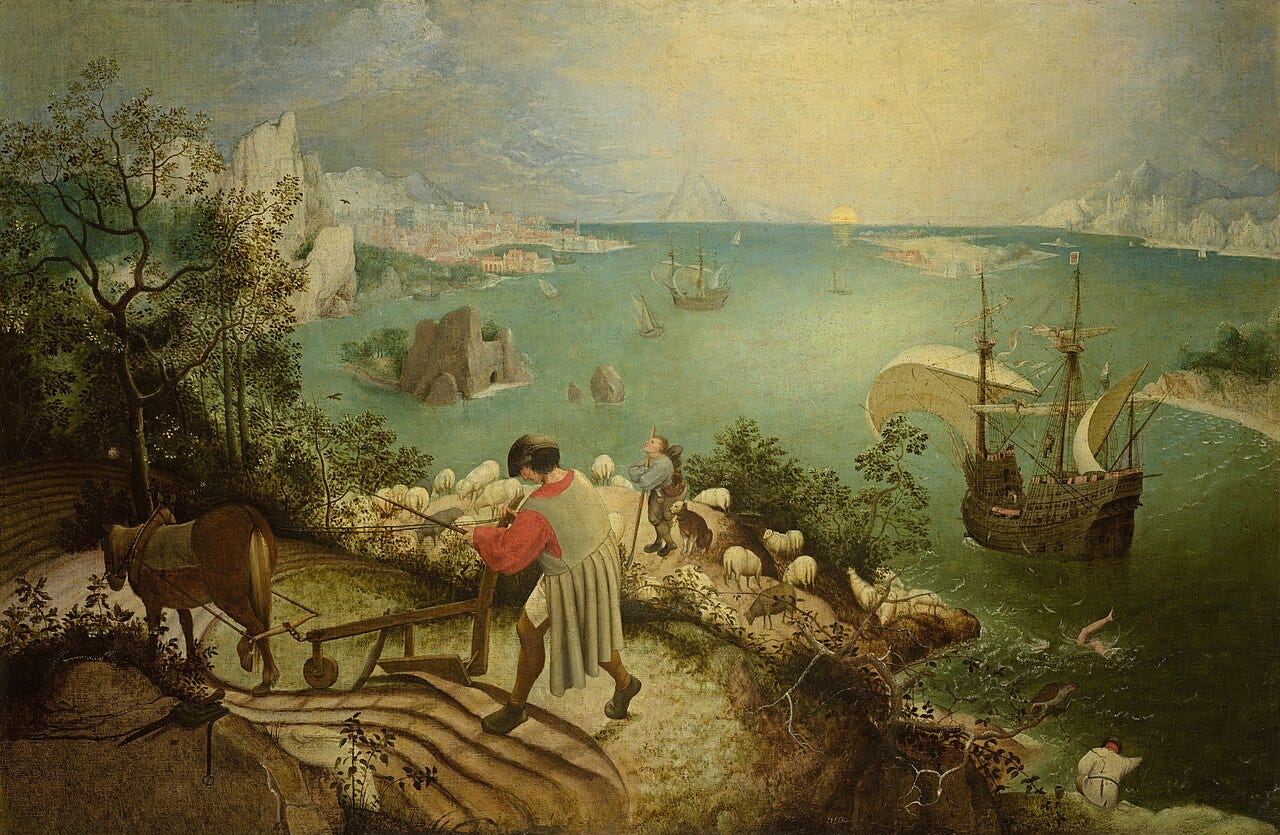
Look at the painting. A plowman cuts his furrows in the foreground. A shepherd leans on his staff, staring at the sky or at nothing. A ship sails out with a full wind.
Now look at the lower right corner, at the water. Two small legs, kicking, halfway under. That is Icarus. That is the entire subject of the painting, and almost nobody in it has noticed.
Landscape with the Fall of Icarus, circa 1560, held at the Royal Museums of Fine Arts of Belgium in Brussels, hides the death of Icarus in a corner of the canvas. A plowman, a shepherd, a fisherman, and a passing ship all ignore the drowning boy.
That is the trick, and it has never been repeated with the same nerve. The mythological catastrophe is nearly invisible. Ordinary work fills the frame instead.
Did Bruegel Actually Paint It?
Here is where most explainers cut a corner. They say Bruegel painted it, full stop. The real answer is more interesting.
The painting was long attributed to Pieter Bruegel the Elder. Then came a technical examination in 1996, and most scholars now consider it very unlikely that Bruegel's own hand executed this canvas.
The current consensus treats it as a good early copy, probably made shortly after Bruegel's death, of a lost original he composed around 1558. The original is gone. What Brussels owns is its best surviving echo.
The museum's own position splits the question in two. The execution is probably not Bruegel's. The composition, meaning the design and the arrangement of every figure, can be attributed to him with confidence.
So the idea is his. The brushwork probably is not. The painting also carries a physical scar of its long life: it is oil on canvas, transferred from an original wood panel.
The Myth Behind the Legs
Daedalus was a master craftsman, the man who built the Labyrinth on Crete for King Minos. Minos then imprisoned him inside his own creation, along with his son Icarus. Some versions place them in a tower instead.
Daedalus built the way out himself: two pairs of wings, feathers held together with wax, so father and son could escape over the sea.
He gave Icarus one instruction with two halves. Do not fly too low, because the damp of the sea would weigh down the feathers. Do not fly too high, because the sun would melt the wax.
Icarus, thrilled by flight, climbed toward the sun. The wax melted, the feathers scattered, and he fell into the sea near the island of Icaria. The Greeks named that stretch of water the Icarian Sea in his memory.
The composition keeps only the last second of the story. No Daedalus mourning, no wings against the sun. Just the splash.
How to Recognize This Icarus Among All the Others
Painters have loved this myth for centuries, and most of them chose the dramatic tradition. Icarus large, central, tumbling from the sky, or laid out and mourned, the way later academic painting liked its heroes.
If you see that, you are looking at a different iconographic family. The Bruegel type has one identifying mark: the indifference of the onlookers.
The plowman keeps plowing. The shepherd and his dog look elsewhere. The fisherman keeps fishing. The ship sails on. The mythological event is reduced to a detail you could miss.
That indifference is the whole point of the picture. Take it away and you have an ordinary Icarus scene.
The Painting That Became a Poem, Twice
In 1938, W.H. Auden saw the painting in Brussels and wrote "Musee des Beaux Arts," named after the museum itself. The poem's argument comes straight from the canvas: suffering happens while someone else is eating, or opening a window, or just walking dully along.
In 1960, William Carlos Williams wrote his own poem, "Landscape with the Fall of Icarus," and fixed on the same detail. The splash, quite unnoticed.
Two major poets, twenty two years apart, drawn to the identical corner of the identical picture. Neither poem is really about the myth. Both are about the composition, the choice to make a death small.
That is a rare thing in art history. The painting did not just illustrate an old story. It changed how people talk about suffering and indifference, and the poems are the proof.
FAQ
Did Bruegel really paint Landscape with the Fall of Icarus?
Probably not with his own hand. After a technical examination in 1996, most scholars regard the Brussels canvas as a good early copy of a lost Bruegel original from around 1558. The museum attributes the composition to Bruegel, and the execution to someone else.
What is the moral of the Icarus myth?
The classic reading is a warning against ignoring wise limits: Daedalus told his son to fly neither too low nor too high, and Icarus flew too high. The painting adds a second moral the myth never had, that the world barely notices individual disaster.
Where can I see the painting?
At the Royal Museums of Fine Arts of Belgium in Brussels, which has owned it since acquiring it after its discovery in 1912.
Why is Icarus so small in the painting?
Because his near invisibility is the idea. The composition makes the viewer hunt for the myth inside an ordinary working landscape, which is exactly what Auden and Williams wrote their poems about.
One Last Fact
The painting surfaced in 1912, and the Royal Museums of Fine Arts of Belgium bought it that same year. It measures 73.5 by 112 centimeters, small enough that Icarus's legs, in the corner, are only a few centimeters long.