The Fall of Rome in Painting: 12 Visions of the End
The fall of Rome has been painted mostly as a warning. Painters gave it orgies, barbarians, fire and ruins, and almost every one of them was really painting about their own century.
Rome did not fall in a day, and historians still argue about whether it fell at all. That never troubled the painters. Here are twelve pictures of the end of the empire, from a Roman banquet drowning its guests in rose petals to a burnt out palace in a swamp, and what each artist was actually worried about.
All are in the public domain.
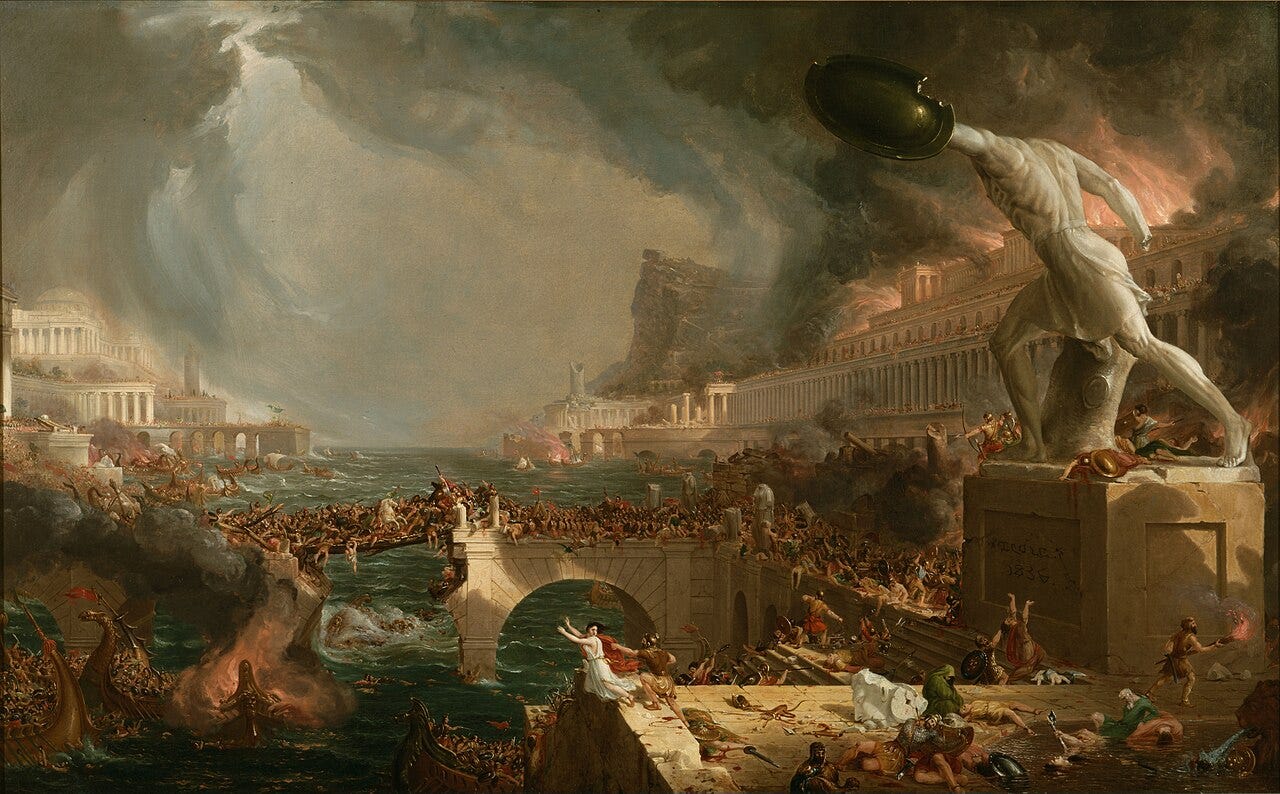
1. Thomas Cole, The Course of Empire: Destruction (1836)
Cole painted the same bay five times, from wilderness to a marble capital and back to weeds, and this is the fourth canvas. Soldiers pour over a bridge, a statue loses its head, a woman throws herself from a wall.
The city is not named, and no Roman would recognize the architecture, because Cole was painting the United States. He believed his own young republic was on the same curve, and he made the sequence for a New York grocer who had grown rich.
Five pictures now hang in a row in Manhattan.
2. Thomas Cole, The Course of Empire: Desolation (1836)
Cole gave the whole cycle one unchanging landmark, a jagged rock on the horizon, so that across five paintings you know it is one place.
In the fifth he removed the human race. A single column stands in the water at sunset with a heron nesting on the capital, and the bay is silent.
He finished the sequence in the year Andrew Jackson left office, in a republic that was busy congratulating itself, and hung the argument on a wall.
Landscape painting has rarely been used this coldly.
3. Thomas Couture, Romans During the Decadence (1847)
An enormous canvas of drunken Romans slumped among their statues after an all night party, and two disgusted philosophers standing at the edge.
Couture showed it at the Salon a year before the revolution of 1848 swept away the French king, and Paris read it as a comment on the regime rather than on Rome.
It made him famous overnight. Manet was his pupil for six years and hated every minute. The verse the picture quotes is from Juvenal, on how conquest ruined Roman morals.
4. Karl Bryullov, The Last Day of Pompeii (1833)
Vesuvius buried Pompeii in 79, three centuries before the empire actually broke, but for the nineteenth century the town became the emblem of Rome's doom, and Bryullov painted it for an audience living through cholera epidemics and revolutions.
He spent six years on it after visiting the excavations, and put himself in the picture, on the left, carrying his paintbox on his head.
It toured Europe, Walter Scott reportedly sat before it for an hour, and Pushkin wrote a poem about it. Russia had never produced a painting Europe took this seriously.
5. Jean Leon Gerome, Pollice Verso (1872)
Gerome researched the armour in Naples and painted it with the exactness of a museum catalogue, then got the crucial gesture wrong: no ancient source proves a turned down thumb meant death.
A gladiator stands over a beaten man while the Vestal Virgins signal from the stands. Painted in Paris in 1872, a year after the city had watched its own commune shot in the streets, it offers cruelty as a spectacle safely two thousand years away.
The picture fixed the image anyway. Ridley Scott said a print of it was the reason he made Gladiator.
6. Henryk Siemiradzki, Nero's Torches (1876)
Siemiradzki was a Pole painting inside the Russian empire, and a scene of an emperor burning a religious minority in his garden read differently in Warsaw than in Saint Petersburg.
Christians are tied to poles while the court settles into cushions to watch. He gave the picture to Krakow, where it became the first item in a new national museum.
Tacitus is the only real source for the human torches, written about fifty years after the fire. Siemiradzki painted the scene in brilliant sunlight, and it is far worse for it.
7. Lawrence Alma Tadema, The Roses of Heliogabalus (1888)
Alma Tadema had roses shipped weekly from the French Riviera to his London studio for four months, in winter, so he could paint them from life.
The teenage emperor Elagabalus is said to have smothered his dinner guests under petals dropped from a false ceiling, a story told by a single unreliable late Roman source.
It was bought by the engineering contractor Sir John Aird, who also shipped a Victorian audience its idea of the ancient world. In 1993 it sold for a reported one and a half million pounds.
8. Joseph Noel Sylvestre, The Sack of Rome by the Barbarians in 410 (1890)
Alaric's men took Rome in August 410 and stayed three days. Contemporaries were stunned, though the sack was mild by ancient standards: the basilicas were spared, and Rome had not been the capital for over a century.
Sylvestre paints a Goth pushing a marble emperor off his pedestal while the crowd behind him carries off the furniture. He painted it in 1890, in a France still arguing about the defeat of 1870 and its own decline.
What falls in this picture is a statue.
9. Ulpiano Checa, The Invasion of the Barbarians (1887)
Checa was a Spaniard trained in Rome, and he understood that an invasion is more frightening when you cannot see who is being invaded.
Horsemen come at you head on across a plain, and there is nothing behind them but dust. Europe in 1887 was busy inventing racial theories about the East, and pictures like this fed the appetite.
The real movements of Huns and Goths into the empire were driven by pressures much further east, which nobody then wanted to paint.
The horses carry the whole picture.
10. Giovanni Paolo Panini, Roman Ruins with Figures (about 1730)
Panini invented and reassembled these ruins from real fragments, a capriccio made to be bought by young Englishmen on the Grand Tour and hung at home.
Broken columns, a shattered arch, a few tiny shepherds resting against a sarcophagus in the sun. Rome's fall had become a souvenir, and the shepherds are always calm, because nobody buys an apocalypse for the dining room.
He ran a workshop turning them out, and taught perspective at the French Academy in Rome.
11. Giovanni Battista Piranesi, Views of Rome, the Colosseum (about 1760)
Piranesi cut the Colosseum into copper as a black cave full of weeds, with people the size of ants at its feet. He sold his etchings to Grand Tourists for some thirty five years and exaggerated the scale on purpose, so the ruins would dwarf the living.
Goethe arrived in Rome and was disappointed that the real buildings were smaller. Piranesi trained as an architect and built almost nothing, in a Europe that was starting to prefer the idea of a building to the building.
He gave that Europe its idea of what a ruin should feel like.
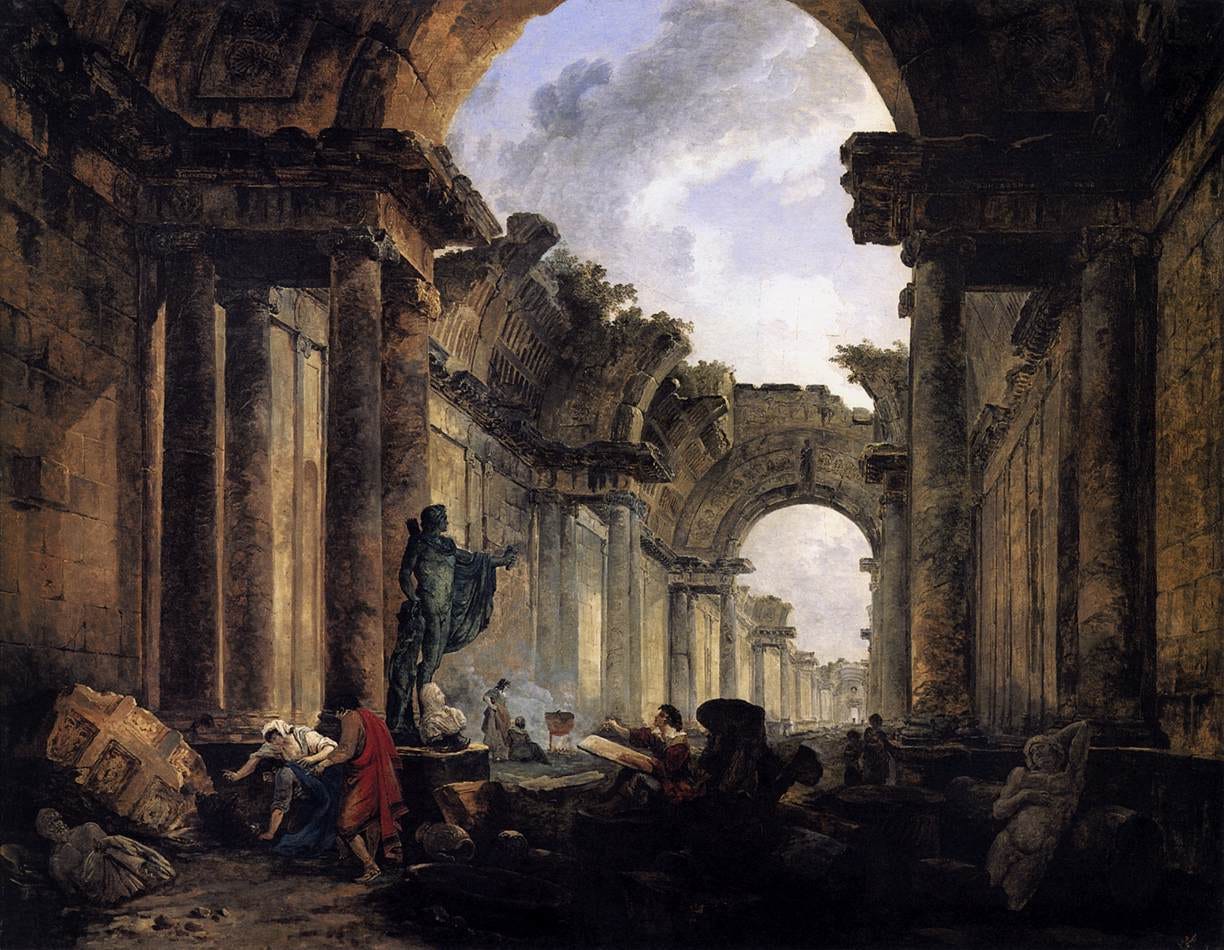
12. Hubert Robert, The Louvre in Ruins (1796)
Two years after coming out of one of the prisons of the Revolution, where he had gone on painting on dinner plates, Robert painted the museum he curated as a roofless ruin, weeds in the vaults, a boy sketching among the fragments.
Rome's ruins had taught him that any building is temporary, including the one he was standing in. The picture hangs in the Louvre today, in a room with a roof.
The end of Rome, in short
When did the Roman Empire fall? Conventionally in 476, when the last western emperor was deposed. The eastern half continued for another thousand years.
What is the most famous painting of the fall of Rome? Thomas Cole's Course of Empire cycle, and Couture's Romans During the Decadence.
Did Nero really burn Christians as torches? Tacitus says so, writing about fifty years later. He is the only source, and historians treat him carefully.
Did the barbarians destroy Rome? The sack of 410 lasted three days and spared the churches. The slower causes were economic, military and political.
Why did painters love Roman ruins? They sold to Grand Tourists, and they let a painter warn his own country about its future without naming it.
If the ruins pulled you in, you will love these too:
The darker truth about Gauguin, the part of the Tahiti story that never makes the wall label
Vermeer, Woman Holding a Balance, what is actually on those scales
The Ambassadors, detail by detail, the object at the bottom that only works from one side
Painting your own decline
Almost none of these pictures is about Rome. Cole was warning New York, Couture was needling a French king, Sylvestre was painting a France afraid of Germany, and Hubert Robert was drawing the roof off his own workplace.
Rome is the costume. Cole finished his five canvases in 1836 and died twelve years later at forty seven; the grocer who paid for them, Luman Reed, died before the paint was dry.