The Garden of Earthly Delights: Meaning of Bosch's Triptych

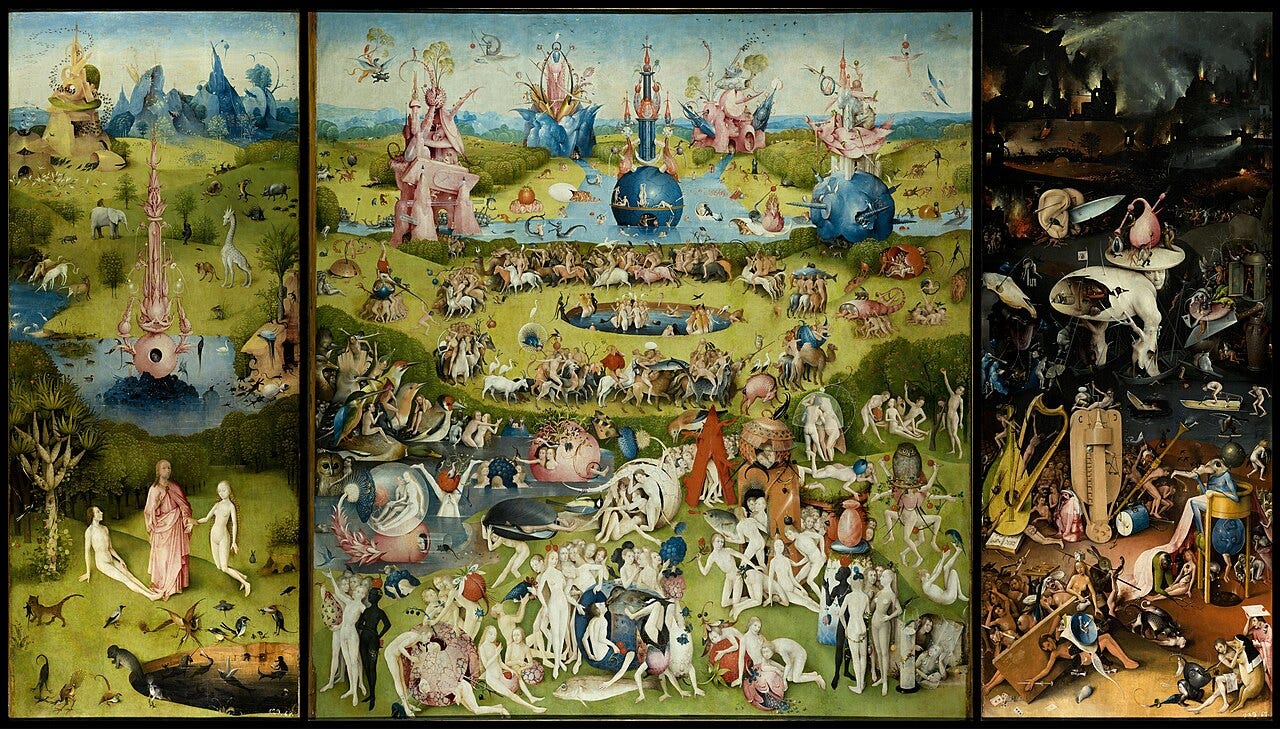
The Garden of Earthly Delights is a triptych painted around 1500 by Hieronymus Bosch, in the Prado in Madrid. It reads left to right: paradise, a vast garden of naked pleasure, and a nightmarish hell.

It is five hundred years old and still the strangest picture ever painted.

Triptych of paradise, a garden of nudes, and hell
Hieronymus Bosch, The Garden of Earthly Delights, about 1500

Bosch was not mad. He was a careful moralist who hid an entire argument about sin, and one joke so odd that people have recorded the music he tattooed on a man's backside. Here is how to read all three panels, and what it means.


Learn art the fun way. Free stories every week, no boring lectures.


A modern name for a lost picture

We do not know what Bosch called it. The Garden of Earthly Delights is a modern title, and the original name and commission are lost.

What we do know is that by 1517, a year after Bosch died, it was hanging in the palace of the counts of Nassau in Brussels, where an Italian visitor described it.

That matters. This was not painted for a church. It was made for a very rich private collector, which is why Bosch could be this free, this strange, this frank about the body.

It is a triptych, three hinged panels, and when the outer wings are folded shut they show something else entirely.

The panel most people never see

Close the wings and the color drains away. On the outside, in shades of stone and ash, Bosch painted the world on the third day of creation, a flat disc of land and water sealed inside a glass sphere.

God sits tiny in the top left corner, and an inscription from the Psalms runs across the top: he spoke, and it was made.

It is a quiet, bare beginning, and it is meant to be. You open the doors on that solemn washed out world and the riot of color inside hits all the harder for it.

Left panel: paradise, with a warning

Inside on the left is Eden, but an uneasy one. A youthful, almost boyish God takes Adam's wrist and presents Eve to him. Adam stares at her, and his cheeks are flushed, the first stirring of desire already in the garden.

Around them the animals are wrong. A three headed bird, a creature reading a book, a cat carrying off a lizard. Even paradise, in Bosch's hands, is already tilting toward the chaos to come.

And God looks out of the panel, straight at you, as if measuring how you will react to what is in the middle.


Join 130,000 readers who get the secrets behind the paintings. Free.


The center: pleasure without consequence

The huge middle panel is the one everyone comes for, and the one I could look at for an hour. Hundreds of naked people swarm across a landscape of giant strawberries, cherries and translucent fruit, riding birds and fish, climbing into shells, feeding each other, embracing.

There is no shame, no clothing, no violence.

Notice what is missing: nobody is old, nobody dies, and there are no children. This is sex with no consequence, pleasure that never turns into a family or a grave.

One powerful reading is that Bosch is painting an alternative history, a what if: what if the Fall had never happened, and Adam and Eve had simply peopled the earth with innocent pleasure?

The garden is the fantasy of a world without sin, painted so seductively that it becomes a warning about wanting it.

Right panel: hell, and the music on the body

Turn to the right and it is night. Cities burn on the horizon, and the instruments of pleasure have become instruments of torture.

A giant harp crucifies a man; a hurdy gurdy grinds the damned. At the center stands the Tree Man, a figure with a cracked eggshell body, legs like rotting tree trunks, and a tavern inside his hollow torso.

The face looking out of it may be Bosch's own; some scholars read it as a hidden self portrait.

A blue bird demon sits on a toilet throne, swallowing sinners and excreting them into a pit. And on the backside of one damned soul, Bosch painted a line of musical notation, a real score.

Modern musicians have transcribed the notes off that buttock and played them, so you can now hear what has been called the six hundred year old song from hell.

In the Prado, and the madness myth

The Garden of Earthly Delights is in the Museo del Prado in Madrid. Philip the Second of Spain bought it in 1591 and kept it at the palace monastery of the Escorial, and it only reached the Prado in 1939.

It does not travel and carries no price. And the popular idea that Bosch was a lunatic or a heretic on drugs is a myth: he was a respected member of a religious brotherhood in his home town, painting for wealthy patrons, using the wild imagery of Symbolism to preach a completely orthodox sermon about where desire leads.

The king who kept it, and the monk who defended it

For a picture this frank, its owners were strait laced. It passed from a Brussels palace to a Dutch rebel against Spain, and ended as the property of the most powerful Catholic king in Europe, Philip the Second, who hung it in his severe monastery palace at the Escorial.

A monk who lived there, Fray Jose de Siguenza, defended it around 1600 against those who cried heresy. He argued that Bosch painted people as they truly are inside, not as they pretend to be, which he thought made the picture more moral than a wall of tidy saints.

It is the earliest real defense of the triptych, and it still holds up.

How little we actually know

Almost nothing about the commission survives. We do not know who ordered it, for which room, or what Bosch himself called it. The name Garden of Earthly Delights was attached long after his death, and even the date is a guess from style, somewhere around 1490 to 1500.

Bosch left no letters and few records. He signed himself Jheronimus Bosch, taking the name of his town rather than his family name van Aken.

For a painter this famous he is almost a blank, and that emptiness is part of why every generation feels free to decide for itself what the triptych means.

The painter the Surrealists claimed

For centuries Bosch was filed as a maker of comic devils, admired but not quite taken seriously. Then the twentieth century found him again.

The Surrealists, hunting for ancestors who painted the logic of dreams, seized on him, and Joan Miro and Salvador Dali both spoke of him as a father of what they were doing.

It changed how the triptych is read. What had looked like medieval moralising started to look like the unconscious spilled onto a panel four hundred years early, and the crowd around the picture at the Prado today is looking for something closer to a dream than a sermon.

Both readings, I think, are in there at once.


The Garden of Earthly Delights, quick answers

  • What does The Garden of Earthly Delights mean? A warning about sin. It moves from paradise, through a garden of consequence free pleasure, into hell, tracing where unchecked desire ends.

  • Who painted it and when? Hieronymus Bosch, around 1500, in the Netherlands.

  • What are the three panels? Left, the Garden of Eden; center, a vast garden of naked pleasure; right, hell. Closed, the wings show the creation of the world in ashen.

  • Is there really music in the painting? Yes. Bosch painted a musical score on a damned figure's backside in the hell panel. Musicians have transcribed and recorded it.

  • Where is The Garden of Earthly Delights? The Museo del Prado in Madrid.


If this triptych pulled you in, you will love these too:


The joke that took five centuries to hear

For most of its life the score on the sinner's backside was just another grotesque detail, too small and too crude for anyone to bother reading.

Then in 2014 a music student in Oklahoma noticed the notes were real, transcribed them onto a modern staff, and posted the tune online.

Bosch had hidden a playable melody on a buttock in hell and waited five hundred years for someone to press play.

You can see The Garden of Earthly Delights in person at the Museo del Prado. For more by the artist, browse the Metropolitan Museum collection.

Questions about the three panels

  • What is The Garden of Earthly Delights? A large triptych, a painting in three hinged panels, made by Hieronymus Bosch around 1500.

  • What do the three panels show? On the left the Garden of Eden, in the center a dreamlike garden of earthly pleasures, and on the right a nightmarish Hell.

  • Where is it? It hangs in the Museo del Prado in Madrid.

  • What is the music on the buttocks? In the Hell panel, musical notes are painted across a figure. A student later transcribed them, and the tune is now known online as Bosch butt music.

  • What does it mean? Scholars still debate it, but most read it as a moral warning about the fleeting pleasures of sin.


Two new stories a week, 130+ secrets unlocked. Start free.