The Gleaners by Millet: Meaning and the 1857 Scandal

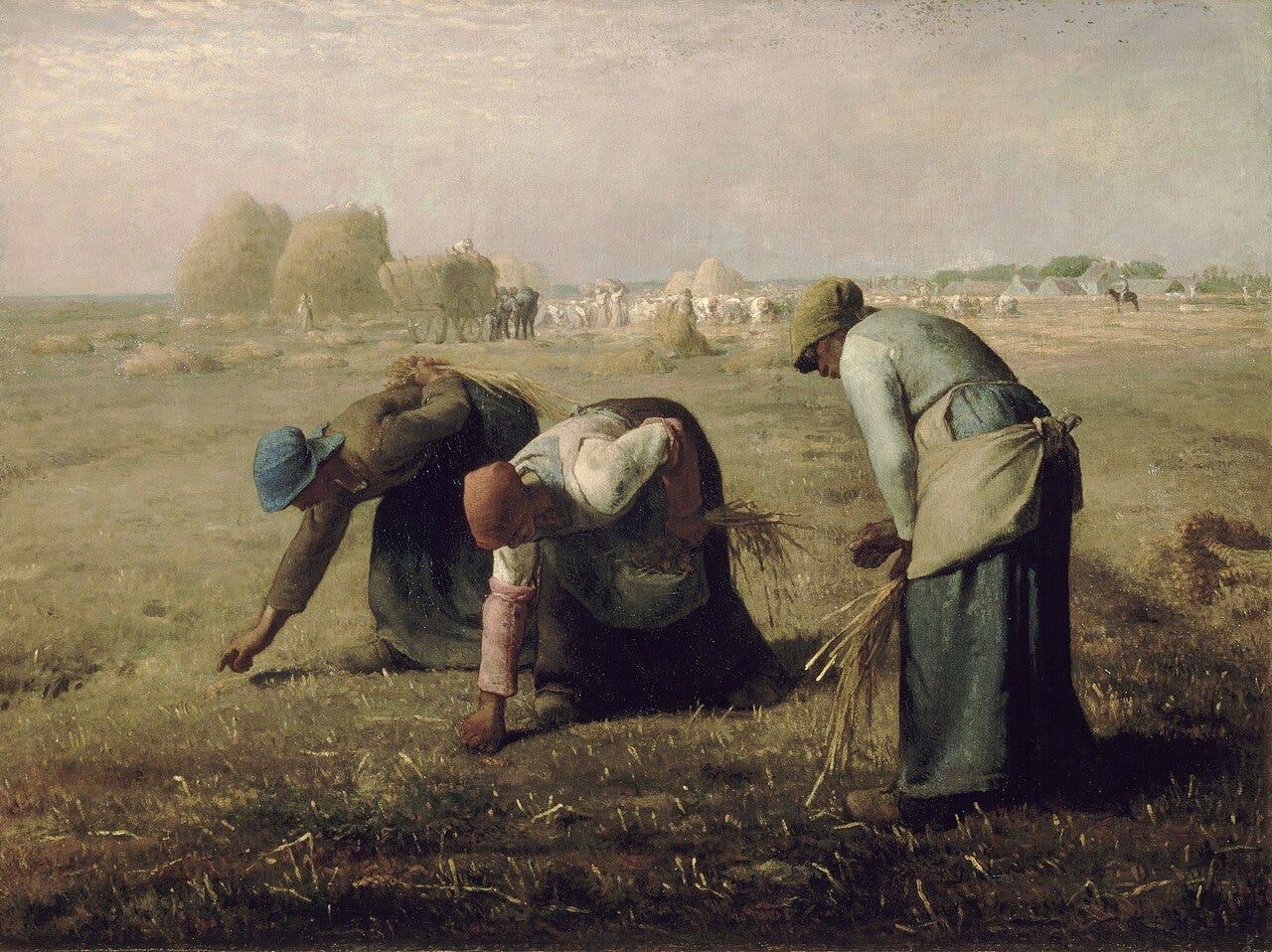
The Gleaners is an 1857 painting by Jean Francois Millet, in the Musee d'Orsay in Paris. Three peasant women stoop in a field, picking up the stray grain left after the harvest.

It looks quiet, and it frightened Paris, because it put the poorest people in France at the scale usually reserved for saints and kings.

Three peasant women bending to pick up grain in a field
Jean Francois Millet, The Gleaners, 1857

This is the painting, not the Agnes Varda film that borrowed its name. Here is what gleaning was, why the picture caused alarm at the Salon, and the quiet trick Millet used to make it bearable.


Learn art the fun way. Free stories every week, no boring lectures.


What the three women are doing

Gleaning was the oldest welfare in Europe. After the reapers had cut and carried the wheat, the very poorest of a village were allowed into the field to collect what had fallen, grain by grain, a right that ran back to the Book of Ruth and was written into French law.

It was backbreaking and it barely fed you. Millet shows the toil honestly: three bent backs, hands in the stubble, a whole day of work for the few ears you can see in their aprons.

He had grown up in a farming family in Normandy, and he painted the countryside as work rather than as scenery.

The whole social order in one field

The meaning is in the distance. Behind the three women the harvest is enormous: golden stacks, a loaded cart, an army of reapers bringing in a rich crop under a warm sky.

Millet paints abundance in the background and three women scraping the leftovers in front.

On the right, on horseback, sits the overseer, the farmer's man, watching the harvest and paying the gleaners no attention at all.

In one picture you can read the entire rural hierarchy: the owner's wealth at the back, the manager on his horse, and at the front the people the system has left with the scraps.

Why a field of women scared Paris

When The Gleaners hung at the Salon of 1857, the critics recoiled. France was less than a decade past the revolution of 1848, when the poor had risen and the streets had filled with barricades, and the middle class was still afraid.

A picture that made rural poverty this monumental read, to nervous eyes, as a warning or even a threat, the three fates of the countryside standing in judgement.

One critic saw in them the pikes of the coming revolt. Millet insisted he was only painting what he had seen every autumn of his life, but in 1857 a poor woman shown at heroic scale was a political act whether he meant it or not.


Join 130,000 readers who get the secrets behind the paintings. Free.


The softening nobody notices

Here is the quiet part. Real gleaners were often desperate, ragged, half starved. Millet's three women are not. They are solid, upright, decently dressed, their movements almost graceful, closer to figures on a Greek frieze than to beggars.

That was deliberate, and it is the choice I find most telling in the whole picture. By painting poverty with dignity rather than squalor, Millet made a subject the Salon could hang on its walls.

He kept the sympathy and removed the horror, and it is exactly this restraint that let the picture survive and become loved rather than banned.

The realism of Realism was never quite the whole truth.

Where the picture ended up

The Gleaners is in the Musee d'Orsay in Paris. It found no eager buyer at first, sold cheaply, and passed through several hands; a later owner left it to the French state around 1890, and it has hung in the national collection since.

It carries no market price now, but the arc is worth noting: a painting once feared as dangerous is now one of the most reproduced images of French country life, printed on everything from posters to biscuit tins.


The Gleaners, quick answers

  • What is The Gleaners about? Three peasant women collecting the grain left in a field after the harvest, an old right of the very poor. Millet paints rural poverty at heroic scale.

  • Why was The Gleaners controversial? Shown in 1857, less than ten years after the 1848 revolution, it made the poor monumental, and a nervous middle class read it as a threat.

  • Who painted it and when? Jean Francois Millet, in 1857.

  • How much is The Gleaners worth? It is not for sale. It entered the French national collection around 1890 and hangs in the Musee d'Orsay, treated as a national treasure.

  • Is this the same as the Agnes Varda film? No. The 2000 documentary The Gleaners and I borrowed the theme. This is Millet's painting.


If this painting pulled you in, you will love these too:


The painter who fed Van Gogh

Millet died in 1875, better paid than he had ever been but still thinking of himself as a peasant with a brush. His quiet dignifying of farm work reached one young admirer above all: Vincent van Gogh copied Millet again and again, called him a father figure, and built his own early art on these bent backs in the fields.

The picture that scared the Salon of 1857 became, twenty years later, the model a future genius taught himself from.

You can see The Gleaners in person at the Musee d Orsay. For more by the artist, browse the Metropolitan Museum collection.

Questions from the harvest field


Two new stories a week, 130+ secrets unlocked. Start free.