The Greatest Sculptures: 12 That Shaped Art History
The greatest sculptures in art history include Michelangelo's David, the armless Venus de Milo, the flying Winged Victory, and Rodin's Thinker. Carved in marble, cast in bronze or modeled in clay, they have outlasted the empires that made them.

A great sculpture is a bet against time. It takes months or years to make, then has to survive earthquakes, looters, wars and clumsy restorers to reach us at all.
The twelve here run from an ancient Chinese tomb to a Paris studio, and almost every one carries a story of near loss, lucky rediscovery or plain scandal.
I have leaned into those.
What to look for in a great sculpture:
The pose. A shift of weight onto one leg, or a body caught mid motion, is what makes stone feel alive.
The material. Marble, bronze and clay each allow different tricks, and the best artists push each to its limit.
The survival. Most ancient sculpture is lost. What remains is often a Roman copy or a lucky dig.
The scale. Standing under a seventeen foot David does something a photograph never will.
The next thing to read
If this is the kind of art history you want more of:
The Ambassadors, detail by detail, the object at the bottom that only works from one side
Luncheon of the Boating Party, detail by detail, who everybody at that table actually was
Ten women artists you need to know, the names the textbooks skipped
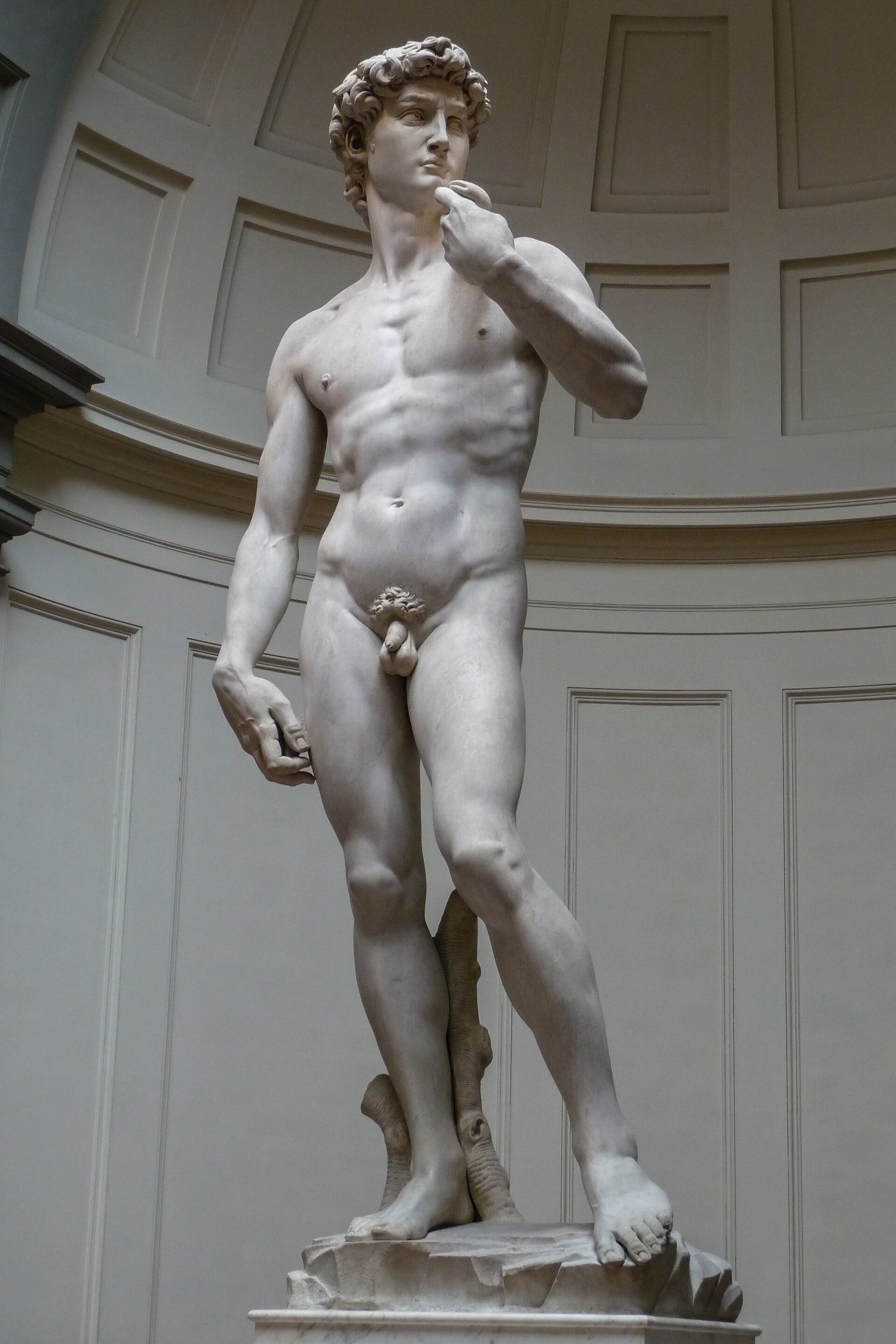
1. Michelangelo, David (1501 to 1504)
A seventeen foot young man stands loose and watchful, sling over his shoulder, weight on one leg in a perfect contrapposto. Michelangelo carved David from a single block of marble that other sculptors had started, botched and abandoned decades earlier.
They called the flawed block the Giant. It had sat in the cathedral works for over thirty years before a twenty six year old Michelangelo talked his way into it and found a hero inside.
For centuries it stood in the open in Florence, a symbol of the small republic ready to face any Goliath. In 1873 it was moved indoors to the Accademia, and a copy took its old place in the square.
2. Venus de Milo (about 130 BC)
The most famous missing arms in art belong to a Greek goddess of love, probably Aphrodite. A little taller than life, she twists gently, her robe slipping, calm and unbothered by the fact that her arms are long gone.
A farmer dug her up on the island of Melos in 1820, in pieces. What happened to the arms in the scramble that followed no one is sure, and a tug of war broke out between French and Ottoman buyers on the beach.
France won and made her a star. The Louvre pushed her as the greatest ancient nude of all, partly to replace another Venus it had just been forced to hand back to Italy.
3. Winged Victory of Samothrace (about 190 BC)
A winged woman strides forward onto the prow of a stone ship, her wet robe pressed back by a sea wind you can almost feel. This is Nike, goddess of victory, landing to crown a naval win.
She was found in 1863 on the island of Samothrace, smashed into more than a hundred pieces and missing her head and arms. Restorers rebuilt the body and mounted her on a marble prow.
Now she owns the grandest spot in the Louvre. She stands at the top of the Daru staircase, so you meet her mid flight, still surging forward after two thousand years.
4. Laocoon and His Sons (about the 1st century)
A priest and his two sons writhe as sea serpents crush them, muscles knotted, mouths open in a silent howl. Three sculptors from Rhodes carved this agony, and it stayed buried and lost for over a thousand years, one of many wonders the ground kept hidden.
It came back on a January day in 1506. Diggers hit it in a Roman vineyard, and the Pope sent Michelangelo running to see it before it was even fully out of the earth.
Then the fixing went wrong. A missing arm was restored straight and heroic, until the real bent arm turned up in a Roman builder's yard four hundred years later and proved the pain was even sharper.
5. Augustus of Prima Porta (about the 1st century)
Rome's first emperor stands barefoot like a god, one arm raised, addressing troops we cannot see. This larger than life marble shows Augustus forever young and flawless, a piece of political theater in stone.
Every inch is a message. The carved breastplate marks a diplomatic win, the return of captured Roman standards by Parthia, and a small Cupid at his leg hints that his family came down from Venus, and the bare feet mark him as more than mortal.
It was dug up in 1863 at the country villa of his wife Livia, just outside Rome. Faint traces of paint show it was once brightly colored, nothing like the clean white marble we picture today.
6. Donatello, David (about the 1440s)
A slim boy in nothing but a hat and boots rests his foot on the head of Goliath, cool and a little smug. Donatello's bronze David is often called the first free standing nude statue cast since antiquity, and it caused a quiet shock.
A thousand years of Christian art had kept the naked body off its pedestals. Here it was again, sensual and self satisfied, made in bronze for the courtyard of the Medici palace in Florence.
When the Medici were driven out of the city in 1494, Florence seized the statue and moved it to the town hall.
It is a strange, dreamy David, nothing like Michelangelo's tense giant. Donatello was after beauty and mischief, not heroic nerve, and he got both.
7. Gian Lorenzo Bernini, Apollo and Daphne (1622 to 1625)

The god Apollo chases the nymph Daphne, and just as he catches her she turns into a tree. Bark climbs her legs, her fingers sprout laurel leaves, and her cry is freezing on her lips, all in white marble.
Bernini was only in his early twenties. He makes stone behave like flesh and leaf, so thin at the fingertips that light passes through it, a level of carving that still baffles sculptors.
It lives in the Borghese in Rome, where it was made for a cardinal. To dodge the awkward subject of a near assault, a Latin motto was added, warning that chasing fleeting pleasure leaves you holding only leaves.
8. The Discobolus (Roman copy after Myron, about 450 BC)
An athlete coils to hurl a discus, wound up like a spring at the split second before release. The Greek sculptor Myron caught that frozen tension in bronze around 450 BC, and everyone agreed it was perfect.
The trouble is the original is gone. Every Discobolus we have is a Roman marble copy, which is true of most famous Greek statues, melted or lost while the Roman imitations survived.
One of the best copies has a dark modern chapter. Hitler bought it in 1938 and shipped it to Munich, and it took until 1948 for Italy to get it back to Rome.
9. Auguste Rodin, The Thinker (about 1904)
A muscular man sits hunched, chin on hand, lost so deep in thought that his whole body seems to strain with it. Rodin first modeled him small, as the poet Dante brooding over the damned above a great set of bronze doors.
Then he blew him up to life size and set him loose on his own. Because Rodin worked in bronze, the figure could be cast again and again, and versions of The Thinker now sit in cities around the world.
The large one was unveiled in 1904 and later set before the Pantheon in Paris, perhaps the first public monument to a man simply thinking.
Rodin left the surface rough on purpose. You can see the marks of his fingers in the clay, a modern honesty about how the thing was actually made.
10. The Terracotta Army (about 210 BC)
An underground army of roughly eight thousand clay soldiers stands in battle order in the dark, each face different, guarding the tomb of China's first emperor. Qin Shi Huang had them made to protect him in the next life.
They lay hidden for over two thousand years. In 1974 farmers digging a well near Xian struck a clay head, and archaeologists slowly uncovered a whole buried legion, complete with horses and chariots.
They were not always gray. The figures were once painted in bright color, most of which flaked off within minutes of hitting the air, a loss the diggers learned about the hard way.
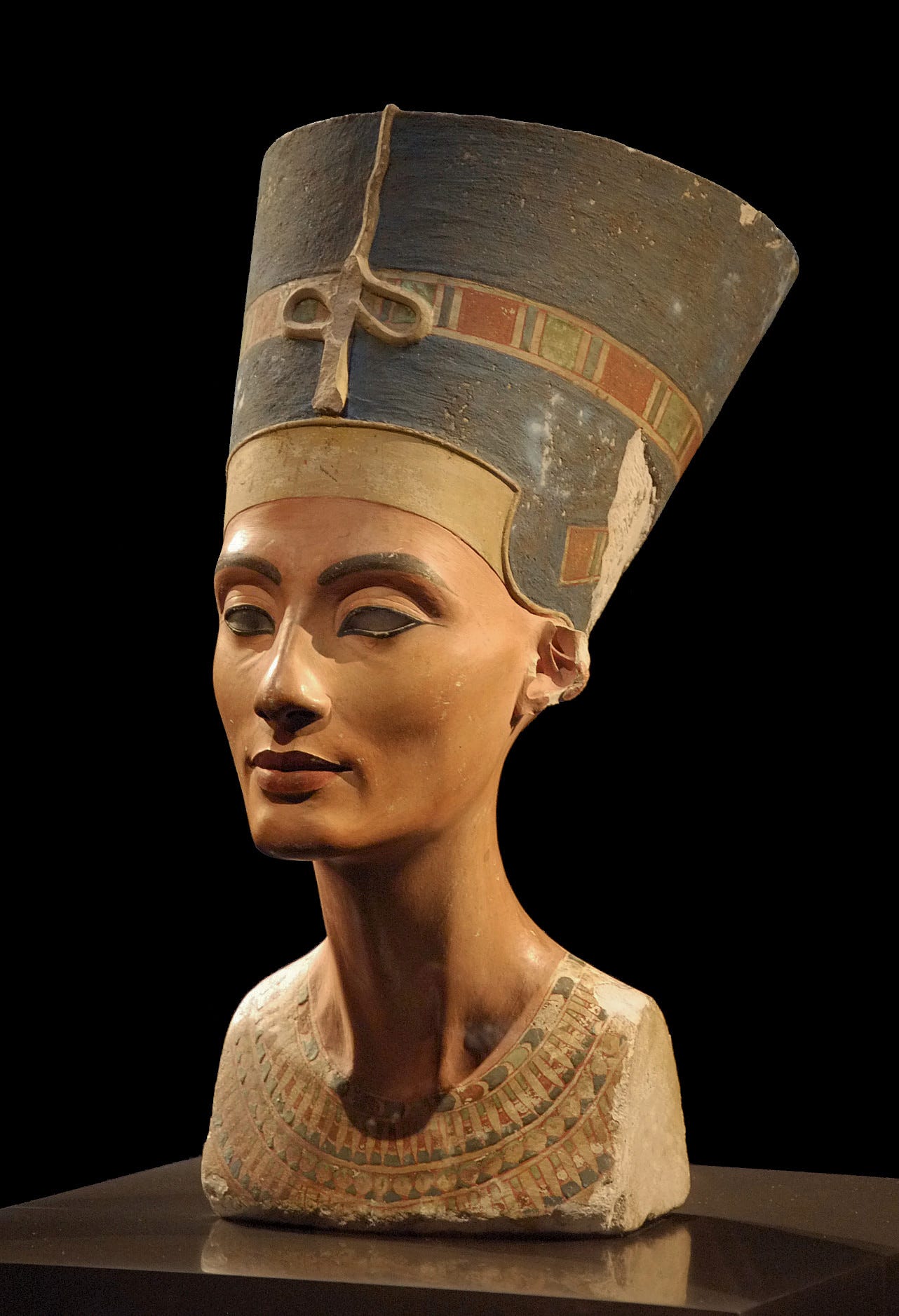
11. The Bust of Nefertiti (about 1345 BC)
A queen looks out under a tall blue crown, her neck long, her face so balanced it looks modern. This painted limestone bust of Nefertiti was made in ancient Egypt and is one of the most copied faces in the world.
It was a sculptor's model, left in a studio. German archaeologists found it at Amarna in 1912 in the ruined workshop of the sculptor Thutmose, and one eye was never finished, its socket left blank.
Egypt has wanted it back ever since. It sits in Berlin, and the argument over how it left the country and whether it should return has run for more than a hundred years.
12. The Moai of Easter Island (about 1250 to 1500)
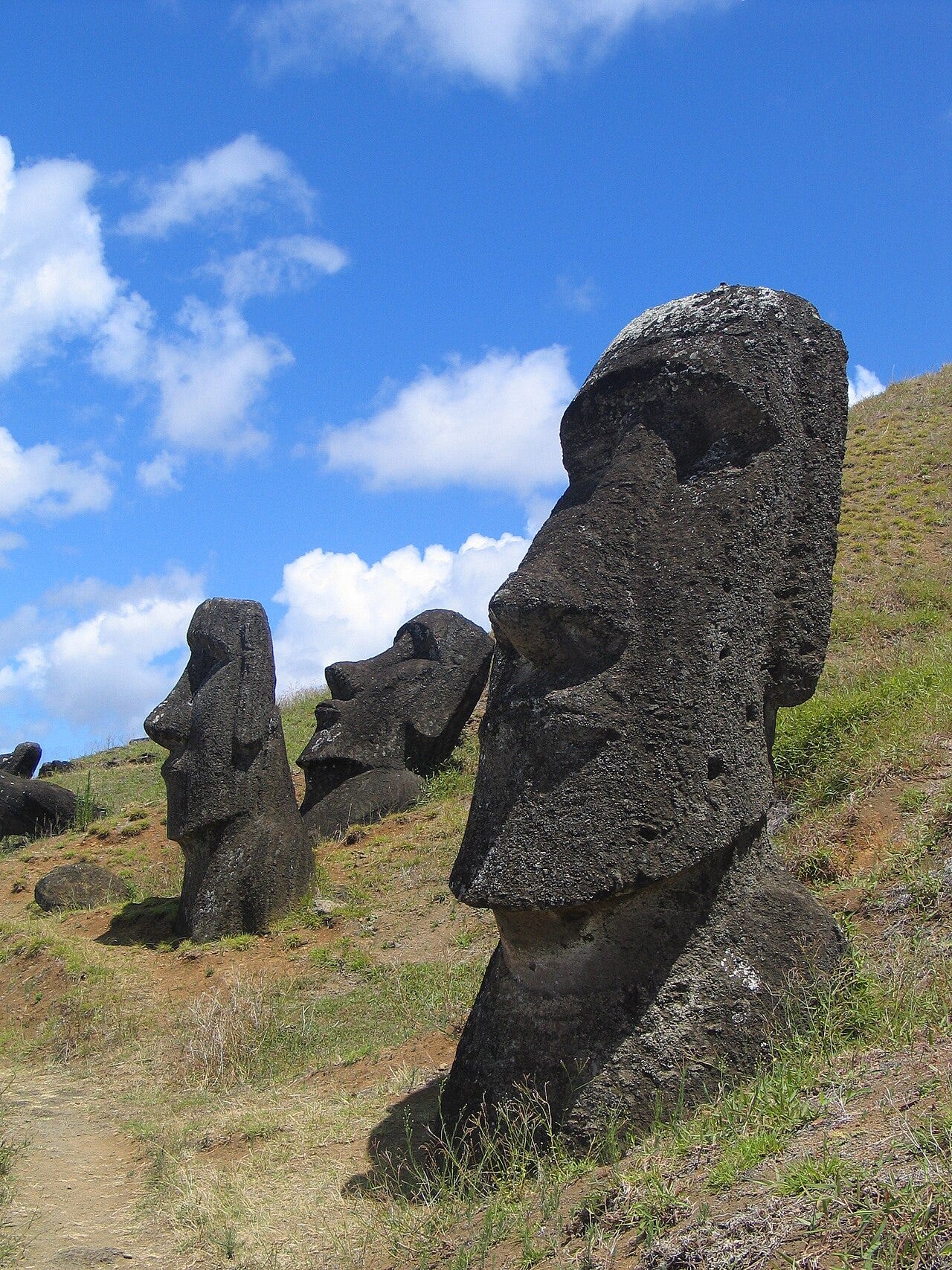
Hundreds of giant heads on heavy torsos stare inland across a remote Pacific island, carved by the Rapa Nui people from soft volcanic rock. There are nearly nine hundred of them, and the largest would stand three stories tall.
Many are not just heads. The famous faces on the slopes have full bodies buried under centuries of silt, only dug out in modern times, which surprised almost everyone.
The real riddle is how they moved. The statues were carved at one quarry and hauled for miles, and one leading theory is that crews rocked them upright with ropes, so they seemed to walk to their platforms.
Where to stand under them
Michelangelo, David: the Galleria dell'Accademia, Florence.
Venus de Milo and Winged Victory: the Louvre, Paris.
Laocoon: the Vatican Museums, Rome.
Bernini, Apollo and Daphne: the Borghese Gallery, Rome.
The Terracotta Army: the site museum near Xian, China.
Keep exploring the third dimension
If bodies carved in stone pull you in, these go deeper:
Was Monet really the first Impressionist, the painting that may have got there first
The secret behind Monet Magpie, one bird in the snow, and why it matters
Lady with an Ermine, detail by detail, why she is holding that animal
Questions people ask about famous sculptures
What is the most famous sculpture in the world? Michelangelo's David is the usual answer, though the Venus de Milo and the Winged Victory of Samothrace, both in the Louvre, run close behind.
Why does the Venus de Milo have no arms? They were lost around the time she was dug up on Melos in 1820. What she was holding, and how the arms broke off, is still unknown.
Who carved the David? Michelangelo, between 1501 and 1504, from a single flawed block of marble that earlier sculptors had abandoned.
Are most ancient Greek statues originals? No. Many, like the Discobolus, survive only as Roman marble copies, since the Greek bronzes were melted down or lost.
Where is the real David? In the Galleria dell'Accademia in Florence. The statue standing in the Piazza della Signoria is a copy.
Stone that refuses to die
Line them up and the pattern is survival. The Laocoon spent a thousand years underground, the Venus lost her arms on a beach, and the Terracotta Army waited in the dark for a farmer with a shovel.
Hitler shipped the Discobolus to Munich before Italy won it back, and the Moai were hauled for miles by people we still do not fully understand. These are not fragile treasures kept alive by luck alone.
They are the toughest things humans have made, faces and bodies that have outlived every hand that touched them.