


180 000+ readers learn art the fun way.
This is a preview. Paid subscribers get the full story.
You’ll also get:
10 new stories / month
The full archive (130+ Art stories)
Your personal art guide. Comment, ask questions, DM me anytime
Apple user? Subscribe at coolstoriesabout.art, not via the app. Apple adds 30% to the price.
This article was written in collaboration with Cool Stories About History .
November 2025, at the Louvre.
Visitors move through the red galleries of monumental French painting, in the Denon wing. They raise their eyes to The Coronation of Napoleon, then stop in front of Géricault’s The Raft of the Medusa.
A little further on, an enormous canvas. Nearly thirteen feet high, more than seventeen feet wide.
A battle out of antiquity. Spears, helmets, bodies.
When they turn around, the visitors find a mirror behind them.
They see the painting in it. And themselves, standing in the middle.
Their reflection puts them inside the battle.
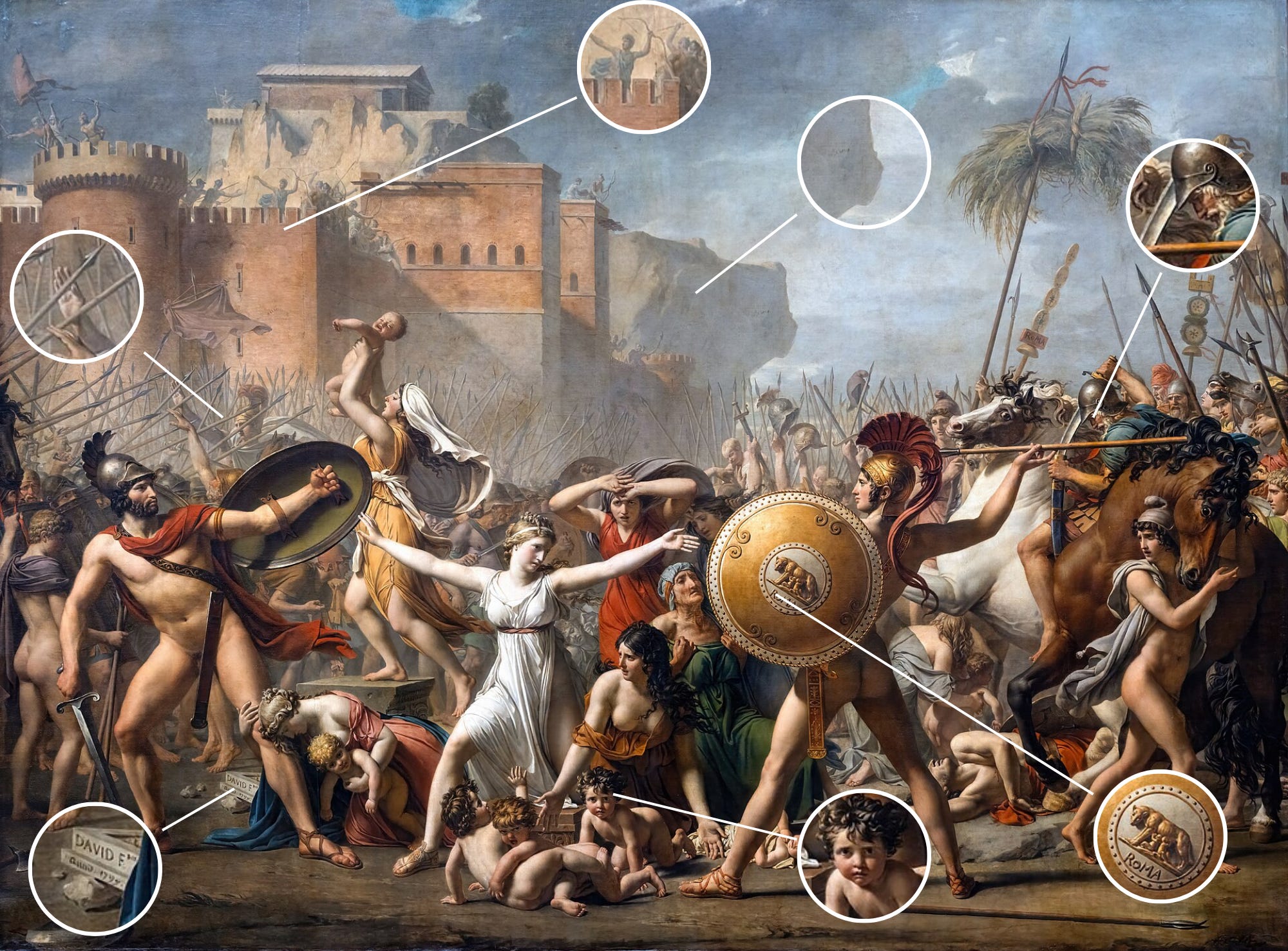
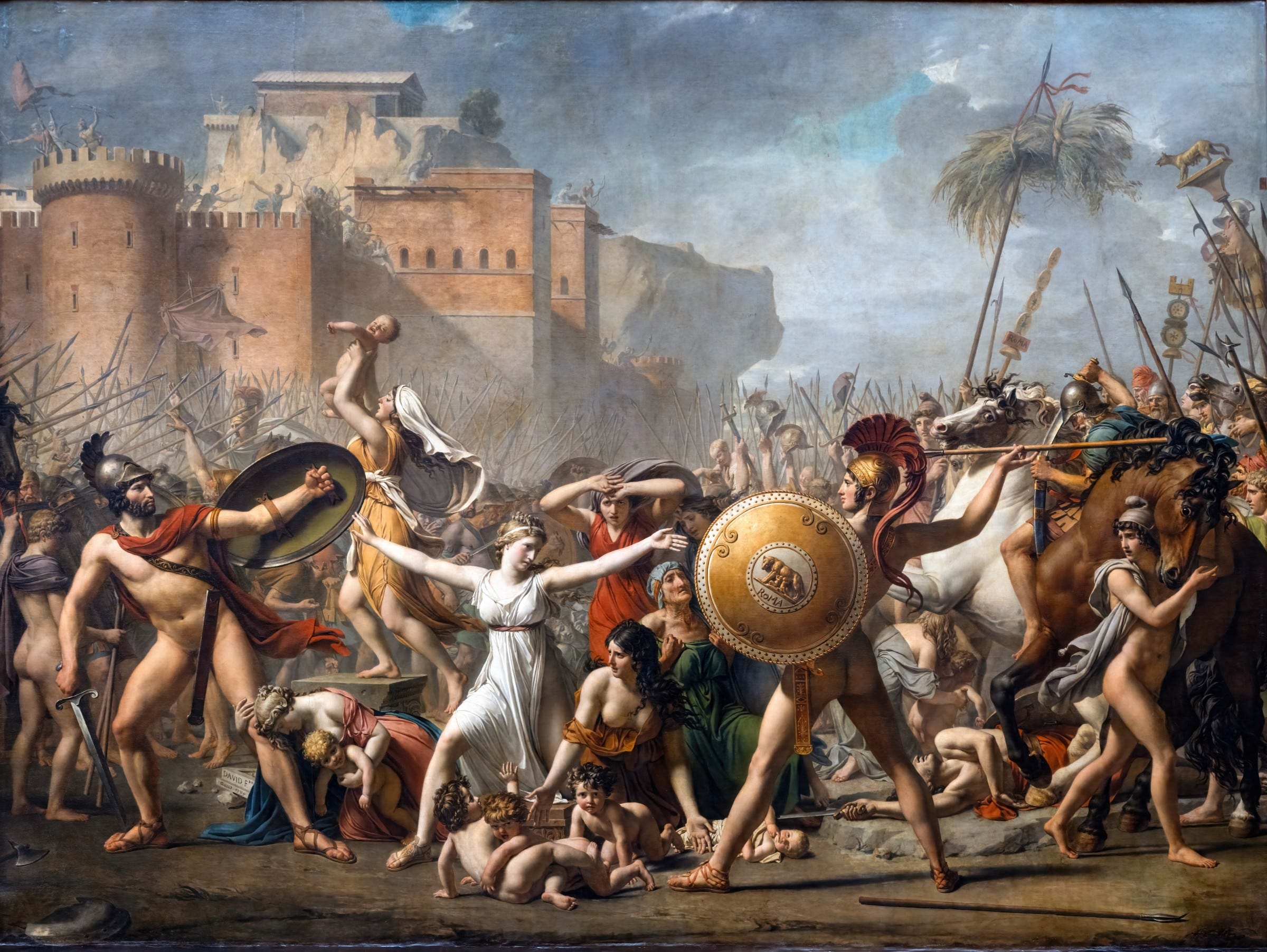
The painting is called The Intervention of the Sabine Women.
That mirror is not there by accident. It is a nod to one of the first great pieces of stagecraft in art history.
A battle out of antiquity, or so it seems. We are going to look at it detail by detail.
The Golden Disk
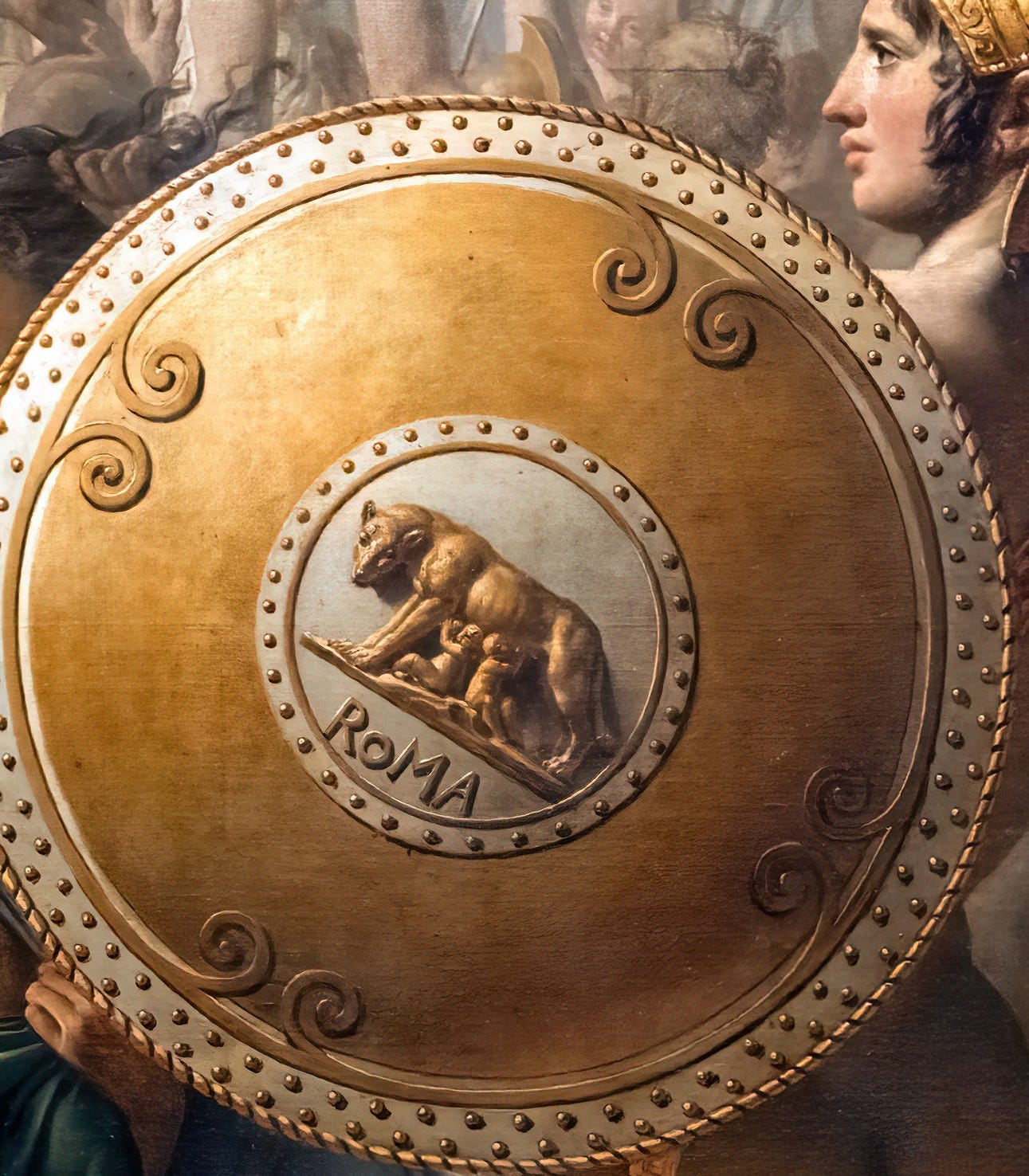
At the center of the canvas, the eye catches on a huge golden disk, round as a sun.
It is a shield.
Look at the middle of it. A she wolf, standing. Under her belly, two infants nursing.
The two children are Romulus and Remus, twins born to Rhea and the god Mars. Abandoned on the bank of the Tiber, they are taken in by a she wolf who feeds them instead of eating them.
Once grown, they found a city on the hills above the river. Romulus gives it his name. The she wolf becomes its emblem.
Below the wolf, David has written four letters: ROMA.
The wolf and the twins already say Rome. Why spell it out?
That addition means something. Keep them in mind.
And look at who is carrying the shield. A naked man, seen from behind, his arm drawn back, his javelin ready to fly.
That is Romulus. The founder of Rome, its first king, the head of its army.
A Handful of Hay
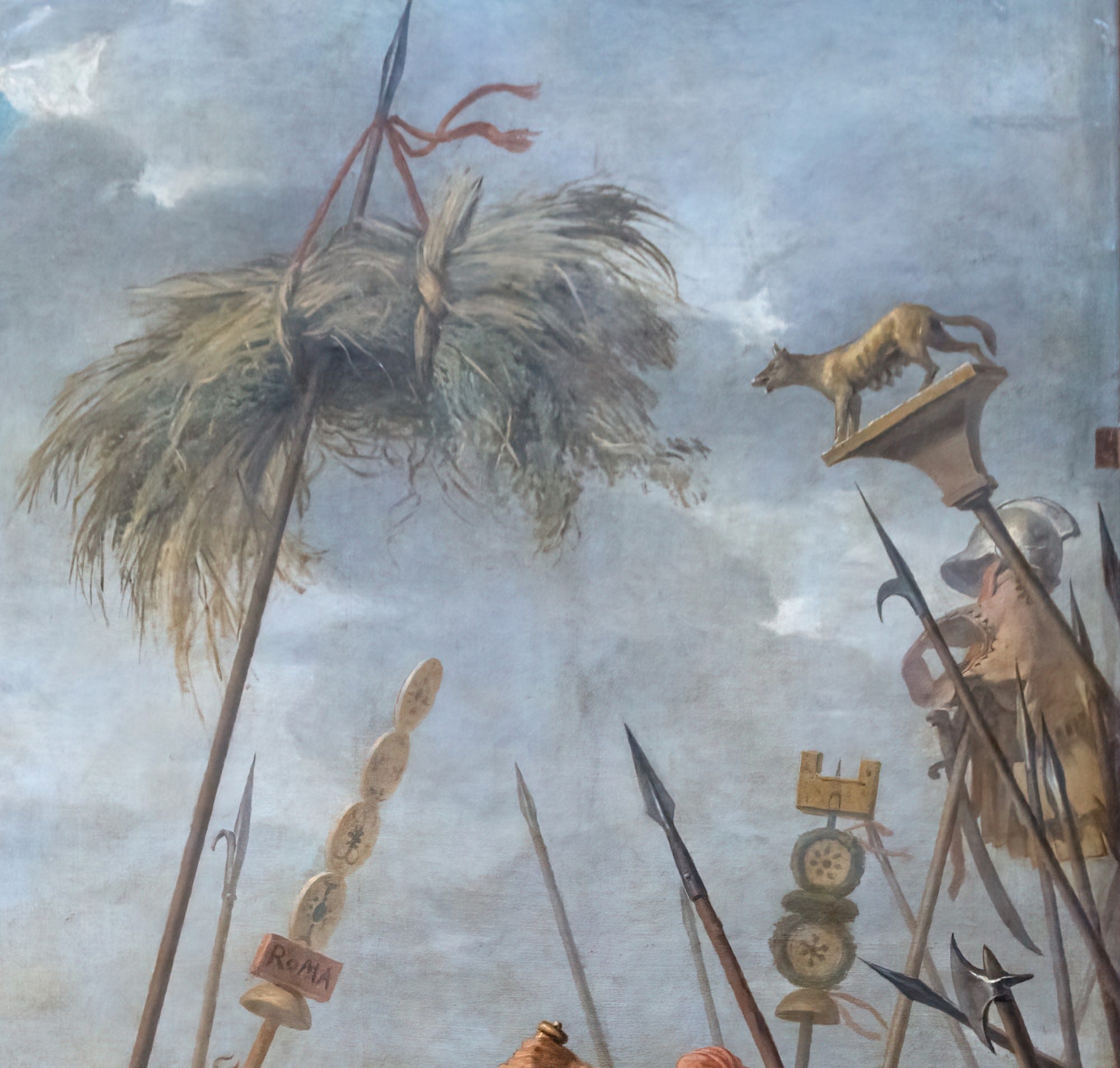
Move up, above Romulus. A forest of spears and helmets.
At the top of one of the poles, the wolf again, in gilded metal, set on a base shaped like a horn.
On another, a bundle of hay lashed to the pole.
In the dust of a battle, a soldier loses sight of his commander. He follows his standard.
That hay tells the story of how the Roman army began. Its very first soldiers gather behind a handful of dry grass tied to the end of a stick. Their first standard, long before the eagle.
That is where the word maniple comes from: manipulus, “a handful.” One of the basic units of the legion.
On the right side of the painting, the army of Rome. An army so young that its flags are still armfuls of grass.
At the End of the Javelin
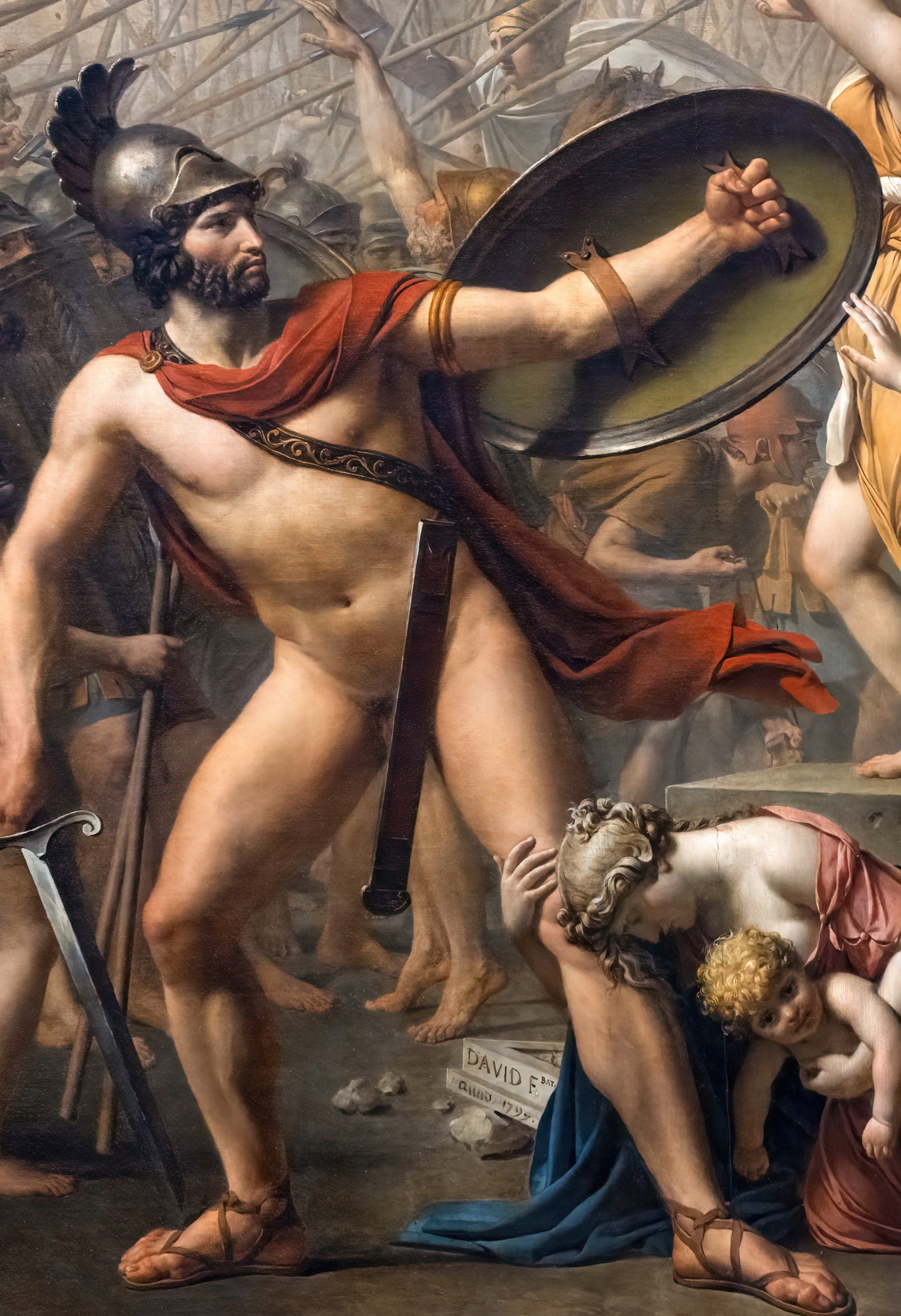
Follow the line of Romulus’s javelin, off to the left.
At the end of it, a warrior facing him, half a step back, his shield raised to block the javelin.
That is Titus Tatius, king of the Sabines. Behind him, his army.
The Sabines, a people of the hills, live northeast of Rome, a few hours’ walk away. Their city is called Cures.
Tatius has led their men here.
The Towers
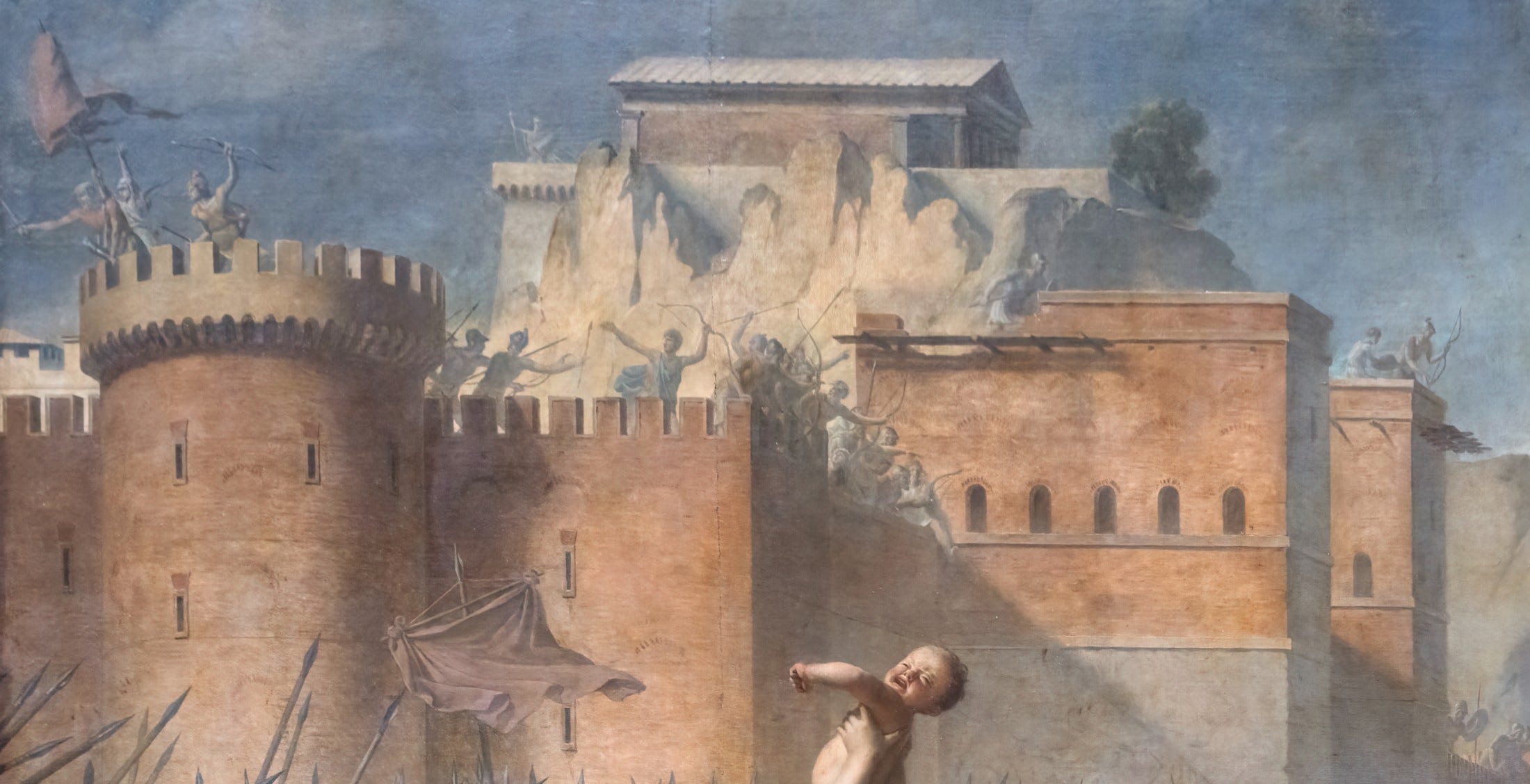
Raise your eyes.
At the very top, a fortress. Ramparts, stone towers. The Capitoline Hill, the hill the Romans hold sacred.
On its walls, small figures are still fighting.
This battle is not being fought in open country. It is being fought inside Rome, at the foot of the citadel.
Look at those towers again. Below, an army marching behind a bundle of hay. Above, cut stone.
In this period, all Rome has on the Capitoline Hill is a modest citadel. Nothing like those towers.
Those ramparts are an anachronism.
A painter who takes that much care over a bundle of hay does not get a citadel wrong.
Almost everyone who walks past the painting misses this. It matters.
Discover my new newsletter !

The Rock
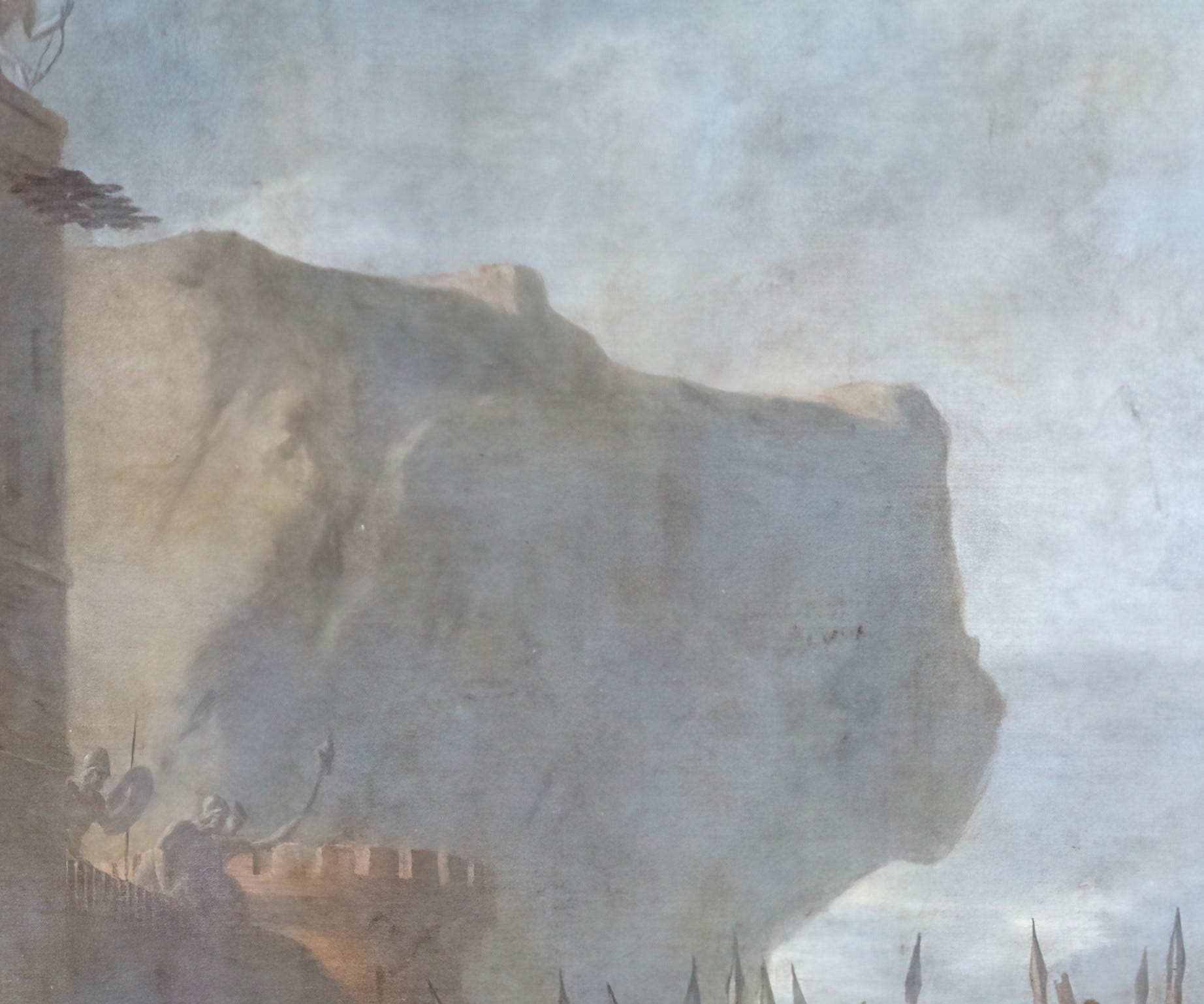
Just to the right of the Capitoline Hill, a sheer rock face.
That rock has a name: the Tarpeian Rock.
For centuries, this is where the Romans throw their traitors to their deaths.
Above the battle, David has placed the spot where Rome punishes betrayal.
In the Foreground
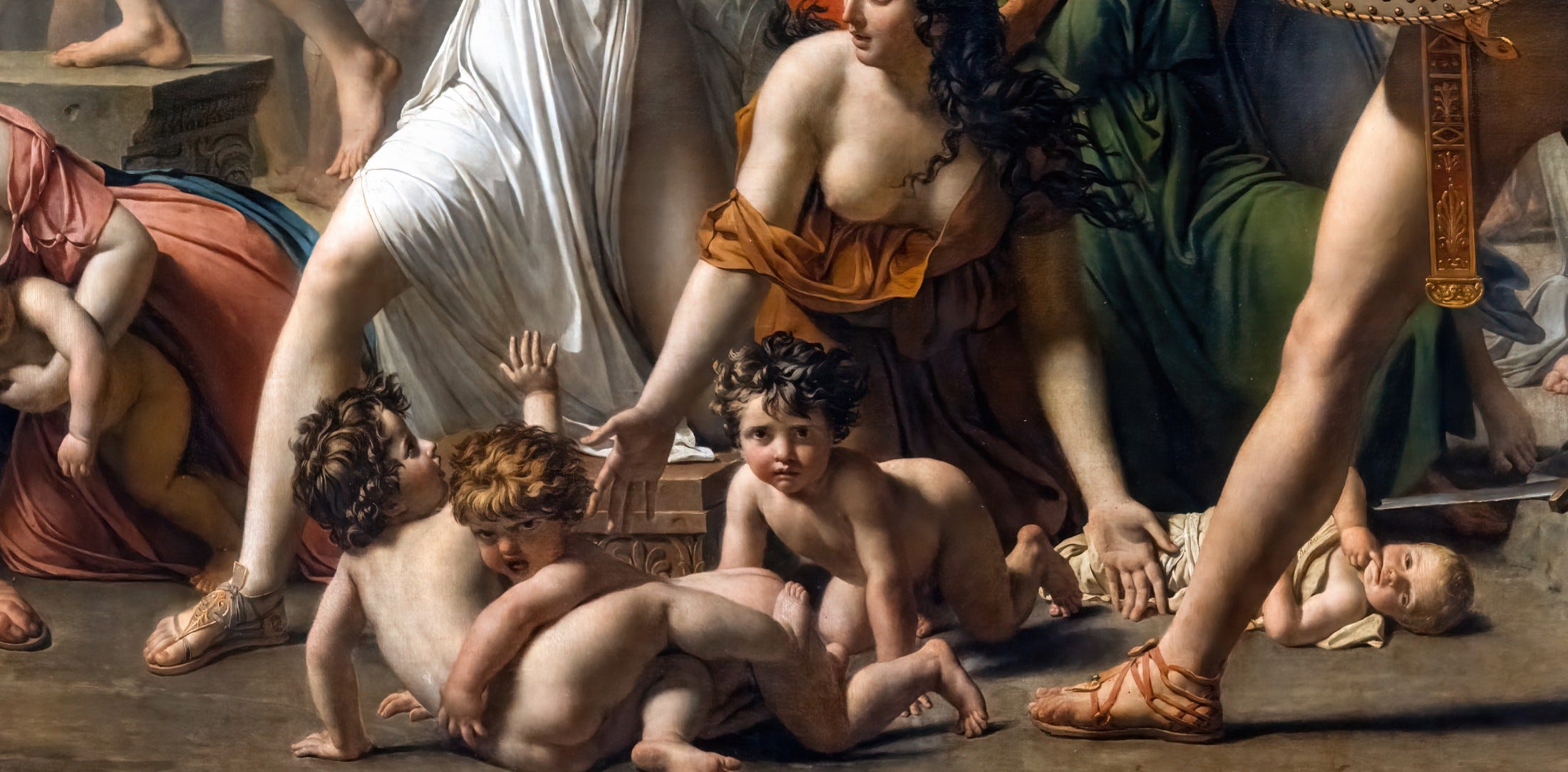
Lower your eyes to the foreground.
Bodies on the ground. Dropped weapons. A horse down.
Frightened faces. Women screaming, hands raised, pleading. One of them clings to Tatius’s leg.
Children everywhere, thrown into the middle of the fight. At the soldiers’ feet, between the legs of the fighters.
Everything in this corner of the canvas points to a massacre.
One child, though, is not watching the battle.
He is looking at us, straight in the eye.
Remember that gaze.
The Woman in White
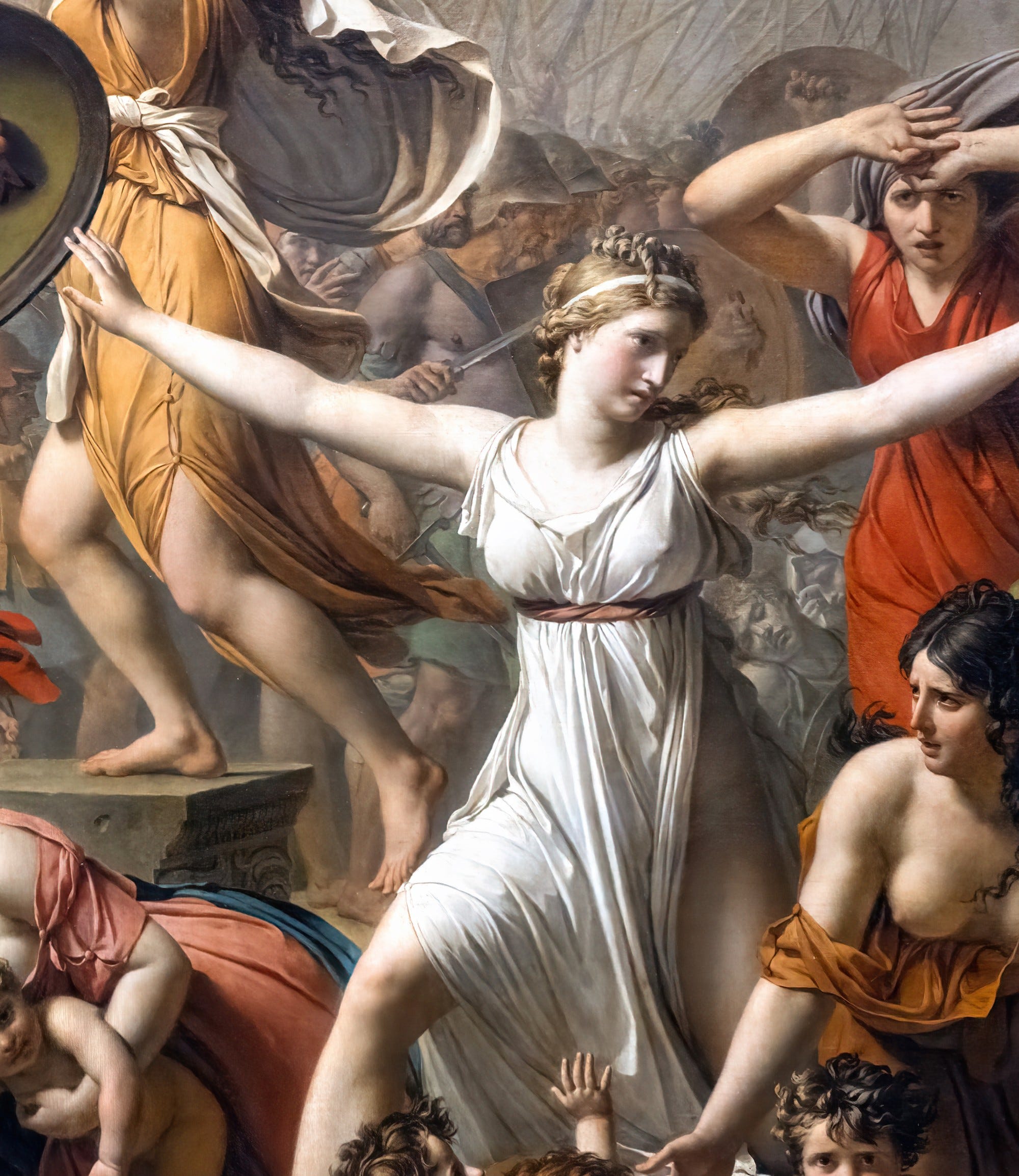
Among all these women, one stands out. In white, at the center, arms held out wide in a cross, one hand reaching toward each leader.
Romulus is aiming at Tatius. She is standing between them.
To reach Tatius, the javelin has to go through her.
Her name is Hersilia. She speaks for every woman in the painting.
Around her, other women are stepping into the space where the men are fighting. Their bodies make a wall between the two armies.
Four Words on a Stone
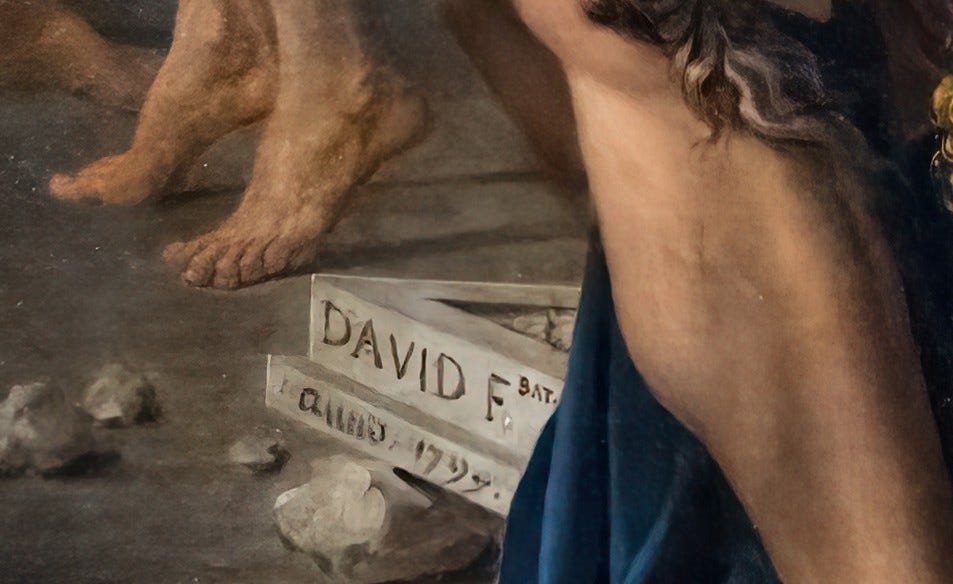
Lower your eyes, between Tatius’s legs. On a stone, four words carved: David fbat anno 1799.
1799, the year he finishes the painting.
When David draws the first sketch for it, he is in prison.
David, the leading neoclassical painter, the greatest artist of his day, is also a relentless revolutionary.
A deputy in the Convention, the assembly that governs France, he votes for the death of King Louis XVI. On the Committee of General Security, the regime’s political police, he sits beside Robespierre, his friend.
A painter, an image maker, but also a politician.
Behind the Spears
In the foreground, everyone sees a massacre.
But look at the background, behind the spears and the weapons.
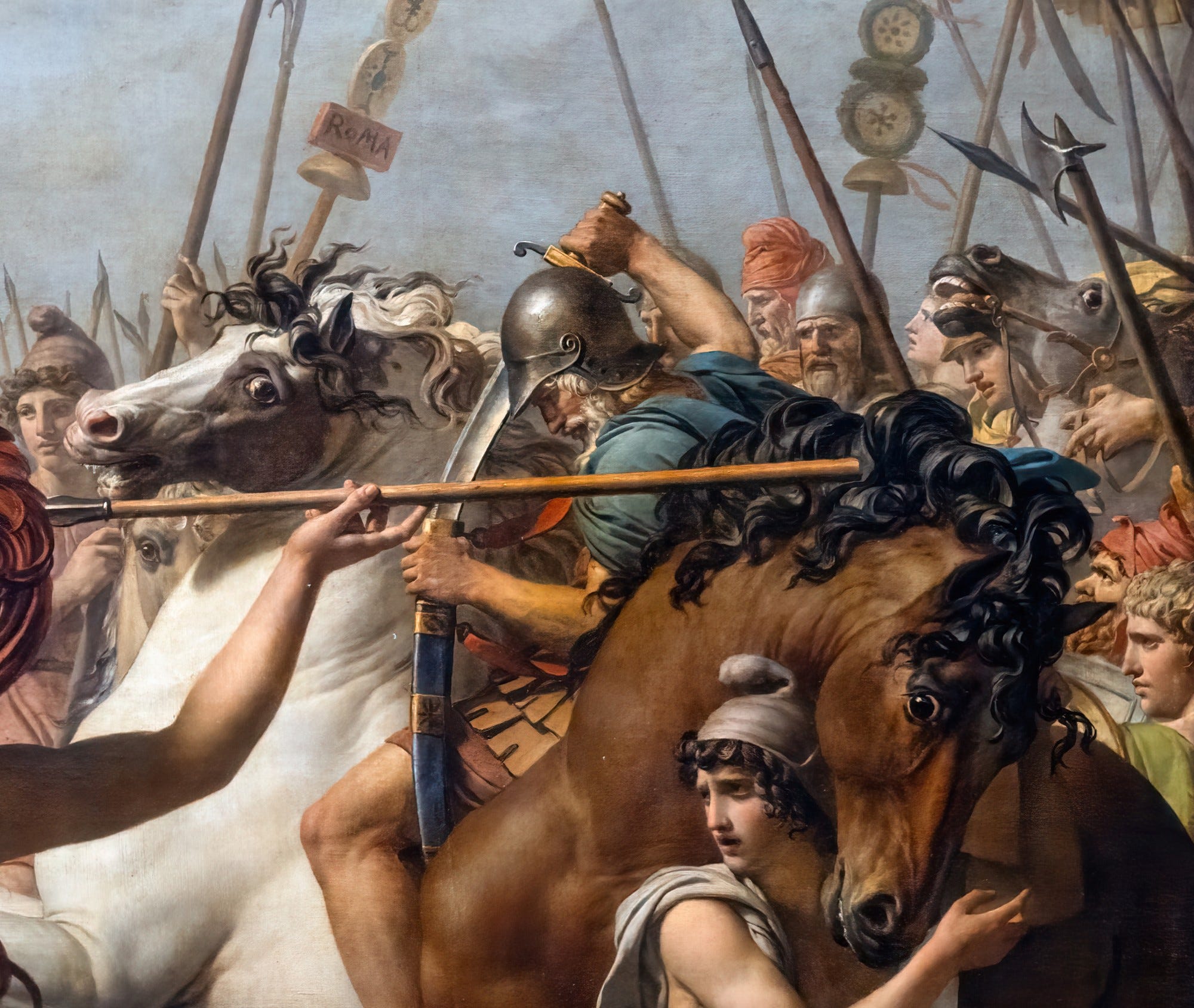
On the right, behind Romulus, an old Roman commander is putting his sword back in its sheath. In the middle of a battle.
On the left, behind Tatius, a Sabine officer on horseback holds his palm out toward his soldiers.
Further back, soldiers are holding their helmets up at arm’s length.
A blade going back into its sheath, a palm calling for a halt, helmets raised at arm’s length.
Those three gestures hold the key to the painting.
What David is staging has nothing to do with the Romans, or with the Sabines.
