
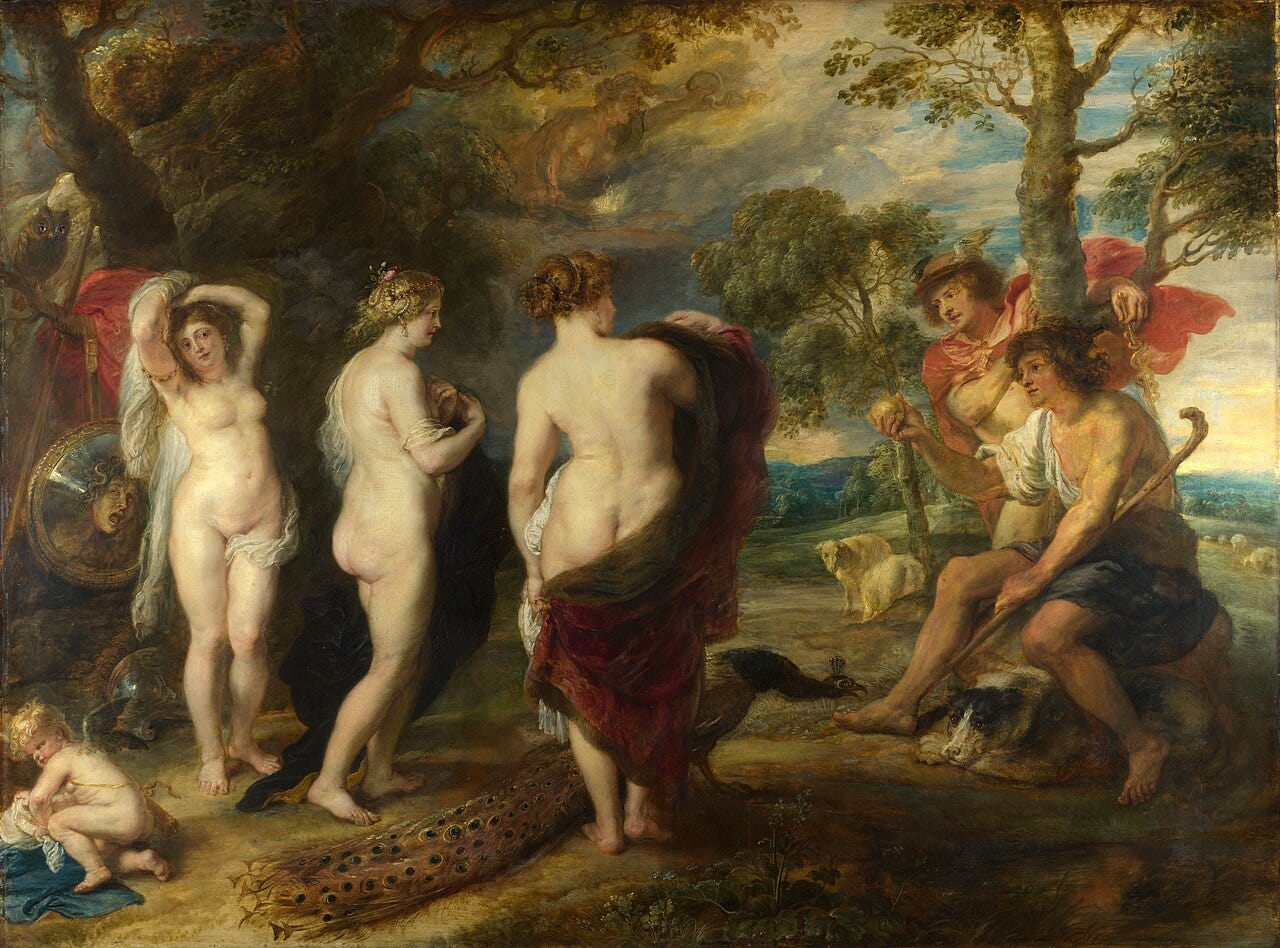
The Judgement of Paris is the Greek myth in which the Trojan prince Paris, living as a shepherd on Mount Ida, must hand a golden apple marked "to the fairest" to one of three goddesses, and gives it to Venus, who has promised him Helen, the most beautiful woman alive, so that the Trojan War follows. The version most often reproduced is Peter Paul Rubens's panel in the National Gallery in London, painted probably in 1632 to 1635.
The story starts at a wedding. Eris, the goddess of discord, had not been invited to the marriage of Peleus and Thetis, and she threw the apple in among the guests. Hera, Athena and Aphrodite, whom painters know as Juno, Minerva and Venus, each claimed it, Zeus refused to judge, and the choice fell to Paris. Painters took up the scene for plain reasons: it asks them to paint three goddesses side by side and a man who must pick one.
In the London panel Paris hands the apple to Venus, who clutches her robe to her breast as if surprised to have won. The National Gallery's caption is less kind to her: the goddesses had all cheated.
Cool Stories About Art is a newsletter to learn art the fun way.
Join 200,000+ readers and get:
10 new art stories / month
The entire archive of content (1,000+ articles)
Comment, ask questions, and chat with other readers
Yet the Paris in that panel is not quite the one Rubens painted. Conservators who studied it found that an unknown artist reworked the scene sometime between 1676 and 1721, for an owner nobody has identified. Rubens had seated Paris with one leg stretched out and the apple resting in his lap, a man still weighing his choice. In the version people have looked at ever since, he sits upright and holds the apple out to Venus, his mind already made up.
The repainter did more than change a pose. Rubens had hidden satyrs in the tree and shown little winged boys tugging at the goddesses' robes, and he had given Paris a straw hat. All of that was painted over, and Paris was given a more handsome face. The scene lost its onlookers, and with them most of its mischief.
The National Gallery restored the panel and chose to keep the later work, because those reworkings had become part of the painting's history. It does not name the repainter, so the handsome face that generations of visitors took for Rubens's Paris belongs to someone whose name is lost.
What You'll Discover
Which print fooled viewers for centuries.
Why Cranach armed the shepherd.
What the cleaning brought back.
What Minerva does after losing.
Which Impressionist traced the same print.