The Language of Flowers in Art: 12 Paintings Decoded
Painters have been sending messages with flowers for six hundred years. A lily means purity, a poppy means sleep or death, a columbine means the Holy Spirit, and a violet given to a woman in 1872 means something the painter could not say aloud.
The Victorians turned this into a parlour game with dictionaries and rules. Long before that, painters were already using flowers as a code their audience could read.
Here are twelve works where the flowers are doing the talking, and what each one is saying. All are in the public domain.
1. Hugo van der Goes, The Portinari Altarpiece (about 1478)
Everything in the two vases at the front of this Nativity is a sentence. The orange lilies are the blood of the Passion, the three carnations are the nails, the columbines are tears, and the seven blue ones stand for the seven sorrows of the Virgin.
Van der Goes painted them from life, in a Flemish triptych shipped to Florence, where local painters queued up to study the flowers.
He later entered a monastery, tried to kill himself, and died there. Even the wheat sheaf beside the vases is a word: Bethlehem, the house of bread.
2. Sandro Botticelli, Primavera (about 1480)
Botanists have counted about a hundred and ninety plant species in this one picture, and roughly a hundred and thirty are identifiable to the species.
They are all in bloom, all at once, which no meadow in Tuscany has ever managed. Flora scatters roses from her dress; the nymph beside her has flowers spilling from her mouth as she is transformed.
Botticelli painted them at the moment the Medici were paying scholars to recover the Roman poets who described exactly this scene.
The flowers are the classical past, brought back into leaf.
3. Albrecht Durer, The Great Piece of Turf (1503)
No message here at all, and that is the shock. Durer knelt down, looked at a patch of weeds, and painted dandelion, plantain, yarrow and meadow grass in watercolor with the seriousness other men gave to saints.
Nothing in it is a symbol. It hangs in Vienna and it is one of the first works in European art where a plant is allowed to be nothing but itself.
Every botanical illustration since is descended from this square metre of wet ground.
4. Ambrosius Bosschaert, Bouquet of Flowers in a Niche (about 1620)
Every flower here is a boast, and none of them met. Bosschaert put tulips, roses, a crown imperial and a cyclamen in one glass, though they bloom in different months.
Dutch flower painters worked from drawings collected across the year, so the bouquet is impossible by design. He painted it while a fine tulip bulb could fetch thousands of guilders, roughly the price of a house on a canal, before the crash of 1637.
The insects and the fallen petals carry the second meaning: this is a still life about wealth and how fast it rots.
5. Jan van Huysum, Flowers in a Terracotta Vase (1736)
A century later the bouquets had become mountains, and van Huysum took as long as two years over one, waiting for the right flower to come into season.
The meaning is in what is eating them. Somewhere in the blooms there is always a bird's nest, a snail, or a caterpillar, the same vanitas reminder the Dutch put in every bowl of fruit.
He was so afraid of imitators that he let nobody into his studio, not even his own brothers, and collectors paid him more than any living painter in Holland.
6. John Everett Millais, Ophelia (1852)
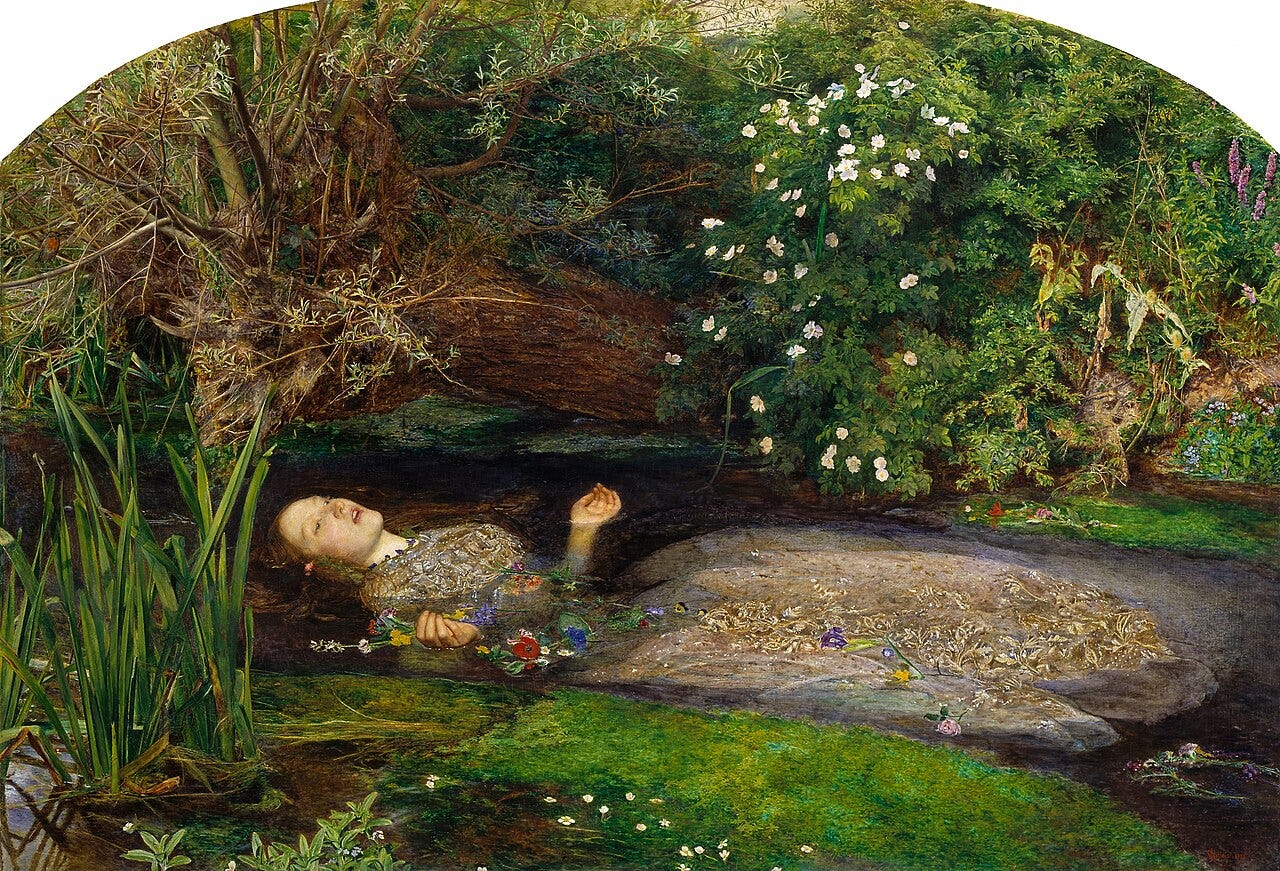
Millais planted every flower Shakespeare names around the drowning Ophelia, plus several he does not. The poppy at her right hand means death, the pansies mean thought, the daisies innocence, the violets faithfulness.
He painted the river in Surrey over five months while a vole swam into the picture and had to be removed. Elizabeth Siddal lay in a bath heated by lamps until the lamps went out and she caught a fever, and her father sent the painter a bill.
7. Charles Allston Collins, Convent Thoughts (1851)
A nun in a walled garden holds a passion flower and stares at it. Every part of that flower was read as a piece of the crucifixion: ten petals for the apostles who did not betray, a crown of thorns in the filaments, three stigmas for the nails.
Collins painted the lilies, the water, the goldfish and the manuscript with Pre Raphaelite exactness. Ruskin defended the picture in public, and said the botany alone was worth the price of admission.
8. Dante Gabriel Rossetti, Beata Beatrix (about 1870)
Rossetti painted this after the death of his wife Elizabeth Siddal, who had taken an overdose of laudanum, which is made from the poppy.
So a red bird drops a white poppy into the hands of a woman with her eyes closed. He called the picture an image of Dante's Beatrice at the moment of her death.
He had buried his poems in Siddal's coffin, and seven years later had her grave opened to get them back. The sundial in the background reads nine, the hour Beatrice died.
9. Edouard Manet, Berthe Morisot with a Bouquet of Violets (1872)
Violets mean modesty in the dictionaries and faithfulness in the songs, and a bunch of them is pinned at Berthe Morisot's breast while she looks straight out of the canvas in black.
Manet painted her eleven times, more than any other model, and afterwards painted the violets alone with a folded note addressed to her and gave her that small canvas too.
She married his brother Eugene two years later, in 1874. He never showed her portrait for sale, and I look at all eleven pictures elsewhere.
10. Henri Fantin Latour, Roses (about 1885)
In the dictionaries the rose is love, and the white rose is love that keeps its silence, which is the flower Fantin Latour painted more than any other, in a plain jug against a brown wall, for thirty years.
He sold most of them in England, where the painter Edwin Edwards acted as his agent, and became better known in London than in Paris.
A centifolia rose has carried his name since about 1900, given because it looked like the ones he painted. He also painted the group portraits of Manet's circle, and preferred the flowers.
11. Vincent van Gogh, Sunflowers (1888)
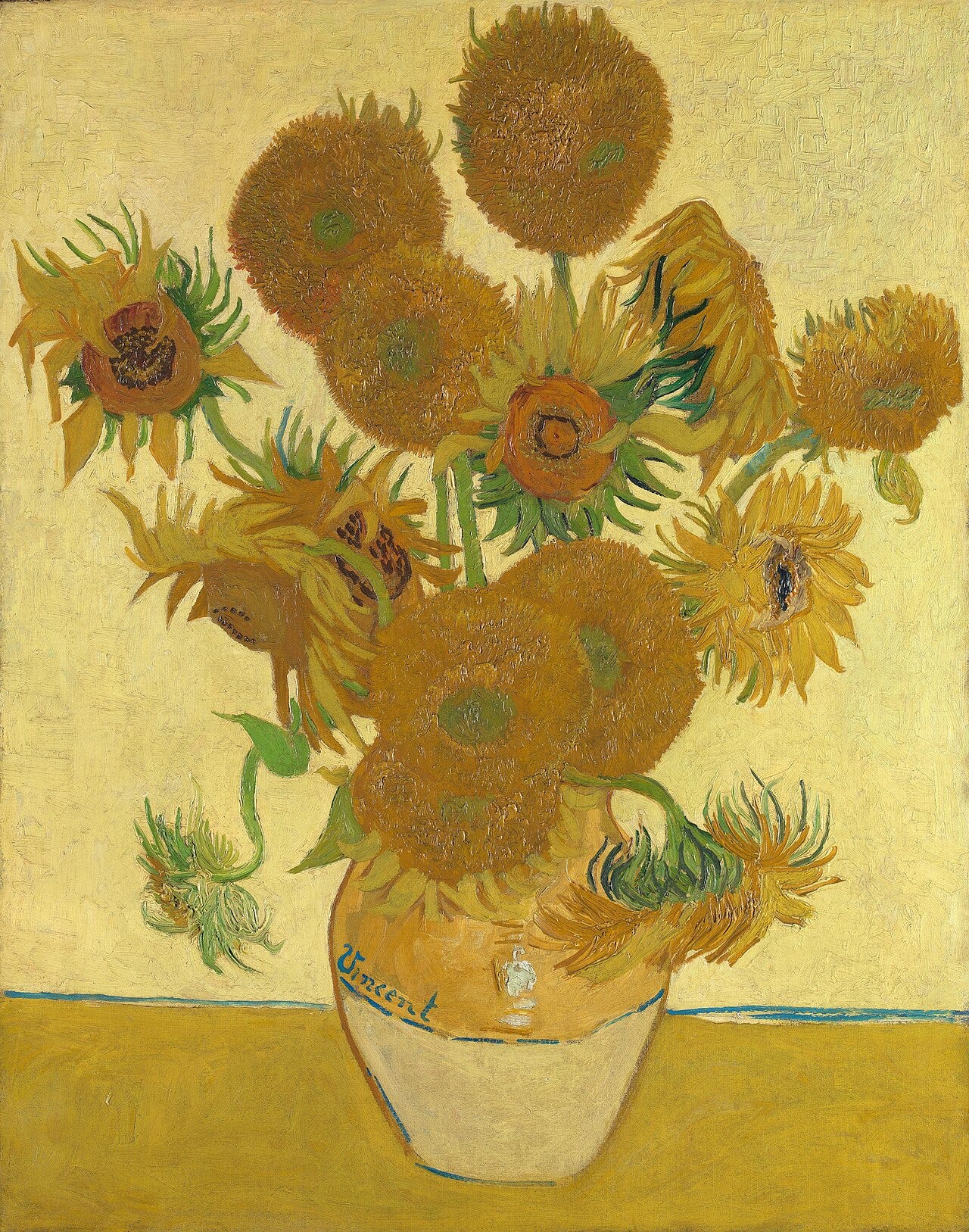
The sunflower stood for devotion in Dutch painting, since it turns to follow the sun, and Van Gogh filled a bedroom with them for Gauguin, who was coming to stay.
Fifteen of them sit in a yellow jug on a yellow table against a yellow wall. He worked at speed because the cut blooms faded within days.
He painted four that August in Arles, two of which hung in Gauguin's room, and Gauguin then painted him painting them. I go into why he chose that flower in more detail elsewhere.
12. Mary Delany, Passiflora laurifolia (1777)
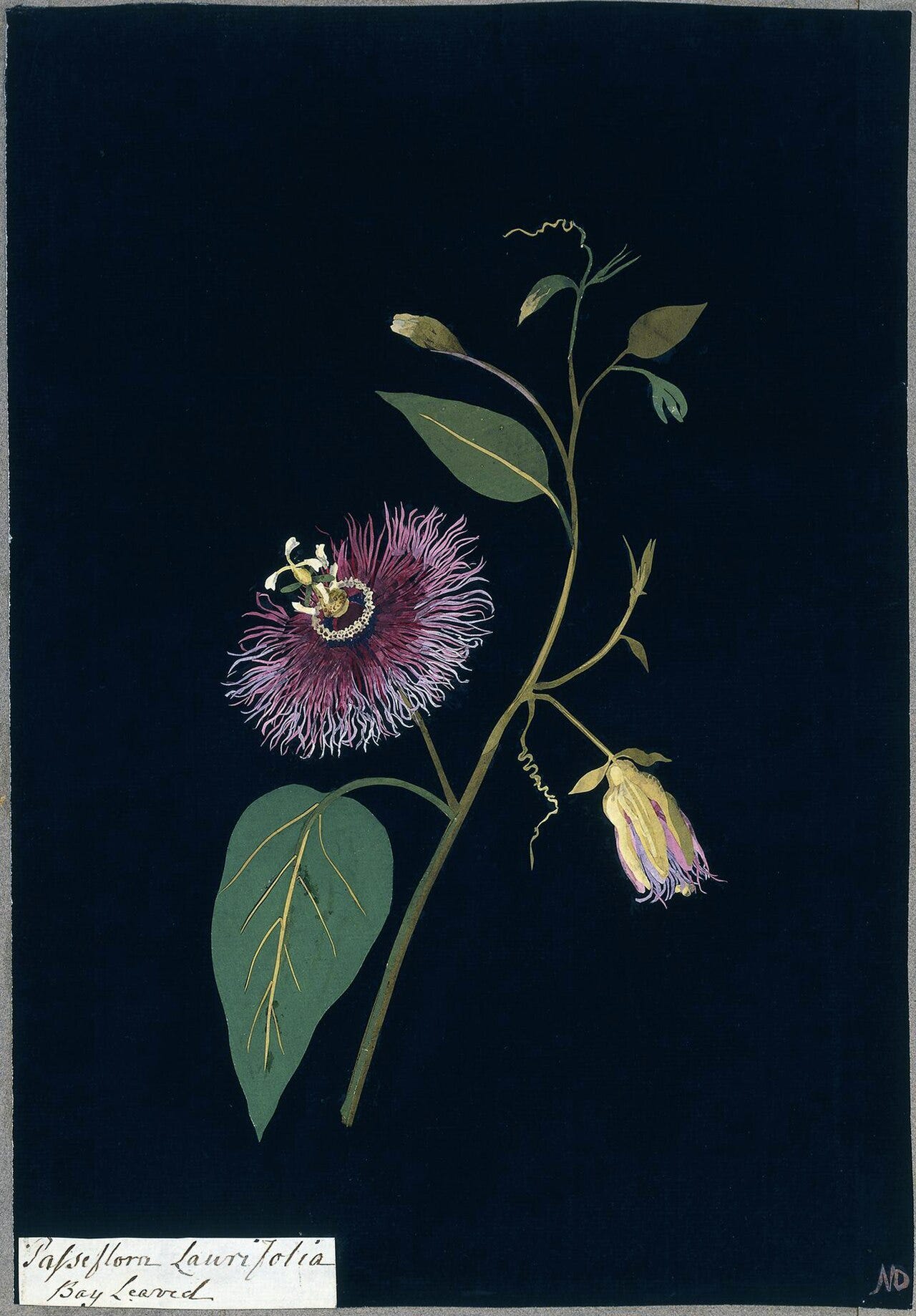
A passion flower, life size, built out of hundreds of pieces of cut paper laid on a black ground. Mary Delany began these at the age of seventy two, after her second husband died, and made close to a thousand of them before her eyesight failed.
Joseph Banks, the botanist who sailed with Cook, said he could describe a plant from her collages without seeing the plant. They are held in the British Museum.
The passion flower she chose is the same one the nun holds in Convent Thoughts, and she cut its ten petals by hand.
Reading the flowers, in brief
What is the language of flowers? A code, popular in the nineteenth century, in which each flower carries a meaning. Painters had used a version of it since the middle ages.
What does a lily mean in a painting? Purity. A white lily in an Annunciation belongs to the angel Gabriel and to the Virgin.
What does a poppy mean? Sleep, and by extension death. Rossetti used it for a wife who died of laudanum.
What do violets mean? Modesty and faithfulness. Manet painted a bunch of them for Berthe Morisot.
Did the Victorians agree on the meanings? No. Rival dictionaries gave the same flower different meanings, so a bouquet could easily be misread.
If these flowers pulled you in, you will love these too:
Titian, Sacred and Profane Love, which of the two women is which
The Last Supper, detail by detail, the detail hiding at that table
Six women, one monster, what Picasso did to the women who loved him
What the bouquet was really saying
Every flower in these pictures was chosen, and most viewers no longer own the dictionary. That is why a nun holding a passion flower now reads as a nun holding a pretty flower.
The code has faded, though its market value has not. In March 1987 one of Van Gogh's Sunflowers sold in London for just under twenty five million pounds, roughly three times the previous record for any painting at auction.