The Moon in Art: 12 Famous Paintings of Moonlight
The moon has haunted painters for as long as they have looked up, a cold lamp that can mean love, madness, death or pure calm depending on who is holding the brush.
Long before anyone walked on it, artists made the moon a mirror for every feeling we could not name. Here are twelve of the most famous paintings of the moon and moonlight, all now in the public domain.
I have gathered the ones that turned a distant pale rock into something to long for.
Three more, if you want them
The ones I would send you to next:
The secret behind Hopper Soir Bleu, the clown picture that went wrong
Six women, one monster, what Picasso did to the women who loved him
The Arnolfini Portrait, detail by detail, the mirror, the dog, and the question everyone asks
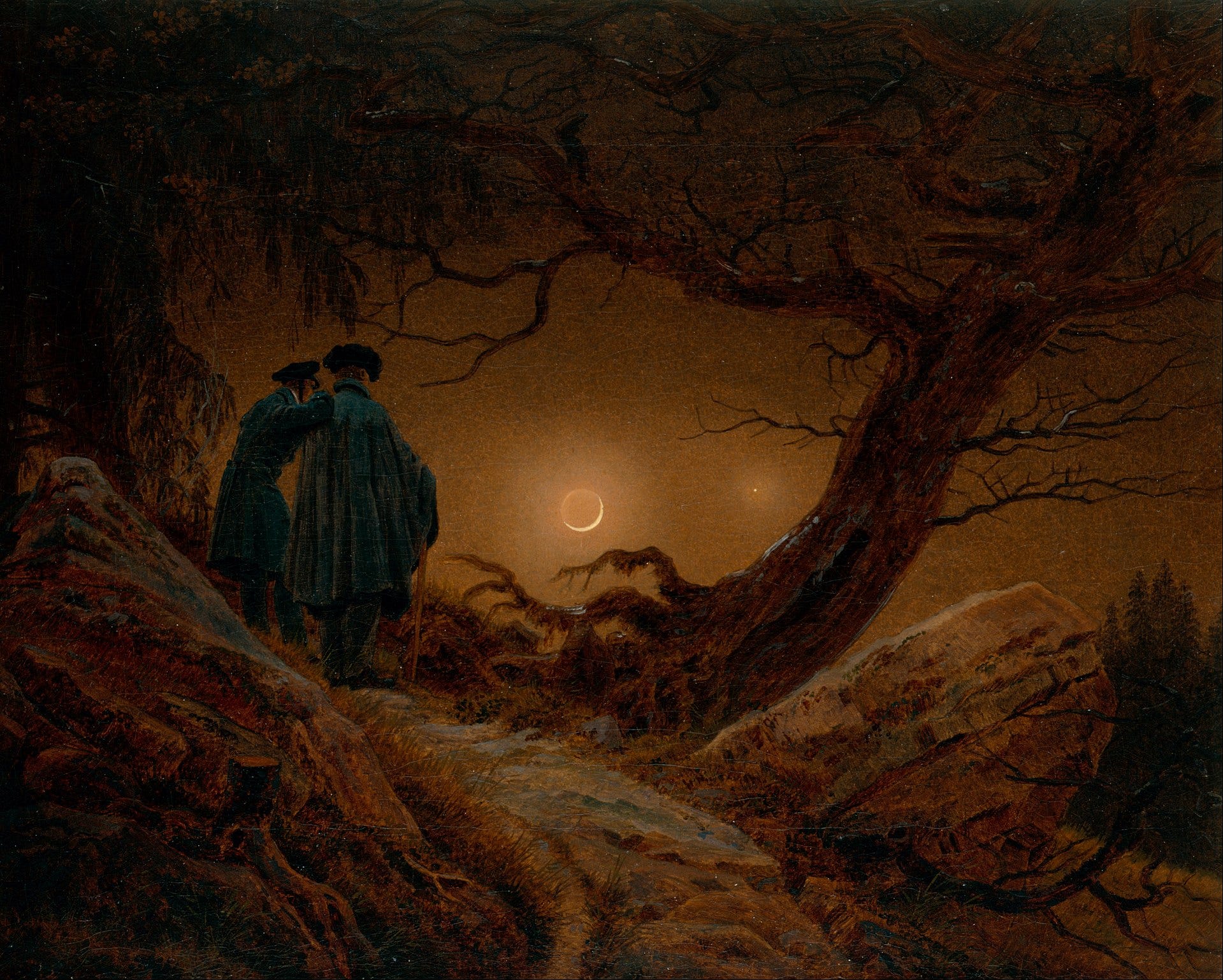
1. Caspar David Friedrich, Moonrise over the Sea (1822)
Three people sit on rocks with their backs to us, watching the moon climb over a calm sea where sailing ships drift home in the dusk. Friedrich, the great German Romantic, painted the moon as a thing to worship, a quiet holy presence in the dark.
The figures are still and small, dwarfed by the huge sky, lost in silent thought. He believed a landscape should stir the soul like a prayer, and the rising moon was his favorite altar.
The picture now hangs in the Nationalgalerie in Berlin, and Friedrich returned to this same image, small figures with their backs turned to a distant moon, again and again across his life.
2. Aert van der Neer, Moonlit Landscape with a Bridge (about 1650)
While the rest of Dutch painting basked in daylight, one man made a whole career out of the moon. Van der Neer painted almost nothing but night, silver clouds parting over frozen canals and quiet villages, the moon doubled in the still water below.
He layered thin glazes to get that cold glow, and nobody in the seventeenth century painted moonlight better. Yet he sold so little that he opened a wine bar to survive, went bankrupt, and died poor.
Today his moonlit rivers hang in the great museums that ignored him in life, a lesson in landscape painting arriving three centuries too late for the man who made it.
3. Anne Louis Girodet, The Sleep of Endymion (1791)
A beautiful youth lies asleep in a forest while a shaft of moonlight slips through the leaves to caress his bare skin. The light is really the goddess of the moon herself, Selene, who fell in love with the shepherd Endymion and visited him each night as he slept forever young.
Girodet, a pupil of the great David, let the moonbeam do the touching, a sly erotic trick that scandalized and thrilled Paris in 1791. A small winged spirit parts the branches to let her light through.
It made the young painter famous overnight, an entire love scene lit by nothing but the moon.
4. J.M.W. Turner, Keelmen Heaving in Coals by Moonlight (1835)
Turner set a full moon over a busy coal port on the river Tyne, its cold light fighting the orange fire of the workers' torches through the night.
Where other painters used the moon for calm, Turner used it for labor, showing men loading coal barges in the small hours by two kinds of light at once.
The moon lays a silver path across the water while flames and smoke boil below. He was fascinated by the new industrial world and its strange new glows.
The picture hangs in Washington, a rare moment where the moon shares the sky with the smoke of the coming machine age.
5. Utagawa Hiroshige, Moon Pine, Ueno (1857)
A single pine tree has been trained into a near perfect circle, and through that loop you glimpse a distant temple and the pale evening sky.
Hiroshige, one of the last masters of the Japanese woodblock print, named it the Moon Pine, turning a living tree into the shape of the thing it framed.
Van Gogh loved his prints so much he copied one of them in oil. The looping branch really grew in a Tokyo park until it died, and the city grafted a new one back into a circle in 2012 to match the picture.
Few artists ever made a bare tree carry the whole idea of the moon.
6. Tsukioka Yoshitoshi, One Hundred Aspects of the Moon (about 1887)
In his final years a dying, half mad genius made the greatest series of moon prints ever cut. Yoshitoshi drew one hundred scenes, each tied to the moon and pulled from Japanese and Chinese legend, history and ghost story.
A warrior stares at the moon before battle, a fox spirit dances under it, a court lady weeps in its light. He was the last true master of the Japanese print before photography swept the old art away, and he fought poverty and mental illness to finish the set.
The prints sold out the mornings they appeared, buyers lining up before dawn, and Yoshitoshi died soon after completing them in 1892.
7. Vincent van Gogh, The Starry Night (1889)
The most famous night sky ever painted has a fat orange moon blazing in its top right corner, nearly as bright as the sun. Van Gogh made it from memory at an asylum in the south of France in June 1889, and I dig into why in the story of The Starry Night He once said the night was more alive and richly colored than the day, and here he swelled the moon into a swirling ball of light.
The eleven stars, the moon and the dark cypress all churn as if the sky itself were breathing. He thought the canvas a failure, yet it is now among the most reproduced images on earth.
8. Ralph Albert Blakelock, Moonlight (about 1885)
An American painter built haunting moonlit forests from thick, dark paint, then lost his mind while other people grew rich selling fakes of his work.
Blakelock scraped and layered his surfaces for years, hiding a small moon behind black lacy trees until it glowed like an ember. He sold his pictures cheap to feed nine children, suffered a breakdown, and spent his last years in an asylum.
While he was locked away his real paintings soared in value, and forgers flooded the market with copies. He died in 1919, just as museums finally began to hang his moonlit trees as serious art.
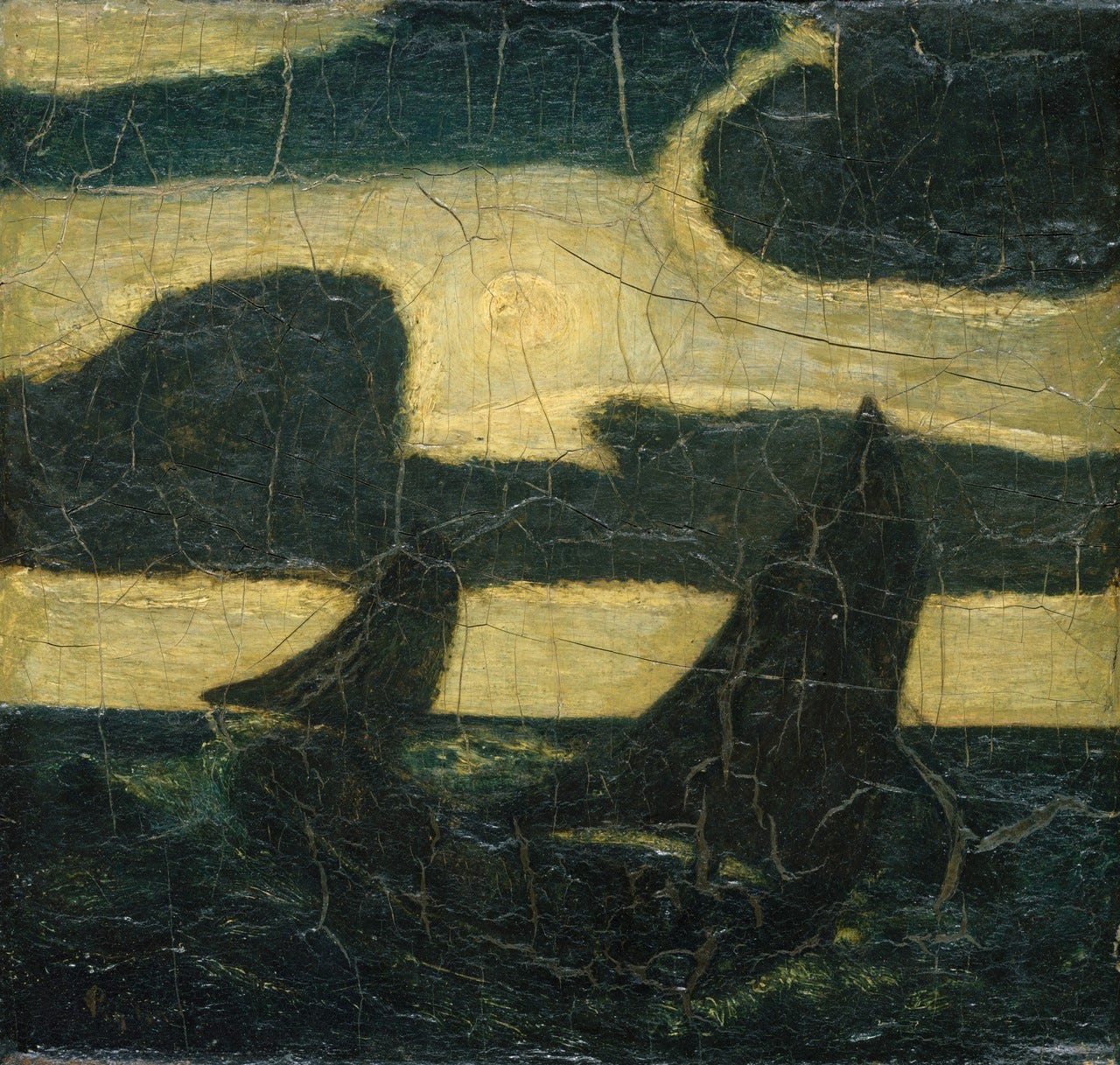
9. Albert Pinkham Ryder, The Toilers of the Sea (about 1884)
A small boat rides a heaving sea under a moon half hidden by racing cloud, painted so plainly it looks almost abstract. Ryder was a recluse who reworked the same small pictures for a decade, piling on paint and varnish until the surfaces cracked like dry mud.
He cared only for mood, boiling a scene down to a boat, a wave and the moon. Many of his paintings have darkened or fallen apart because of his strange methods, so what survives is rare and precious.
Jackson Pollock later called Ryder the only American painter who mattered to him.
10. Jean Francois Millet, The Sheepfold Moonlight (about 1860)
A lone shepherd pens his flock under a wide evening sky as the moon rises over the flat fields of northern France. Millet, famous for painting the hard lives of peasants, set this quiet moment at the end of a working day, the sheep pouring into their fold like a pale river.
There is no drama here, only tiredness and the coming night. He painted the countryside as it truly was, poor and beautiful at once, and the moon is a working person's moon.
Van Gogh worshipped Millet and copied his peasant scenes for years.
11. Arkhip Kuindzhi, Moonlit Night on the Dnieper (1880)
A single band of pale green light glows on a great river winding through the dark, so bright that visitors in 1880 suspected a hidden lamp behind the canvas.
Kuindzhi, a Russian master of light, showed this one painting alone in a blacked out room, and crowds lined up around the block to watch it shine. He mixed his own secret colors, some of which later dimmed, chasing a glow nobody had caught before.
The novelist Turgenev was spellbound, and a grand duke bought it and carried it off to sea, where the salt air faded it further. Even dimmed, its moonlit river is one of the most famous night skies in Russian art.
12. Edvard Munch, Moonlight (1893)
A woman stands frozen against a pale wall in the blue dark, while the moon lays a thick pale column of light straight down the water behind her.
Munch painted the moon's reflection as a solid bar of light, a shape that runs through many of his night scenes like a signature.
The mood is uneasy, full of longing and dread, the woman caught between desire and fear. He made the picture the same year as The Scream, deep in the Symbolist search for the feeling behind a scene.
He came back to that column of moonlight for the rest of his life, and Moonlight belongs to the same great cycle of love and dread he called the Frieze of Life.
The moon in painting, common questions
Who painted the most famous moon? Van Gogh's The Starry Night has the most famous moon in all of art.
What does the moon symbolize in art? Depending on the picture, love, madness, death, mystery or calm; the Romantics treated it as almost holy.
Who is the moon goddess in art? The Greeks called her Selene and the Romans Diana, often shown visiting the sleeping shepherd Endymion.
Why did so many painters love moonlight? A single cool light lets an artist simplify a whole scene into mood, shape and glow.
Who painted the moon best in Japan? Tsukioka Yoshitoshi, whose One Hundred Aspects of the Moon is the most famous moon series ever made.
If these moonlit scenes pulled you in, you will love these too:
The darker truth about Gauguin, the part of the Tahiti story that never makes the wall label
Vermeer, Woman Holding a Balance, what is actually on those scales
Inside Monet house at Giverny, room by room, including his own bedroom
The light we still reach for
For thousands of years the moon was the one thing in the sky everyone could see and nobody could touch, so painters loaded it with everything they felt.
Then in 1969 people walked on it, and the mystery seemed to end. Yet the painted moon has lost none of its pull. We still stop in a gallery in front of a silver disc over dark water, and something old in us leans toward the light.