The Most Beautiful Paintings: 12 That Stop You Cold
The most beautiful paintings are a matter of taste, yet a few keep stopping people cold across the centuries: Botticelli's dancing spring, Klimt's golden kiss, Van Gogh's almond blossom. Here are twelve I would hang on any wall, and why they work.
Beauty is its own thing, separate from fame and from importance. It is the moment a picture makes you go still. These are the ones that do it for me, and the reasons run from pure line to sheer tenderness.
What makes a painting beautiful:
Line. A pure, flowing outline the eye loves to follow, from Botticelli to Mucha.
Color. A chord of tones that simply feels right, gold, rose or deep blue.
Light. The way a picture seems to glow from inside, not merely show a scene.
Tenderness. A moment of love or calm that softens you without your knowing why.
If you like knowing what nobody mentions
If this is the kind of art history you want more of:
Ten women artists you need to know, the names the textbooks skipped
The secret behind Monet Magpie, one bird in the snow, and why it matters
Lady with an Ermine, detail by detail, why she is holding that animal
1. Sandro Botticelli, Primavera (about 1480)
Few pictures move like Botticelli's Primavera. Painted around 1480, it gathers Venus, the Three Graces and a flower strewn spring in a dark orange grove, and the whole panel seems to sway to music you cannot quite hear.
The magic is all in the line. Botticelli drew his figures with a long, flowing outline, their feet barely touching the ground, so grace itself seems to drift across the picture.
Botanists have counted close to two hundred plant species in it, each one painted true to life.
2. Raphael, The Sistine Madonna (about 1512)
You already know the bottom of this painting, even if you have never seen the whole. The two dreamy cherubs leaning on a ledge, chins on their hands, come from Raphael's Sistine Madonna of around 1512.
Above them the Virgin walks toward you on clouds, calm and impossibly gentle, holding a child who looks out with a strange, knowing seriousness.
Raphael made beauty look effortless, and for centuries this was the picture other painters measured tenderness against.
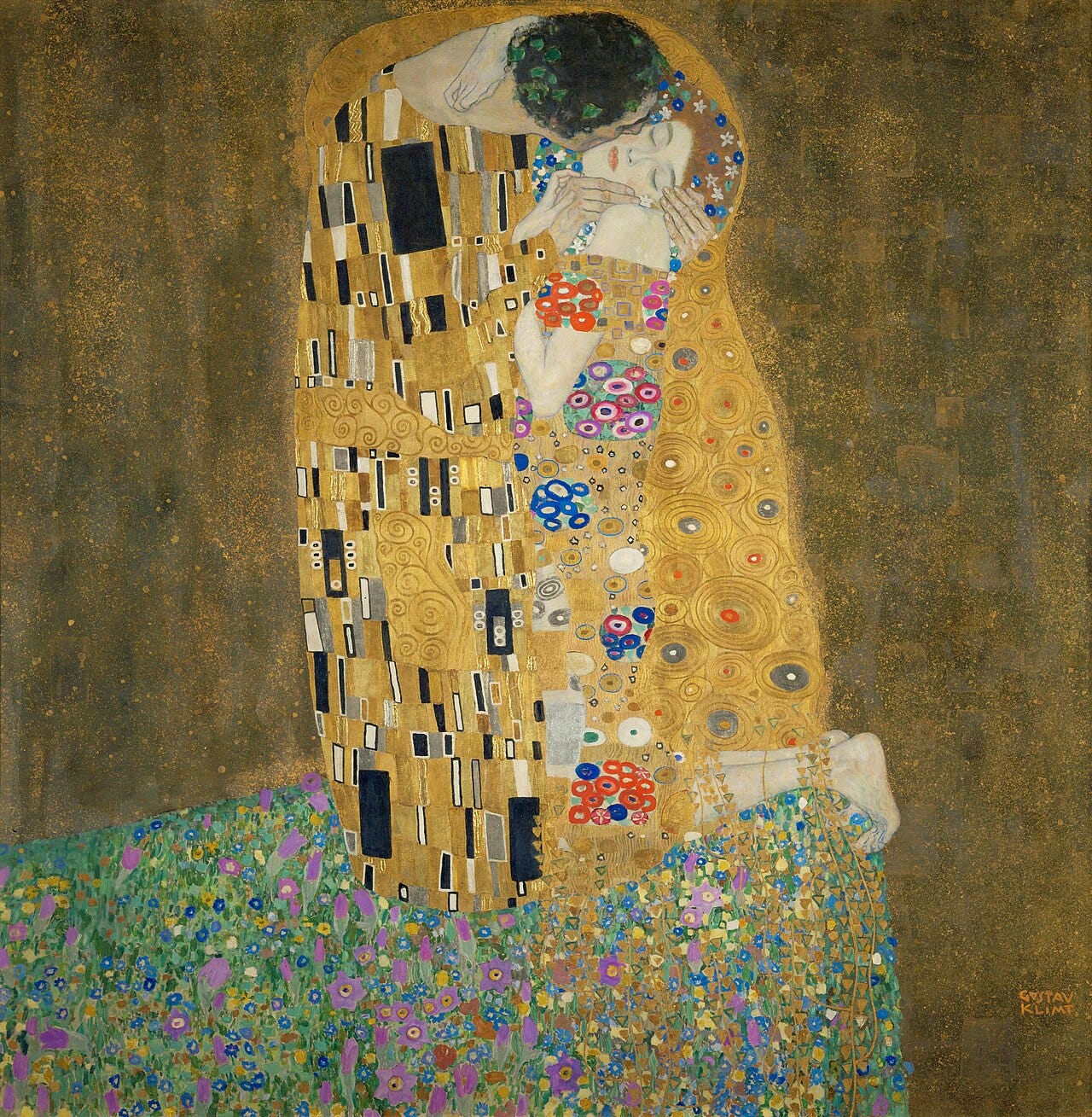
3. Gustav Klimt, The Kiss (1908)
Two lovers kneel wrapped in a single cloak of gold, and the whole world falls away. Gustav Klimt painted The Kiss between 1907 and 1908, at the peak of his golden years, pressing real gold leaf into the surface so it glitters like a mosaic.
Look closely and the man's robe is full of hard black rectangles, the woman's of soft circles and flowers, two patterns melting into one. It is desire turned into pure pattern and light, and it may be the most reproduced image of love ever made.
4. Johannes Vermeer, Girl with a Pearl Earring (about 1665)
She turns, her lips just parted, as if you had said her name. Vermeer painted this girl around 1665, and her quiet beauty comes almost entirely from light, one soft glow on the cheek and one hard spark on the pearl.
There is no story and no setting, only a face against the dark. That emptiness is the trick, since it leaves nothing between you and her.
Despite the films and the novels, she is probably not a real portrait at all but a tronie, an imagined face and costume, so the girl everyone tries to name may never have existed.
5. John William Waterhouse, The Lady of Shalott (1888)
A pale woman drifts down a river toward her own death, and somehow it is heartbreakingly lovely. John William Waterhouse painted The Lady of Shalott in 1888, from Tennyson's poem, all autumn colors and still water.
The sadness is deliberate. Her white dress, loosened hair and the candles guttering in the boat turn a doomed journey into something you want to keep looking at, the Pre Raphaelite love of melancholy made visible.
6. Frederic Leighton, Flaming June (1895)
A woman sleeps curled in a blaze of orange silk, and the color alone almost warms the room. Frederic Leighton painted Flaming June in 1895, and the glowing gown against the blue sea behind her is one of the most satisfying color chords in all of art.
The sleeping pose is a perfect coil, knee up, arm folded, borrowed from classical sculpture. Oddly, the picture fell so far out of fashion that in the early 1960s it changed hands for a pittance, its frame reckoned worth more than the painting, before the world fell for it all over again.
7. Alphonse Mucha, The Seasons (about 1896)
Alphonse Mucha turned advertising into pure decoration. Around 1896 he painted panels like The Seasons, women wrapped in flowers and flowing hair, framed by soft arcs and pale color that feel like stained glass.
His whip like line and gentle palette became the look of a whole era, Art Nouveau, and put beauty on posters, tins and theater walls. Mucha made the everyday world lovelier, and never once apologized for it.
8. Caspar David Friedrich, Chalk Cliffs on Rugen (about 1818)
Three tiny figures peer over a fringe of white chalk cliffs at a sea that glows impossibly blue. Caspar David Friedrich painted Chalk Cliffs on Rugen around 1818, and it works through vertigo, the sheer drop and the calm water far below.
Friedrich made it soon after his honeymoon, and some read the three figures as the painter, his new bride and a friend. Either way, it turns a German cliff into a doorway between the small human world and something vast.
9. Auguste Renoir, Luncheon of the Boating Party (1881)
Everyone in this picture looks like they are having the best afternoon of their lives. Renoir painted Luncheon of the Boating Party in 1881, a riverside lunch full of friends, wine, straw hats and dappled sun.
What holds you is the warmth and the light, the way the whole scene glows with easy happiness. I take it apart figure by figure in Renoir's luncheon, since almost everyone at that table was someone he loved.
10. Vincent van Gogh, Almond Blossom (1890)
Van Gogh painted this one out of pure joy, which was rare for him. In 1890 his brother had a baby boy and named him Vincent, and the painter made Almond Blossom, branches of white flowers against a bright blue sky, as a gift for the cradle.
He borrowed the flat, cropped look from the Japanese prints he loved, an influence called japonisme. It is one of his calmest, happiest pictures, painted for a child, and it hung above the baby's bed.
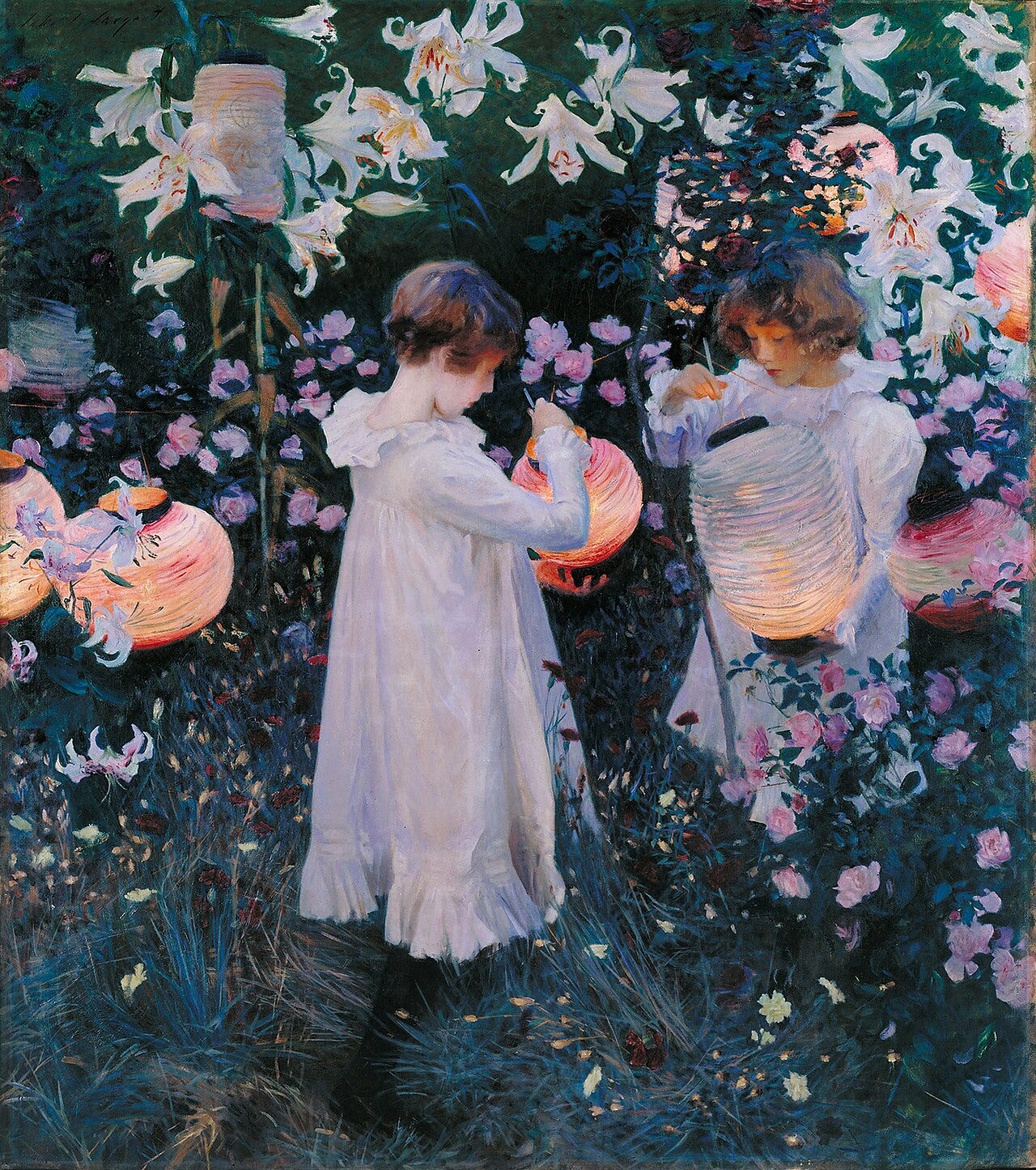
11. John Singer Sargent, Carnation, Lily, Lily, Rose (1885)
Two little girls light paper lanterns in a garden at dusk, and the whole picture seems to hold the last minutes of daylight. John Singer Sargent painted Carnation, Lily, Lily, Rose between 1885 and 1886, working only a few minutes each evening to catch the exact fading glow.
He repainted it night after night through a whole autumn, as the real flowers died and had to be swapped for fakes. The result is one of the most tender images of childhood ever made, and it takes its odd name from a popular song of the day.
12. Mary Cassatt, The Child's Bath (1893)
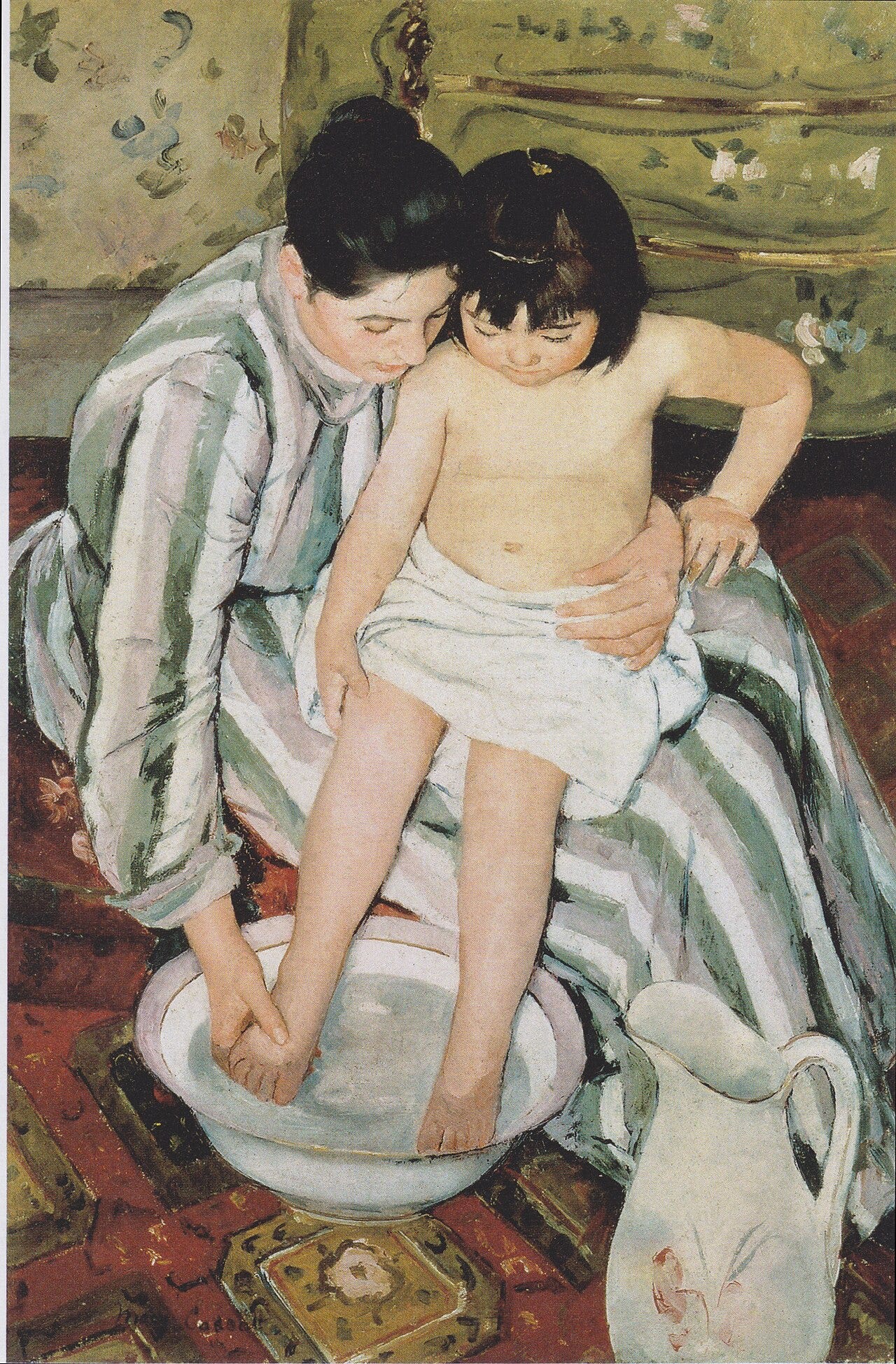
A mother bends to wash her child's feet, and nothing more happens, which is exactly the point. Mary Cassatt painted The Child's Bath in 1893, looking down on the pair from above, their striped and patterned clothes folding softly together.
Cassatt, an American among the Impressionists, made ordinary tenderness her great subject at a time when women were rarely taken seriously as painters, a story I tell in the old masters were women too. Beauty, she reminds us, is often just attention paid to something small and loved.
Go and stand in front of them
Botticelli, Primavera: the Uffizi, Florence.
Raphael, The Sistine Madonna: the Gemaldegalerie, Dresden.
Klimt, The Kiss: the Belvedere, Vienna.
Vermeer, Girl with a Pearl Earring: the Mauritshuis, The Hague.
Leighton, Flaming June: the Museo de Arte de Ponce, Puerto Rico.
Cassatt, The Child's Bath: the Art Institute of Chicago.
If beauty is your reason to look, keep going:
The secret behind Hopper Soir Bleu, the clown picture that went wrong
Titian, Sacred and Profane Love, which of the two women is which
The Last Supper, detail by detail, the detail hiding at that table
Beautiful paintings, a few honest questions
What is the most beautiful painting? It is a matter of taste, but Botticelli's Primavera, Vermeer's Girl with a Pearl Earring and Klimt's The Kiss top many lists.
What makes a painting beautiful? Usually some mix of flowing line, a pleasing chord of color, glowing light, and a feeling of calm or love.
Is beauty the same as being famous? No. Some famous paintings are unsettling or plain, and some of the most beautiful are barely known.
Why do people find Klimt's Kiss so beautiful? The real gold leaf, the tender pose, and the two patterns melting into one make it feel like love turned into light.
Who painted the most beautiful women? Botticelli and Raphael are the classic answers, with Vermeer close behind for sheer quiet glow.
Beauty is the one that makes you stop
Line them up and there is no rule, only a feeling. A golden kiss, a sleeping woman in orange, a branch of almond blossom against blue, a mother washing a small foot.
Some are grand and some are tiny, and that is the point, since beauty is not about size or fame but about the moment a picture makes you go still.
Flaming June was once so unloved that in the early 1960s it sold for a pittance, its frame said to be worth more than the picture.
The museum in Puerto Rico that later bought it now guards the painting like treasure, and people fly across the world just to stand in that orange glow.