
Most of the paintings on this page now hang in famous museums, and some draw crowds every day. Each was once judged unfit to be seen as it was, by a churchman, a mayor, a critic or a family. Several of those quarrels left marks on the picture itself, and they can still be found there.
Cool Stories About Art is a newsletter to learn art the fun way.
Join 200,000+ readers and get:
10 new art stories / month
The entire archive of content (140+ articles)
Comment, ask questions, and chat with other readers
How These Were Chosen
A painting becomes controversial when someone with the power to act decides that it should not be seen, or not seen as it is. Over five centuries that someone has been a churchman, a politician, a critic, a judge or a crowd of ordinary viewers.
Each quarrel here did more than produce a bad review. It reached the picture itself or the way it has been seen since: covered, hidden, seized, moved, repainted, renamed, taken to court, or left on the wall after a demand to take it down.
Side by side, the twelve quarrels keep returning to two charges. The first is a body shown too plainly, without the usual excuses. The second is a picture judged unfinished, or not painted by the hand it claims.
12. Balthus, Thérèse Dreaming (1938)
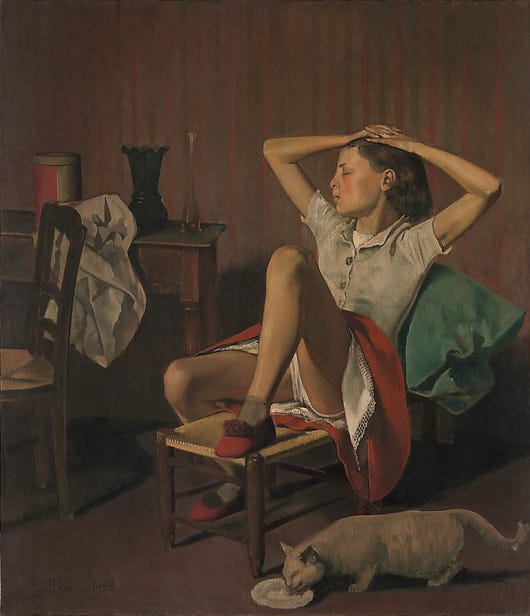
A girl leans back on a low seat, her eyes closed and her hands crossed on top of her head, one knee raised so that her skirt has slid back to show her white underwear. At her feet a cat laps milk from a saucer. The model for Thérèse Dreaming, painted in Paris in 1938, was Thérèse Blanchard, a neighbor of Balthus then about twelve or thirteen years old.
The picture had hung at the Metropolitan Museum of Art in New York since 1998. What changed in 2017 was the climate around it. In October the #MeToo movement spread online, and on 30 November a New York resident named Mia Merrill started a petition on the website Care2, asking the museum to remove "Balthus's Suggestive Painting of a Pubescent Girl."
Her case was that "it can be strongly argued that this painting romanticizes the sexualization of a child," and she tied it to "the current climate around sexual assault." Within five days, more than 8,700 people had signed.
Merrill was not asking for the painting to be destroyed, though. She did not want it "censored, destroyed or never seen again," she wrote. She wanted it taken down, or given a label warning that some viewers find it offensive or disturbing, and she suggested hanging a work by a woman artist of the same period in its place.
The museum said no. In early December 2017 it left Thérèse Dreaming on the wall with its label unchanged, and Kenneth Weine, its chief communications officer, said that "moments such as this provide an opportunity for conversation."
Part of the unease comes from the cat. Balthus gives the scene a single witness, and that witness is busy with its milk, head down in the saucer, which leaves the viewer as the only one looking at the girl.
At a Glance
Artist: Balthus, born Balthasar Klossowski de Rola (1908 to 2001)
Painted: 1938
Medium: Oil on canvas
Size: 149.9 × 129.5 cm (59 × 51 in)
Where to see it: The Metropolitan Museum of Art, New York
11. Leonardo da Vinci (attributed), Salvator Mundi (c. 1500)
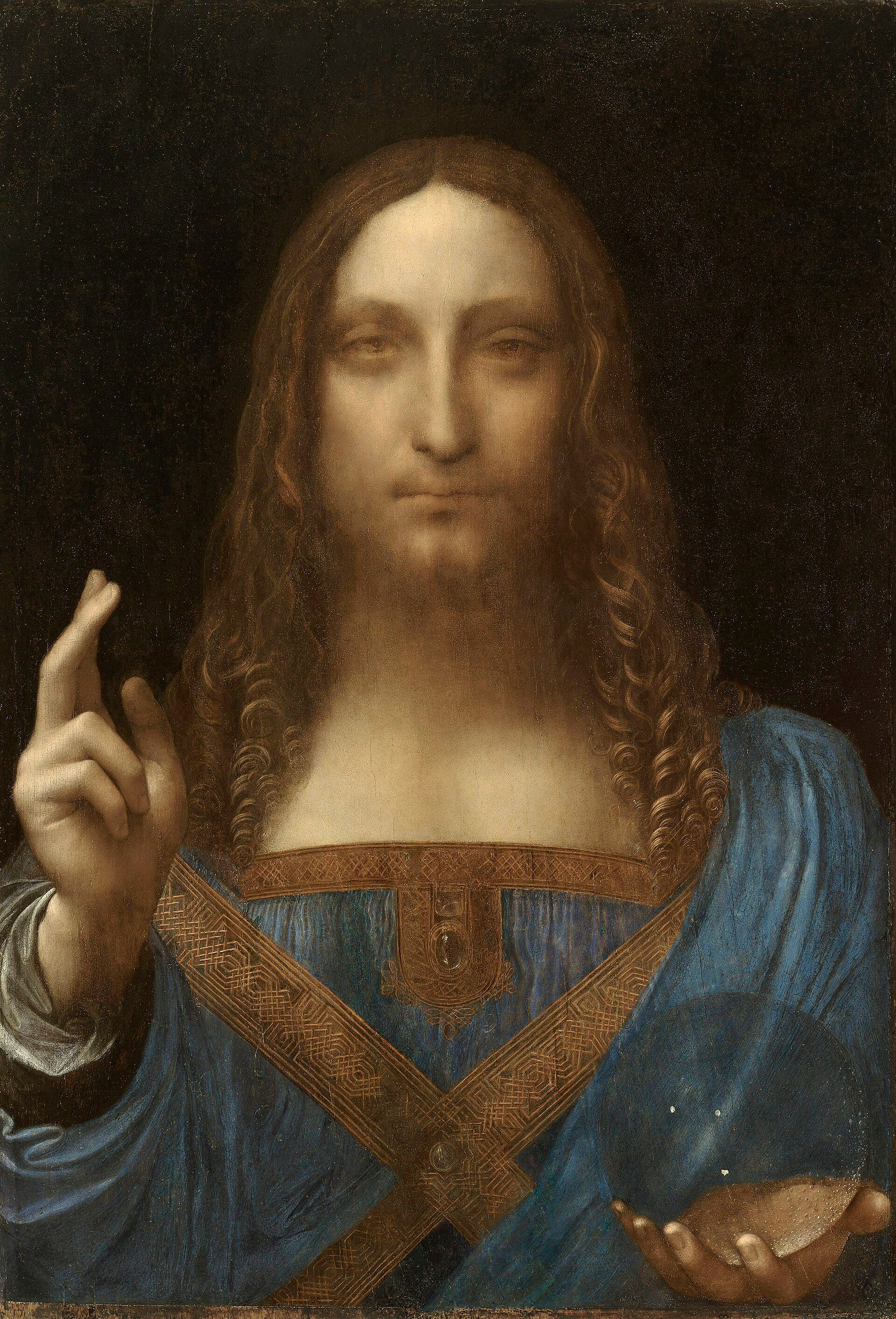
Christ faces straight out of the panel in a blue robe, his right hand raised in blessing, his left holding a clear crystal orb. The painting is Salvator Mundi, Latin for Savior of the World, attributed to Leonardo da Vinci and dated by Christie's to about 1500.
On 15 November 2017, in New York, Christie's sold it for $450,312,500 after nineteen minutes of bidding, more than any work of art had ever fetched at auction. The buyers were paying for a name, and that name had been attached to the panel only a few years before.