
The most expensive painting ever sold is Salvator Mundi, a panel of Christ attributed to Leonardo da Vinci. It brought 450.3 million dollars on November 15, 2017, at an auction held by Christie's in New York.
It heads twelve paintings that each brought more than 175 million dollars. Only five of them sold at public auction, and one, the Leonardo itself, had changed hands in 2005 for less than the price of a used car.

Leonardo da Vinci (attributed), Salvator Mundi, about 1500, sold in 2017 for 450.3 million dollars
Cool Stories About Art is a newsletter to learn art the fun way.
Join 200,000+ readers and get:
10 new art stories / month
The entire archive of content (140+ articles)
Comment, ask questions, and chat with other readers
Paintings change hands at these prices in one of two ways. The first is a public auction, run by firms such as Christie's and Sotheby's, the two rival houses at the top of the art market. Bidders raise the price in turn until no one goes higher, and the auctioneer brings down a small hammer to close the sale.
That last bid is called the hammer price. The buyer then pays the auction house a fee on top of it, and the total, announced the same evening, is the figure the newspapers report.
A private sale works the other way. A dealer or an auction house quietly brings a seller and a buyer together, and nothing is announced. The real figure surfaces later, if ever, in a newspaper, a courtroom or a national budget, and seven of the twelve prices on this list came out that way.
Read in order, the twelve sales also bring back the same few names: a Russian billionaire living in Monaco, a Swiss dealer, a Chicago financier, a New York dealer and the royal family of Qatar.
Because the figures come from such different places, the list ranks every painting by one number, the total the buyer paid, fees included. Prices in euros are converted at the rate of the day the sale was announced, and when two paintings were sold in a single deal, each counts with its own reported price.
12. Pablo Picasso, Women of Algiers (Version O), 1955: 179.4 million dollars
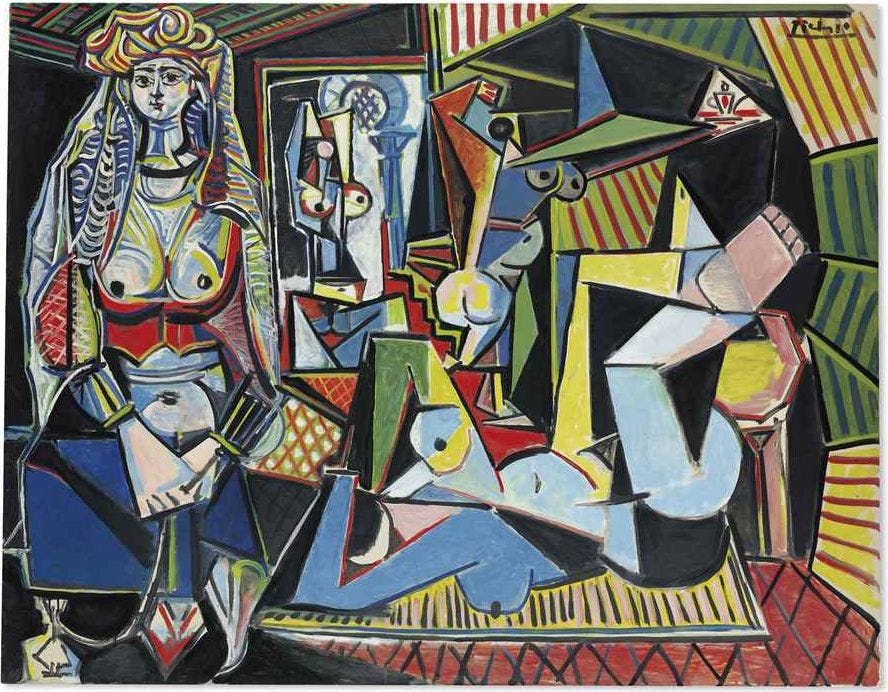
Pablo Picasso, Women of Algiers (Version O), 1955, private collection. Low resolution image, used for commentary.
At the center of Pablo Picasso's Women of Algiers (Version O), a reclining woman is broken into hard, angular planes of red and blue, as if her body had been cut apart and put back together. Other women of the same household fill the crowded room around her. In 2015 the canvas sold for 179,365,000 dollars, fees included.
The picture grew out of a rival's death. Five weeks after Henri Matisse died, Picasso began reworking Women of Algiers, a scene of Algerian women at home that the French painter Eugène Delacroix had painted in 1834.
In the weeks that followed he painted fifteen versions of it, lettered from A to O. He finished the last one, Version O, in Paris on February 14, 1955.
At first Version O was not even sold alone. In June 1956 the New York collectors Victor and Sally Ganz bought all fifteen canvases together from Daniel-Henry Kahnweiler, Picasso's dealer in Paris, for 80 million francs, about 212,500 dollars at the time. They later resold ten and kept five, Version O among them.
Four decades later, in November 1997, the Ganz heirs sold their collection at Christie's. Version O, estimated at 10 to 12 million dollars, went for 31.9 million.
Eighteen years later, in May 2015, Christie's put it up again. This time the estimate was about 140 million, and bidding opened just below 100 million. After about eleven minutes the hammer fell at 160 million. With the fee, Version O became the most expensive artwork sold at auction up to that day.
The buyer stayed anonymous. Press reports later named Sheikh Hamad bin Jassim Al Thani, a former prime minister of Qatar, a claim that has never been confirmed.
At a Glance
Artist: Pablo Picasso (1881 to 1973)
Painted: 1955
Medium: Oil on canvas
Size: 114 × 146.4 cm (44.9 × 57.6 in)
Where to see it: Private collection, location not public
11. Jackson Pollock, Number 7A, 1948: 181.2 million dollars

Jackson Pollock, Number 7A, 1948, private collection. Low resolution image, used for commentary.
Black lines loop and tangle across Jackson Pollock's Number 7A, a long, low strip of canvas almost 11 feet wide. Pools of black, thin trickles and a few flashes of red run from one end to the other, with no single spot where the eye comes to rest.
Pollock made it in 1948 in his barn studio on Long Island, with the canvas laid flat on the floor while he poured and dripped paint onto it from above. He left the fabric unprimed, without the white undercoat painters usually lay down first, so the paint sank straight into it.
In May 2026 Number 7A came up for sale at Christie's. It had not been seen in public for almost fifty years, and the auction house would not even print an estimate.