
The most stolen paintings in history, from the Mona Lisa and The Scream to Vermeer's The Concert, have spent years in wall cavities, car trunks and ransom letters.
Some came back by pure chance, a few yards from where they were taken. Others, The Concert among them, have never been seen again.

How These Were Chosen
A stolen masterpiece is strange loot. No auction house, dealer or serious collector will touch it, so thieves put it to other uses: as a ransom demanded from an owner or an insurer, as currency in the underworld, or as a secret kept for years.
Each of the twelve pictures here was taken more than once or stayed out of its owners' hands for years. A theft solved within a few days was left out, however spectacular, because its story ended almost as soon as it began.
The list opens with a theft carried out by a government, with paperwork instead of a ladder. In Vienna, the Nazi regime simply confiscated a portrait by Gustav Klimt, and it took the sitter's family more than sixty years to get it back.
Cool Stories About Art is a newsletter to learn art the fun way.
Join 200,000+ readers and get:
10 new art stories / month
The entire archive of content (140+ articles)
Comment, ask questions, and chat with other readers
12. Gustav Klimt, Portrait of Adele Bloch-Bauer I, known as "Woman in Gold" (1907)
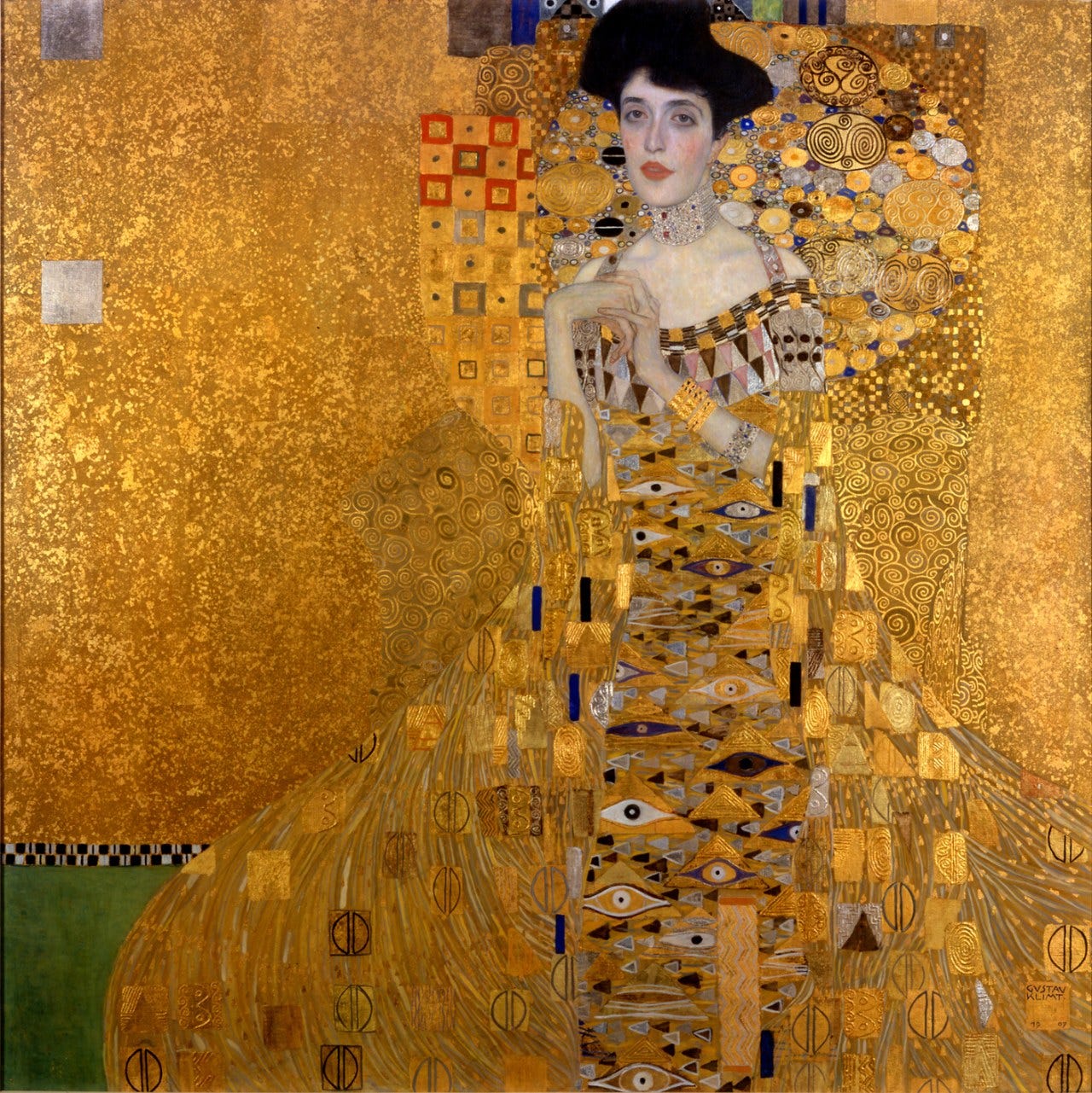
That portrait is Portrait of Adele Bloch-Bauer I, a square canvas by Gustav Klimt in which gold leaf covers nearly everything except the face of the woman it shows. Her dress, her chair and the wall behind her all dissolve into the same glittering gold.
The sitter was Adele Bloch-Bauer, the wife of Ferdinand Bloch-Bauer, a Jewish banker and sugar industrialist in Vienna. Ferdinand paid for the portrait, and Klimt spent four years on it, from 1903 to 1907.
Adele died in February 1925. In her will, written in 1923, she asked her husband to leave her portraits by Klimt to the Austrian state gallery after his own death, and until then the painting stayed in Ferdinand's home.
His death did not come first. In March 1938, Nazi Germany annexed Austria, and Ferdinand, as a Jew, fled Vienna. The new regime falsely accused him of tax evasion, froze everything he owned and put a Nazi lawyer, Friedrich Führer, in charge of his confiscated property.
In December 1941, Führer handed the portrait to the Belvedere, the state gallery in Vienna, and used Adele's will as his excuse. The gallery hung it as Dame in Gold, German for Lady in Gold, a title that left out the Jewish family name of its sitter.
Ferdinand died in exile in Switzerland soon after the war and left everything to his nephews and nieces. One of them, Maria Altmann, had escaped to the United States and settled in Los Angeles, and decades later she set out to get the portrait back.
Suing in Austria was out of reach. Court fees there were calculated on the painting's value and would have cost her more than $1.5 million, so in 2000 she sued Austria in an American court instead, and in 2004 the US Supreme Court ruled that the case could go ahead.
Both sides then agreed to let three Austrian arbitrators, private judges, settle the matter. On January 16, 2006, they ruled in Altmann's favor, and after 64 years in a state gallery the portrait went back to the family it had been taken from.
At a Glance
Artist: Gustav Klimt (1862 to 1918)
Painted: 1903 to 1907
Medium: Oil and gold leaf on canvas
Size: 140 × 140 cm (55 × 55 in)
Where to see it: Neue Galerie, New York
11. Paul Cézanne, The Boy in the Red Vest (1888 to 1890)
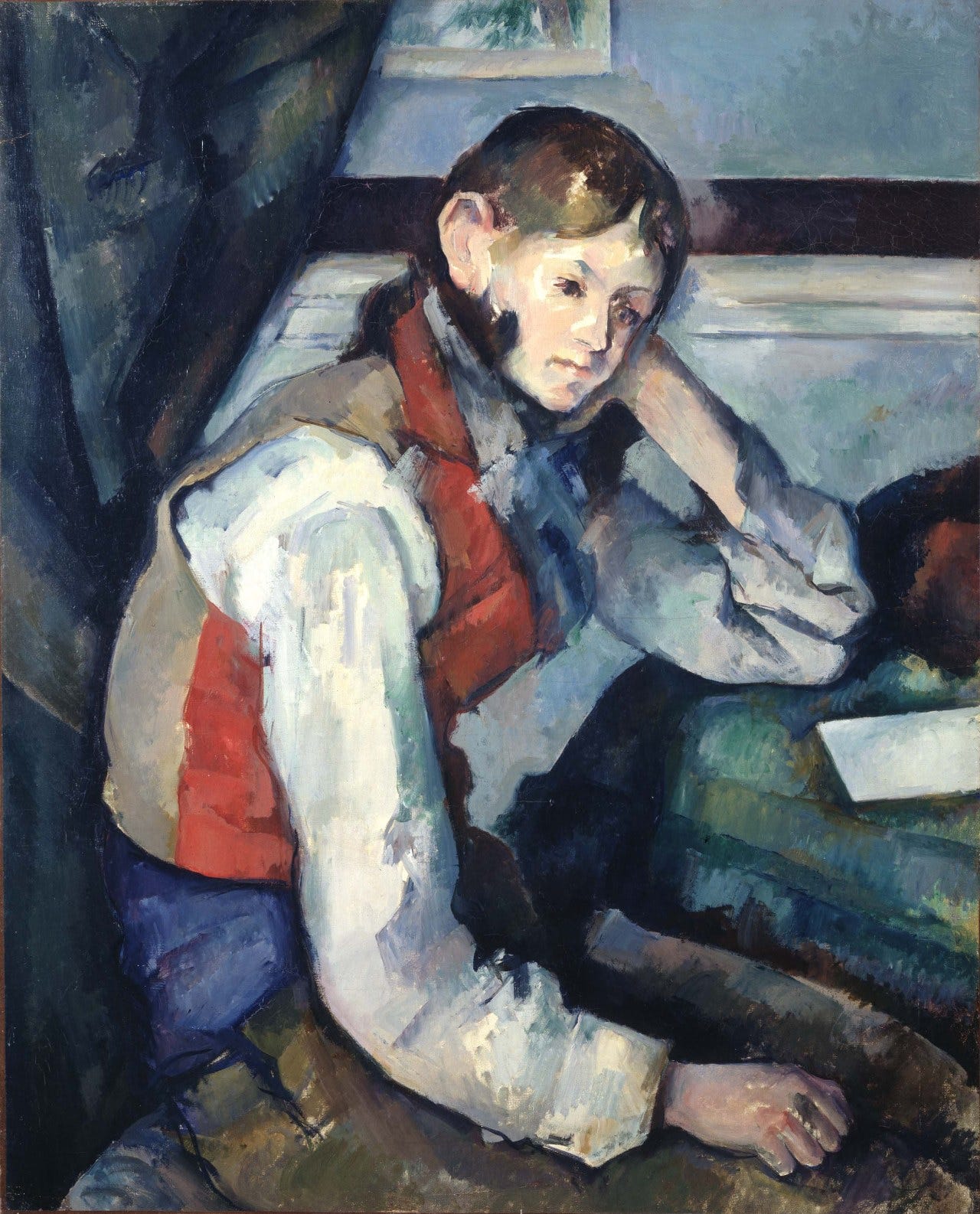
Elbow on the table, head resting on his hand, a young man in a bright red waistcoat fills The Boy in the Red Vest. Paul Cézanne painted the same model four times between 1888 and 1890.
This version belongs to the E.G. Bührle Foundation, the collection of a Zurich industrialist, which is now shown at the Kunsthaus Zürich, the city's art museum. In 2008, though, The Boy in the Red Vest hung in the foundation's own small museum, and on a Sunday afternoon that February, three masked men walked in, one of them carrying a pistol.