
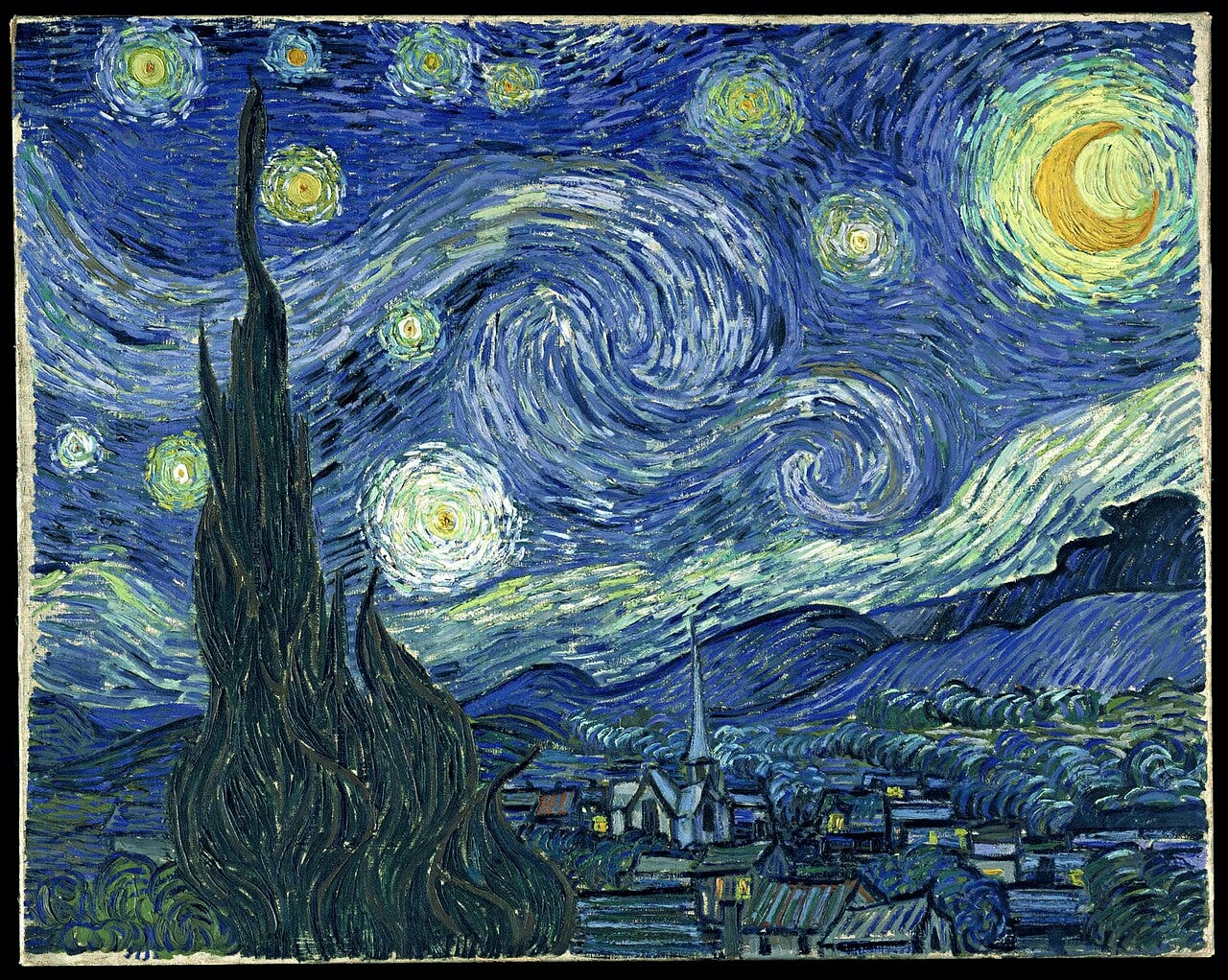
Almost every famous painted night sky is astronomically wrong, and deliberately so. Van Gogh’s Starry Night has eleven stars where the constellation has seven, Munch painted a sky red from a volcano he never saw, and the star of Bethlehem in one fresco is a comet Giotto had watched two years earlier.
Learn art the fun way
1 | The Starry Night, Vincent van Gogh (1889)
Painted from the asylum at Saint Remy, from a window that did not have that view, with a village added that is not there. The swirls are invention, not observation.
More in why Van Gogh painted The Starry Night. More on him in Vincent van Gogh.
The sky he painted that year is tied to the last months of his life, which I retrace in the last day of Vincent van Gogh.
2 | Starry Night Over the Rhone, Vincent van Gogh (1888)
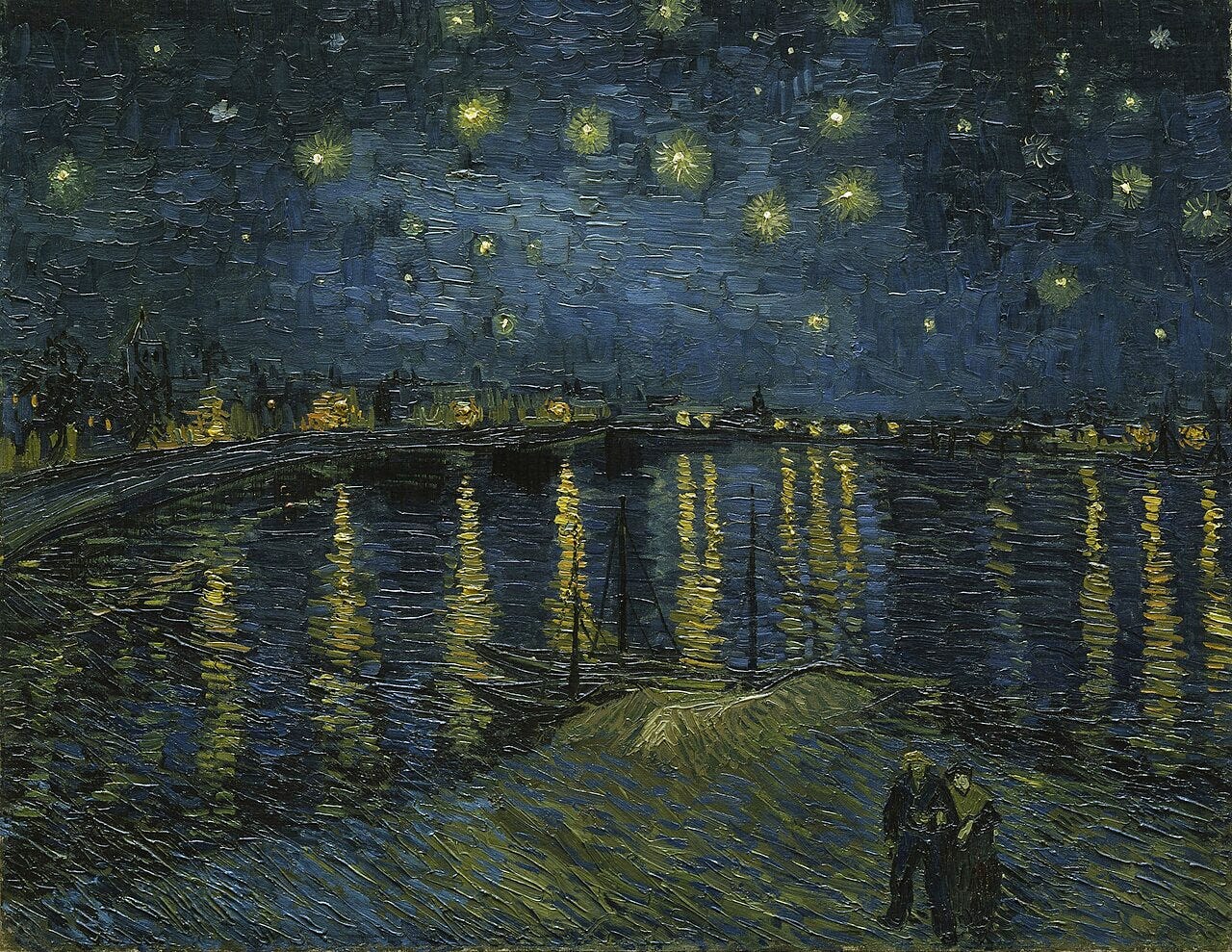
The earlier and more accurate one. He painted it at night on the quay in Arles, and the Great Bear sits about where it should, over gas lamps reflected in the water.
He wrote to his brother that the sky was greenish blue and the stars had colour.
3 | The Adoration of the Magi, Giotto (around 1305)
The star over the stable is painted as a comet with a tail. Giotto had watched Halley’s Comet in 1301, and he put what he saw into the Nativity.
The European probe sent to that comet in 1986 was named Giotto. More on him in Giotto.
4 | The Scream, Edvard Munch (1893)
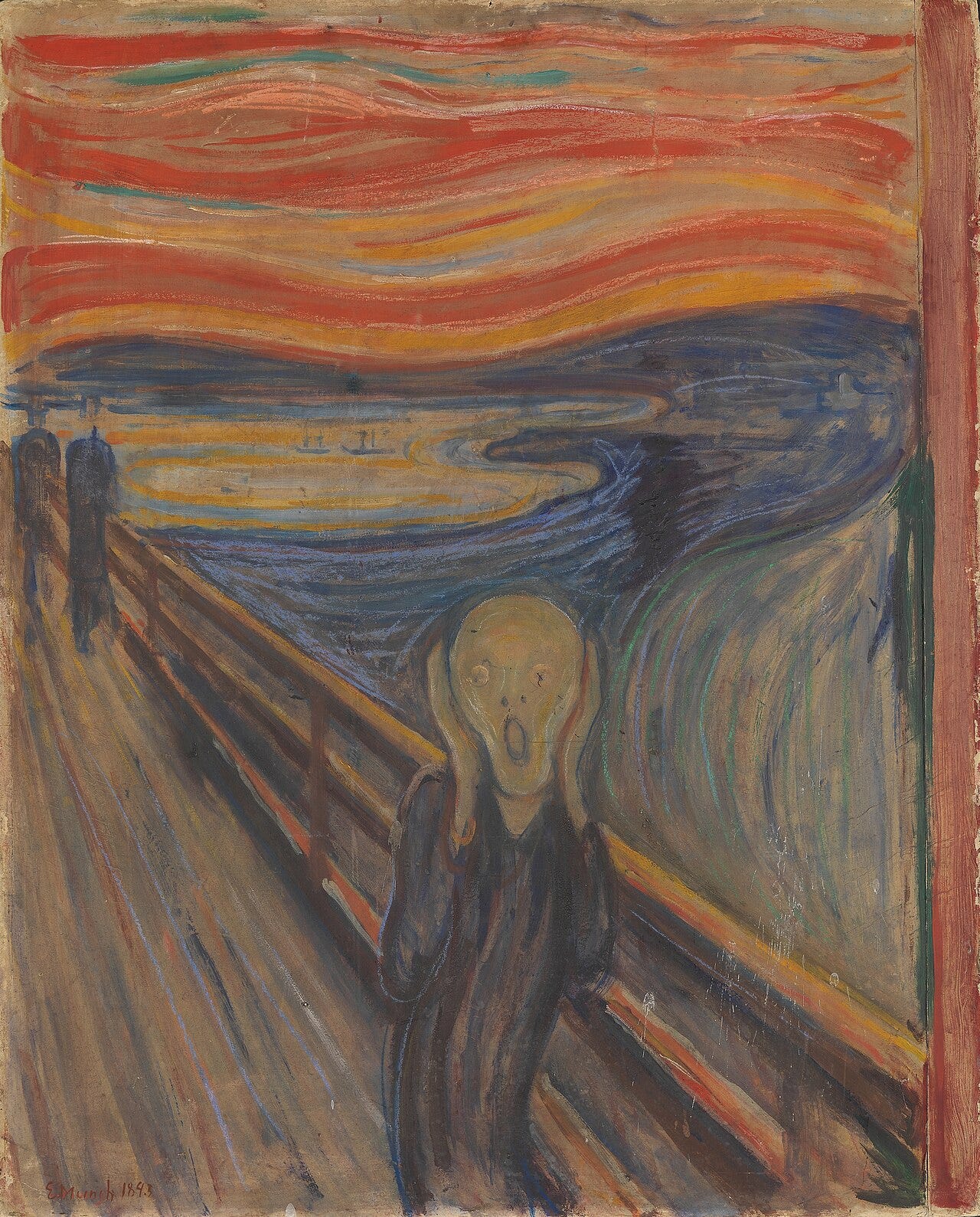
Munch wrote of a sky that turned blood red over the fjord. The usual explanation is the ash from Krakatoa, which coloured skies across Europe in 1883 and 1884.
More on him in Edvard Munch.
Krakatoa erupted in August 1883 and the ash produced red sunsets across Europe for months. Norwegian newspapers reported them, and Munch wrote of walking with two friends when the sky turned blood red.
5 | The Old Sacristy ceiling, Florence (around 1442)
A blue dome with the night sky painted as it stood over Florence on one specific date. Astronomers have proposed July 1442, and the same sky appears in the Pazzi Chapel.
It is one of the earliest datable star charts in Western art, painted in fresco on a dome.
6 | The Milky Way in myth
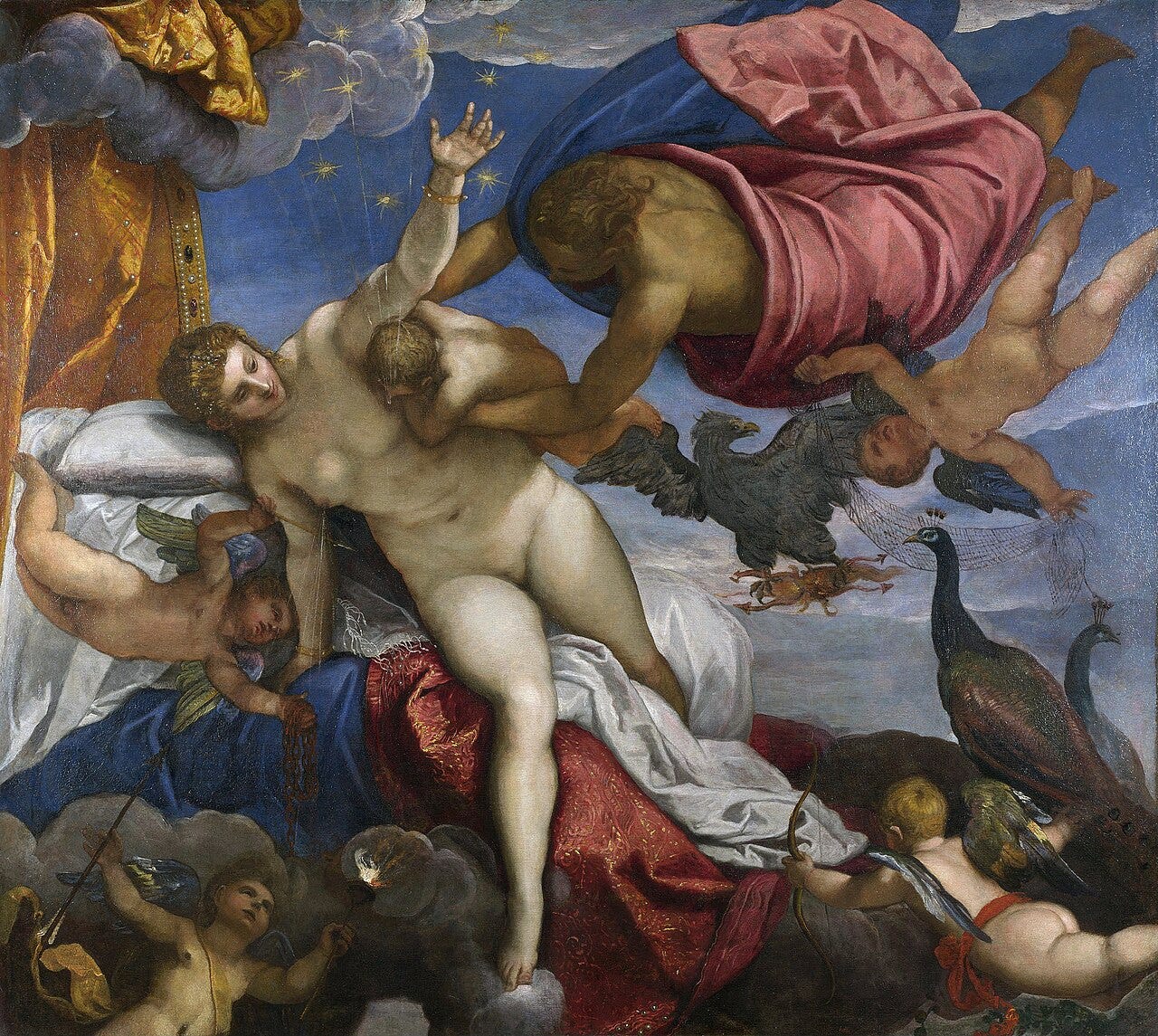
Tintoretto painted The Origin of the Milky Way, in which Hera’s milk sprays across the sky as Heracles is pulled away. The Greeks explained the galaxy with a domestic accident.
More on him in Tintoretto.
Tintoretto painted it around 1575 and the canvas has been cut down, so the lilies that grew where the milk fell to earth are missing from the bottom. The Greek word galaxias comes from gala, milk.
7 | Night skies in the Northern landscape
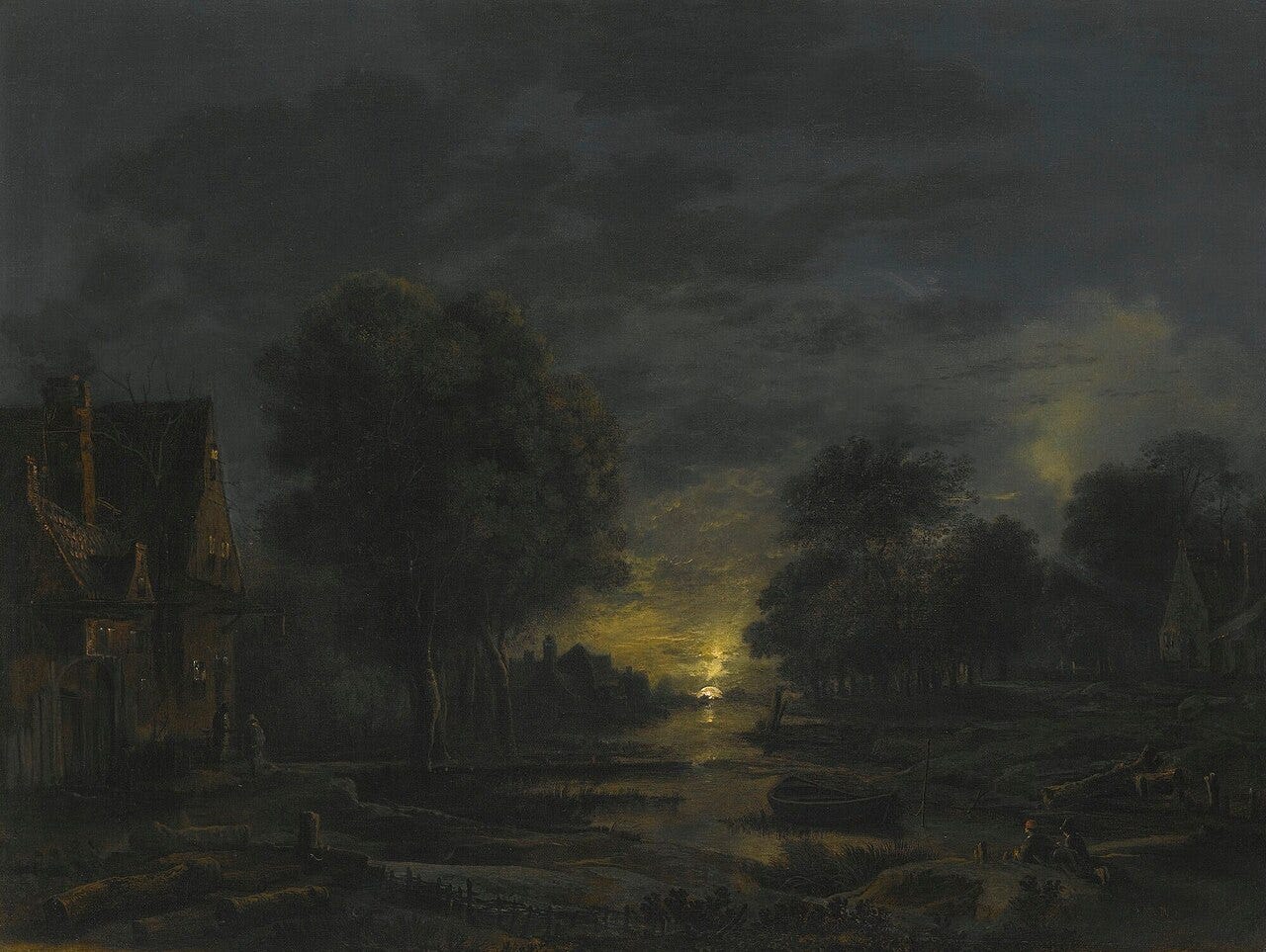
Aert van der Neer built a career on moonlit rivers, painting the same low sky over and over in the 1640s and 1650s while barely selling anything.
More in famous night paintings.
Van der Neer painted almost nothing else for thirty years and died insolvent in 1677, having run a tavern to survive. His moonlit rivers sold poorly in his lifetime and are now in every major collection. He is one of many painters who kept returning to the moon itself as a subject, not just the stars around it.
8 | Friedrich and the two figures under the moon
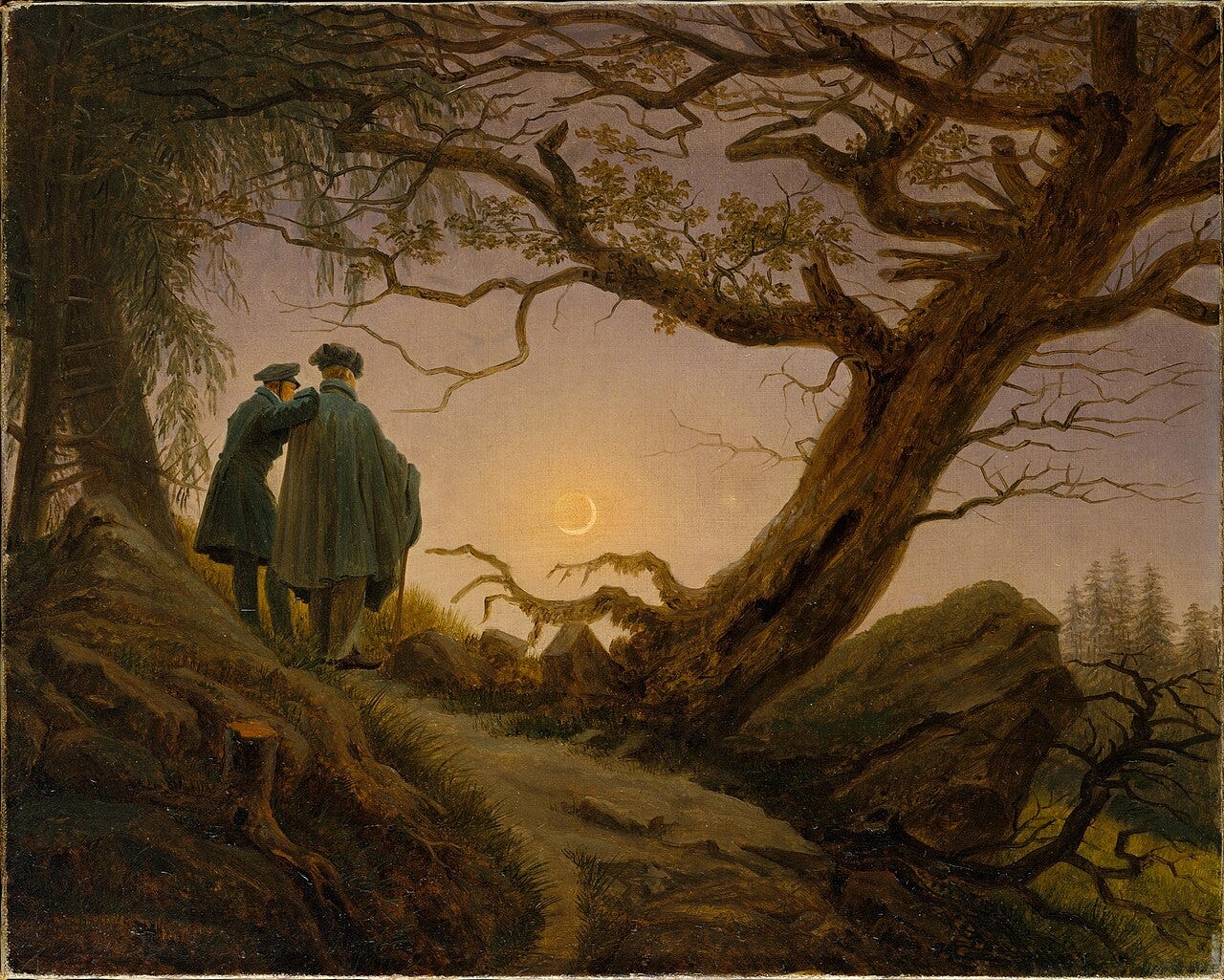
Two men in cloaks with their backs to us, looking at a moon low over the trees. Friedrich made several versions, and the sky is the whole subject.
More on him in Caspar David Friedrich.
He painted the subject at least three times from about 1819. Beckett said Waiting for Godot came partly from one of these pictures, two figures with their backs turned, waiting.
9 | The moon painted from the wrong side
A crescent moon must have its horns pointing away from the sun, and its lit edge facing the sunset or sunrise. Painters routinely get this backwards, because a crescent looks better tilted the other way.
Once you see it you will not be able to stop checking.
10 | Astronomy enters the picture
After the telescope arrived in 1609 the moon stops being a smooth disc in painting and starts having craters. Some of the first painted craters follow Galileo’s drawings.
Cigoli painted a cratered moon under the Virgin’s feet in Rome around 1612.
Galileo published the Sidereus Nuncius in March 1610 with his own wash drawings of the cratered moon. Cigoli, a painter and his friend, put a cratered moon under the Virgin in Santa Maria Maggiore around 1612.
11 | Hokusai and the sky as pattern
The prints are woodcuts, so the sky is cut into blocks of colour rather than mixed on a palette. That is why a Japanese night reads as design and a European one reads as weather.
Japanese prints treat the sky as flat colour and the stars as spacing, not as a light source. It is a different problem entirely, solved by design rather than observation.
More on him in Katsushika Hokusai.
12 | Why painters get the sky wrong on purpose
An accurate night sky is dim, flat and mostly empty. A painter needs contrast, rhythm and a place for the eye to rest, so the stars get bigger, fewer and brighter.
The wrongness is the design.
Real stars vary in brightness by a factor a canvas cannot hold, and the eye sees almost no colour at night. Every painted night sky is a translation, and the good ones admit it.
The night sky on canvas, questions readers ask
Is The Starry Night an accurate sky? No. It was painted from memory at Saint Remy in 1889, with a village that is not in the view. Starry Night Over the Rhone of 1888 is far closer to the real sky.
Did Giotto paint a real comet? Yes. He watched Halley’s Comet in 1301 and painted the star of Bethlehem as a comet a few years later, in the Scrovegni Chapel. A 1986 space probe was named after him.
Why is the sky red in The Scream? The usual explanation is ash from the Krakatoa eruption of 1883, which turned skies red across Europe for months.
Are there accurate star maps in painting? Yes. The Old Sacristy dome in Florence shows a specific night sky, commonly dated to July 1442.
Where is The Starry Night today? MoMA for The Starry Night, the Orsay for the Rhone, the Scrovegni Chapel in Padua for Giotto, the National Museum in Oslo for Munch.
Find the crescent moon in a painting and look at which way the horns point. If they do not point away from where the sun set, the painter chose beauty over astronomy, and most of them did.
Search either of these and you will turn up dozens more: the Met and the Rijksmuseum.
This subject is one thread in a wider theme. See how it fits into The Sky in Art.