The Nude in the Renaissance: How It Came Back

In the Renaissance, roughly 1400 to 1600, European artists reintroduced the unclothed human figure after nearly a thousand years of absence, using classical mythology and biblical stories as acceptable cover in a deeply Christian culture.

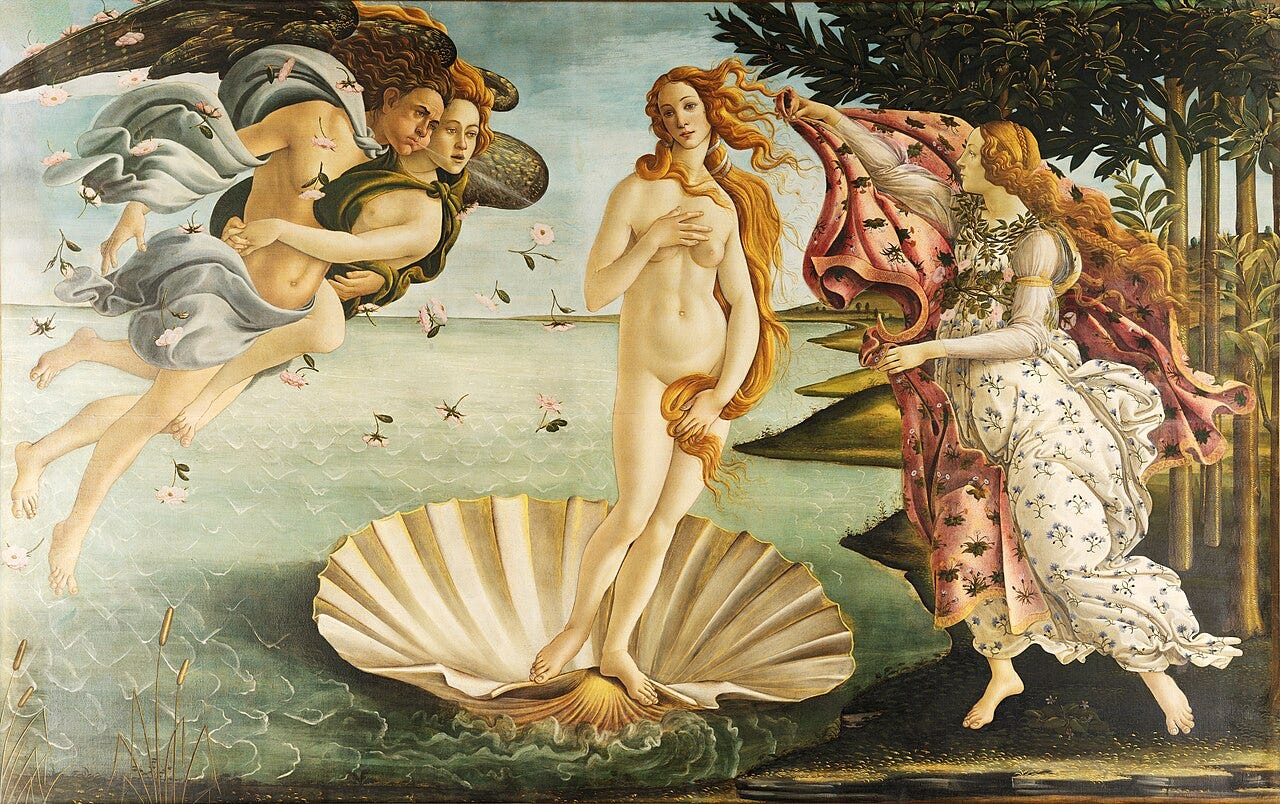
Botticelli's Birth of Venus, a nude goddess standing on a shell at the shore
Sandro Botticelli, The Birth of Venus, about 1485, tempera on canvas, Uffizi Gallery, Florence

The Renaissance nude was born under a hat. Around the 1440s, Donatello cast a bronze David for Cosimo de Medici wearing nothing except a shepherd's hat and a pair of boots, one foot resting on Goliath's severed head.

It was the first freestanding male nude sculpture anyone had made since antiquity. For close to a thousand years, no European artist had produced anything like it.

That gap is the real story. The naked body did not slowly fade back into Western art. It vanished for centuries, then returned in the space of a few generations, and every step of that return was contested, negotiated, and sometimes burned.

This is the origin story behind every Venus, every academy life class, and every fig leaf that came after.

A Thousand Years Without a Body

Greek and Roman sculptors treated the unclothed figure as the highest subject in art. Medieval Christian Europe treated it as a problem.

After the fall of Rome, the nude nearly disappeared from Western art. When bodies appeared unclothed at all, it was to signal shame: Adam and Eve covering themselves at the expulsion, sinners tumbling into hell on church portals. Nakedness meant the fall of man, poverty, or punishment.

The distinction matters, and it is the one that still structures how we talk about this subject. A naked figure is simply undressed. A nude is an artistic ideal, a body composed and perfected. The full definition is worth reading on its own: what the nude actually means in art.

Medieval Europe had naked figures. It had no nudes. Rebuilding that category took the rediscovery of an entire buried civilization.

The Alibi Carved in Marble

Fifteenth century Italy was digging up its own past. Ancient Roman sculpture kept surfacing from the ground, and humanist scholars were reading Greek and Latin texts that treated the ideal body as a subject of serious study.

For artists, these excavated statues solved two problems at once. They were a model, showing how antiquity had handled proportion and anatomy. And they were an alibi. If the ancients had honored the unclothed figure, a Christian artist could claim to be reviving classical learning rather than trafficking in flesh.

Donatello's bronze David, now in the Bargello in Florence, is the first proof that this permission structure worked. It stands on its own, unsupported, the first such bronze cast of the Renaissance. And crucially, it is biblical. David is scripture. A Medici patron could display him in a courtyard without scandal, because the subject was holy even if the body was bare.

That became the formula for the entire period. Venus, Adam and Eve, the damned in Last Judgment scenes: the nude reentered Western art wearing a costume of myth or scripture. Botticelli's Birth of Venus, painted around 1485 for Lorenzo di Pierfrancesco de Medici, hung in the family villa at Castello as a classical allegory, and stayed there for centuries.

New here? Learn art the fun way. Free stories every week, no boring lectures.

The Bonfire and the Garland

Michelangelo's Last Judgment fresco with nude figures that drew Vatican criticism
Michelangelo, The Last Judgment, 1536 to 1541, fresco, Sistine Chapel, Vatican City
Michelangelo's marble David, a nude youth once fitted with a copper garland
Michelangelo, David, 1501 to 1504, marble, Galleria dell'Accademia, Florence

The alibi did not convince everyone.

In 1497 and 1498, the Dominican friar Girolamo Savonarola staged the Bonfire of the Vanities in Florence. Artworks, books, and objects judged immoral went into the flames, reportedly including nude imagery. The same city that had commissioned Donatello's bronze David was now burning bodies on canvas.

Savonarola was excommunicated and executed in 1498. Three years later, Michelangelo began carving his own David from a block of marble, finishing it in 1504.

What happened at the unveiling tells you exactly where Florence stood. The statue went up in the Piazza della Signoria, the most public square in the city, a marble man 17 feet tall in front of the seat of government. And the authorities immediately dressed him. A ghirlanda, a garland of 28 copper leaves, was fastened around his waist to cover his nudity.

The garland stayed in place for decades. Florence wanted its David and wanted him decent, and it held both positions at once.

Michelangelo would fight this battle again at the end of his life, when the nudity of his Last Judgment in the Sistine Chapel drew an attack from the Vatican's own master of ceremonies. That fight, and the loincloths painted over his figures after his death, is a story of its own: how the Church censored art with fig leaves and loincloths.

Durer Carries the Body North

Titian's Venus of Urbino, a reclining nude built on the Renaissance nude tradition
Titian, Venus of Urbino, 1534, oil on canvas, Uffizi Gallery, Florence
The Medici Venus, the ancient nude statue Durer used as his model for Eve
Medici Venus, Roman marble copy of a Greek original, about the first century BC, Uffizi Gallery, Florence
The Apollo Belvedere, the ancient nude statue Durer used as his model for Adam
Apollo Belvedere, Roman marble copy of a Greek bronze, about 120 to 140 AD, Vatican Museums
Durer's Adam and Eve panels, nude figures modeled on ancient statues
Albrecht Durer, Adam and Eve, 1507, oil on panel, Museo del Prado, Madrid

In Italy, the nude had classical soil to grow from. North of the Alps, it had nothing. German painting had no tradition of the ideal body and no excavated Venuses in the ground.

Albrecht Durer imported it. In 1504 he engraved an Adam and Eve, and in 1507 he completed a pair of oil panels of the same subjects, considered the first full scale nude subjects in German painting.

He did not work from imagination. Durer built Adam's proportions on the ancient Apollo Belvedere and Eve's on the Medici Venus, applying Italian humanist theories of ideal proportion for a Northern audience that had never encountered them. The subject, once again, was scripture. The method was pure antiquity.

With Durer, the Renaissance nude stopped being an Italian phenomenon and became a European one.

And then it became a curriculum. From the Renaissance forward, art academies built their training around the life class: drawing from a posed nude model, session after session, year after year. Proportion, foreshortening, anatomy. Mastering the naked figure was treated as the ultimate proof of skill, the exam every serious artist had to pass.

Every nude that followed, from Titian's Venus of Urbino to Manet's Olympia, stands on the foundation laid in these two centuries. Twelve of the most consequential are gathered here: the famous nude paintings that shaped art history.

FAQ

  • Why did the nude disappear from Western art in the Middle Ages? Medieval Christian culture associated nakedness with sin and shame. Unclothed figures appeared mainly as Adam and Eve after the fall or as the damned, never as an ideal to admire.

  • What was the first Renaissance nude? Donatello's bronze David, made around the 1440s for Cosimo de Medici, is the first freestanding male nude sculpture since antiquity. It is now in the Bargello in Florence.

  • Why were Renaissance nudes almost always mythological or biblical? A bare body needed religious or classical justification to be acceptable in a Christian society. Venus, David, and Adam and Eve gave artists a legitimate subject; the rediscovery of ancient Greek and Roman sculpture gave them a model and an excuse at once.

  • Did anyone oppose the return of the nude? Yes. Savonarola burned nude imagery in the Bonfire of the Vanities in 1497 and 1498, Florence covered Michelangelo's David with a copper garland in 1504, and the Vatican later ordered loincloths painted over the Last Judgment.

  • Who brought the nude to Northern Europe? Albrecht Durer. His Adam and Eve oil panels of 1507, built on the proportions of the Apollo Belvedere and the Medici Venus, are considered the first full scale nude subjects in German painting.

Enjoyed this? Join the readers who learn art the fun way, free every week.

The garland Florence hung on Michelangelo's David in 1504 was made of exactly 28 copper leaves.

Related reading