The Potato Eaters: Meaning and Why Van Gogh Made It Dark

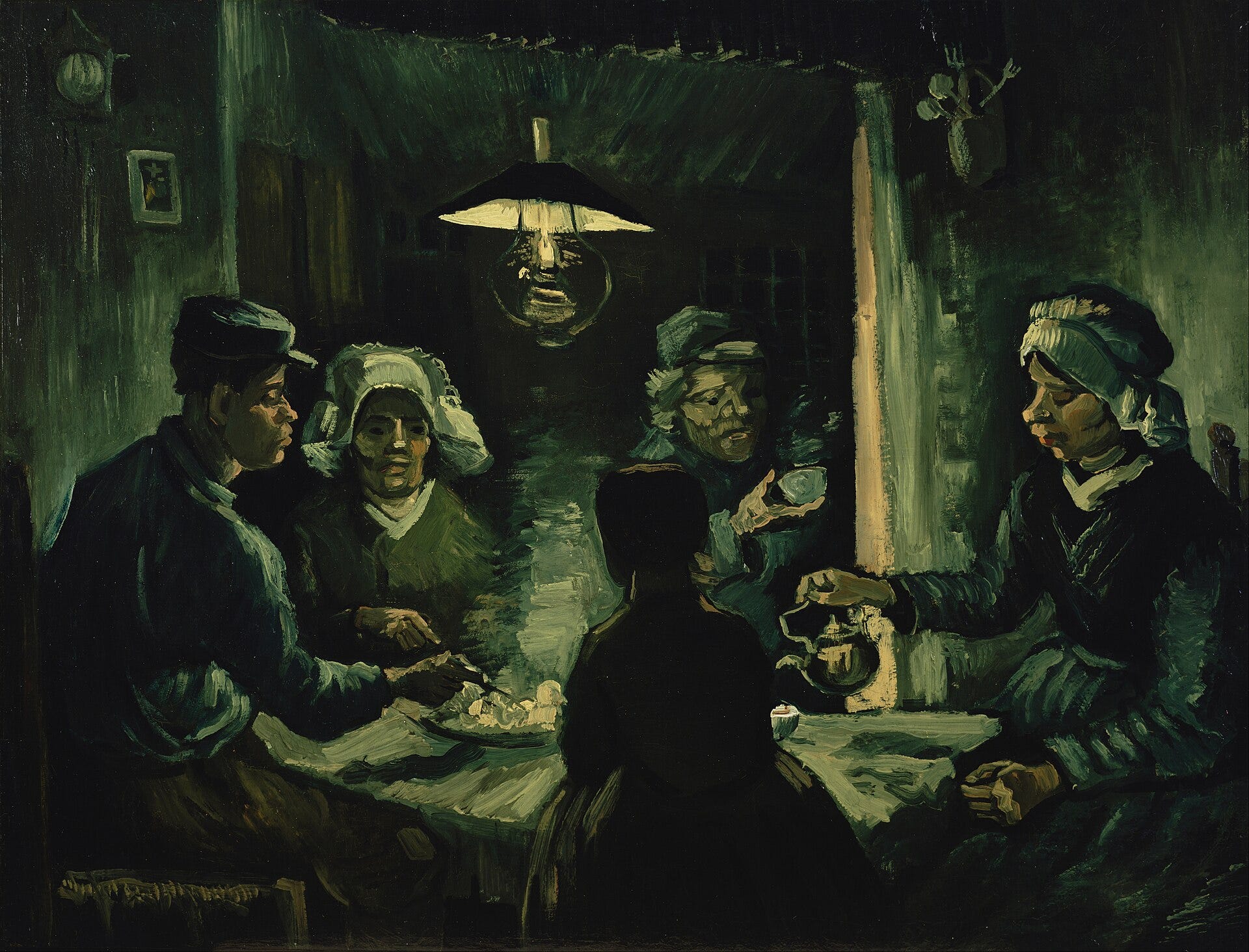
The Potato Eaters is an 1885 painting by Vincent van Gogh, in the Van Gogh Museum in Amsterdam. It shows five peasants sharing a plate of potatoes by one dim lamp.

Van Gogh made it deliberately dark and ugly, and he thought it was the best thing he had ever done.

Five peasants sharing potatoes around a table by one lamp
Vincent van Gogh, The Potato Eaters, 1885

It was painted five years before The Starry Night, by a self taught beginner nobody wanted. Here is what Van Gogh was trying to say, why he made it so grim on purpose, and the friendship it destroyed.


Learn art the fun way. Free stories every week, no boring lectures.


Five people and one lamp

A cramped cottage in the Dutch village of Nuenen, at night. Five members of a peasant family sit around a small table, and a single hanging oil lamp is the only light. On the table is their whole meal: a dish of boiled potatoes and a pot of coffee.

The faces are heavy and knobbly, the hands enormous and rough. Van Gogh wanted you to see that the same hands digging these potatoes out of the earth are now reaching for them on the plate.

He painted it in the spring of 1885, based with his family in Nuenen, weeks after his father died, working from dozens of studies of local farmers he had drawn all winter.

The ugliness was the whole point

Van Gogh could have made these people handsome. He refused. He wrote to his brother Theo that he wanted the picture to smell of bacon, smoke and steamed potatoes, and that a peasant painting should not be perfumed.

Painting hungry people as pretty, he thought, would be a lie.

So the colors are the brown of a dusty potato and a muddy field, the drawing is clumsy, the room airless. This was a decision, not a failure of skill.

He was building his whole early art on the idea that honesty about hard lives mattered more than beauty, the same conviction that runs through the Realism of Millet, the painter he most admired.

The letter to his sister

Van Gogh was explicit about what he meant. He told his family that he had tried to show that these people, eating their potatoes by lamplight, had dug the earth with the very hands they now put into the dish, that they had honestly earned their food.

That is the meaning in one sentence: not pity, but respect. He was not mocking the poor or asking you to feel sorry for them. He was insisting that a life of hard work at the bottom of society was worth painting at the scale usually given to saints and generals.

It is his manifesto, made before he had found color or light.


Join 130,000 readers who get the secrets behind the paintings. Free.


The friendship it broke

Not everyone admired it. Van Gogh's friend Anthon van Rappard, a fellow painter, wrote him a harsh letter attacking the picture, complaining that the figures were badly drawn, the hands and faces wrong, the whole thing careless.

Van Gogh was wounded and furious. He sent the letter back and the long friendship between the two men never recovered. He kept believing in the painting anyway.

Years later, in the south of France, he still called The Potato Eaters one of his best works, the one where he had said something true.

Amsterdam, and the night it was taken

The Potato Eaters is in the Van Gogh Museum in Amsterdam, and it is not for sale. In 1991 it was one of twenty Van Gogh paintings taken in a night raid on the museum, one of the largest art thefts of the century.

The thieves got no further than the car park: the works, including this one, were recovered within about an hour, abandoned in a car.

His grimmest picture had a very close call.

The winter of forty heads

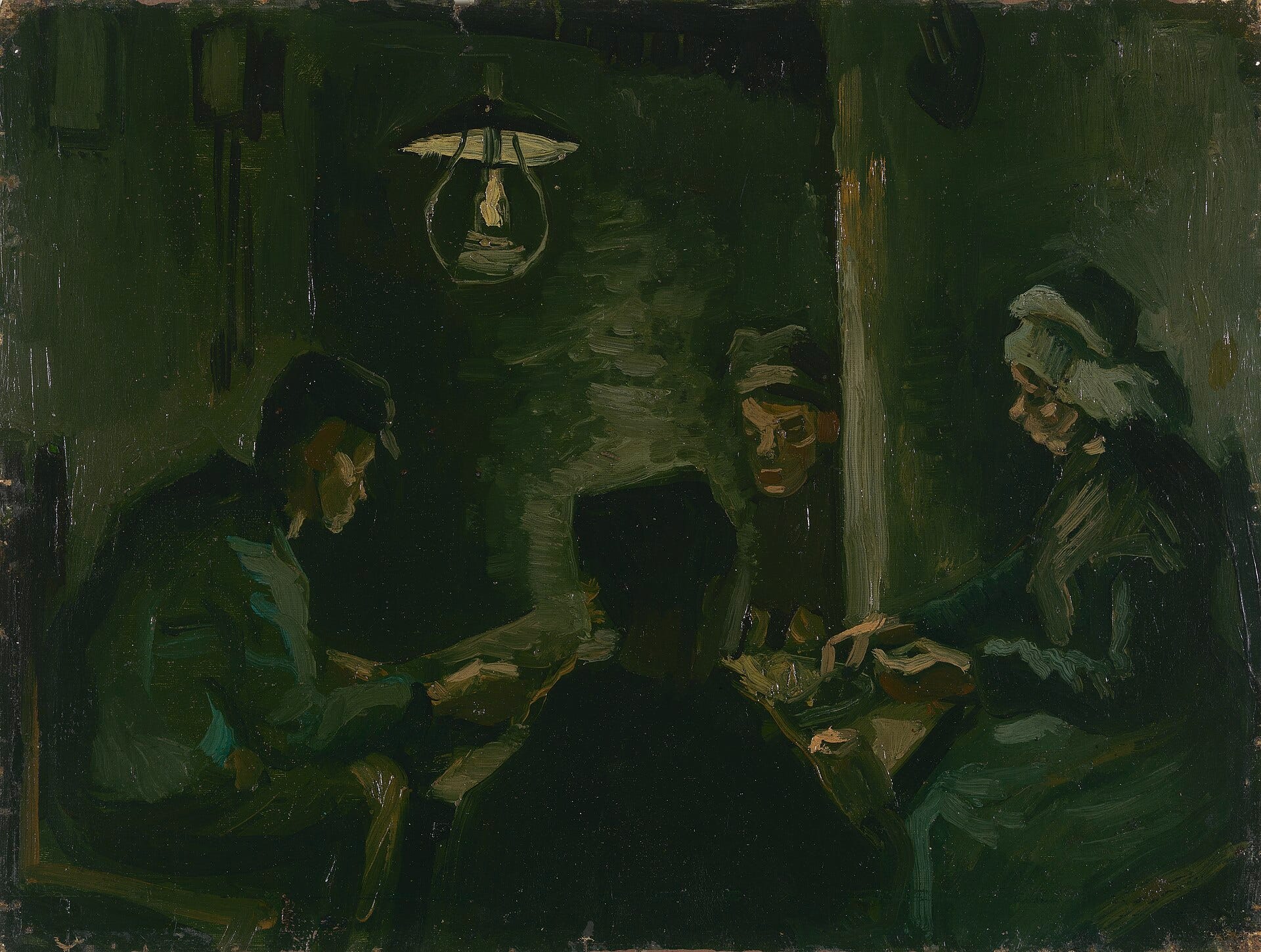
The Potato Eaters did not come from nowhere. Through the winter of 1884 and 1885, in the village of Nuenen, Van Gogh painted dozens of studies of the heads and hands of local peasants, a project he thought of as painting the people themselves.

The dark, knobbly faces around the table are the harvest of that long winter of practice.

He was in a hurry to prove himself. He drew the composition onto a lithographic stone from memory, before the painting was even finished, and printed a small edition to give to friends and to his brother Theo, staking a claim to be the painter of peasant life.

He wanted this to be his arrival.

The color of a dusty potato

The muddy browns and sour greens are a decision, not a beginner's accident. Van Gogh wrote that he wanted the picture to have the color of a really dusty potato, unpeeled, and that a peasant painting should smell of bacon and smoke, not of perfume.

He was still working inside the dark palette of the Dutch and French realists he worshipped, Jozef Israels and above all Jean Francois Millet, years before Paris and Arles would set his colors on fire.

This is the sound of Van Gogh before the sunflowers, teaching himself in the gloom of a Dutch cottage.

Five people, one lamp, no comfort

Look at how he stages it. A single hanging oil lamp throws all the light onto the potatoes and the hands, and leaves the faces half in shadow.

One figure is seen only from the back, pulling you into the circle. Nobody looks comfortable, the room has no air, and that airlessness is the point: he wanted you to feel the weight of the day in the bodies, not to admire a cozy supper.


The Potato Eaters, quick answers

  • What is the meaning of The Potato Eaters? Respect for honest work. Van Gogh shows peasants eating potatoes they dug with their own hands, and painted them plain and rough on purpose to tell the truth about their lives.

  • Why did Van Gogh make it so dark? On purpose. He wanted it to feel of smoke and steamed potatoes, not be prettied up. He believed making the poor look pretty would be dishonest.

  • Who painted it and when? Vincent van Gogh, in 1885, in Nuenen in the Netherlands, five years before The Starry Night.

  • Did Van Gogh consider it a success? Yes. Despite harsh criticism at the time, he called it one of the best things he ever made.

  • Where is The Potato Eaters? The Van Gogh Museum in Amsterdam.


If this painting pulled you in, you will love these too:


The beginner behind the genius

It is worth remembering how early this is. In 1885 Van Gogh had been painting for only about five years, was entirely self taught, sold nothing, and lived on money from his brother.

The loose brush and blazing color everyone knows had not arrived; that came after he reached Paris and then Arles. The Potato Eaters is the sound of a man teaching himself in the dark, and he was proud of it to the end, which tells me as much about him as any sunflower.

You can see The Potato Eaters in person at the Van Gogh Museum. For more by the artist, browse the Metropolitan Museum collection.

Questions around the lamp

  • What does The Potato Eaters show? A poor peasant family sharing a dish of potatoes by the light of a single hanging lamp. Vincent van Gogh painted it in 1885.

  • Why is it so dark and rough? Van Gogh wanted honesty, not prettiness. He said the same hands digging in the dish had dug the earth, and he kept the faces coarse and the colors muddy on purpose.

  • Was it a success? No. It was criticized at the time, even by his friend Anthon van Rappard, yet Van Gogh always saw it as his first real achievement.

  • Where is the painting? It hangs in the Van Gogh Museum in Amsterdam.

  • Who painted it? Vincent van Gogh, years before his bright southern pictures. It sits within the tradition of Realism.


Two new stories a week, 130+ secrets unlocked. Start free.