The Reclining Nude: 500 Years of One Pose in Art

The reclining nude is a compositional formula in Western art, a figure lying diagonally across the canvas with one arm raised or resting, that painters from Giorgione to Manet to Modigliani have repeated and reworked for five hundred years.

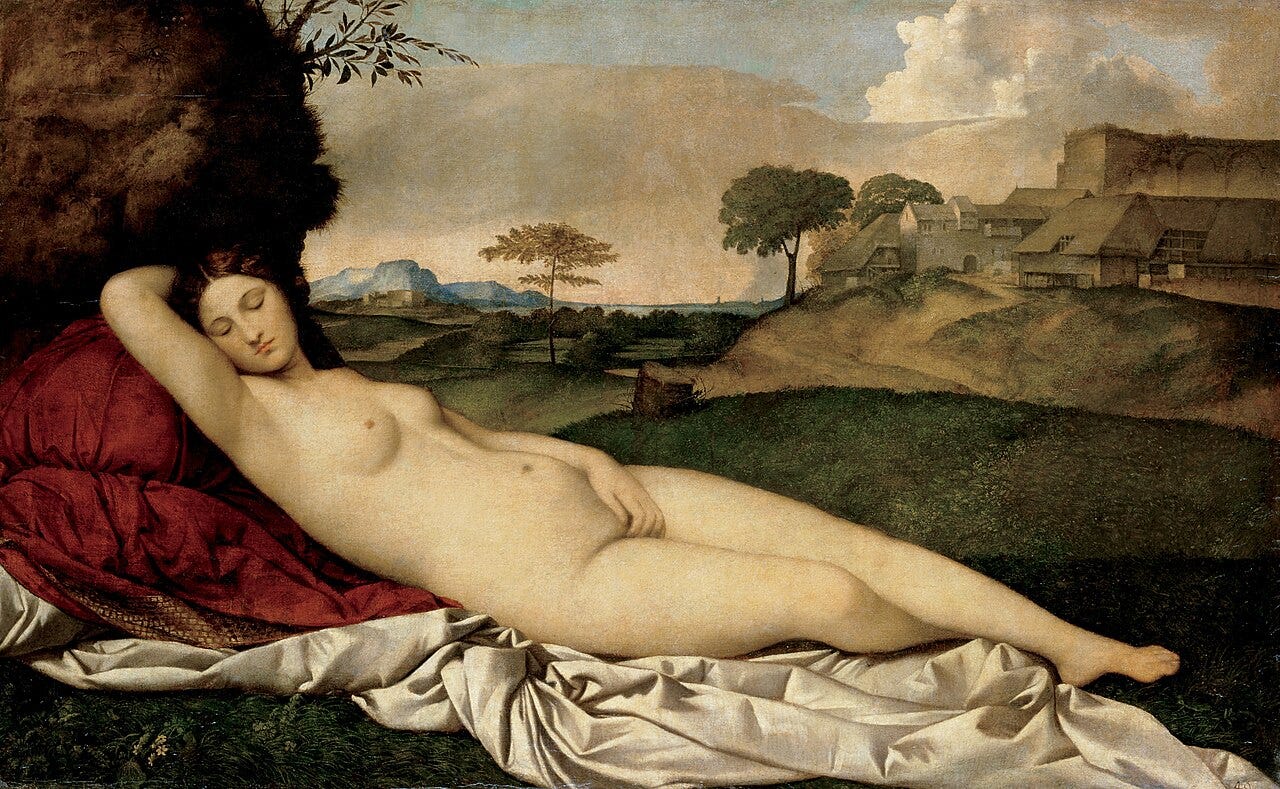
Giorgione's Sleeping Venus, a nude figure lying diagonally with eyes closed
Giorgione, Sleeping Venus, about 1510, oil on canvas, Gemaldegalerie Alte Meister, Dresden

Around 1510, a painter in Venice laid a sleeping woman diagonally across a canvas. In 1917, police in Paris shut down a gallery over paintings built on the exact same diagonal.

Four hundred years apart, same skeleton. A body stretched from one corner of the frame toward the other, one arm placed just so, a face that either meets your eye or refuses to.

Art history usually tells this as a series of separate scandals. It reads better as one story: the biography of a pose, passed from hand to hand like a recipe, with each generation changing a single ingredient.

If you want the full case files on the famous versions, the individual dramas, dates and police reports, they live in our guide to famous nude paintings. This piece is about the recipe itself. For the wider genre, start with what the nude actually means in art.

Venice Builds the Template

Titian's Venus of Urbino, a reclining nude with her gaze returned to the viewer
Titian, Venus of Urbino, 1534, oil on canvas, Uffizi Gallery, Florence

Giorgione's Sleeping Venus and Titian's Venus of Urbino set the modern template in the early sixteenth century. That single sentence is all we need here, because the invention matters less than what they standardized.

What Venice fixed in place was a set of parts. The body crosses the canvas on a diagonal, which gives the eye a path to travel. One arm goes up behind the head or a hand comes to rest at the hip or thigh. And the eyes are either closed, a goddess unaware of you, or open, a woman who knows you are there.

Every painter who touched the pose afterward was really adjusting those three dials. Nothing else about the formula changed for centuries. The mattress changed, the curtains changed, the dials stayed.

Boucher Turns the Body Over

For two hundred years the dials barely moved. Then in 1751 Francois Boucher rotated the entire figure.

His Resting Girl, also called The Blonde Odalisque, lies face down on a tangle of cushions. It is the standard reclining formula flipped on its stomach, diagonal intact, but with the gaze dial removed entirely. A body that cannot look back at you cannot confront you.

Boucher liked the solution enough to paint it twice, in 1751 and again in 1752.

The model was Marie Louise O'Murphy, a mistress of King Louis XV of France. She was a young teenager when Boucher painted her, reportedly around fourteen or fifteen years old. That is a documented historical fact, and it is worth stating plainly, because it marks exactly how differently the centuries have read this pose: what the French court framed as gallantry, later eras would come to see as something far darker.

The eighteenth century version of the formula, in other words, was built for a private audience of aristocratic men. The pose served the patron. That arrangement had about a century left to live.

New here? Learn art the fun way. Free stories every week, no boring lectures.

The Gaze Comes On

Manet's Olympia, a reclining nude who returns the viewer's gaze flatly
Edouard Manet, Olympia, 1863, oil on canvas, Musee d'Orsay, Paris
Goya's Nude Maja, a reclining nude with a direct, unembarrassed stare
Francisco Goya, Nude Maja, about 1800, oil on canvas, Museo del Prado, Madrid

The nineteenth century did not change the body. It changed the eyes.

Goya's Nude Maja, around 1800, gave the reclining figure a direct, unembarrassed stare, and the painting spent years locked away partly because of it. Manet's Olympia went further in 1863, returning the viewer's gaze so flatly that Paris treated the canvas as an insult. Both scandals are told in full, with dates and consequences, in the pillar guide to famous nudes.

For the story of the pose, one thing matters. Neither painter invented a new composition. They took the Venetian diagonal, the resting arm, the familiar mattress, and flipped the one switch Boucher had removed.

The lesson the century taught was brutal in its simplicity. Audiences could absorb a nude body without protest. What they could not absorb was a nude body that looked back.

Matisse Breaks the Skeleton

By 1907 the gaze had been switched on and the culture had survived it. So Henri Matisse attacked the only part of the formula no one had touched: the body itself.

His Blue Nude, subtitled Souvenir de Biskra, keeps the reclining diagonal and the raised arm. Everything else is taken apart. The flesh is worked in raw blue tones, the anatomy twisted into simplified, angular masses, the mattress replaced by rough foliage.

It was still recognizably the old pose. That is precisely what enraged people. A random arrangement of blue limbs would have been ignored; a Venus you could still identify under the wreckage felt like vandalism of something owned in common.

The proof came in America. Blue Nude traveled to the 1913 Armory Show in New York and Chicago, and on the final day of the Chicago run, art students staged a mock trial of Matisse and prepared to burn reproductions of several of his works, Blue Nude among them. Accounts differ on whether the copies were actually set alight before Art Institute staff stepped in.

Four years later, Modigliani painted his reclining nudes with the diagonal and the returned gaze fully intact, and police closed his Paris gallery show on opening day in 1917. The full story is in the famous nudes guide. By then the pattern was complete: the same pose had scandalized four different centuries for four different reasons.

FAQ

  • What defines the reclining nude pose? Three recurring elements: the body placed diagonally across the canvas, one arm raised behind the head or a hand resting at the hip or thigh, and the presence or absence of a gaze returned toward the viewer.

  • Why does the gaze matter so much? Art historians treat the returned gaze as the biggest single signal in the formula. Averted or closed eyes read as a passive ideal; eyes meeting the viewer read as active confrontation, which is what fueled the reactions to Goya and Manet.

  • How did Boucher change the pose? In his Resting Girl of 1751 and 1752 he turned the figure face down instead of on her back, removing the gaze from the equation entirely. The model, Marie Louise O'Murphy, was a mistress of Louis XV and reportedly around fourteen or fifteen years old, a documented detail that shapes how the painting is discussed today.

  • What did Matisse do to the pose in 1907? His Blue Nude kept the diagonal and raised arm but rebuilt the body in blue toned, simplified, angular form. At the 1913 Armory Show in Chicago, art students held a mock trial of Matisse and prepared to burn reproductions of it.

  • Where can I read the full stories of the famous reclining nudes? The individual histories of Giorgione, Titian, Goya, Manet and Modigliani are told in detail in our guide to famous nude paintings.

Enjoyed this? Join the readers who learn art the fun way, free every week.

Boucher's experiment survives in duplicate: the 1751 version of the Resting Girl hangs in the Wallraf Richartz Museum in Cologne, and the 1752 version in the Alte Pinakothek in Munich.

Related reading