The School of Athens: Who Is Who in Raphael's Fresco

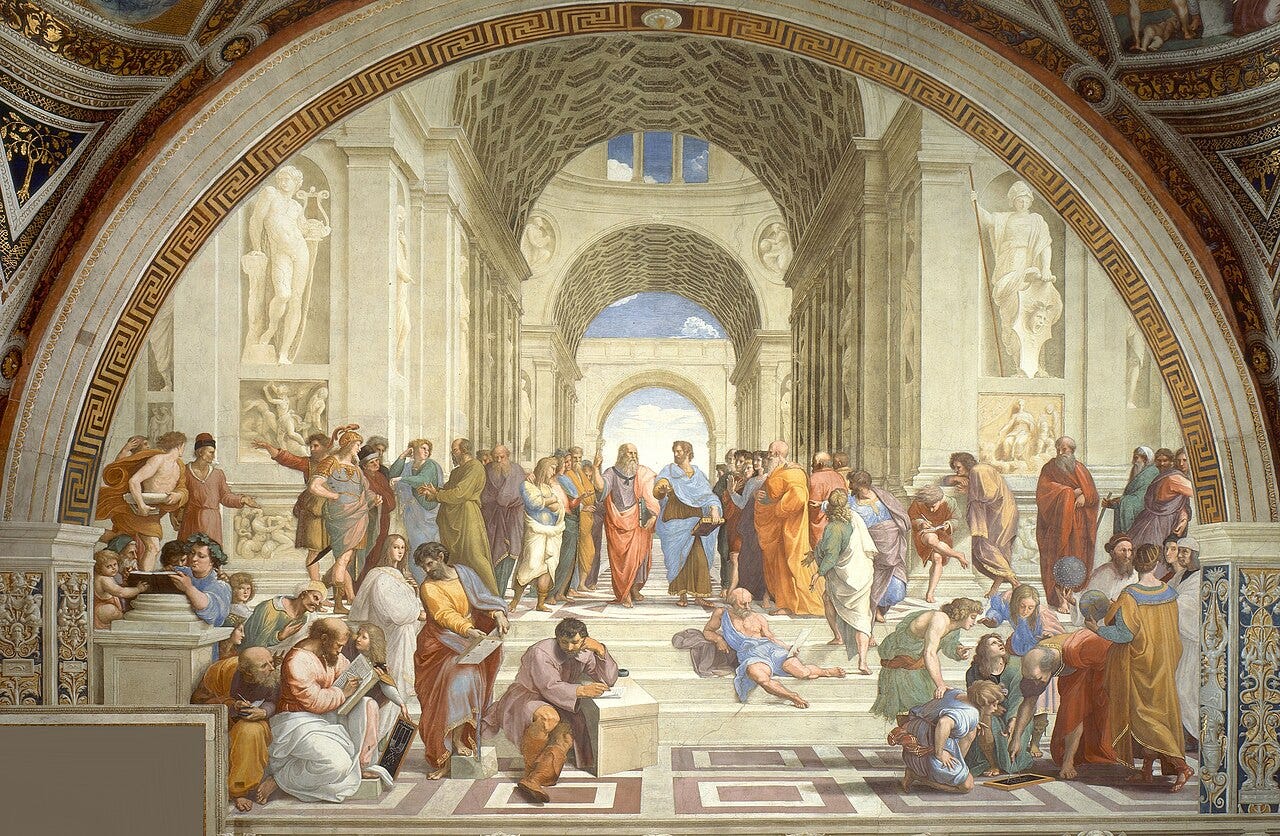
The School of Athens is a fresco painted between 1509 and 1511 by Raphael, on a wall of the Vatican. It gathers the great thinkers of the ancient world into one hall, and it hides the faces of Raphael's own rivals inside them: Plato is Leonardo da Vinci, and the brooding man on the step is Michelangelo.

Ancient philosophers gathered in a vast vaulted hall
Raphael, The School of Athens, 1509 to 1511

It was never a real school. Raphael invented a room where philosophers who lived centuries apart stand together, and he smuggled the artists of his own Rome in among them. Here is who is who, and where Raphael painted himself.


Learn art the fun way. Free stories every week, no boring lectures.


A meeting that never happened

Pope Julius II gave Raphael, then twenty five, the walls of his private library. On this one Raphael painted philosophy: around fifty figures, about twenty one of them identifiable philosophers, who never shared a room or even a century, from Pythagoras to the Islamic scholar Averroes, arranged as if mid debate under a vast vaulted hall.

The grand vaulted hall behind them opens to the sky and is a stage set rather than a real place, a sign that this gathering exists only in the mind.

The fresco sits in the Stanza della Segnatura, and Raphael painted it at the same moment Michelangelo was at work elsewhere in the Vatican, on the Sistine ceiling.

Plato and Aristotle, heaven against earth

The two figures at the center carry the whole argument. On the left, old and white haired, Plato holds his book the Timaeus and points one finger straight up, to the world of ideas above us.

On the right, younger, Aristotle holds his Ethics and stretches a flat hand out over the ground, to the world we can touch and measure.

Everything else fans out from that pair. The thinkers who deal in pure thought cluster on Plato's side; the ones who study the physical world gather on Aristotle's.

Two statues watch over them, Apollo with his lyre and Athena in her armor, the gods of poetry and wisdom.

The rivals hidden in the crowd

This is the part the guidebooks rush past, and to me it is the best thing in the picture. Raphael gave his philosophers the faces of the artists he knew.

Plato is widely believed to wear the face of Leonardo da Vinci, then in his late fifties, bearded and serene. The heavy, solitary figure slumped on the steps in the foreground, writing, is Michelangelo, added late, after Raphael sneaked a look at the Sistine ceiling and rebuilt part of his fresco in that heavier manner.

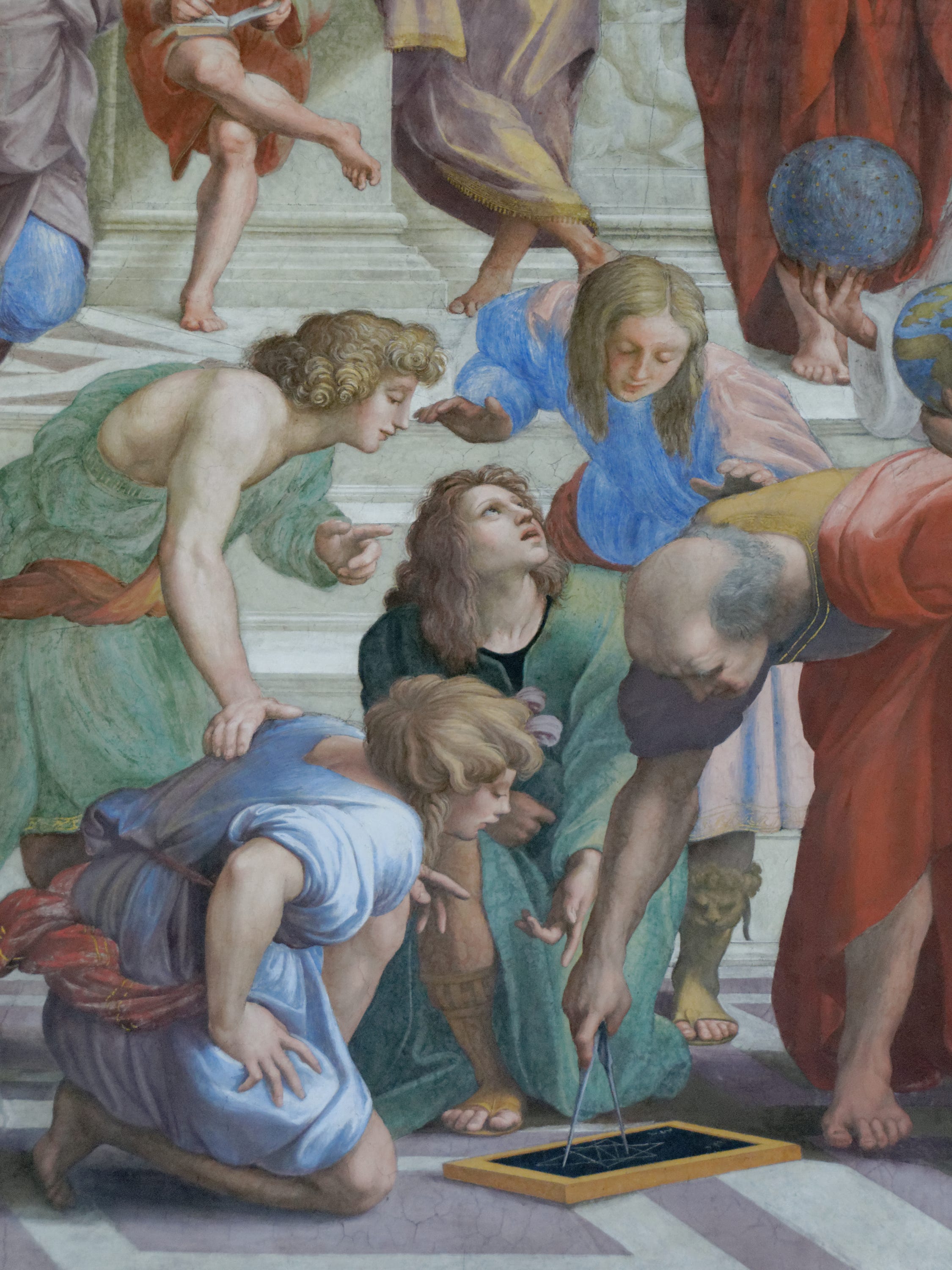
Euclid, bent over a compass on the right, is given the face of the architect Bramante, who was designing the new Saint Peter's. And in the far right corner, in a dark cap, looking straight out at you, is Raphael himself, signing the crowd with his own face.


Join 130,000 readers who get the secrets behind the paintings. Free.


The only woman on the wall

Among all these men, one figure in white looks out toward us on the left. She is usually identified as Hypatia of Alexandria, the mathematician and philosopher murdered by a mob in 415.

There is a story, hard to confirm, that a cardinal objected to a pagan woman in a papal library, and that her features were softened to resemble a nephew of the Pope.

Whether or not that is true, her presence is deliberate. In a room meant to hold the whole of human thought, Raphael would not leave her out.

It cannot leave the wall it was painted on

The School of Athens is in the Raphael Rooms of the Vatican Museums in Rome, on the wall where it was painted, and it cannot move: it is a fresco, plaster and pigment fused to the wall itself.

That also means it has no auction price. You reach it near the end of the long route that ends at the Sistine Chapel, and most visitors walk past it too fast, chasing Michelangelo two rooms on.

The room it belongs to

The fresco is one wall of four in the Stanza della Segnatura, Julius II's private library and the room where he signed documents.

Each wall stands for a branch of knowledge: philosophy here, theology in the Disputation of the Sacrament opposite, poetry in the Parnassus, and law on the fourth.

Raphael's hall of philosophers was never meant to stand alone. It is one quarter of a painted map of everything a Renaissance mind thought worth knowing, the ancient thinkers on one wall facing the Christian saints on the other, reason and faith kept in the same small room.

The figure Raphael added last

The brooding Michelangelo on the steps is not in Raphael's original design. The full size preparatory drawing survives in Milan, and he is not in it.

He was painted in afterward, onto a separate patch of fresh plaster, which means Raphael went back and inserted him once the wall was largely done.

The likeliest reason is the one I find hardest to resist: partway through the job Raphael was let in to see Michelangelo's half finished Sistine ceiling next door, came away staggered, and paid tribute by smuggling its author into his own crowd, painted in Michelangelo's own heavier manner.

The trick that pulls your eye to the center

Stand in front of it and the architecture does the work. The great barrel vaults and the receding arches all funnel toward a single vanishing point on the horizon, and Raphael set that point in the empty air exactly between the heads of Plato and Aristotle.

You cannot help it: the whole room drives your eye to the two men at its heart, heaven and earth, the idea and the thing. The soaring vaults themselves echo the new Saint Peter's that Bramante was then designing a few steps away, so Raphael painted his imaginary school inside the most ambitious building of his own moment.


The School of Athens, quick answers

  • Who painted The School of Athens? Raphael, between 1509 and 1511, for Pope Julius II.

  • Who is in the painting? Ancient philosophers with Plato and Aristotle at the center, plus Pythagoras, Euclid, Diogenes, Averroes, Zoroaster and others, many wearing the faces of Raphael's contemporaries.

  • Where is Raphael in The School of Athens? In the far right corner, in a dark cap, looking out at the viewer. It is his self portrait.

  • Who is the only woman? She is usually identified as Hypatia of Alexandria, the ancient mathematician and philosopher.

  • Where is The School of Athens? The Raphael Rooms in the Vatican Museums, Rome. It is a wall fresco and does not travel.


If this fresco pulled you in, you will love these too:


The insult painted in plaster

The brooding Michelangelo in the foreground is the sharpest joke in the picture. Michelangelo was famously sour and solitary, and Raphael painted him exactly that way, apart from the crowd, hunched over his own writing, in the very style Michelangelo had just invented on the Sistine ceiling.

It is a tribute and a needle at once, and the two men, who could not stand each other, are now stuck on the same Vatican wall forever.

You can see The School of Athens in person at the Vatican Museums. For more by the artist, browse the Metropolitan Museum collection.

Reading The School of Athens


Two new stories a week, 130+ secrets unlocked. Start free.