Everything else in a painting will pose for you. A model holds still. A mountain holds still. Even the sea repeats itself. The sky does neither, and it never has.
A cloud that took twenty minutes to observe no longer exists. A sunset changes faster than a brush can be reloaded. For most of art history, painters did not paint the sky they saw. They painted the sky they could remember, or the sky they could invent.
The sky is the part of a painting no artist could ever copy from life, because it refuses to hold still. This page traces how painters solved that problem across seven centuries, then points you to our twelve dedicated guides, one for each kind of sky.
Three facts set the stakes.
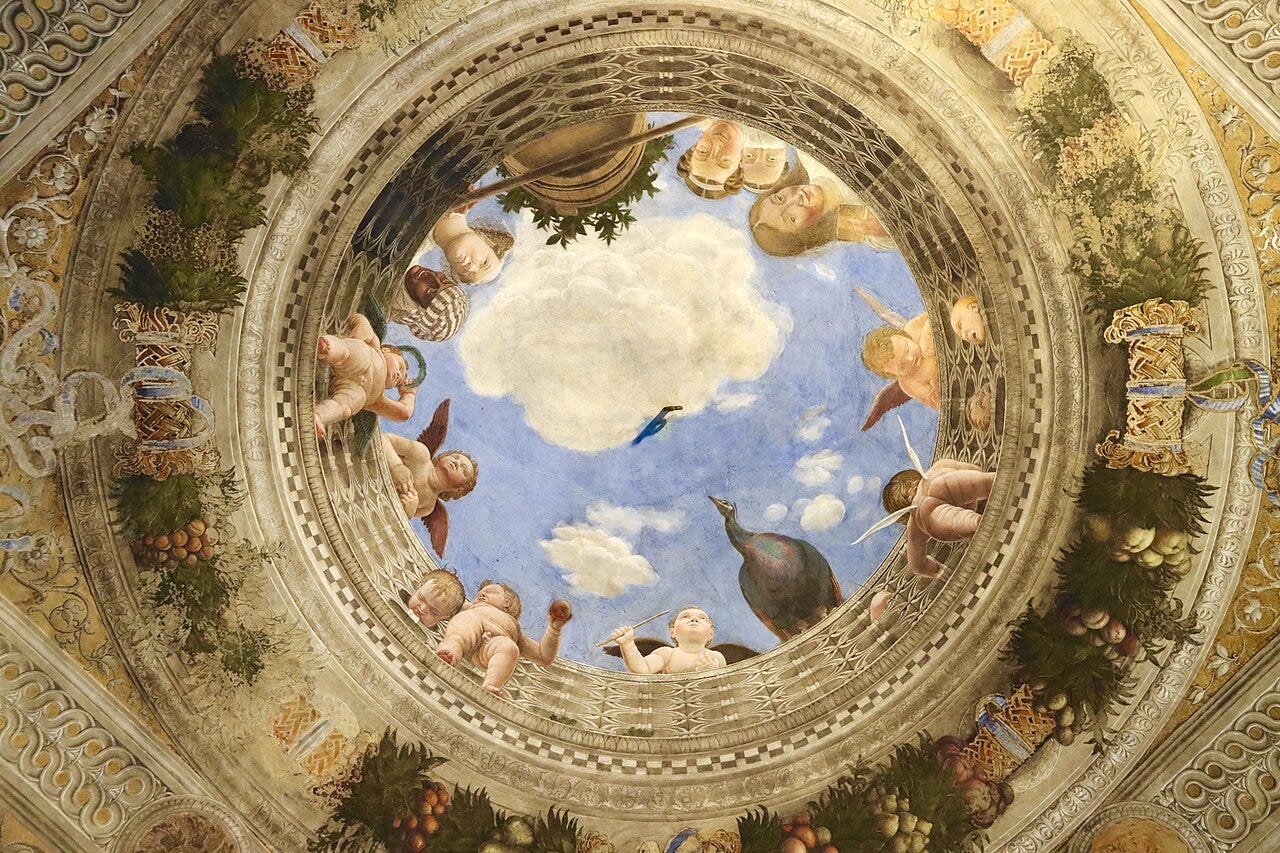
Around 1474, Andrea Mantegna finished the ceiling of the Camera degli Sposi in the Palazzo Ducale in Mantua. He painted a fake circular opening, an oculus, through which a painted sky appears, with figures leaning over the rim and looking down at you. It is one of the first true painted skies punched through a ceiling in Western art, a trick later named di sotto in su.
Around 1500, Leonardo da Vinci wrote in his notebooks that the sky looks blue because illuminated air is seen against the darkness of space beyond it. The physical explanation, Rayleigh scattering, was only worked out in the 19th century. A painter got there by observation, roughly four hundred years early.
And between 1821 and 1822, John Constable stood on Hampstead Heath and made around 50 surviving oil studies of nothing except sky. He called the practice skying. Many are inscribed on the back with the date, the time of day, the wind direction and the cloud type, using the classification system Luke Howard had published in 1802: cumulus, cirrus, stratus, nimbus. Meteorologists still use those names today.
The problem no other subject poses
A face has edges. A tree has structure. The sky has neither, and it also happens to be the light source for everything else in the picture.
That double role is the trap. Get the sky wrong and every shadow in the painting contradicts it. Constable put it plainly in a letter of 1821, writing that the sky is the chief organ of sentiment in a landscape.
So for centuries, most painters simply avoided the fight. Medieval panels used flat gold where the sky should be. Gold was not a failure of skill. It was a decision that heaven mattered more than weather.
Faking the heavens overhead
The Renaissance attacked the problem from below, literally. Mantegna's oculus in Mantua opened the ceiling. Two and a half centuries later, Giovanni Battista Tiepolo closed the argument.
Around 1753, Tiepolo finished the fresco above the staircase of the Wurzburg Residence in Germany. It is commonly described as one of the largest ceiling frescoes in the world, a continent of painted cloud carrying allegorical figures for the four corners of the earth.
These ceilings admit something honest. Since nobody can paint the real sky, the next best thing is to build a convincing counterfeit and put the viewer underneath it.
Clouds as grammar, not weather
Japanese painters found a third way. In narrative handscrolls and screens, artists used bands of stylized gold cloud, a convention called suyari gasumi, to separate scenes and to hide jumps in time and place.
These clouds carry no meteorology at all. They work the way a paragraph break works, and audiences read them that way for centuries.
European painting had its own coded sky in aerial perspective, the technique of making distant things paler, bluer and softer to suggest depth. Leonardo described it in his writings on painting. It is the reason a hazy horizon reads as far away, and it is the technical thread connecting fog, distant mountains and pale morning light across the whole European landscape tradition.
When the sky became the subject
Constable's Hampstead studies mark the turn. After him, the sky stopped being a backdrop and started being the point.
The 19th century pushed hard in that direction, and several of the works that defined it live on our other pages: Turner's weather, Monet's harbor at dawn, Van Gogh's stars. We cover each of them where they belong, in the guides below.
The 20th century then did something no earlier painter could. In 1965, Georgia O'Keeffe painted Sky Above Clouds IV, based on the cloud fields she had seen from airplane windows after she began flying commercially in her seventies. For the first time in history, a painter had looked at the sky from above.
Choose your sky
Every page below is a full guide with twelve works apiece. Pick the sky you are actually curious about.
The Sun in Art tackles the one object in nature no painter can study directly, since staring at it blinds you, and shows the workarounds artists invented.
Sunrise Paintings is our new feature on first light specifically, the coldest and briefest light of the day, and why so few painters were awake for it.
Sunset Paintings covers the opposite end of the day, when color is at its most saturated and the risk of sliding into kitsch is at its highest.
The Moon in Art treats the moon as a portrait subject, a single lit object surrounded by dark, which is a completely different problem from painting a field of stars.
The Night Sky and Stars in Art is where the field of stars lives, including the full story of Van Gogh's night skies, which we deliberately do not retell here.
Comets and Eclipses in Art is our new guide to the skies that appear once in a lifetime, the events people painted as omens long before anyone painted them as astronomy.
Clouds in Painting is also new, and it gathers the works where the cloud is the main character and everything on the ground is just an excuse to look up.
Storm Paintings is the sky as a threat in motion, wind and lightning arriving, the only weather that gives a painting a plot.
Fire in Art flips the direction of the light entirely, skies lit from below by burning cities and ships, orange where every other page on this list is blue.
Fog in Art is the sky come down to ground level, and it is really a guide to erasure, to how much of a picture an artist can remove and still have a picture.
Rain in Painting deals with the one weather you cannot actually see, only its effects, from Hiroshige's slanted lines to wet Paris pavement.
Rainbows in Art covers the sky's rarest apparition, a piece of pure optics that painters kept getting physically wrong for centuries.
Frequently asked questions
Why did medieval painters use gold instead of blue sky? Gold signified heaven and divine light, and it was also enormously expensive, which made it an offering in itself. Naturalistic blue skies only became standard as painting turned toward observation in the Renaissance.
Who first explained why the sky is blue? As a matter of physics, Lord Rayleigh in the 19th century. But Leonardo da Vinci had already written in his notebooks that the blue comes from lit atmosphere seen against the darkness beyond it, which is remarkably close to the modern answer.
What is di sotto in su? An Italian term meaning seen from below upward. It describes ceiling paintings built as illusions, where figures and sky are foreshortened as if you were looking through a real opening. Mantegna's Camera degli Sposi oculus, finished around 1474, is an early landmark.
Did painters study the sky scientifically? Constable did. His oil sky studies of 1821 and 1822 record date, time, wind and cloud type on the back, using Luke Howard's 1802 cloud classification. He treated skying as research, and the studies were never meant for sale.
What is aerial perspective? The technique of painting distant objects paler, bluer and less defined to create depth. Leonardo described it, and it underlies almost every convincing horizon in European landscape painting.
Who wrote the first book about the sky? The earliest surviving Western attempt is Aristotle's Meteorologica, a treatise on rainbows, halos, comets and weather that tried to explain sky phenomena instead of reading them purely as omens.
One page in this family does not belong to the sky at all. Candlelight Paintings is about a single flame indoors, the exact opposite problem: a light source the painter controls completely, with none of the sky's freedom and none of its excuses.
As for the sky itself, the last word goes to the painter who finally saw it from the other side. Georgia O'Keeffe's Sky Above Clouds IV of 1965 measures roughly 8 feet by 24 feet, was painted from what she saw through airplane windows in her seventies, and hangs at the Art Institute of Chicago.


