The Sleeping Gypsy: Meaning and the Hoax Suspicion
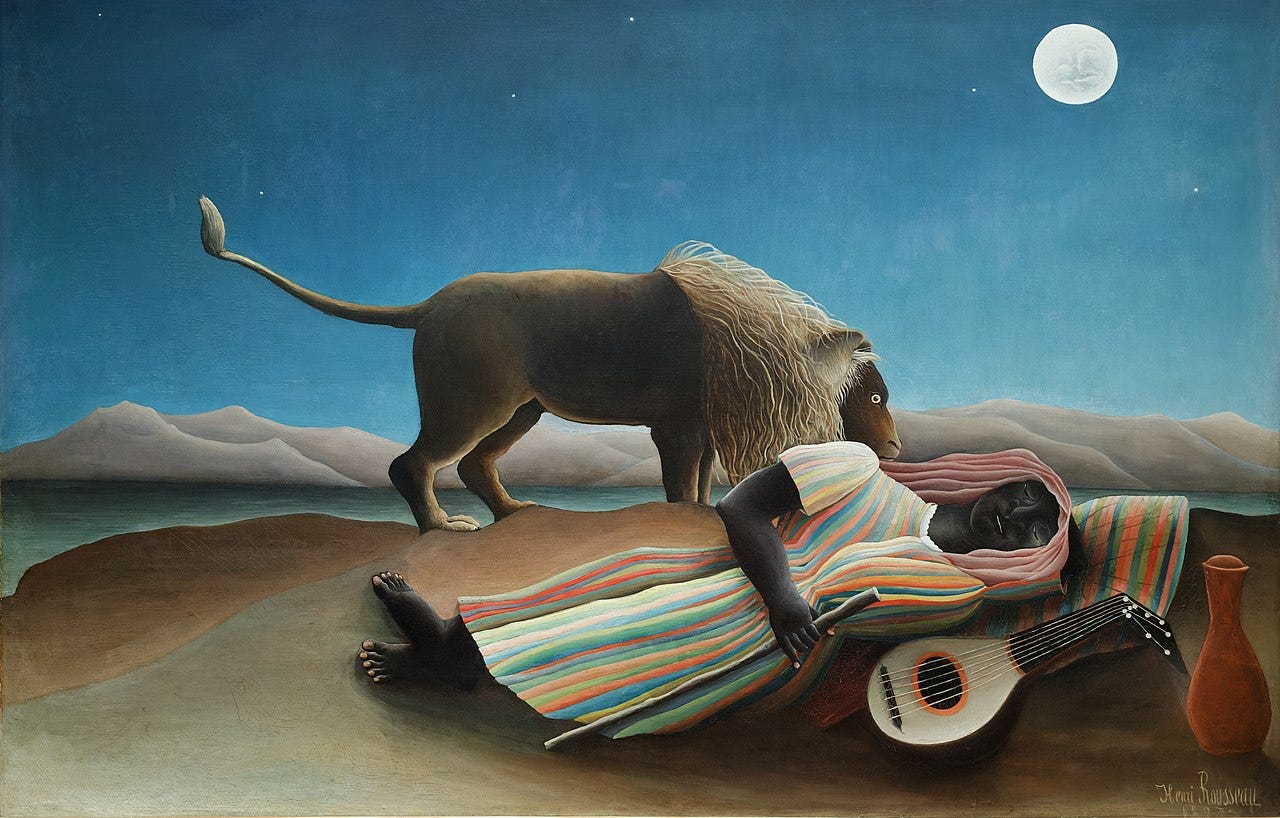
The Sleeping Gypsy is an 1897 painting by Henri Rousseau, in the Museum of Modern Art in New York. A wanderer in a striped robe sleeps in a moonlit desert while a lion stands over her, sniffing, and does not attack.
It is so strange and so still that experts once refused to believe a self taught tax collector had painted it.
Rousseau was mocked as an amateur in his own lifetime, and this dreamlike scene is now one of the most loved paintings in New York. Here is what it means, why it was suspected of being a hoax, and what Rousseau himself said about the lion.
A lion that does not eat
The scene is simple and impossible. A woman lies flat on her back in a bare desert, eyes shut, in a robe of many colored stripes.
Beside her rest a mandolin and a jar of water. A lion has wandered up and lowers its head to her, tail stiff, mane bristling, close enough to bite.
Nothing happens. Above them hangs a round full moon in a still blue night.
Rousseau left his own description of it, and it is the key to the picture. A wandering musician, worn out, sleeps deeply, he wrote, and a lion happens by, sniffs her, and does not devour her.
The whole tension of the painting is that refusal. The beast that should kill her simply looks, as if held by the same spell that keeps her asleep.
Is the lion even real
Because her eyes are closed and the mood is so trancelike, many viewers read the lion as part of her dream rather than a real animal in the sand.
The mandolin at her side suggests a song, and the whole night has the logic of sleep, where a predator can stand over you and mean no harm.
Rousseau never explained it that far. He gave you the wanderer, the lion, the moon, and left the meaning open. That openness is why, for me, the picture has drawn poets and Symbolist dreamers for over a century: it looks like a memory of a dream you cannot quite place.
The customs officer everyone laughed at
Rousseau was not a trained artist. He worked for years as a toll and tax collector on the edge of Paris, which earned him the nickname Le Douanier, the customs officer, and he taught himself to paint in his spare time, copying in the museums and inventing lush jungles he had never seen.
The art world treated him as a joke. Critics laughed at his flat perspective and his stiff figures, and he was often the entertainment at avant garde parties rather than a respected guest.
He believed in himself completely anyway, and a handful of younger artists, Picasso above all, saw that the flatness the critics mocked was doing something new.
His Post Impressionist contemporaries were loosening the brushstroke; Rousseau was rebuilding the world as a clear, dreaming child might see it.
The painting nobody believed
After Rousseau died in 1910 the picture vanished from view for years. When it resurfaced in Paris in the 1920s, some of the sharpest eyes in the art world could not accept it.
It was too strange, too accomplished in its own odd way, to be the work of the amateur they remembered.
There were serious suspicions that it was a hoax, a modern fake dressed up as a lost Rousseau. Scholars argued over it until the evidence, including Rousseau's own recorded attempt to sell it decades earlier, confirmed it was genuine.
The strangeness that made people doubt it is exactly what makes it his.
Where the sleeper hangs now
The Sleeping Gypsy is in the Museum of Modern Art in New York, which received it in 1939 as a gift of Mrs Simon Guggenheim, and it is one of the museum's most visited works.
It carries no market price now. Rousseau, who died poor and largely unrecognized in 1910, never knew that the picture the experts nearly rejected would end up a treasure of the greatest modern art collection in the world.
The Sleeping Gypsy, quick answers
What does The Sleeping Gypsy mean? Rousseau kept it open. A wanderer sleeps in a desert while a lion sniffs her and does not attack. It reads as a dream, poised between danger and calm.
Why did experts think it was a hoax? When it resurfaced in the 1920s, its strange perfection made scholars doubt a self taught amateur had painted it. It was later confirmed genuine.
Who painted it and when? Henri Rousseau, a self taught French artist nicknamed Le Douanier, in 1897.
Is the lion real or a dream? Rousseau never said. Because the sleeper's eyes are shut and the mood is trancelike, many read the lion as part of her dream.
Where is The Sleeping Gypsy? The Museum of Modern Art in New York.
If this painting pulled you in, you will love these too:
The darker truth about Gauguin, the part of the Tahiti story that never makes the wall label
Vermeer, Woman Holding a Balance, what is actually on those scales
The Ambassadors, detail by detail, the object at the bottom that only works from one side
The banquet held in his honor as a joke
In 1908 Pablo Picasso threw a now famous banquet for Rousseau in his studio, hanging one of the old man's paintings in a place of honor.
Historians still argue over how much of it was sincere tribute and how much was the young avant garde amusing itself at the douanier's expense.
Rousseau took it as pure homage and wept with happiness. Either way, the joke aged badly for the mockers: the amateur they toasted for a laugh now hangs in the same museums as the men who laughed.
You can see The Sleeping Gypsy in person at the Museum of Modern Art. For more by the artist, browse the Metropolitan Museum collection.
The questions the desert keeps
What does The Sleeping Gypsy show? A woman in a striped robe sleeps in a moonlit desert while a lion stands over her, sniffing. A mandolin and a jar rest beside her. Henri Rousseau painted it in 1897.
Is the lion about to attack her? The scene is left unresolved on purpose. The lion looms but does not pounce, which gives the picture its dreamlike calm.
Who painted it? Henri Rousseau, a self taught French painter mocked in his day as naive but later admired by the modern artists of Paris.
Where is The Sleeping Gypsy? It hangs in the Museum of Modern Art in New York.
Was the painting ever doubted? Yes. It dropped out of sight for years and only resurfaced in the 1920s, and for a time some experts even suspected it might be a fake.