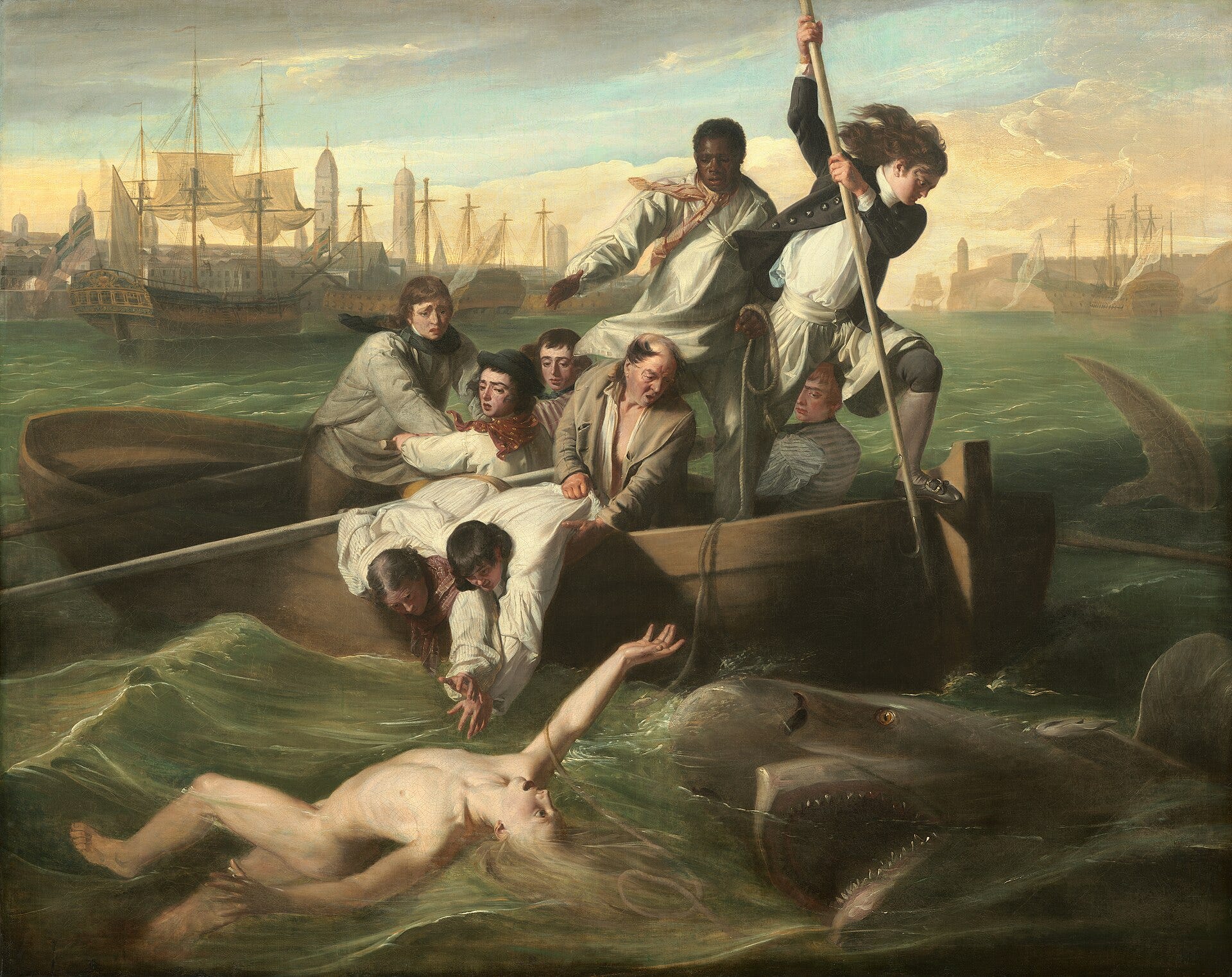
Copley's painting shows a shark attack that really happened. Brook Watson lost part of his leg in Havana harbor in 1749, survived, and later asked for that same leg to appear on his own coat of arms.
John Singleton Copley painted the moment a shark attacked fourteen year old Brook Watson in Havana harbor, based on an account Watson gave him decades after it happened.
Date: Completed in 1778, depicting an event from 1749
Medium: Oil on canvas, about 182 by 229 centimeters
Location: National Gallery of Art, Washington, D.C.
More Paintings Built on Real Disaster
Copley was not the only painter who turned a real catastrophe into a history painting. These three do the same.
A Commission From the Survivor Himself
Brook Watson was a fourteen year old orphaned cabin boy swimming alone in Havana harbor in 1749 when a shark attacked him three times, taking part of his right leg before his crewmates pulled him free. He survived and, by 1778, commissioned Copley to paint it.
Watson gave Copley a detailed account of the attack decades later, once the two men had become friends in London, and Copley used that description to build the composition.
The amputation left him reliant on a wooden leg for the rest of his life, and Londoners came to know him as the wooden legged commissary.
What strikes me is that Watson waited decades to commission this. He carried the story long before he ever put it in a painting.
The Coat of Arms That Remembers the Shark
Watson did not let the attack end his ambitions. He built a career as a London merchant, banker, and politician, and when he was granted a coat of arms he asked for it to include a shark, Neptune, and his own severed leg.
He became a director of the Bank of England and served as Lord Mayor of London in 1796 and 1797, decades after the attack that nearly killed him.
The shark and severed leg on his crest turned a private trauma into a public, permanent symbol, carried on his own family heraldry rather than left out of the record.
To me the coat of arms says more than the painting does. He turned the worst day of his life into something he wore on purpose.
Three Versions
Copley painted the composition more than once. The original from 1778 hangs in the National Gallery of Art in Washington, a full scale replica stayed in his own studio and later went to the Museum of Fine Arts in Boston, and a smaller 1782 version is now in Detroit.
The original stayed within Brook Watson's own family and estate for decades before the National Gallery of Art purchased it in 1963.
The Boston version entered that museum's collection in 1889, given by Mrs. George von Lengerke Meyer, while the Detroit version had passed through the collection of art dealer Noël Desenfans before the museum bought it in 1946.
I read the three versions as proof of how much this image mattered to him. Copley kept a copy for himself even after selling the original.
A New Kind of History Painting
History painting in 1778 was reserved for kings, saints, and myths. Copley instead gave that grand, heroic treatment to an ordinary sailor and a real, recent event, then placed a Black sailor at the very center of the rescue, reaching directly toward Watson from the bow of the boat.
The painting was exhibited at the Royal Academy in 1778 and helped Copley's election to the Academy that same year, a rare achievement for a history painting built around a living, non aristocratic subject.
That sailor's identity was never recorded by Copley or Watson, and art historians still debate whether he represents a specific crew member or a symbolic figure.
His Other Dramatic Rescue From Reality
Copley returned to the same formula five years later with The Death of Major Peirson, a large history painting of a young British officer killed defending Jersey in January 1781. Both paintings turn a real, violent, recent event into heroic spectacle.
Both paintings share the same formula: ordinary participants elevated to the scale usually reserved for kings, and a composition built to pull the viewer directly into the moment of crisis.
Copley worked in London by then, and both paintings mark his shift from portraits toward large scale history scenes built around real, named participants.
Watson Never Stopped Telling the Story
Watson commissioned more than one version of his own near death and eventually placed several of them in institutions where students would see them. He wanted the shark attack read as a lesson: survive the crisis in front of you and keep going.
Watson bequeathed the original painting to Christ's Hospital, a London charity school for orphaned and poor children, specifically so students there could see it.
He also served as a Member of Parliament, adding a seat in the Commons to his roles as merchant, banker, and Lord Mayor, all built on the same nerve that got him back to sea after losing a leg to a shark at fourteen.
He Never Saw the Harbor, or the Shark
Copley had never been to Havana and had never seen a shark when he painted the scene. He built Watson's twisting pose from the Borghese Gladiator, a Roman statue he knew only from prints circulating in London at the time.
Copley and Watson became friends only after Copley settled in London in 1774, twenty five years after the attack itself. The painting grew out of that friendship, not from any account gathered on the scene.
It became the first in a series of large scale history paintings Copley made after leaving portraiture behind in London.
More Stories Worth Reading
A few more paintings that reward a second, closer look.
Frequently Asked Questions
Did the shark attack in the painting really happen?
Yes. Brook Watson was attacked by a shark while swimming in Havana harbor in 1749, when he was fourteen years old, and lost part of his right leg in the attack.
Why did Watson wait nearly thirty years to commission the painting?
By 1778 he was a wealthy London merchant, and the commission came once he had the means and the standing to have himself memorialized in a large scale history painting.
Are there multiple versions of the painting?
Yes. Copley painted more than one version, including the original now in the National Gallery of Art in Washington, along with later versions in the Museum of Fine Arts Boston and the Detroit Institute of Arts.
Why was it considered unusual for a history painting at the time?
History paintings traditionally depicted noble or mythological figures. Copley instead gave that grand, heroic treatment to an ordinary sailor and a real, recent event, a significant break from convention.
What happened to Brook Watson after the attack?
He recovered, built a successful career as a merchant and politician, and was eventually elected Lord Mayor of London in 1796.
Did Brook Watson mark the shark attack anywhere else in his life?
Yes. When he was granted a coat of arms, he asked for it to include a shark, Neptune, and his own severed leg, turning the attack into a permanent part of his family heraldry.