The Story of Dogs Playing Poker

A dog slides an ace under the table while cigar companies cashed in. Here is who actually painted Dogs Playing Poker, and why one pair sold for 658,000 dollars.

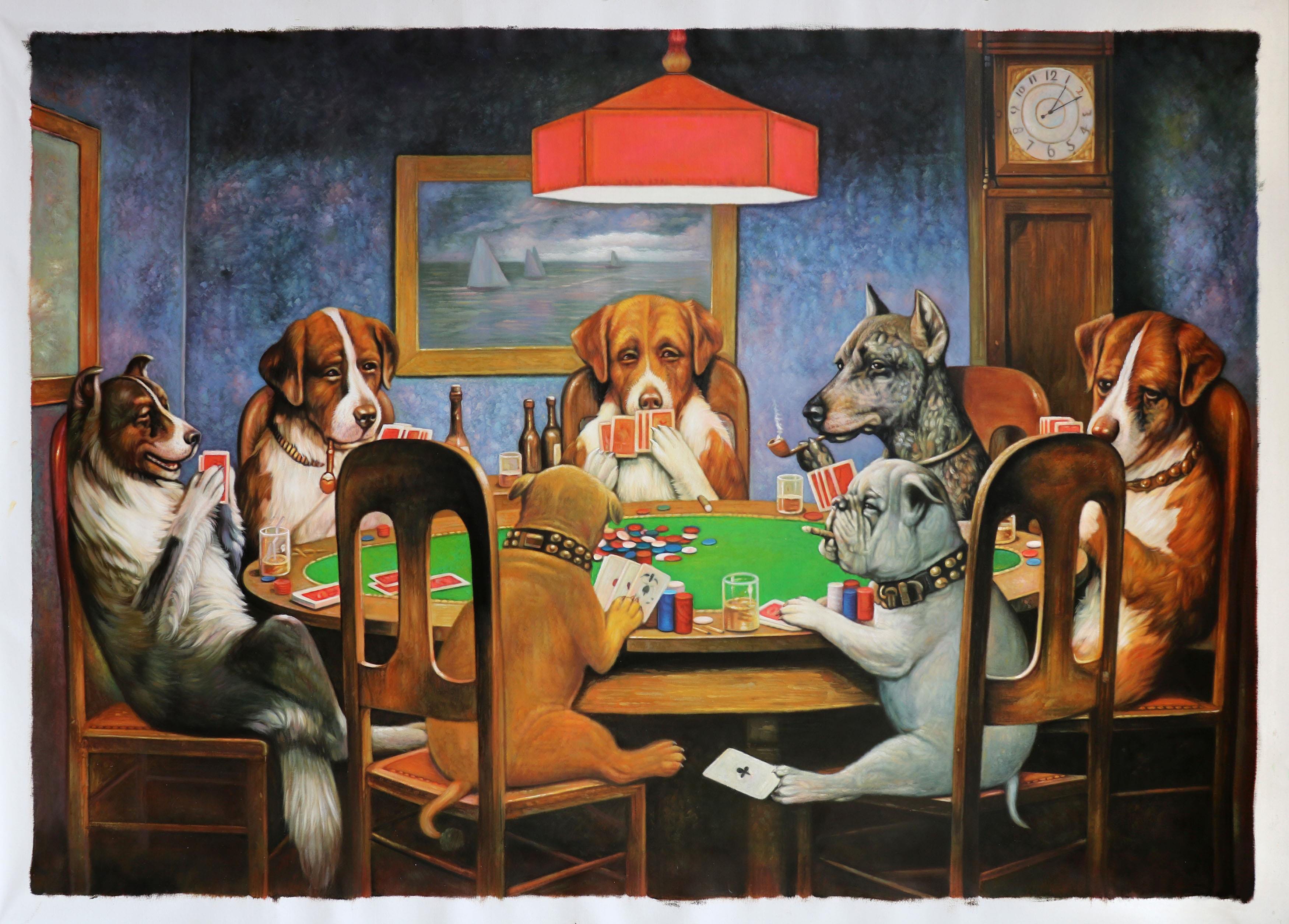
Cassius Marcellus Coolidge painted dogs playing poker as cigar advertisements in 1903. One dog slides an ace under the table to another. Critics dismissed the whole series as kitsch. In 2015, a pair of these paintings sold for over half a million dollars.

Dogs playing poker painting
Cassius Marcellus Coolidge, A Friend in Need, 1903.

The most famous single scene, A Friend in Need, shows a bulldog quietly passing the ace of clubs under the table to his partner while the rest of the table looks the other way.

  • Date: 1903, for A Friend in Need.

  • Medium: Oil on canvas, part of a sixteen painting advertising series.

  • Commissioned by: Brown and Bigelow, an advertising firm in St. Paul, Minnesota.


One painting. One story. Every week. Free, with 170,000 readers who never sat through an art history lecture.


More Artists Who Took Their Work Less Seriously

Coolidge was not the only painter willing to be funny on purpose. These three had their own sense of humor too.


Cigar Ads Dressed Up as Dog Paintings

Coolidge never set out to make fine art with these dogs. Brown and Bigelow paid him by the painting to sell cigars, calendars, and playing cards, the same way a modern agency commissions stock photography. The joke worked because it had to survive one glance on a drugstore counter, not a gallery wall.

Brown and Bigelow commissioned Coolidge in 1903 to paint dogs in human situations, mainly to sell cigars, calendars, and playing cards. The dog paintings were never meant to hang in a museum. They were meant to sell a product.

That advertising origin is part of why serious critics ignored the series for decades, even as ordinary buyers kept the prints in circulation.

The Ace Under the Table

The whole gag in A Friend in Need lives in one paw. A bulldog slides the ace of clubs below the table edge while his partner's face stays perfectly calm, and every other dog at the table is busy, distracted, or looking the wrong way. Read it once and the joke is finished.

In A Friend in Need, the cheating dog's paw disappears below the table edge, the ace of clubs held just out of sight of the other players. Every other dog at the table is caught mid gesture, distracted or unaware.

It is a simple, readable joke, built the same way a good advertising image needs to be understood in a single glance.

To me, that discipline is the real skill here. Coolidge was not a naive painter, he understood exactly how much a viewer needs to see to get the joke in one second.

Dogs pinched with four aces painting
Cassius Marcellus Coolidge, Pinched with Four Aces, 1903.

Learn art the fun way. Join 170,000 readers getting one painting and its story every week.


One Artist, Sixteen Paintings

It's easy to assume Dogs Playing Poker is a single painting. It is not. Coolidge painted sixteen separate scenes for the series between 1894 and 1910, and only nine of them actually show a card game at all. A Friend in Need is simply the one that got reprinted the most.

Coolidge painted sixteen scenes total for the series, each one a different vignette: dogs bluffing, dogs consoling a sick friend, dogs fleeing after a bad hand. Waterloo and Sitting Up With a Sick Friend are two of the better known entries beyond A Friend in Need.

Every scene uses the same trick, taking a very human vice, gambling, drinking, cheating, and handing it to dogs in tuxedos instead.

What strikes me is how well that trick still works. Put the same vice on a human face and it reads as judgment. Put it on a dog and it reads as comedy.

Dogs Waterloo painting
Cassius Marcellus Coolidge, Waterloo, 1906.

The Sentimental Painter He Was Answering

Coolidge was not the first painter to give animals human feelings. British painter Edwin Landseer had spent decades painting dogs with loyal, mournful, almost human expressions, and Victorian buyers loved him for it. Coolidge took that same trick and pointed it somewhere meaner, handing dogs cigars, whiskey, and a deck of marked cards instead of loyalty.

Where Landseer wanted the viewer to feel for the dog, Coolidge wanted the viewer to recognize the human vice underneath the fur, gambling, drinking, cheating at cards among men who could afford to lose. That shift, from sentiment to satire, is what critics who dismissed the series as merely cute tended to miss.

A Prototype from 1894

Nearly a decade before the Brown and Bigelow commission, Coolidge had already painted a similar poker scene with dogs in 1894, working out the format he would return to later at a much larger scale.

Coolidge Poker Game painting
Cassius Marcellus Coolidge, Poker Game, 1894.

Kitsch That Sold for Half a Million Dollars

Calling the whole series worthless kitsch stopped being accurate in 2015. A Bold Bluff and Waterloo, two canvases from the same set that once sold for pocket change to cigar companies, brought 658,000 dollars at Sotheby's that year, sold as a pair to a private collector who wanted them together.

In 2015, a paired set of two paintings from the series, A Bold Bluff and Waterloo, sold at Sotheby's for 658,000 dollars, a result that surprised critics who had spent a century treating the whole series as a joke rather than as art worth collecting.

I think that surprise says more about the critics than the paintings. The joke had been working the whole time, just not in rooms critics were paying attention to.

Dogs sitting up with sick friend painting
Cassius Marcellus Coolidge, Sitting Up With a Sick Friend, 1905.

No boring lectures, ever. Join 170,000 readers learning art the fun way, free.


More Stories Behind Famous Paintings

Not every painting worth knowing was made to hang quietly in a gallery.


A Career That Started Before Poker

Cassius Marcellus Coolidge was born in 1844 in Antwerp, New York, and worked as a druggist, a sign painter, and a newspaper cartoonist for years before Brown and Bigelow hired him. He had no formal art training and came to painting through commercial jobs rather than a studio or an academy.

He died in 1934, having spent the last three decades of his working life almost entirely on commissioned advertising art, the dog paintings among them.

No Name on the Calendar

For decades, the calendars, playing cards, and cigar box prints that carried Coolidge's images rarely credited him by name. Advertising art of that period was treated as anonymous commercial product, not authored work, so most buyers had no idea who had painted the scenes hanging in their homes.

It took later collectors and historians tracing the prints back to Brown and Bigelow's records to reconstruct Coolidge's authorship and put a name to a series most Americans had grown up seeing without ever learning who made it.

A Second Look From Museums

The idea that serious art historians have always sneered at these paintings does not hold up anymore. Individual canvases from the series now turn up in museum surveys of American commercial illustration, studied for what they reveal about how ordinary households actually decorated their walls rather than dismissed on sight.

Despite decades of being dismissed as pure kitsch, individual paintings from the series have since appeared in museum surveys of American advertising art and popular illustration, alongside other commercial images historians now study as evidence of how ordinary Americans actually decorated their homes.

That shift in status, from throwaway advertising premium to auctioned collectible, took roughly a century to complete.

A Company That Outlasted the Joke

Brown and Bigelow is not a defunct novelty printer from a bygone era. The Minnesota company that commissioned these dogs in 1903 is still operating today, more than twelve decades later, still producing calendars and promotional print for corporate clients the same way it did when cigar advertising was its main business.

Brown and Bigelow, the Minnesota advertising and promotional products firm that commissioned the series in 1903, is still in business today, more than a century later, still printing calendars and promotional goods for corporate clients.

The dog paintings stayed part of its catalog for generations, reprinted on calendars, playing cards, and home decor long after cigar advertising itself faded from American life, which is largely why the images kept circulating even after nobody remembered where they came from. Today the phrase itself has outgrown the paintings, used as shorthand for cheap decor long before most people who say it have ever seen an actual Coolidge canvas.

Frequently Asked Questions

  • Who painted Dogs Playing Poker?

    Cassius Marcellus Coolidge, an American artist who created the series in 1903 for the advertising firm Brown and Bigelow.

  • What is the most famous painting in the series?

    A Friend in Need, showing one dog passing an ace under the table to another.

  • Were the paintings originally meant for advertising?

    Yes. Brown and Bigelow commissioned them to promote cigars and other products, including calendars and playing cards.

  • How many paintings are in the series?

    Sixteen, each showing dogs in a different human situation.

  • Have any sold for significant money?

    Yes. A pair from the series sold at Sotheby's in 2015 for 658,000 dollars.


Ten minutes, one masterpiece. That is the deal. 170,000 readers already took it, free.