The Story of Louis Wain, the Man Who Painted Cats

How a grieving Victorian illustrator taught an entire country to love cats.

Louis Wain was a Victorian illustrator who drew thousands of cats standing upright, wearing suits, playing golf, and drinking tea, and in doing so single handedly changed how Britain felt about cats. Before him, cats were considered useful vermin control. After him, they were characters.

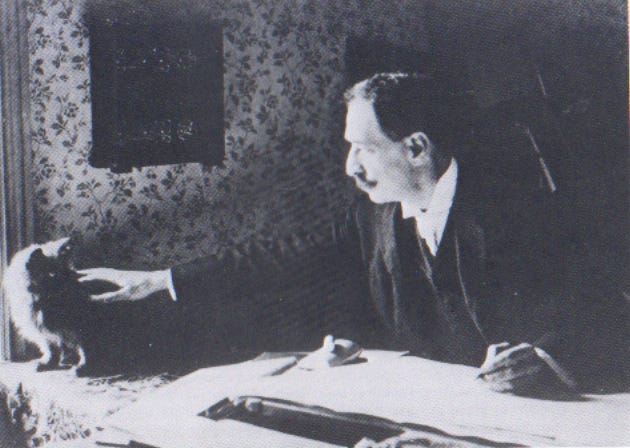
Louis Wain seated at his drawing table
Louis Wain at his drawing table, 1890.

He started drawing cats to comfort his dying wife. He ended his life in a pauper's ward, saved only by a public fund that H.G. Wells personally helped organize. In between, he became one of the most reproduced artists in England and still died broke.

  • Artist: Louis Wain, British, 1860 to 1939

  • Known for: anthropomorphic cats, hundreds of drawings a year, 16 Christmas annuals

  • Died: Napsbury Hospital, Hertfordshire, 1939

I think Wain gets flattened into a sad meme, the mad cat artist whose paintings supposedly document his descent into madness. The real story is stranger, funnier, and more generous than that meme allows.

A Governess, a Stray Kitten, and a Marriage

Louis William Wain was born in 1860 in Clerkenwell, London, the oldest of six children and the only son. When his father died, 20 year old Louis became responsible for supporting his mother and five sisters.

At 23, he married Emily Richardson, who had been his sisters' governess and was ten years older than him. It was already an unusual match by Victorian standards. Then, only a few years into the marriage, Emily was diagnosed with breast cancer.

The Cat Who Comforted a Dying Woman

During Emily's illness, the couple took in a stray black and white kitten they named Peter. Emily found real comfort in the animal, and she encouraged Louis to draw him, over and over, as a way to lift her spirits during her decline.

Those sketches became the foundation of his entire career. Emily pushed him to get them published. She died in 1887, only a few years after their wedding, but she lived long enough to see her husband start turning grief into a body of work that would define him.


One painting. One story. Every week. Free, with 170,000 readers who never sat through an art history lecture.


Three More Artists Whose Stories Get Flattened

Louis Wain is not the only artist whose real biography got simplified into a tidier, sadder legend. These three deserve the same second look.


How Louis Wain Invented the Cat as We Know It

Wain joined the staff of the Illustrated London News in 1886 and quickly became known for drawings of cats standing on two legs, dressed in waistcoats and dresses, playing cards, smoking, attending dinner parties, and generally behaving like small, mischievous humans.

This was not how Victorian Britain generally regarded cats before Wain. They were working animals, tolerated for catching mice, not household companions people doted on. His drawings reframed cats as clever, funny, and worth loving for their own sake.

H.G. Wells later summarized the shift bluntly: Wain had made the cat his own, inventing a cat style, a cat society, an entire cat world, so thoroughly that English cats who did not look and live like Louis Wain cats seemed to have something to be ashamed of.

Anthropomorphic cats dressed up watching a play
Louis Wain, Cats at the Play, early 20th century.

Postcards, Annuals, and a Face on Everything

Wain's cats were not confined to newspaper pages. They appeared on postcards, in advertisements, on ceramics, and in board games, spreading his particular version of cat personality into ordinary British homes long before mass media made that kind of reach common.

That reach is exactly what makes his financial situation so frustrating in hindsight. His cats were genuinely everywhere in British popular culture for decades, recognizable the way a mascot is recognizable, while the man who invented them kept almost none of the profit.

President of the National Cat Club

Wain's popularity was not a niche phenomenon. He produced hundreds of drawings a year, illustrated more than 100 children's books, and released 16 hugely popular Christmas annuals under his name.

He served as president of the National Cat Club twice, in 1898 and again in 1911, cementing his position as the public face of Britain's growing affection for the animal he had spent his career humanizing on paper.


No boring lectures, ever. Join 170,000 readers learning art the fun way, free.


The Slow Slide Into Poverty

Wain was a terrible businessman. He routinely sold his drawings outright for a flat fee, which meant publishers could reprint them endlessly without ever paying him another penny, no matter how popular the image became.

He was also supporting five unmarried sisters for most of his adult life on an illustrator's inconsistent income. After the First World War, public taste shifted and demand for his cat drawings declined sharply, right as his financial situation was already fragile.

The Diagnosis, and the Doctor Who Guessed the Order

In 1924, at 64 years old, Wain was committed to an asylum. Prime Minister Stanley Baldwin personally intervened to move him from a grim facility in Tooting to a more comfortable hospital, Napsbury, in Hertfordshire, where he would spend the rest of his life.

A doctor named Walter Maclay later assembled a group of Wain's paintings and arranged them in a sequence meant to show a clinical progression from realistic cats toward increasingly abstract, brightly patterned versions.

That sequence became the basis of the popular story that Wain's art visually documents his own worsening schizophrenia.

Cat face dissolved into a symmetrical kaleidoscope pattern
Louis Wain, Kaleidoscope Cat II, undated.

What the Psychedelic Cats Story Actually Gets Wrong

The problem is that Maclay's paintings were undated. There is no solid evidence they were painted in the order he arranged them in, and several art historians, including the specialist Chris Beetles, have argued the famous progression is largely invented.

In reality, Wain kept producing conventional, skillfully drawn cat pictures well into his later years, alongside occasional experiments with vivid, repeating patterns he called wallpaper designs. Those two styles appear to have coexisted rather than one steadily replacing the other.

Three cats singing, a conventional Louis Wain cat illustration from his later years
Louis Wain, Three Cats Singing, circa 1925 to 1939.

His schizophrenia diagnosis itself is also debated. Some researchers have proposed autism instead, pointing out that his technical skill never actually deteriorated the way a progressive breakdown would suggest.

The tidy narrative of madness visible in brushstrokes makes a better headline than it does honest art history.

Cat face rendered as a bright abstract pattern
Louis Wain, Psychedelic Cat, undated.

The Asylum Years and the Public Rescue

In 1925, the writer and bookshop owner Dan Rider discovered Wain drawing quietly in a pauper ward and was shocked by the conditions. Rider started a public fund to secure him better care.

The campaign drew support from Prime Minister Ramsay MacDonald and from H.G. Wells, whose public endorsement helped push the fund into the national press.

By the end of August 1925, Wain had been moved to Bethlem Royal Hospital, and he felt well enough that year to help organize an exhibition of 80 of his cat paintings at the XXI Gallery.

For more on artists whose personal lives shaped the images they are remembered for, 10 artists you need to know and the greatest painters of all time are worth reading next.

A Second Life on Screen

In 2021, Wain's story reached a much wider audience through The Electrical Life of Louis Wain, a biographical film starring Benedict Cumberbatch that covered his marriage to Emily, his cat drawings, and his years in institutional care.

The film leaned into the dramatic version of his mental health decline, the same version historians like Beetles have pushed back on, which shows just how durable Maclay's undated sequence of paintings turned out to be, more than 80 years after he first arranged them.

How He Died and What Was Left Behind

Wain lived out his final years at Napsbury Hospital, where the grounds reportedly included cats he was able to spend time with, and he continued drawing almost until the end. He died on July 4, 1939, at 78 years old.

He left behind thousands of images that had already done their work decades earlier, reshaping cats from tolerated pest control into the beloved household companions most of the world now takes completely for granted. That shift in affection outlived every publisher who underpaid him.

If you want to see how another artist turned personal loss directly into a signature body of work, famous self portraits is a good next stop.


More Artists Worth a Second Look

If Wain's real story surprised you, these three might too.


Ten minutes, one masterpiece. That is the deal. 170,000 readers already took it, free.


Quick Questions About Louis Wain

  • Why did Louis Wain start drawing cats? He and his wife Emily adopted a stray kitten named Peter during her illness with breast cancer, and drawing the cat became a way to comfort her and, later, to launch his career.

  • Did Louis Wain's paintings really show his schizophrenia getting worse over time? That popular story comes from an undated sequence arranged by a doctor decades later, and there is no solid evidence the paintings were actually made in that order.

  • Was Louis Wain actually diagnosed with schizophrenia? He was diagnosed with schizophrenia by doctors at the time, though some modern researchers have suggested autism instead, and the diagnosis remains genuinely debated.

  • Why did Louis Wain end up poor despite being famous? He routinely sold his drawings outright for flat fees, which let publishers reprint them endlessly without paying him again, while he also supported five unmarried sisters for most of his life.

  • Who helped save Louis Wain from poverty? A public fund organized in 1925 by writer Dan Rider, with support from Prime Minister Ramsay MacDonald and author H.G. Wells, moved him from a pauper ward to Bethlem Royal Hospital and better care.

  • How many cat pictures did Louis Wain make? He produced hundreds of drawings a year across a career spanning decades, illustrated more than 100 children's books, and released 16 popular Christmas annuals.

  • Where did Louis Wain die? He died at Napsbury Hospital in Hertfordshire in 1939, the same facility he had been transferred to years earlier through the personal intervention of Prime Minister Stanley Baldwin.

  • What was Louis Wain's biggest impact on culture? He is widely credited with changing how Britain viewed cats, turning them from tolerated pest control animals into beloved household companions through decades of humorous, anthropomorphic illustration.


Never miss a story. 170,000 readers get one painting explained every week, free.