
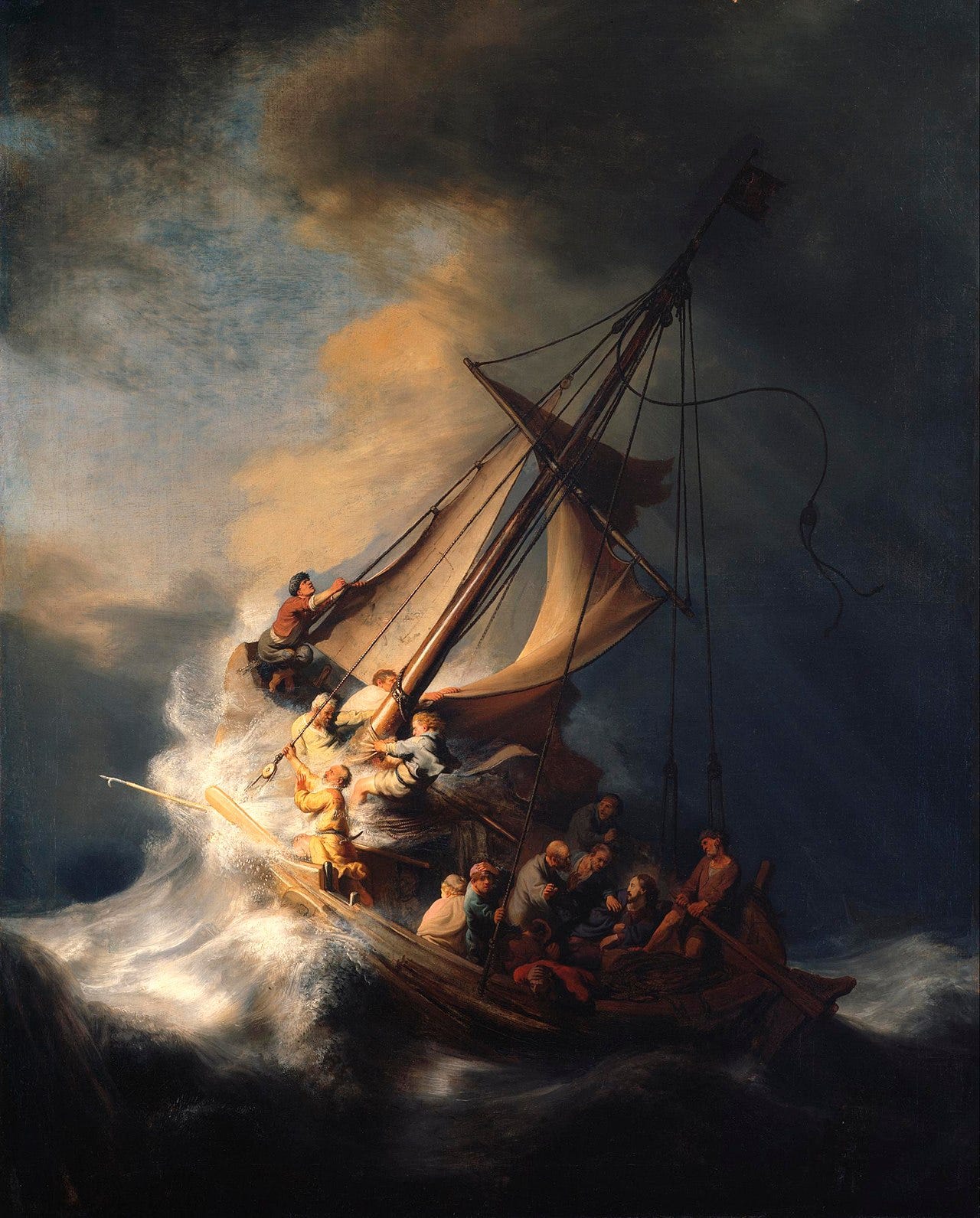
Rembrandt's The Storm on the Sea of Galilee has been missing since March 18, 1990, when two men dressed as police officers cut it from its frame at the Isabella Stewart Gardner Museum in Boston. It is Rembrandt's only known seascape. No one has been charged with the theft, and the FBI says the trail ran to Connecticut and the Philadelphia region before it went cold.
It was one of thirteen works taken in a single night, together worth more than half a billion dollars. The museum still keeps the empty frame on its wall.
Cool Stories About Art is a newsletter to learn art the fun way.
Join 200,000+ readers and get:
10 new art stories / month
The entire archive of content (1,000+ articles)
Comment, ask questions, and chat with other readers
The odd thing is that the FBI says it knows who did it. In March 2013, on the twenty third anniversary of the theft, Richard DesLauriers, the special agent in charge of the bureau's Boston office, announced that the thieves were members of a criminal organization based in the Mid Atlantic states and New England. He gave no names.
The Boston Globe has since reported that the bureau believes the two men who walked through the museum door were local criminals who both died in 1991.
If that is right, the men who held the painting are dead, and the people who could still be charged are those who knowingly hold or hide it. Prosecutors said in 2013 that the time limit for charges tied to the theft itself had run out, but that they were open to immunity deals in return for the paintings.
Nobody has been charged with the theft, and no painting has come back. The FBI believes it was carried to Connecticut and the Philadelphia region, and the trail stops there.
That leaves a puzzle. The bureau says it knows who the thieves were, prosecutors have offered to talk about immunity, and there is still no canvas. The story of how it was lost begins at a side door of the museum, at 1:24 in the morning.
Who rang the bell at the Gardner at 1:24 in the morning?
The man at the door wore a police uniform, and no one has ever been charged with putting him there. That night, students walking past the museum had noticed two uniformed men sitting in an unmarked hatchback, and one of them saw that it had no police license plate, but the group walked on.
At 1:24 a.m. on March 18, 1990, the car stopped at the employee entrance and one of the men pressed the buzzer, saying they were responding to a disturbance. The guard on duty, Richard Abath, broke protocol and let them in.
Inside, the thieves handcuffed Abath and a second guard and tied them up with duct tape in the basement. The Globe counts 81 minutes of work inside the building, which fits the museum's account that the men left at 2:45 a.m. The guards stayed handcuffed until police arrived at 8:15 a.m. Anthony Amore, the museum's security director, has called the plan "a kind of flimsy plan that worked."
Abath, who buzzed them in, has never been charged, and he has denied any role in the heist. He told the Globe in 2013 that a federal investigator once said to him, "we've never been able to eliminate you as a suspect."
Federal authorities have also released a security video from the night before that shows Abath admitting a man they call an "unauthorized visitor." Abath said he did not recognize the man, and he has declined to comment on the video. The thieves themselves spent their 81 minutes on two floors, and not everything they carried out made sense.
What You'll Discover
What they cut from its frame.
What the FBI knows and won't say.
The painting a reporter was shown.
What hangs in its place.