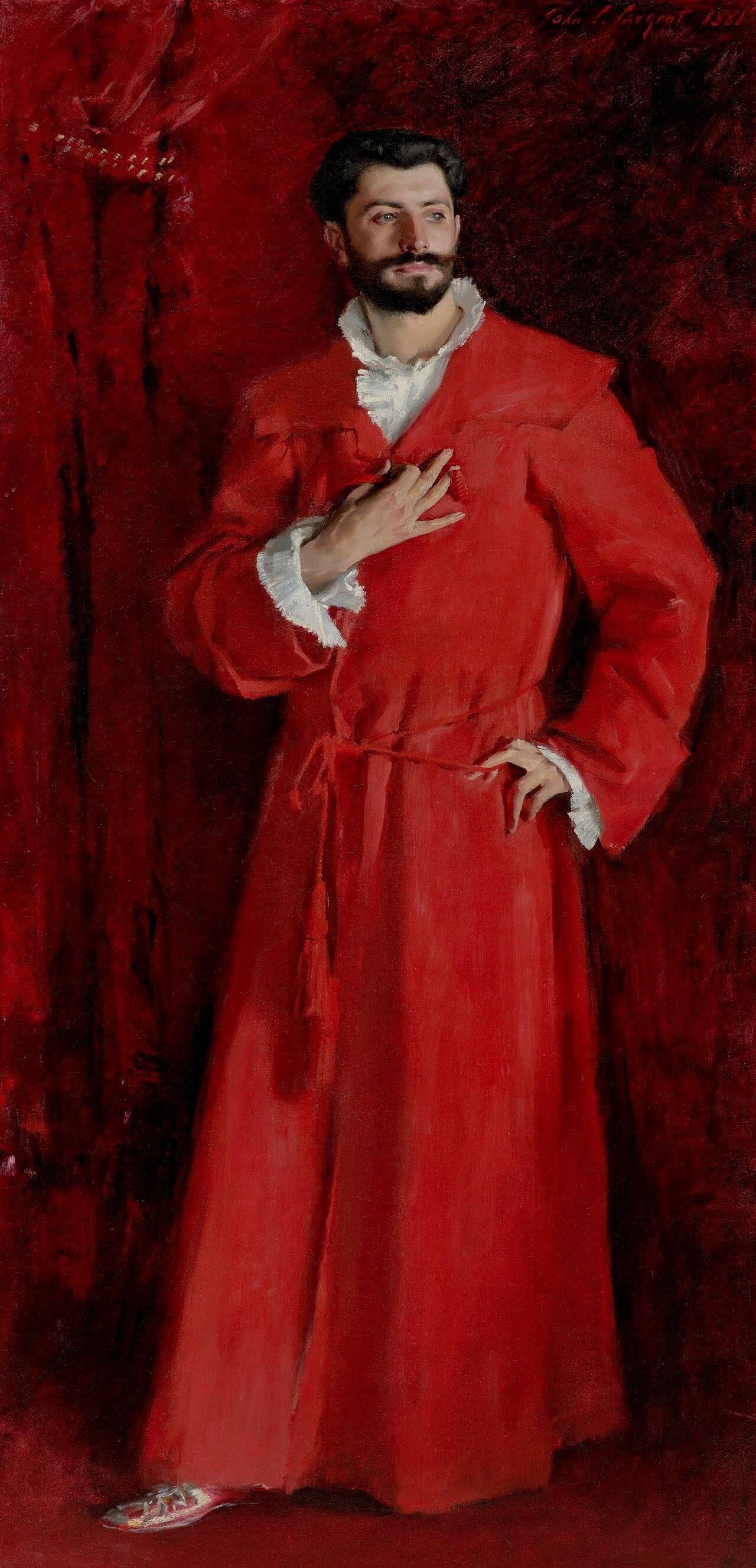
Dr Pozzi at Home is an 1881 portrait by John Singer Sargent of the French surgeon Samuel Pozzi, standing in a scarlet dressing gown, hand pressed to his chest like a cardinal posing for a Renaissance master.
Pozzi was 35, already one of the most talked about men in Paris, a brilliant gynecologist and a legendary womanizer whom Sarah Bernhardt nicknamed Docteur Dieu, Doctor God.
Artist: John Singer Sargent, American, 1856 to 1925
Painted: 1881, when Sargent was 25 years old
Housed at: The Hammer Museum, Los Angeles
More Portraits With a Story Behind Them
The ones I would send you to next.
Who Was the Man in the Red Robe
Samuel Jean Pozzi was born in 1846 in Bergerac, in the southwest of France. By the time Sargent painted him, he was already building a reputation as the man who would establish the first Chair of Gynecology in Paris.
He was also, by every account from his contemporaries, one of the most attractive men in French society. Marcel Proust knew him. Sarah Bernhardt loved him. He collected art, hosted salons, and dressed with a precision that made him look staged even when he was not.
Sargent met him through the painter's own social circle and asked to paint him at home, in his dressing gown, rather than in the formal black suit a surgeon of his standing would normally wear for a portrait.
The Nicknames Paris Actually Used
Sarah Bernhardt called him Docteur Dieu. The two met when they were young, became lovers, and stayed close friends for the rest of his life, which tells you something about how Pozzi handled the people he had once seduced.
The salon hostess Madame Aubernon gave him a different nickname, l'amour medecin, borrowed straight from the title of a Moliere comedy about a doctor who cures through love rather than medicine.
Both nicknames describe the same reputation from two different angles. One frames him as a god. The other frames him as a joke everyone was in on, including Pozzi himself.
Why Sargent Painted Him in a Dressing Gown
The robe is the whole argument of the painting. Sargent had Pozzi pose in his own home, in a floor length scarlet robe with a high collar, instead of the stiff formal dress that defined most male portraiture of the period.
The color and the drapery deliberately echo portraits of popes and cardinals by the old masters, the kind of red robe that signals authority and ceremony. Sargent borrowed that visual authority and handed it to a gynecologist standing in his own living room.
It is a strange, specific choice. A doctor dressed like a prince of the church, at home, informally, mid gesture, one hand resting against his chest as if he is about to make a confession or start a seduction.
The Hands That Give Him Away
Look at his hands. Sargent painted them long, elegant, and very deliberately placed, one gathering the folds of the robe near his waist, the other pressed flat against his chest.
Those hands are doing double duty. They are a surgeon's hands, precise enough to matter in an operating room. They are also, in this pose, an unmistakably theatrical gesture, the kind an actor uses on stage to signal intimacy or sincerity.
Sargent was 25 when he painted this, still early in his career, and already this good at making a single detail carry two meanings at once.
More Secrets to Unlock
A few more stories worth your time.
Sargent's Career Right Before the Scandal
Sargent was born in Florence in 1856 to American parents and trained in Paris under Carolus Duran, a fashionable portraitist known for teaching his students to paint fast, directly, without heavy underdrawing.
Dr Pozzi at Home came early in that Paris period, three years before the portrait that would nearly destroy Sargent's French career, Madame X, whose plunging black dress and pale skin caused a public scandal at the 1884 Salon.
After that controversy, Sargent left Paris for London and rebuilt his reputation as the portraitist of choice for wealthy English and American society. Dr Pozzi at Home is a glimpse of the bolder, less cautious painter he was before that backlash changed his approach.
A Portrait That Almost Didn't Sell
This was Sargent's first large portrait of a male subject, and it became the first work he ever exhibited at the Royal Academy in London. It did not make him famous the way his later portraits would.
The painting stayed in a kind of limbo for decades, passed among collectors, never quite achieving the status of Sargent's more celebrated female portraits from the same era. It took almost a century for it to land somewhere permanent.
The Museum It Ended Up In
The industrialist and collector Armand Hammer bought Dr Pozzi at Home in 1967. It has been part of the Hammer Museum in Los Angeles since 1991, where it remains one of the most reproduced portraits in the collection.
At just over two meters tall, the painting is nearly life size, so visitors end up standing at Pozzi's own height, looking him directly in the eye the way Sargent's original sitters would have.
The Women in Dr Pozzi's Life
Sarah Bernhardt was the most famous of Pozzi's relationships, but she was far from the only one. He was married, to Therese Loth Cazalis, and the marriage was reportedly unhappy for both of them for most of its length.
Contemporaries described a long list of affairs, conducted with enough discretion and charm that most of the women involved apparently stayed on good terms with him afterward. That pattern, seduction without lasting resentment, is part of why Paris found him so fascinating.
It also connects him to Marcel Proust, who knew Pozzi through his own father, the physician Adrien Proust. Pozzi treated Marcel Proust as a patient for years and is widely considered one of the models behind the character Doctor Cottard in In Search of Lost Time.
The Surgeon Behind the Dandy
It is easy to look at this portrait and see only the costume. Pozzi's actual medical career was serious and genuinely important to the history of surgery in France.
He was an early and consistent advocate of Joseph Lister's antiseptic techniques at a time when many French surgeons still resisted them, and his push for hygienic surgical practice saved lives well beyond his own operating room.
In 1884 he became the first professor to hold a dedicated Chair of Gynecology in Paris, a position that let him train a generation of French surgeons in techniques he had spent years refining.
The Book That Brought Him Back
In 2019 the novelist Julian Barnes published The Man in the Red Coat, a biography built almost entirely around this single portrait, tracing Pozzi's life and the wider world of Belle Epoque Paris that produced him.
That book reintroduced Pozzi and this painting to a much wider audience outside art history circles, and it is a large part of why Dr Pozzi at Home gets discussed today far more than most 19th century male portraits.
A Killing In His Own Consulting Room
Pozzi's death was violent and sudden. On June 13, 1918, a former patient named Maurice Machu came to his consulting room in Paris. Two years earlier, Pozzi had amputated one of Machu's legs, an operation that had also left him impotent.
Machu asked Pozzi to operate again and reverse the damage. Pozzi told him, honestly, that there was nothing more he could do. Machu shot him four times in the stomach, then killed himself.
Pozzi asked to be buried in his military uniform and died shortly after the shooting, at 71 years old, in the same city where he had spent his entire career being simultaneously admired and gossiped about.
Why This Portrait Still Stops People
Most 19th century male portraits are stiff on purpose. Dark suits, closed postures, faces built to project authority through restraint. Dr Pozzi at Home breaks every one of those rules.
Sargent painted a man who is fully aware of his own effect on people and comfortable enough with that fact to let it show, at home, in a robe, without a shred of the usual formal armor.
That confidence is why the painting still reads as modern more than a century later. Pozzi is not performing dignity for the viewer. He is simply being looked at, and he clearly does not mind.
If distinctive personalities captured in paint are what draw you in, the greatest painters of all time and 10 artists you need to know are good places to keep going.
FAQ
Who was Dr Pozzi?
Samuel Jean Pozzi, a French surgeon who established the first Chair of Gynecology in Paris and was also one of Belle Epoque society's most talked about men.
Who painted Dr Pozzi at Home?
John Singer Sargent, in 1881, when he was 25 years old and still early in his Paris career.
Why is Pozzi wearing a red robe in the portrait?
The color and drapery echo portraits of popes and cardinals by the old masters, borrowing that visual authority for a gynecologist standing in his own home.
Where can you see Dr Pozzi at Home today?
It hangs in the Hammer Museum in Los Angeles, where it has been since 1991, after Armand Hammer bought it in 1967.
How did Dr Pozzi die?
He was shot by a former patient, Maurice Machu, in his consulting room on June 13, 1918. Machu then killed himself.
What is The Man in the Red Coat about?
It is a 2019 biography by Julian Barnes, built almost entirely around this portrait, tracing Pozzi's life and the Belle Epoque Paris that produced him.
Was Dr Pozzi involved with Sarah Bernhardt?
Yes. They became lovers when young and stayed close friends for the rest of his life. She nicknamed him Docteur Dieu, Doctor God.
How old was Sargent when he painted this?
He was 25, and it was his first large portrait of a male subject and the first work he exhibited at the Royal Academy in London.