What Is the Story of Self Portrait in the Green Bugatti?

Tamara de Lempicka never owned a Bugatti. Here is what she really drove, and why the fake car became one of the most famous images of the century.

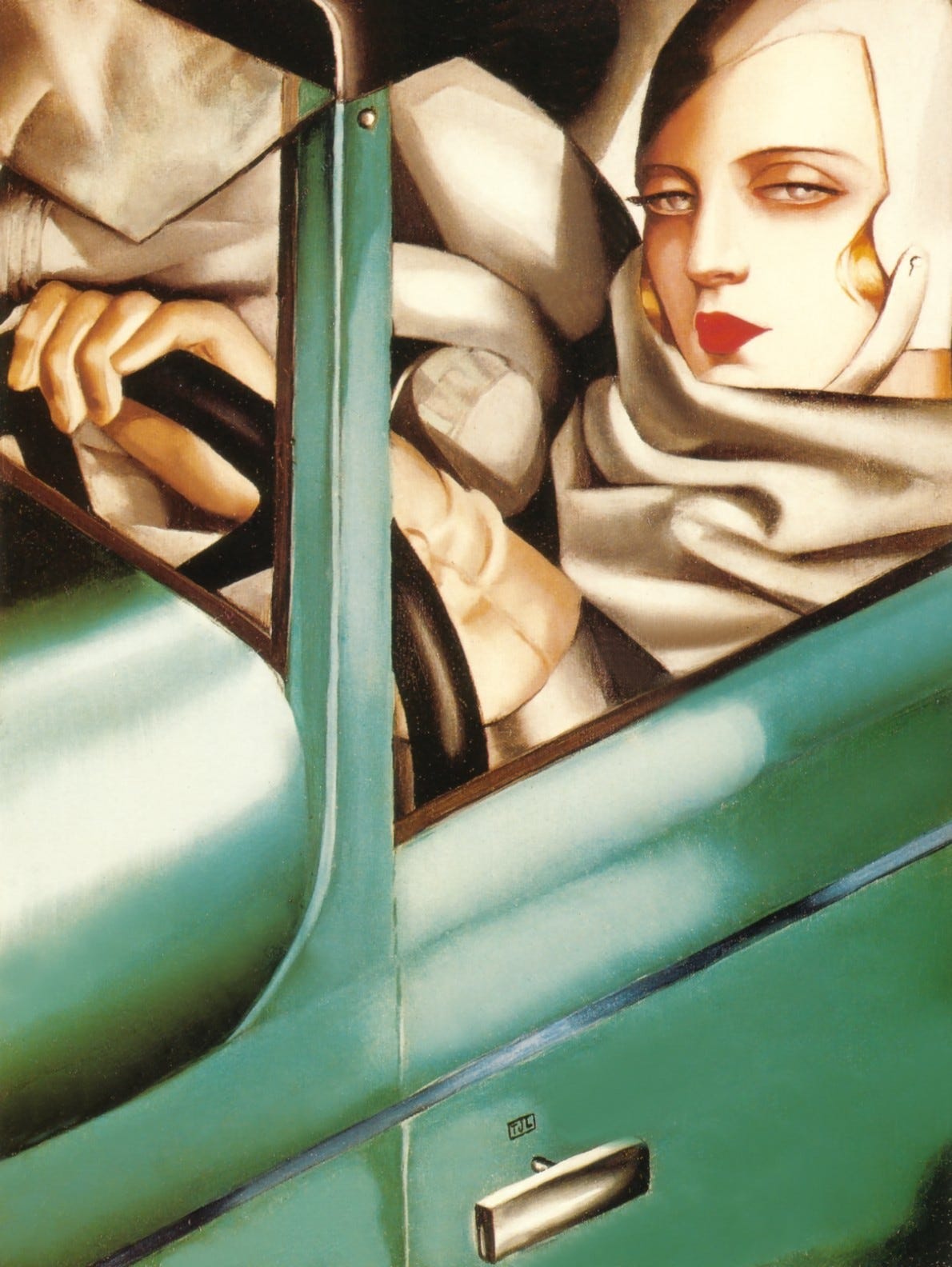
Tamara de Lempicka painted this in 1929 for a magazine cover, and she never owned a Bugatti. Her real car was a small yellow Renault, stolen one night while she celebrated with friends in Montparnasse.

Tamara de Lempicka self portrait, the artist behind the wheel of a green car, painted for a 1929 magazine cover
Tamara de Lempicka, Self Portrait in the Green Bugatti (Tamara in the Green Bugatti), 1929

I first saw this painting on a coffee mug, long before I knew who painted it or why. That is probably how most people meet it now.

  • Artist: Tamara de Lempicka, 1898 to 1980

  • Painted: 1929, for the cover of Die Dame magazine

  • Style: Art Deco, hard edged glamour portraiture


Learn art the fun way. Join 170,000 readers getting one painting and its story every week.


More Portraits Worth Knowing

Lempicka was one of many artists who turned a self image into legend. These stories look at portraits, and the women behind them, from a few other angles.


Who Was Tamara de Lempicka Before This Painting

Black and white period photograph portrait of Tamara de Lempicka wearing a hat
Tamara de Lempicka, portrait photograph, Paris, circa 1930s

The real story behind the image is stranger and more calculated than the glamour it sells. Lempicka was born in Poland, grew up mostly in Russia, and fled to Paris after the 1917 revolution with her husband, a lawyer who had been arrested by the Bolsheviks.

She married Tadeusz Lempicki, a Warsaw lawyer, in 1916, and once they reached Paris she added the aristocratic de to her married name herself, a small piece of self invention that fit everything else she did.

In Paris she had no money and no name. She taught herself to paint by studying with Andre Lhote and Maurice Denis, and she built a client list of aristocrats, industrialists, and their mistresses who wanted portraits that made them look expensive.

By the late 1920s she was one of the most requested portrait painters in the city. She dressed the part, drove fast when she could afford to, and understood image management decades before anyone had a word for it.

Tamara de Lempicka portrait painting of a young woman in a blue dress, Art Deco style
Tamara de Lempicka, Portrait of a Young Woman in a Blue Dress.

A Magazine Cover, Not a Confession

I used to assume this painting was Lempicka showing off her own life. It reads like a boast, a glamorous woman gripping a wheel, scarf snapping in the wind, eyes fixed and cold.

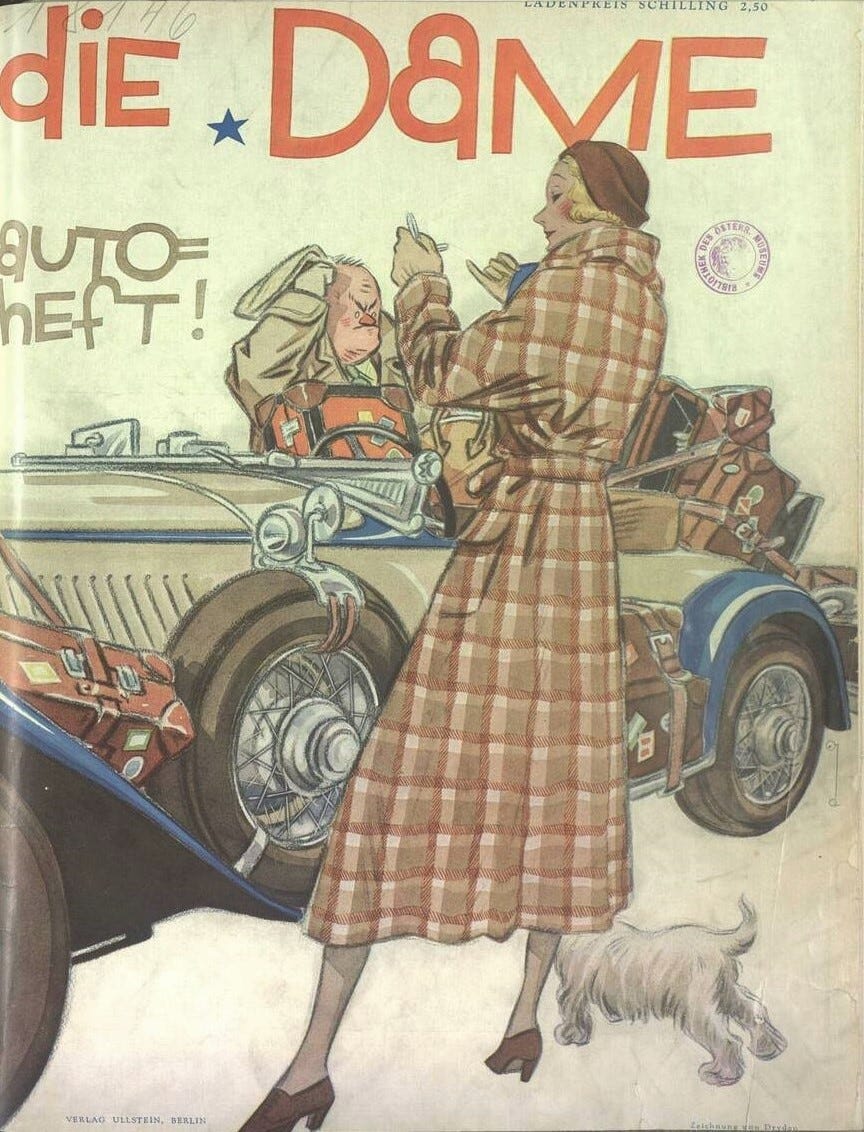
The truth is more interesting. The German magazine Die Dame commissioned the image in 1929 for a cover celebrating the modern, independent woman. It ran that October.

A car cover was smart marketing, not a diary entry. It put Lempicka's name in front of readers across Europe who had never bought one of her portraits and never would, but who would remember her name.

Serious art critics of the period mostly ignored magazine commissions like this one, since illustration work was considered beneath real painting. That snobbery is part of why it took decades for Lempicka's reputation to catch up with her talent.

The Photograph She Copied

Lempicka did not invent this pose from nothing. A year earlier, in October 1928, the French weekly Vu ran a cover photograph by Andre Kertesz of a young woman behind the wheel of a sports car, helmet and scarf included.

Lempicka borrowed the setup closely: the tight helmet like hat, the leather collar, the scarf caught mid air. She replaced the photographer's model with herself, and the ordinary car with a Bugatti, the fastest and most wanted machine of the era.

One of the most reproduced images of the twentieth century started as a painter's remix of someone else's magazine photo shoot. Art history rarely admits how much borrowing happens at the top.

Why a Bugatti, Specifically

Bugatti was not just any car in 1929. Ettore Bugatti built machines in Molsheim, in eastern France, that dominated Grand Prix racing through the 1920s, winning events across Europe with a level of engineering polish few rivals could match.

Owning one signaled money, taste, and a life spent somewhere other than behind a desk. A Bugatti Type 43 or Type 46, the models closest to the one in the painting, cost more than most people earned in years.

Lempicka did not need to own the car to understand what it meant. She had spent a decade painting the people who did own cars like it, and she knew exactly which details would make a reader stop turning pages.

The Woman at the Wheel

Lempicka paints herself with gloved hands locked on the wheel, chin lifted, mouth set. She does not look at the viewer with warmth. She looks past us, already somewhere else.

That distance was the point. In 1929, a woman driving alone, fast, and unbothered by anyone's opinion was still a small act of defiance. Lempicka sold that defiance as glamour, and readers bought it.

I think that is why the image still works on a phone screen a century later. It is not really about a car. It is a woman deciding she answers to no one, rendered in hard edges and cool color.

The Technique Behind the Glamour

Look closely at the painting and the surface is almost impossibly smooth. Lempicka trained under Andre Lhote, who taught a softened version of Cubism, and she carried its faceted, geometric shading into every fold of fabric and curve of metal.

She also studied the classical portrait tradition, particularly Jean Auguste Dominique Ingres, whose influence shows in the porcelain finish of her skin tones. The combination is why her subjects look less like people and more like objects built to be admired.

That coldness was not a flaw. It was the entire selling point. A Die Dame reader in 1929 was not looking for warmth on a magazine cover. She was looking for a version of herself she could aspire to, and Lempicka delivered exactly that, one hard edge at a time.

Tamara de Lempicka painting of four nude figures in her signature faceted Art Deco style
Tamara de Lempicka, Groupe de quatre nus (Group of Four Nudes).

The Car That Never Existed in Her Garage

Here is the detail that surprises almost everyone the first time they hear it. Tamara de Lempicka did not own a Bugatti.

Her actual car at the time was a small yellow Renault. One night, while she and her friends celebrated at the Cafe de la Rotonde in Montparnasse, someone stole it off the street.

A green Bugatti looked like freedom and money. A stolen yellow Renault looked like an artist living paycheck to paycheck in a city full of thieves. She chose the fantasy, and it worked so well that people still repeat it as fact.

There is a second detail hiding in plain sight. Lempicka painted the steering wheel on the left side of the car. The real Bugatti models from that period, the 23, the 43, the 46, all had the wheel on the right. She was not documenting a vehicle. She was building an icon.

She was hardly the only artist of her era rewriting her own biography. Self invention was practically a job requirement among the international set living in Paris between the wars, and Lempicka played the game better than most.

Why the Fantasy Still Sells

I find this useful to remember whenever someone insists a famous painting must be true because it looks so specific. Specific and true are not the same thing.

Lempicka painted during the Art Deco years, between the two world wars, when speed, machinery, and hard geometric shapes became glamorous in a way they had never been before. Cars, trains, and skyscrapers were the era's status symbols, and she painted herself wearing that status like a coat.

Scholars who catalog her work usually call the painting My Portrait, closer to the title Lempicka gave it herself. Green Bugatti became the popular name because that is the detail people remember, which says everything about how an image changes once it leaves the artist's hands.

I think about this whenever someone asks a photographer to make a headshot look more successful than the actual week behind it. Lempicka was doing the same job in 1929, just with oil paint instead of a filter.

The Painting's Afterlife

The cover made her recognizable, but her later years were far less glamorous than the image she sold to Die Dame's readers.

She left Europe as the political situation worsened through the 1930s, eventually settling in the United States and later in Mexico, where she died in 1980. Fashions in art moved on without her for decades, and her work fell out of critical favor.

It came back hard. Collectors including Jack Nicholson and Madonna started buying her paintings in the 1970s and 1980s, and Green Bugatti became one of the most licensed Art Deco images in the world, printed on posters, book covers, and phone cases.

Her reputation has recovered enough that some critics now rank her among the greatest painters of all time.

Her auction prices tell the same story. Other Lempicka paintings have sold for tens of millions of dollars in the past decade, climbing into the same territory as the most expensive paintings ever sold.

A woman who faked owning a sports car for a magazine cover ended up more famous than most people who owned a real Bugatti in 1929.

Her story even made it to Broadway. A musical called Lempicka, starring Eden Espinosa, opened at the Longacre Theatre in April 2024. It closed after a short run, but its existence says something about how much appetite there still is for her life story, car and all.


One painting. One story. Every week. Free, with 170,000 readers who never sat through an art history lecture.


More Secrets to Unlock


FAQ

  • Did Tamara de Lempicka really own a green Bugatti?

    No. She owned a small yellow Renault, which was stolen outside a cafe in Montparnasse. The Bugatti in the painting was invented for the image, chosen because it was the most desirable car of the moment.

  • What is the real title of the painting?

    Lempicka called it My Portrait. Green Bugatti, or Tamara in a Green Bugatti, became the popular nickname because of the car, and it is the name most people search for today.

  • Who commissioned the painting?

    The German magazine Die Dame commissioned it in 1929 as a cover celebrating independent modern women. It was published that October.

  • Was the pose inspired by a photograph?

    Yes. A 1928 cover of the French magazine Vu, shot by photographer Andre Kertesz, showed a woman at the wheel of a sports car in a similar helmet and scarf. Lempicka adapted that composition for her own self portrait.

  • Is the car in the painting historically accurate?

    No. Real Bugatti models from that period had the steering wheel on the right side. Lempicka painted it on the left, which suggests she was working from memory and imagination rather than a real vehicle in front of her.

  • Is this one of the most famous self portraits ever painted?

    Yes. It regularly appears on lists of famous self portraits, alongside other artists who used their own face to build a public image long before social media existed.


No boring lectures, ever. Join 170,000 readers learning art the fun way, free.