What Is the Story of Sorolla's Strolling Along the Seashore?

Inside the 1909 beach walk that made a painter's wife and daughter famous forever.

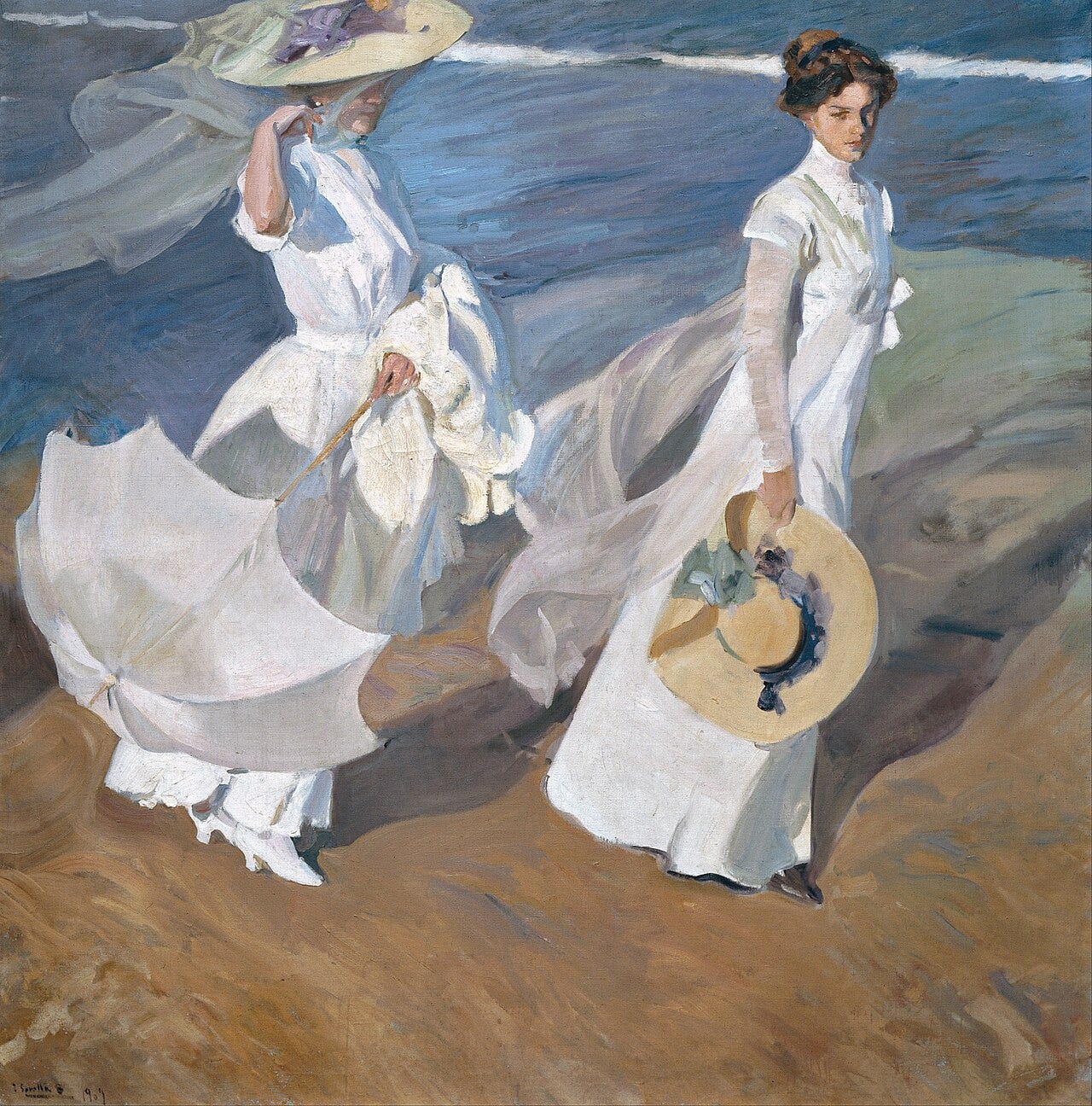
Strolling Along the Seashore is a 1909 painting by Joaquin Sorolla, showing his wife Clotilde and their eldest daughter Maria walking a Valencia beach. He painted it months after a sold out New York show, home rich and famous, on an ordinary family walk instead.

Clotilde and Maria walking the beach
Joaquin Sorolla, Strolling Along the Seashore, 1909.

It is painted in broad blue and violet strokes that made it one of the defining works of Spanish luminism.

  • Artist: Joaquin Sorolla, Spanish, 1863 to 1923

  • Painted: 1909, months after his sold out New York show

  • Housed at: The Museo Sorolla, Madrid


Learn art the fun way. Join 170,000 readers getting one painting and its story every week.


More Paintings Full of Light and Ordinary Days

The ones I would send you to next.


A Walk That Was Never Really a Walk

The painting looks like a snapshot. That is the whole trick. Clotilde's wide brimmed hat is cut off at the top edge of the canvas, and there is an empty strip of sand at the bottom that a formal composition would never leave in.

Sorolla was borrowing the logic of photography, which was everywhere in Spain by 1909. Cameras froze people mid step, cut off the tops of hats, left odd gaps of empty foreground. He used that visual language on purpose, on a canvas over two meters wide.

The dresses do the rest of the work. Both women wear long white cotton dresses that catch the wind, and the fabric folds in the same direction as their scarves and Maria's hat ribbon. It reads as one gust of wind captured in a single instant, not a pose held for minutes.

The Painting's Two Names

In Spanish the title is Paseo a orillas del mar, which translates literally to a walk at the edge of the sea. English sources translate it a few different ways, Strolling Along the Seashore, Walk on the Beach, and sometimes Women Walking on the Beach.

That is not a small detail if you are trying to find it online. All three titles point to the exact same 1909 canvas in the Museo Sorolla, so do not assume you have found three different paintings when you search.

Who Clotilde and Maria Really Were

Clotilde Garcia del Castillo married Sorolla in 1888. She was the daughter of his first teacher's business partner, and she appears in more of his paintings than any other person, by a wide margin.

Maria was their first child, born in 1890, so she was about 19 when this painting was made. She would go on to marry the painter Victor Manuel Guillen Ferrandiz, and she is the daughter Sorolla painted most often as she grew up.

Clotilde was not just a model. After Sorolla's death she donated the family house, his studio, and most of his remaining paintings to the Spanish state in 1925. That gift became the Museo Sorolla.

Sorolla portrait of Clotilde in evening dress
Joaquin Sorolla, Clotilde in Evening Dress.

One painting. One story. Every week. Free, with 170,000 readers who never sat through an art history lecture.


More Secrets to Unlock

A few more stories worth your time.


Coming Home From New York a Different Painter

In March 1909, Sorolla opened a solo exhibition of 356 paintings at the newly built Hispanic Society of America in New York, at the invitation of its founder Archer Huntington.

The show pulled in roughly 160,000 visitors in four weeks. The museum stayed open until 11pm to handle the crowds, and Sorolla sold close to 200 paintings to American collectors.

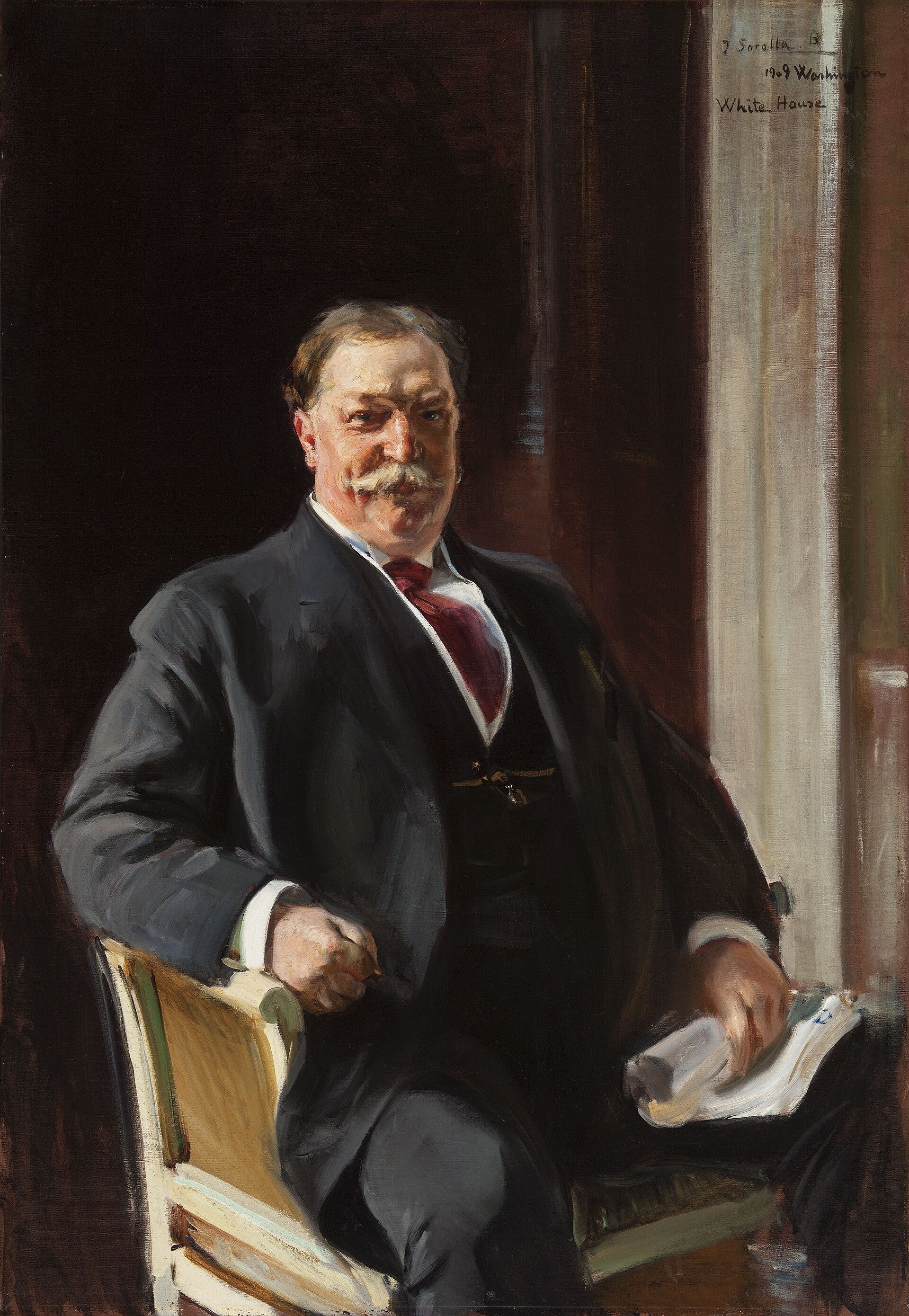
He stayed in the United States for months afterward, painting portraits on commission, including one of President William Howard Taft. He went home to Spain that summer wealthier and more famous than he had ever been, and he spent it painting his wife and daughter on a beach in Valencia.

Two years later, in 1911, he used part of that fortune to build a house and studio in Madrid. Strolling Along the Seashore has not left that house since.

The Beach Paintings He Made Before This One

Sorolla had been painting the beaches of Valencia for two decades before 1909, but earlier ones are a different kind of picture entirely. Sewing the Sail, from 1896, shows fishermen's wives repairing a huge canvas sail in dappled shade.

Sad Inheritance, from 1899, is harder to look at. It shows disabled boys bathing in the sea under the care of a monk, and it won the Grand Prix at the 1900 Paris Exposition. Sorolla rarely gets credit for how directly he painted poverty and illness earlier in his career.

By 1909, that register was mostly gone from his beach scenes. Strolling Along the Seashore belongs to a later, sunnier decade, when Sorolla painted his own family at leisure instead of fishermen at work. The subject changed because his life had changed.

Sorolla children with small sailing boat
Joaquin Sorolla, The Little Sailing Boat.

Painting Wind You Cannot Touch

Sorolla painted almost entirely outdoors, working fast, in a single sitting whenever he could manage it. Beach scenes like this one were painted directly on the sand, not staged later in a studio from sketches.

That method forced a kind of shorthand. He could not render every fold of fabric or every grain of sand while the light and the wind kept changing, so he laid down broad, loaded strokes that suggest form rather than describe it.

Look closely at the sea in this painting and it dissolves into unconnected patches of blue, mauve, and turquoise. Step back and it reads instantly as water catching the midday sun.

That gap between what the paint actually is and what your eye decides it means is the whole engine of the picture.

The Small Sketches Behind the Big Canvas

Before a large beach scene like this one, Sorolla often made rapid oil sketches on small wood panels, right there on the sand, to study one specific effect of light for a few minutes before it changed.

Those small panels were not preliminary drawings in the usual sense. They were closer to notes, fast enough to catch a single passing condition of weather that would be gone in under an hour.

Several of them survive and now hang in the Museo Sorolla alongside the finished paintings, which gives visitors a rare, direct look at how a two meter wide masterpiece actually started as a five minute study.

The Palette Sorolla Actually Used

Sorolla worked from a huge palette loaded with far more paint than most of his contemporaries would use in a single session. He needed that much because he rarely mixed colors on the canvas itself. He mixed on the palette, then applied the stroke once, decisively.

For the brightest highlights, the sunlit edge of a wave or the crown of a hat, he sometimes applied paint almost straight from the tube, thick enough to catch real light off the surface of the canvas. That is why his whites in this painting look lit from within rather than simply pale.

His easel, brushes, and palette are still on display in his old studio in Madrid, now part of the Museo Sorolla, largely unchanged since the day he stopped painting in 1920.

If you want to see how differently other painters have handled a single memorable image, this piece on the saddest paintings in art history is a useful contrast. Sorolla is chasing joy on purpose, and it shows in every choice he made that summer.

Beach of Valencia in morning light
Joaquin Sorolla, Beach of Valencia by Morning Light, 1908.

What Luminism Actually Means Here

Sorolla is usually filed under Spanish luminism, a label that gets thrown around loosely. In practice it means his real subject was never the people or the beach. It was the specific quality of Mediterranean light at a specific hour.

He shared some tools with French Impressionism, broken color, visible brushwork, outdoor painting. But Sorolla kept a much stronger sense of drawing and structure underneath the light effects. The figures never dissolve completely the way they sometimes do in Monet.

In Strolling Along the Seashore, the light is doing narrative work too. It bleaches the dresses almost white, throws hard shadows under the hats, and turns the wet sand into a mirror. Midday Valencian sun, and nothing else, is the reason this painting looks the way it does.

The House That Painting Never Left

Strolling Along the Seashore is the centerpiece of the Museo Sorolla in Madrid, the same house Sorolla built in 1911 with money from his American tour.

Sorolla kept painting almost until the end. In 1920, while working in the garden of that same house, he suffered a stroke that left him paralyzed. He never painted again, and he died on August 10, 1923.

Clotilde outlived him by two years and used that time to make sure the house, the studio, and the paintings stayed together instead of being sold off piece by piece. That decision is the only reason you can still stand in front of this exact canvas today, in the room it was always meant for.

Sorolla portrait of mother and child
Joaquin Sorolla, Mother, 1895.

A Detail Almost Everyone Scrolls Past

Look at Maria's feet. Sorolla barely paints them, just a few quick strokes suggesting motion against wet sand. He is not interested in anatomical accuracy at that scale. He is interested in speed, in making you feel the next step before it happens.

That same restraint shows up in the horizon line, which Sorolla removed almost entirely. Sea and sky blur into each other at the top of the canvas, so nothing competes with the two women for your attention.

It is worth comparing this kind of quiet, personal subject to painters working on the opposite end of the emotional scale. If bright, joyful pictures are not your usual interest, the most expensive paintings ever sold shows how differently the art market prices spectacle versus intimacy.

Sorolla's beach scenes were never his highest sellers, but they are the works people travel to Madrid specifically to see.

Visiting It Today

The Museo Sorolla sits on General Martinez Campos street in Madrid, in the house and garden Sorolla designed himself. Strolling Along the Seashore hangs among dozens of other family portraits, garden studies, and beach scenes, so you can trace the whole arc of his career in a couple of rooms.

It is a small museum by Madrid standards, which is exactly why it works. There is no competing with a hundred other masterpieces down the hall. You get Sorolla, on his own terms, in the house his own family actually lived in.

Why This Painting Still Works

Part of it is scale. At 205 by 200 centimeters, the canvas is almost square and nearly life size, so standing in front of it in Madrid puts you at eye level with Clotilde and Maria, mid stride, forever.

Part of it is that Sorolla never over explains the scene. There is no story being told beyond two women walking on a beach on an ordinary summer day. He trusted the light and the brushwork to carry all of the emotional weight, and it does.

I think that restraint is the real lesson of this painting. Sorolla had just proven, in New York, that he could paint anything and sell it. He chose to paint his wife and daughter walking on sand instead, and it became the single image most people associate with his entire career.

For more on painters who built entire careers around a handful of unforgettable images, the greatest painters of all time is a good next stop.


Ten minutes, one masterpiece. That is the deal. 170,000 readers already took it, free.


FAQ

  • Who painted Strolling Along the Seashore?

    Joaquin Sorolla, a Spanish painter known for capturing Mediterranean light, painted it in 1909.

  • Who are the two women in the painting?

    Clotilde Garcia del Castillo, Sorolla's wife, and Maria, their eldest daughter, who was about 19 at the time.

  • What are the painting's other names?

    In Spanish it is Paseo a orillas del mar. English sources also call it Walk on the Beach or Women Walking on the Beach, all referring to the same 1909 canvas.

  • Where can you see the painting today?

    It hangs in the Museo Sorolla in Madrid, inside the house Sorolla built for his family in 1911.

  • What is Spanish luminism?

    A loose label applied to Sorolla's style, meaning his real subject was the specific quality of Mediterranean light rather than the people or scene themselves.

  • When did Sorolla paint Strolling Along the Seashore?

    In the summer of 1909, only months after a sold out solo exhibition in New York that made him rich and internationally famous.

  • How big is the painting?

    It measures roughly 205 by 200 centimeters, almost square, which puts viewers close to eye level with the two women.

  • Did Sorolla paint darker beach scenes too?

    Yes. Sad Inheritance, from 1899, shows disabled boys bathing in the sea under a monk's care, a far more somber register than his later, sunnier family scenes.


No boring lectures, ever. Join 170,000 readers learning art the fun way, free.