

170 000+ readers. Learn art the fun way.
This is a preview. Paid subscribers get the full story.
You’ll also get:
10 new stories every month
The full archive (120+ Art stories)
Your personal art guide. Comment, ask questions, DM me anytime
iPhone user? Subscribe at coolstoriesabout.art, not via the app. Apple adds 30% to the price.
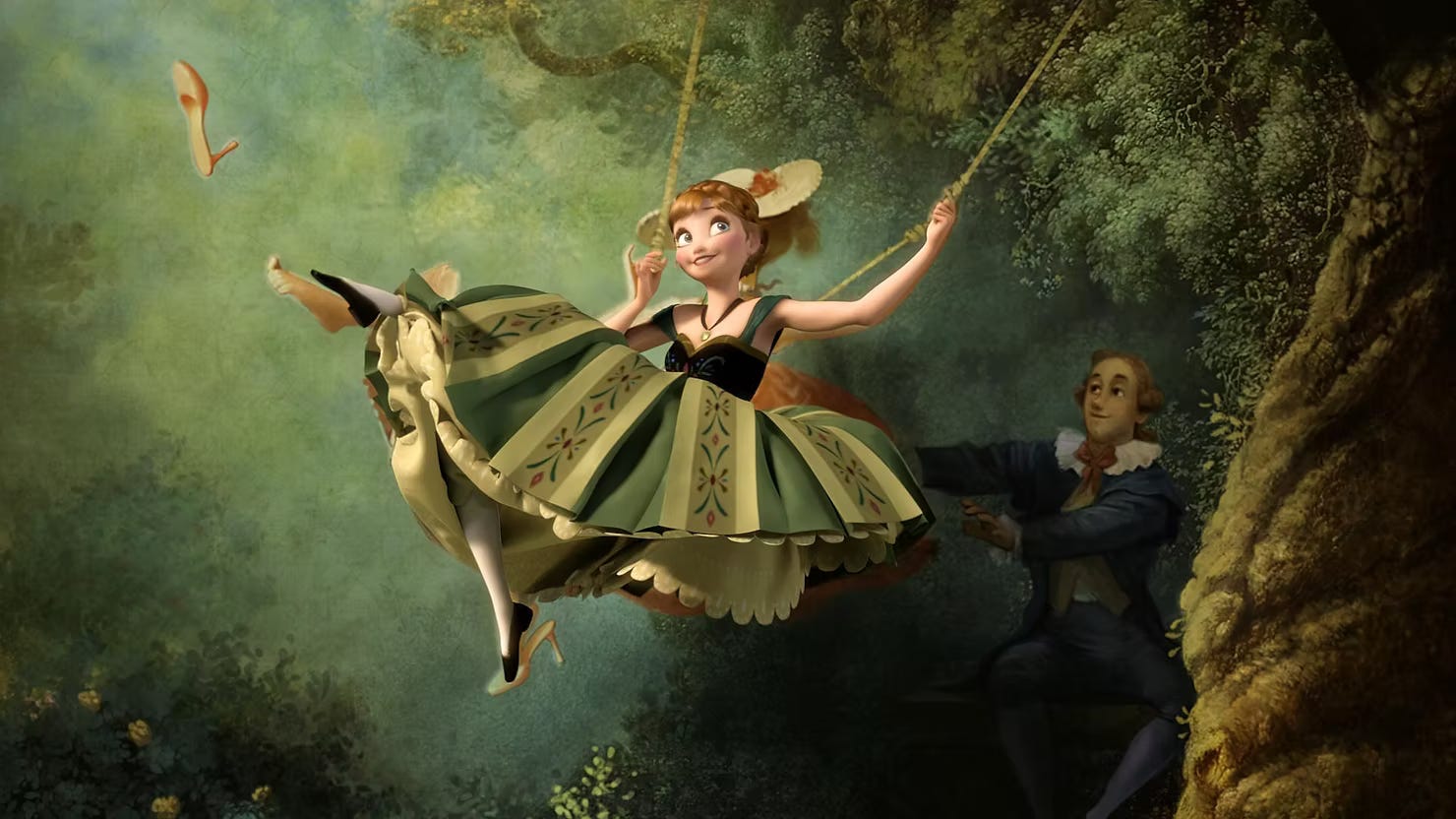
In Frozen, in 2013, Princess Anna strikes the exact pose of a young woman in pink on a swing.
Disney is copying one specific painting.
That painting is 250 years old. You find it everywhere, on novel covers, in ads, on mugs. Everyone thinks they know what it shows. A carefree young woman swinging in a garden.
Nothing in this scene is innocent.
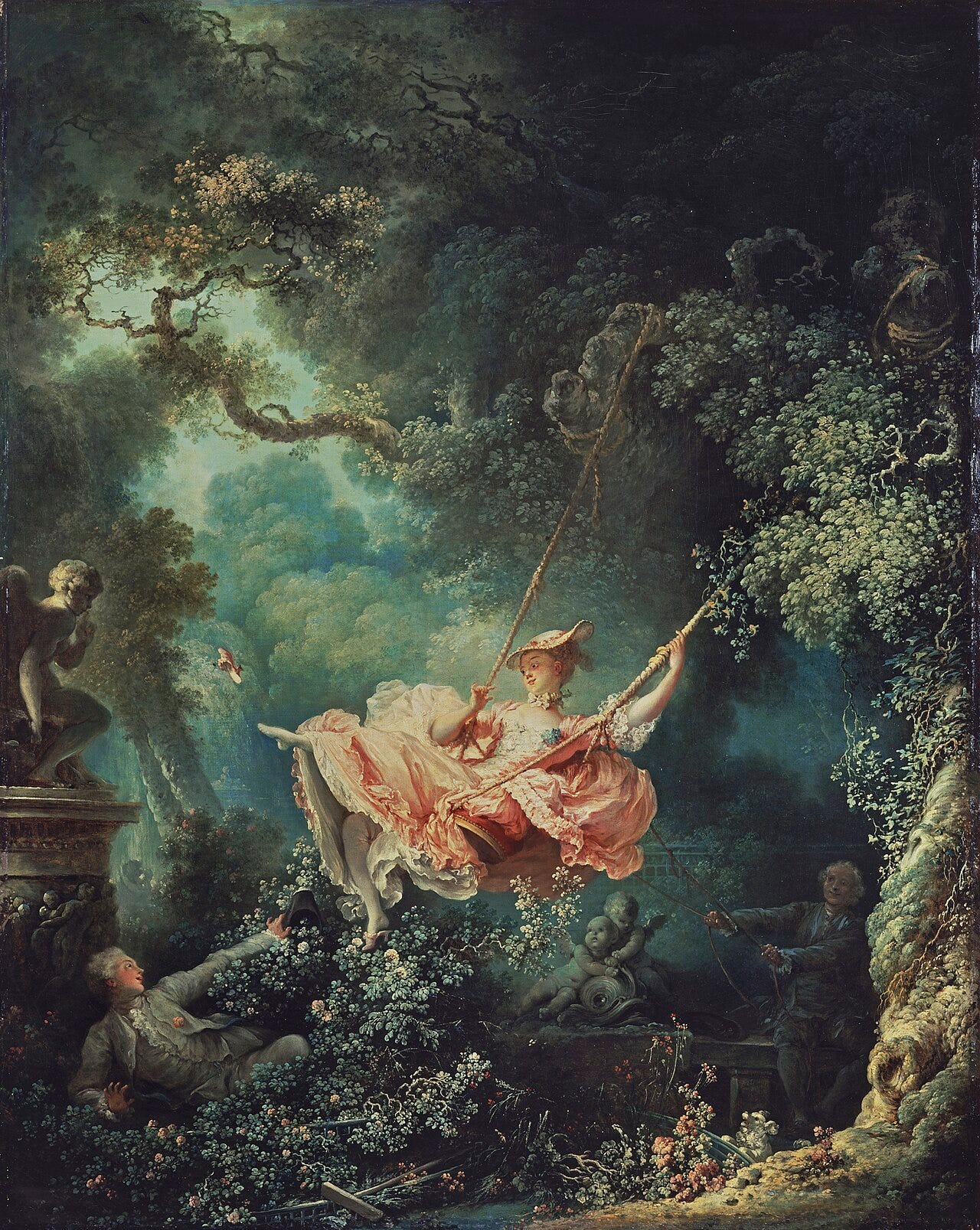
It is called The Swing. Painted in 1767 by Jean Honoré Fragonard. Today it hangs in the Wallace Collection, in London.
The painter first approached said no. The commission had scandalized him. Another one said yes.
Let's look at it, detail by detail.
This article is a collaboration with Behind the Masterpiece . We share the same mission: making art accessible to everyone through clear, engaging storytelling instead of intimidating jargon. If you enjoy Cool Stories About Art , you’ll probably love Behind the Masterpiece too. Be sure to subscribe.
Discover my new newsletter !

The swing
A woman on a swing, in painting, is never a child's game.
Since the early 1700s, from Watteau to Lancret, the motif has a fixed meaning. The swing goes back and forth, it never settles, it tips one way then the other. It is the image of inconstancy, of a heart that fixes on no one.
With Watteau, the motif stayed tame. The couples look at each other from a distance, the swing barely moves.
Fragonard does the opposite. He sets it in motion, he throws the woman off balance, he opens the dress at the top of the arc. What Watteau only hinted at, he puts on full display.
Look at the seat, too. Gilded wood, red velvet. A boudoir armchair hung from a tree.
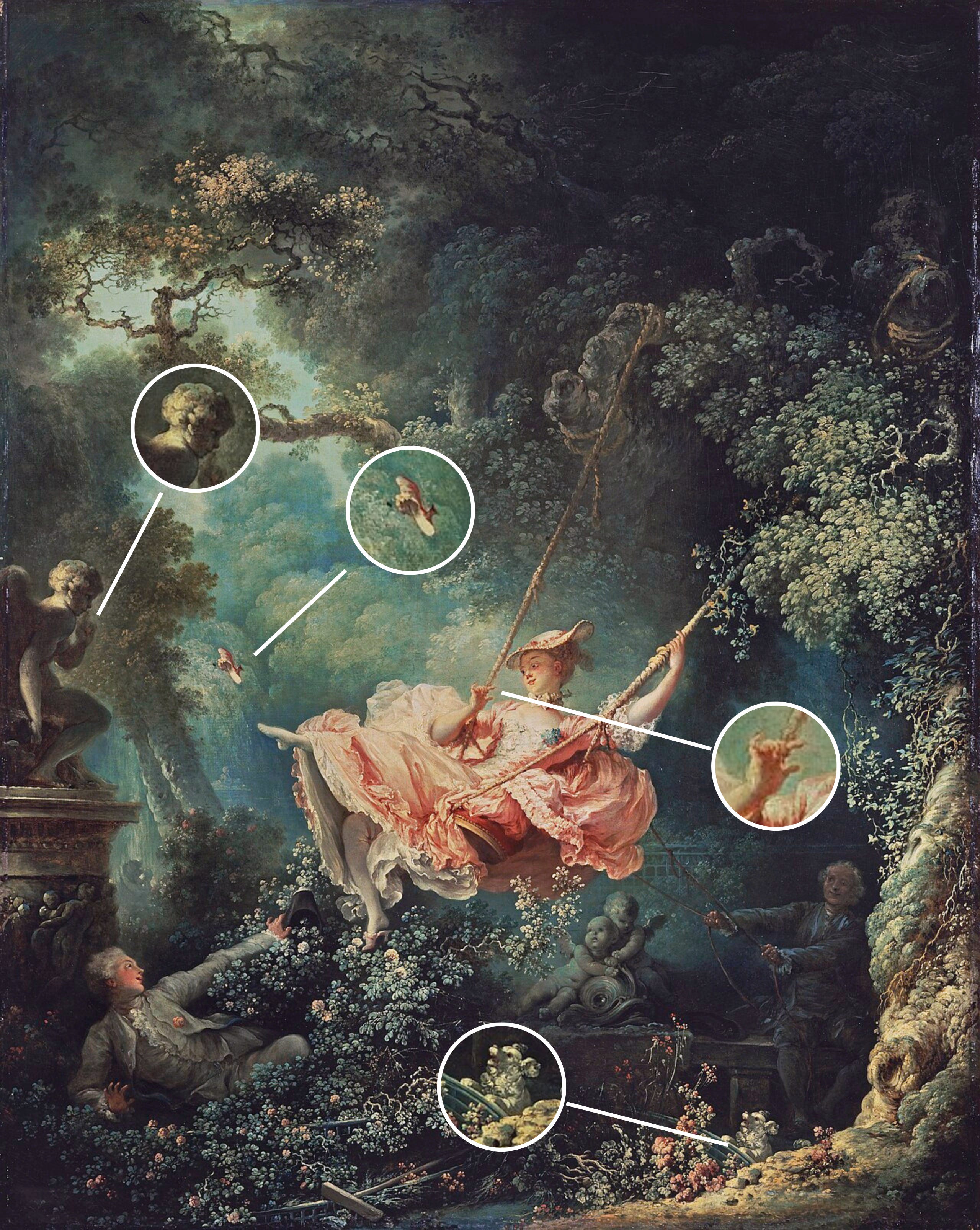
And look at the rope, up where it meets the branch. It is worn, frayed, barely tied.


The garden
Look at the setting. A huge, overgrown park, left to run wild, closing the scene in like a green room.
This loose garden, all curves and tangle, is the new fashion coming from England, the opposite of the ruler-straight avenues of Versailles.
It is a place made for slipping away, out of sight.
Here the trees rise so high and the foliage is so thick that you barely see the sky. Nature seals the space and hides from outside eyes what is going on within.
The man in the roses
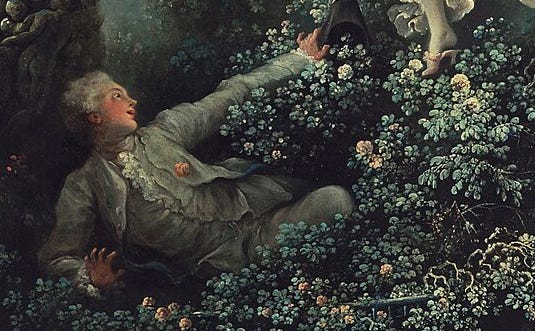
Lower your eyes toward the bottom left corner. A young man lies in a rosebush.
He is half hidden by the flowers. His left arm reaches toward the young woman, his hat at the end of it. His head is tipped back, his face turned up, right along the line of the dress as it opens at the top of the arc.
Get closer to his face. The cheeks are flushed, the mouth open.
He is not admiring a landscape. He is looking up under her skirts, and he sees everything.
In this period, a woman wears nothing under her shift. What the young man has in front of his eyes is not just legs.
This is the detail that changes how you read the painting. This man is not a stroller caught by chance. He is the logical center of the whole composition. The light, the diagonal, the opening of the dress, all of it is built for his point of view alone.
The slipper
Follow his gaze upward. At the tip of her outstretched left foot, a little pink slipper has just flown off.
It sails through the air, to the left, toward a statue.
In the 1700s, the lost shoe is a code everyone can read. To show a bare foot, to let a slipper drop, is the standard metaphor for virtue given up. The woman who loses her shoe is the woman who gives in.
And that slipper does not fall on its own. The leg is extended, the foot kicked out. The path aims straight at the man in the roses.
This slipper hides a story no one guesses. We will come back to it.

The hand and the little finger
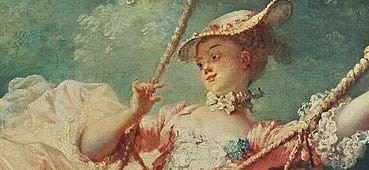
Stay on the young woman, and look at her right hand, raised in the air.
The gesture looks like a flirtation. Look again. She raises the index finger and the little finger together, the others folded down.
It is the sign of the horns. The mark of the cuckolded husband, known since antiquity.
You can read it as mockery. With her own hand, as she swings, she is taunting the man pushing her from behind.
Almost no one who walks past the painting catches this detail. Keep it in mind.
The pusher in the shadows
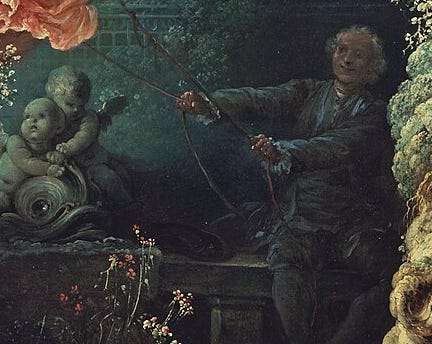
Now slide your gaze to the right, behind the young woman. An older man sits there, in the half light.
He holds two ropes. He is the one giving the swing its push. He wears a suit of blue silk, and his eyes rest tenderly on the young woman.
He sees only her back. He knows nothing of the man lying in the roses, across from him, whom she reveals with every return of the swing.
He is the man who pushes, who does the work, and who hands his own wife to another man's eyes without suspecting a thing.
Look closely at his face. No sharp features, no readable role. Fragonard left him with no identity, sunk into the shadow.
Why erase this man so completely? The answer lies in what he was meant to be at the start.
The little dog
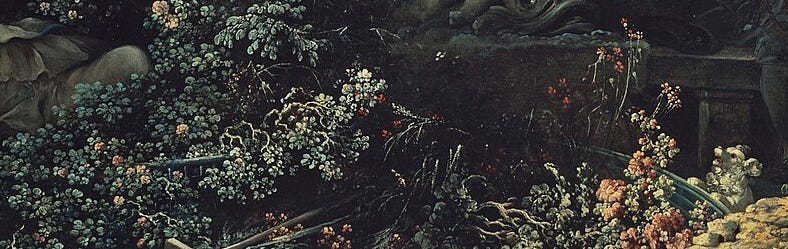
To the right, at the pusher's feet, a small white dog is worked up. Mouth open, eyes fixed on its mistress, it is barking.
In painting, since the Middle Ages, the little dog is the symbol of marital faithfulness.
Here it is turned on its head. The only one who sees the betrayal is this animal. It catches the scent, it raises the alarm, it barks toward the young woman.
No one listens.
Keep learning art the fun way


The stone Cupid
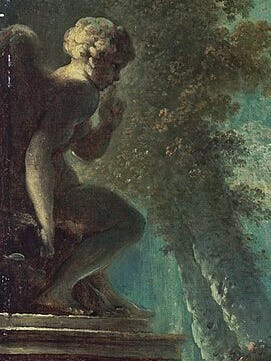
Pick up the slipper's path again. It flies toward a marble statue, on the left, higher than the man lying below.
It is a Cupid, the child of love. He holds a finger to his lips. The gesture that orders silence.
This Cupid is not something Fragonard invented. It is an exact copy of a famous statue, shown in 1757 at the Salon, the big public exhibition in Paris. It had caused a sensation there, and the whole aristocracy recognized it at a glance.
The marble watches the scene and commands quiet. It lays down the rule of secrecy.
The man lying in the roses really existed. So did the woman, so did the husband.
Without their names, this swing is a charming scene.
With their names, it is a scandal, dictated one evening in October 1767…