
The idea that suffering produces great painting is a marketing story, and it was written mostly in the nineteenth century. Van Gogh sold work in his lifetime, Vermeer was respected in Delft, and the myth of the doomed genius took hold because it sold pictures after the painter was dead.
The short version
The tortured artist idea is largely a Romantic invention of the late 1700s and 1800s.
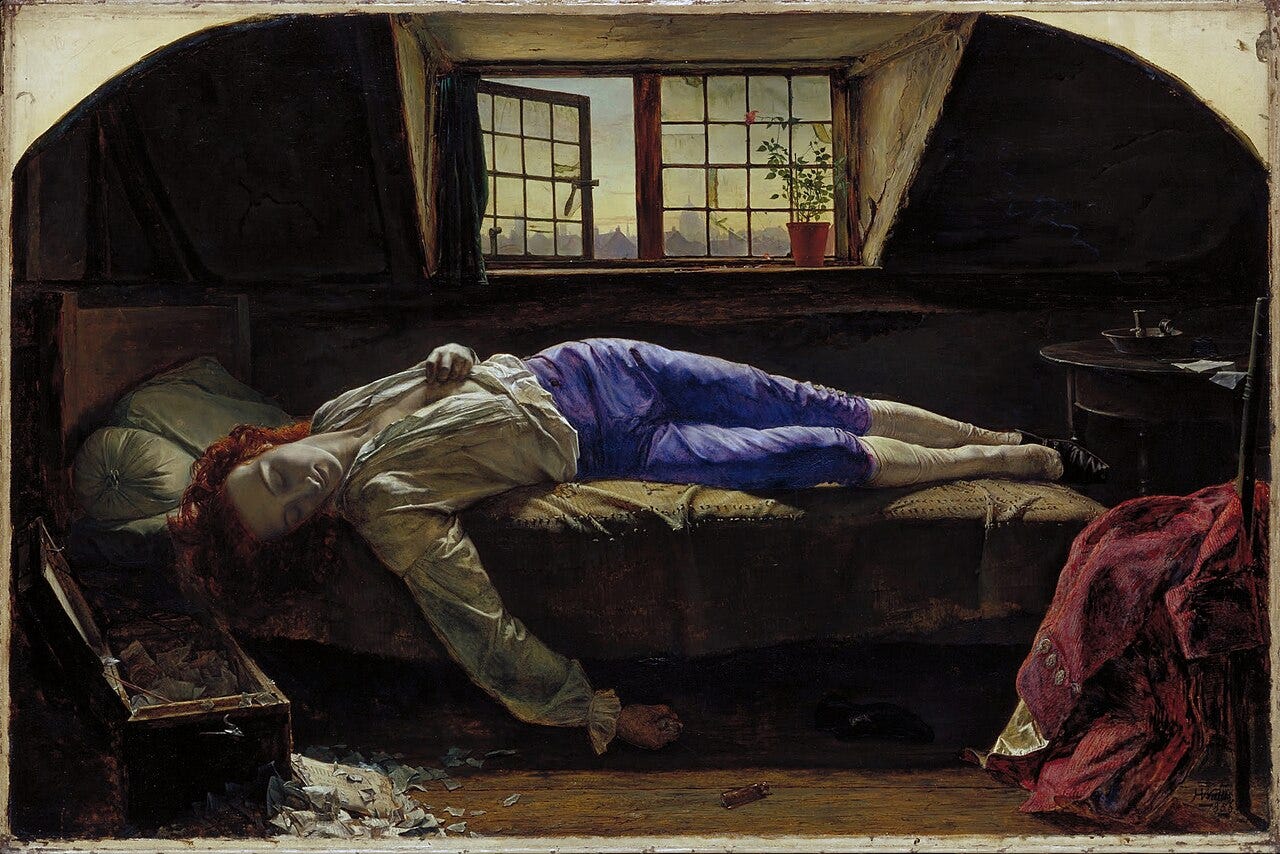
One painting of a dead young poet became the emblem of the whole legend, and the model went on to become a famous novelist.
Van Gogh’s death has been disputed by serious biographers since 2011.
Melancholy was once considered a medical condition of scholars and artists, with its own imagery.
The painters who lived long, ordinary lives rarely get written about at all.
Learn art the fun way
1 | The Death of Chatterton, Henry Wallis (1856)
The poet Thomas Chatterton died in 1770 at seventeen. Wallis painted him eighty six years later in a garret, and the picture, not the life, created the legend of the doomed young artist.
The model was the writer George Meredith. It hangs at Tate Britain.
2 | Melencolia I, Albrecht Durer (1514)
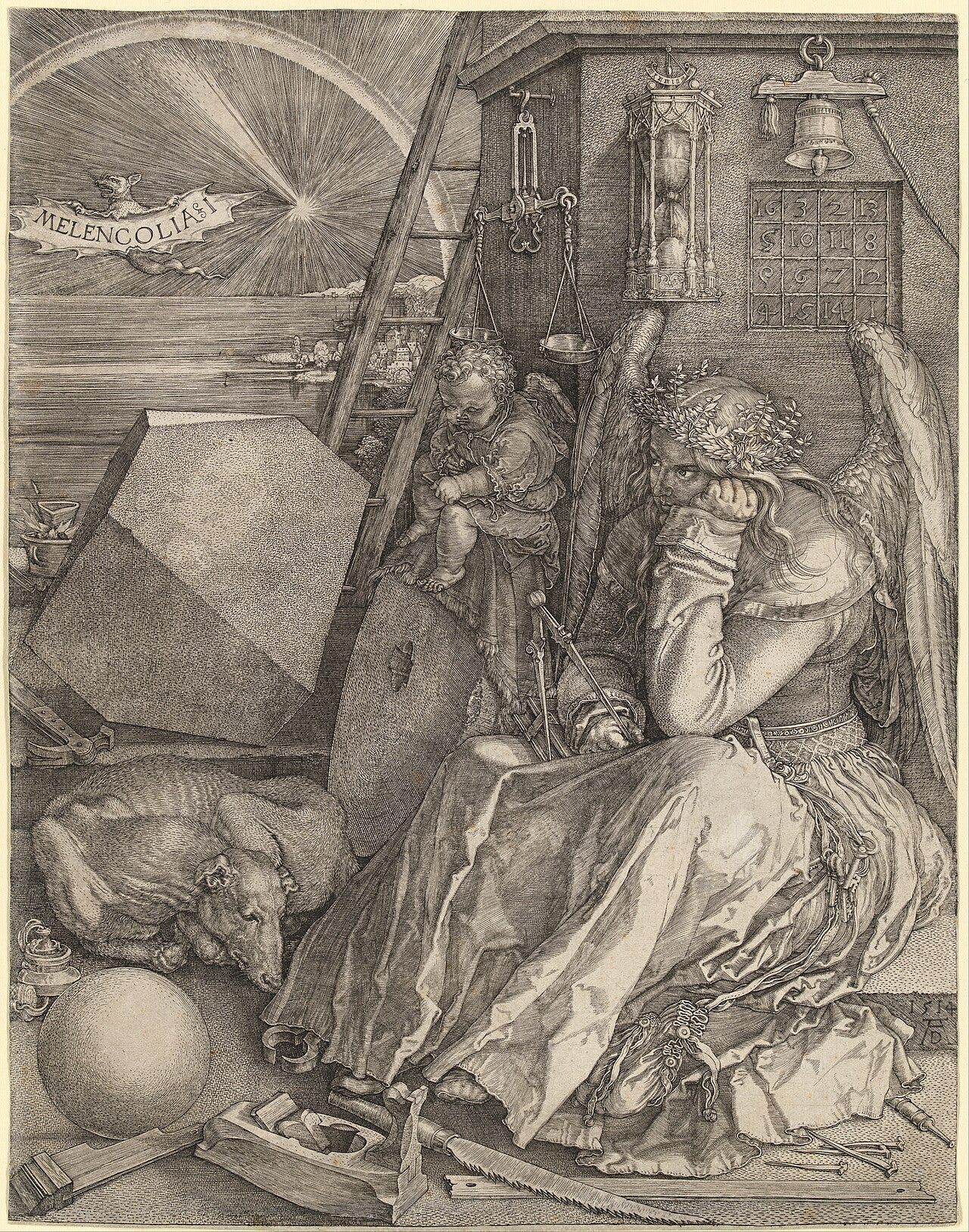
A winged figure sits surrounded by unused tools. In Renaissance medicine melancholy was the humour of thinkers, and Durer treats it as a condition of the working mind, not a personal collapse.
More on him in Albrecht Durer.
The engraving is dated 1514, the year his mother died. The magic square in the top corner has the numbers 15 and 14 side by side in the bottom row, which is how we know.
3 | Van Gogh and the disputed ending
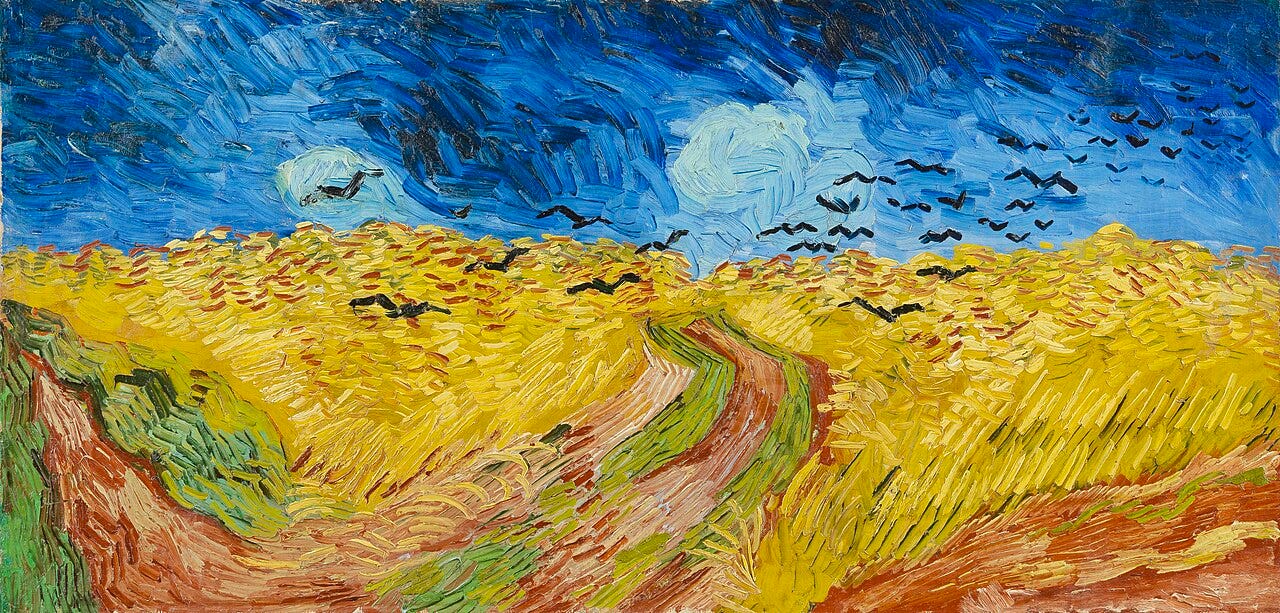
The standard account is a self inflicted gunshot in July 1890. In 2011 the biographers Steven Naifeh and Gregory White Smith argued the wound came from someone else, and the debate is still open.
The evidence is laid out in the last day of Vincent van Gogh. More on him in Vincent van Gogh.
4 | Ophelia, John Everett Millais (1851 to 1852)
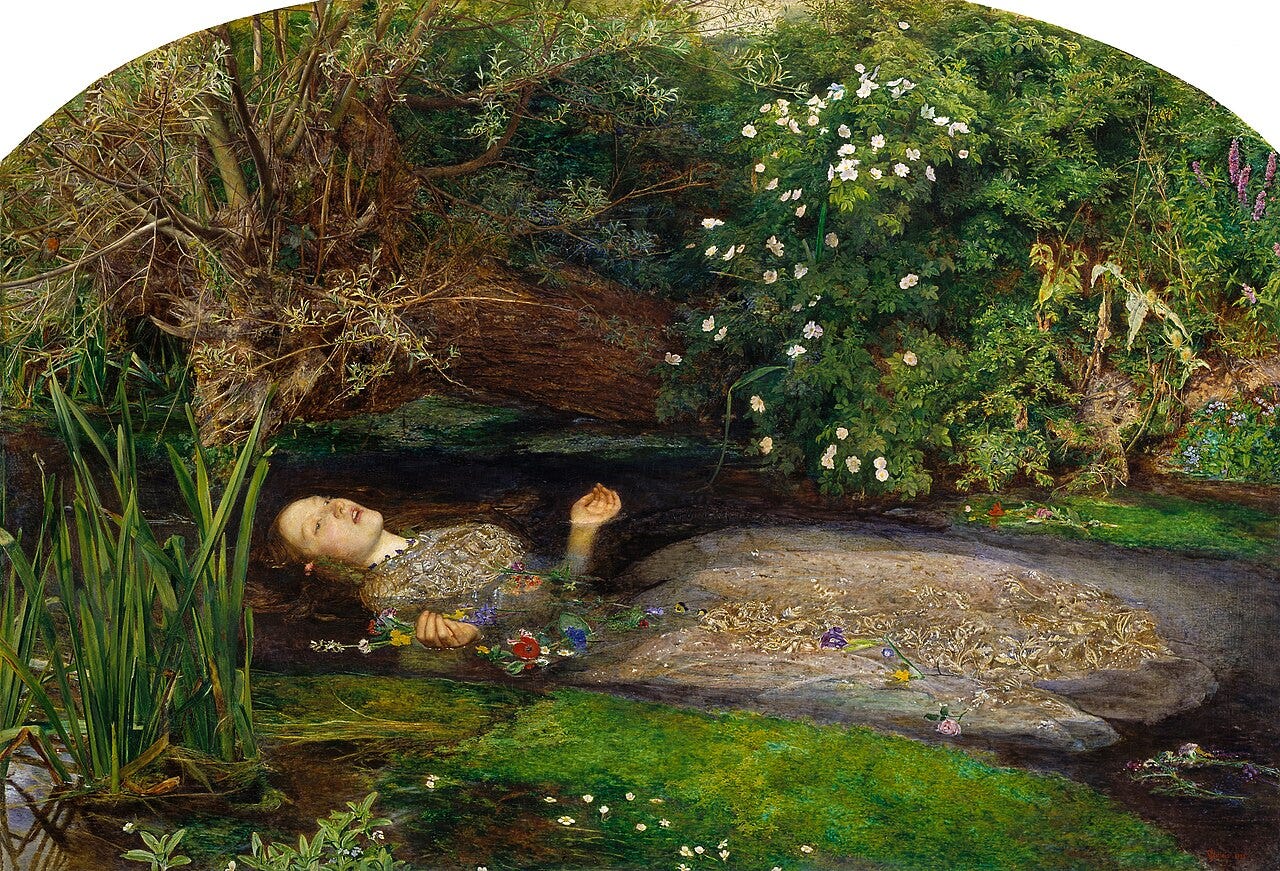
Millais painted a drowned Shakespearean character with botanical accuracy, and the model Elizabeth Siddal lay in a bath that went cold and made her ill.
The painting is about a fiction, not a painter. More on him in John Everett Millais.
Millais painted the river at Ewell in Surrey over five months in 1851, then the figure in his studio. Elizabeth Siddal lay in a bath heated by lamps that went out, caught a severe cold, and her father sent Millais the doctor’s bill.
5 | Lucretia and the Roman precedent
Classical stories gave painters a way to show a chosen death as honour rather than despair. Lucretia, Cato and Dido were painted for centuries as examples of virtue.
The reading system is in what is iconography.
Livy tells the story, and Augustine argued against admiring it in the City of God. Painters ignored him: there are versions by Botticelli, Cranach, Titian, Rembrandt and Artemisia Gentileschi.
6 | Goya and the black years
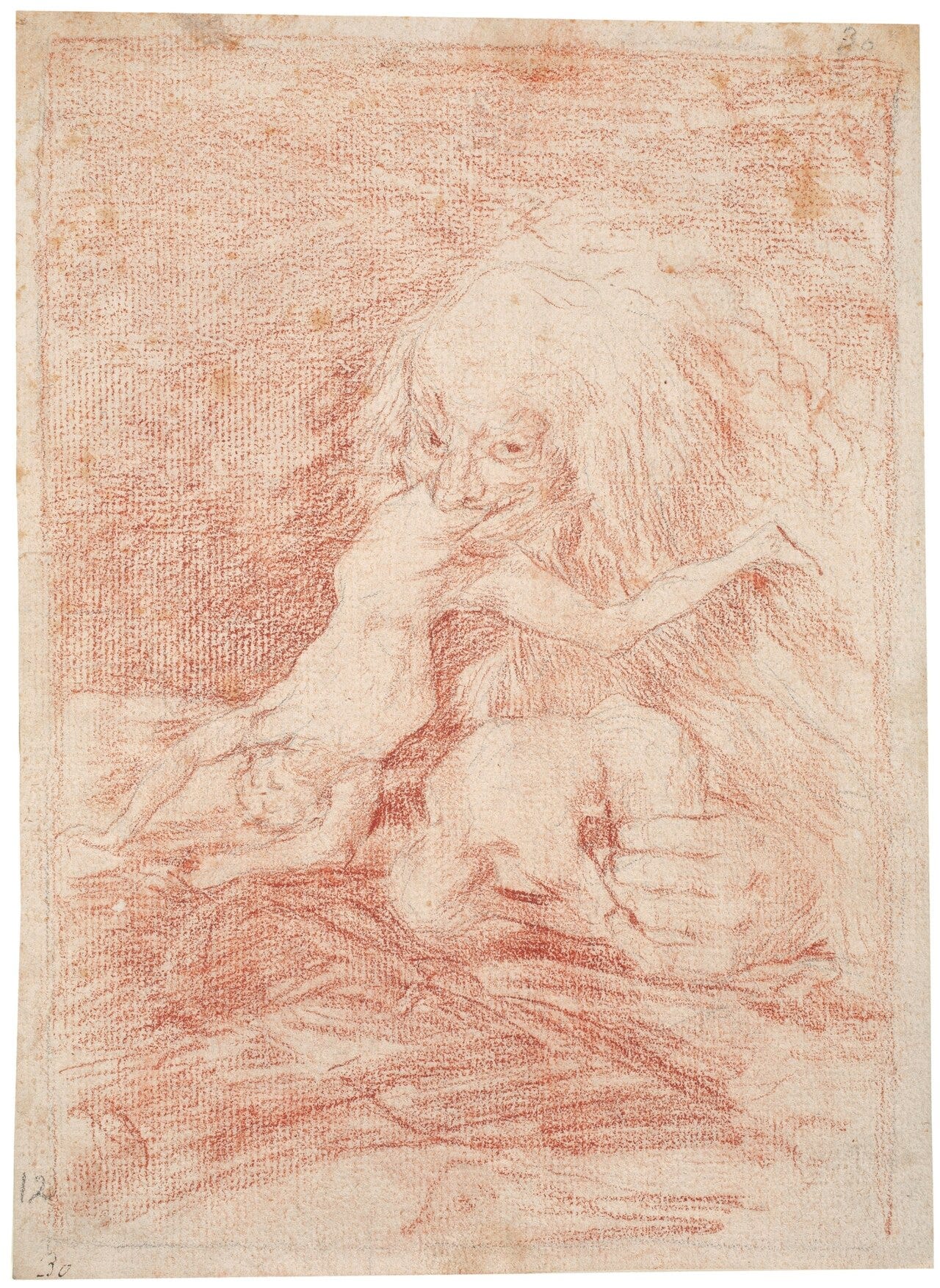
After illness and deafness Goya painted the Black Paintings directly onto the walls of his house. They were never made for sale or for anyone else to see.
More on him in Francisco Goya.
He bought the Quinta del Sordo in 1819 and painted fourteen scenes directly onto its plaster walls between 1820 and 1823. They were transferred to canvas in the 1870s, badly, and given titles by someone else.
7 | Munch and the frieze of life
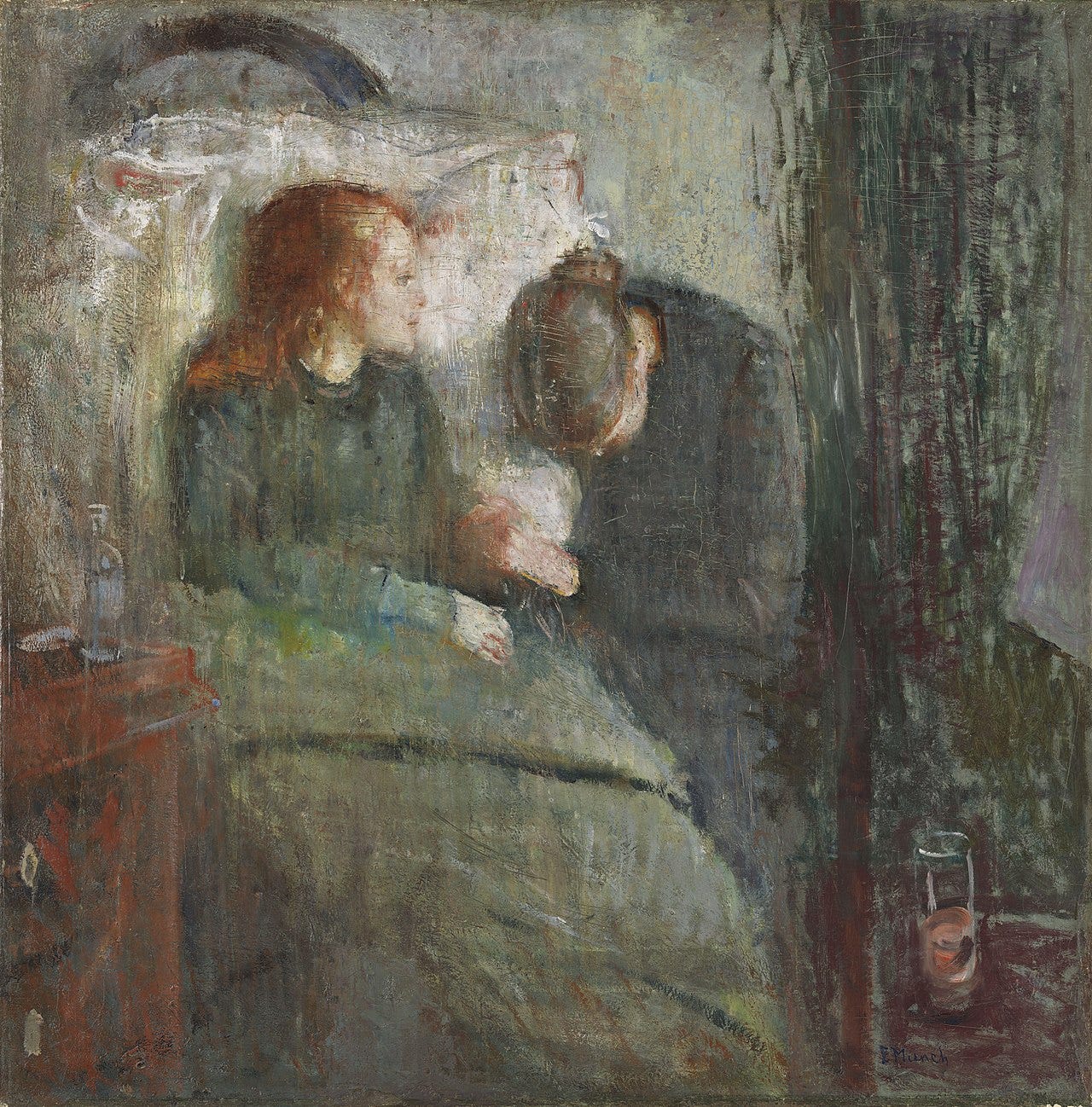
Munch lost his mother and sister young and made grief his subject on purpose, as a project, over decades. He also lived to eighty and worked steadily to the end.
More on him in Edvard Munch.
His mother died when he was five and his sister Sophie when he was thirteen, both of tuberculosis. He organised his work into a cycle he called the Frieze of Life and exhibited it as a set from 1893.
8 | The Romantic invention
Before around 1800, a painter was a craftsman running a workshop. Romanticism recast him as an outsider whose suffering was proof of authenticity, and dealers found the story very useful.
More on the period in what is romanticism art.
Vasari had already started it in 1550 with his Lives, full of difficult, solitary geniuses. Romanticism turned that literary device into a job description, and the art market found it useful.
9 | Degenerate art and the real damage
In 1937 the Nazi regime seized modern work and put it on show to be mocked. Several of the painters attacked were driven out of work, out of the country, or worse.
That is external persecution, not inner torment, and the two are constantly confused.
10 | The painters who were fine
Rubens ran a large studio and a diplomatic career. Titian lived to around eighty six. Monet gardened. Matisse worked from a wheelchair into his eighties.
None of them fit the legend, and all of them are in the first rank.
11 | What the research actually says
Studies linking creative work and mood disorders exist, but the effect sizes are modest and the samples are small. No serious researcher claims suffering causes talent.
Correlation in a small sample is not a life plan.
12 | Why the myth survives
It makes a good story, it raises prices, and it lets us treat a painting as a symptom instead of a decision. Reading a picture as an illness is a way of not reading it at all.
The work was made by someone who turned up and did the job.
The tortured artist, questions people ask
Where does the tortured artist idea come from? Mainly Romanticism, from the late eighteenth century onward, reinforced by nineteenth century biographies and by dealers after the painter’s death.
Did Van Gogh sell nothing in his lifetime? No. He sold at least one painting, The Red Vineyard, and his work was shown and reviewed before he died.
Is the cause of Van Gogh’s death settled? No. A 2011 biography by Naifeh and Smith argued the shot came from someone else, and specialists remain divided.
What is Melencolia I about? Melancholy as the humour of scholars and makers, shown as a winged figure surrounded by tools that are not being used.
Where is The Death of Chatterton today? Tate Britain for Chatterton and Ophelia, the Prado for Goya’s Black Paintings, the Munch Museum in Oslo.
Van Gogh’s letters are full of colour theory, prices, rent and plans for next week. They read like a working man’s notebook, because that is what they are.
If any of this touches something you are going through, it is worth talking to someone you trust or a professional. I can point you to resources if that would help.
More on these painters sits at the Met and the Rijksmuseum.