
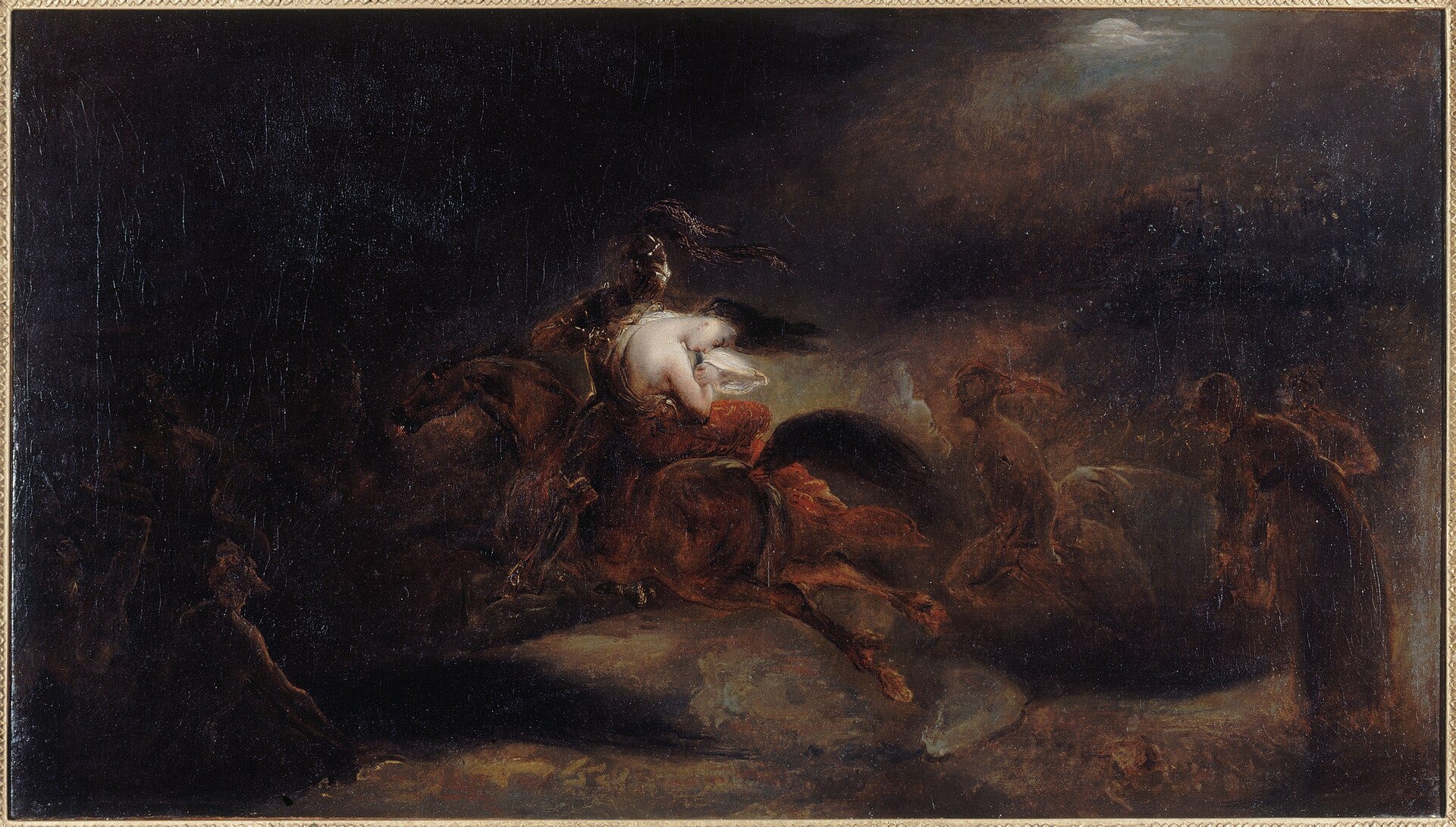
Around Yule, the midwinter festival, people in northern Europe told of the dead riding across the sky in a troop, and of the bad luck that struck anyone who met it. For a thousand years and more, artists kept giving that troop a new leader, until the legend reached a lumber camp in Quebec, where the riders swapped their horses for a canoe.
Cool Stories About Art is a newsletter to learn art the fun way.
Join 200,000+ readers and get:
10 new art stories / month
The entire archive of content (140+ articles)
Comment, ask questions, and chat with other readers
Who Rides With the Wild Hunt
The Wild Hunt is the name that troop came to carry, and its leader depended on the country telling the story. In the north it was Odin, whom the Germans called Wodan or Wotan. In England it was Herne, in France Hellequin, and elsewhere a lord damned for going hunting during Mass. Anyone who saw it go by was told to throw himself flat on the ground.
For painters, the subject meant showing what nobody was supposed to watch, a crowd at full gallop through the night air. It held their attention for centuries because each region kept its own version, with its own rider and its own warning.
The works chosen show either the troop itself or one of the shapes it took on its travels: a damned huntsman, a dead man on horseback, a masked crowd, witches in a storm cloud, a ghost met in the snow. Each legend is told as a legend, in the form its believers gave it.
12. Henri Julien, La Chasse-galerie (1906)
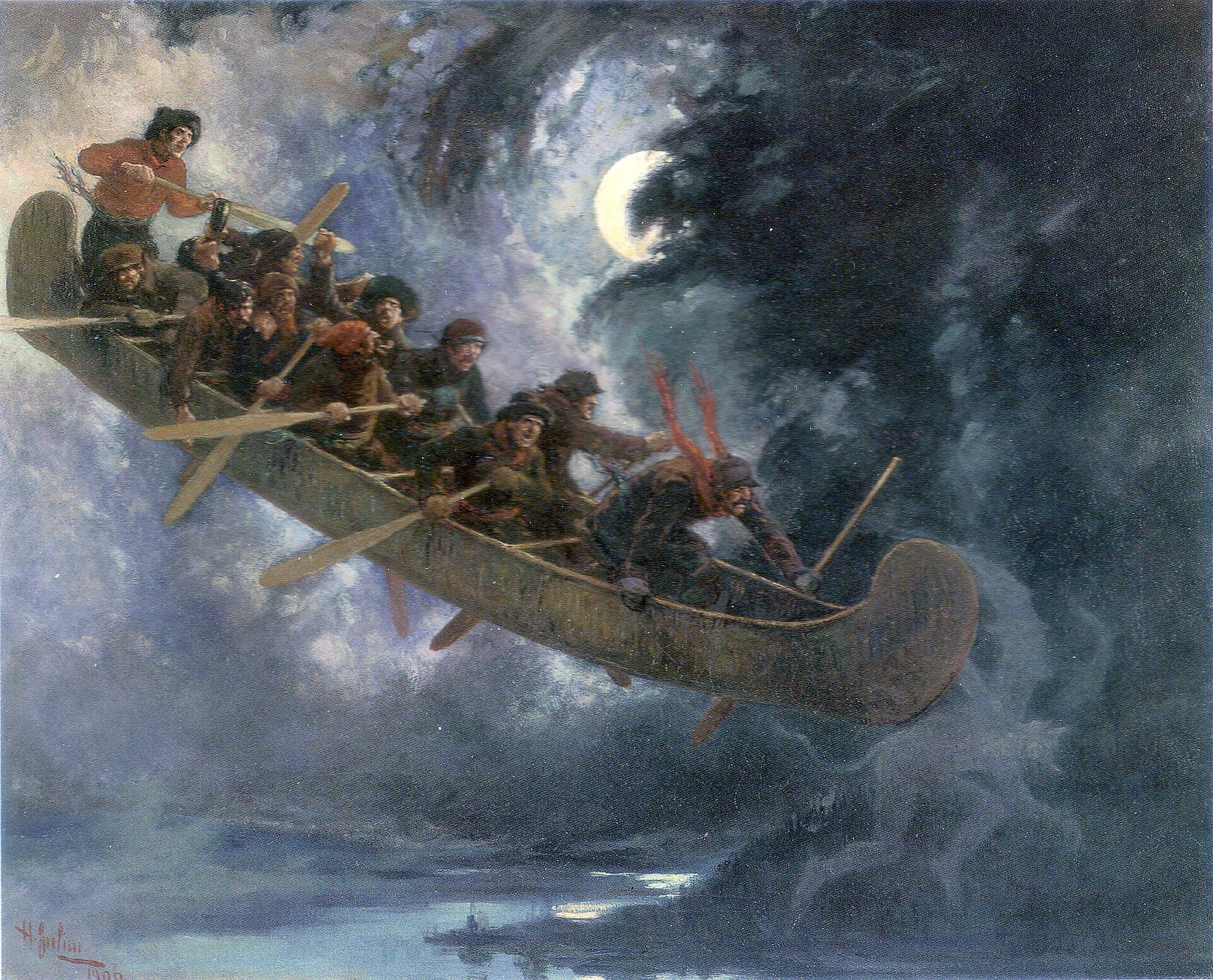
A canoe full of men paddles through the night sky, high above a snowy winter landscape. Their story starts in old France, where people told of a lord named Gallery who loved hunting more than Sunday Mass and was condemned to chase across the night sky forever, his hounds at his heels.
Across the ocean, the chasse-galerie, Gallery's hunt, changed its crew. In Quebec it became a canoe flown through the air by lumberjacks, and the version everyone remembers was written by the writer and journalist Honoré Beaugrand.
Beaugrand's tale appeared in the New Year's issue of the newspaper La Patrie on December 31, 1891, with a drawing by Henri Julien, and in English in The Century Magazine the following August. The drawing made Julien known outside Canada, and in 1906 he painted the scene again, this time in oil.
In that canvas, the Wild Hunt has lost its lord, its hounds and its horses. What is left is a crew of working men riding the night on a bargain with the devil.
The tale itself opens on New Year's Eve, 1858, in a logging camp far up the Gatineau River, and Joe, the camp cook, is the one who tells it. The foreman, Baptiste Durand, offers the men a way to visit their sweethearts in Lavaltrie, across the St. Lawrence. The price is their souls, promised to Satan if they break a single rule.
Those rules leave little room. The men must be back within six hours, never say the name of God, touch no cross on any steeple and drink nothing on the way. They shout the magic words, "Acabris! Acabras! Acabram!", and ask to be carried over the mountains. The canoe rises, passes above Montreal and lands them at a dance at the house of Batissette Augé.
Everything goes wrong on the way back. Baptiste has been drinking whisky, takes the steering, grazes a cross on top of Mount Belœil and drives the canoe into a snowbank on Mount Royal. The men tie him up. He breaks loose and threatens them with his paddle, and the canoe crashes into a tall pine.
One after another, the men tumble from branch to branch into the snow, and that is where they are found, unconscious, at about eight in the morning.
At a Glance
Artist: Henri Julien (1852 to 1908)
Painted: 1906
Medium: Oil on canvas
Size: 54.4 × 66.8 cm (21.4 × 26.3 in)
Where to see it: Musée national des beaux-arts du Québec, Quebec City
11. William Blair Bruce, The Phantom Hunter (1888)
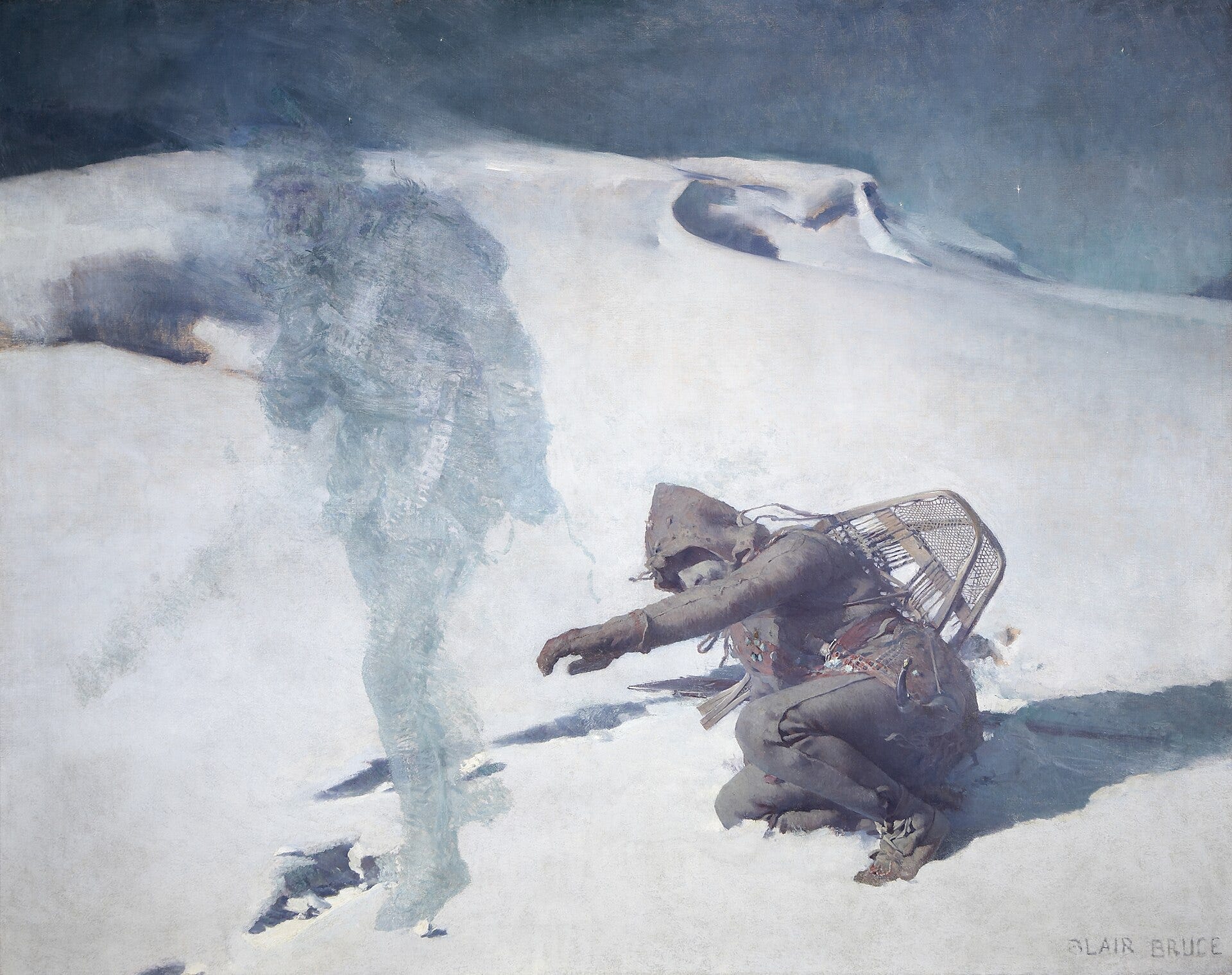
Snowshoes still on his feet, a trapper lies collapsed in deep snow at night and reaches toward a pale figure who walks past without a glance. To paint him, William Blair Bruce, a Canadian painter then living in Giverny, France, wrote to his father in Hamilton, Ontario, in October 1887, asking him to send across the Atlantic the snowshoeing outfit and the snowshoes he had left behind in Canada.