
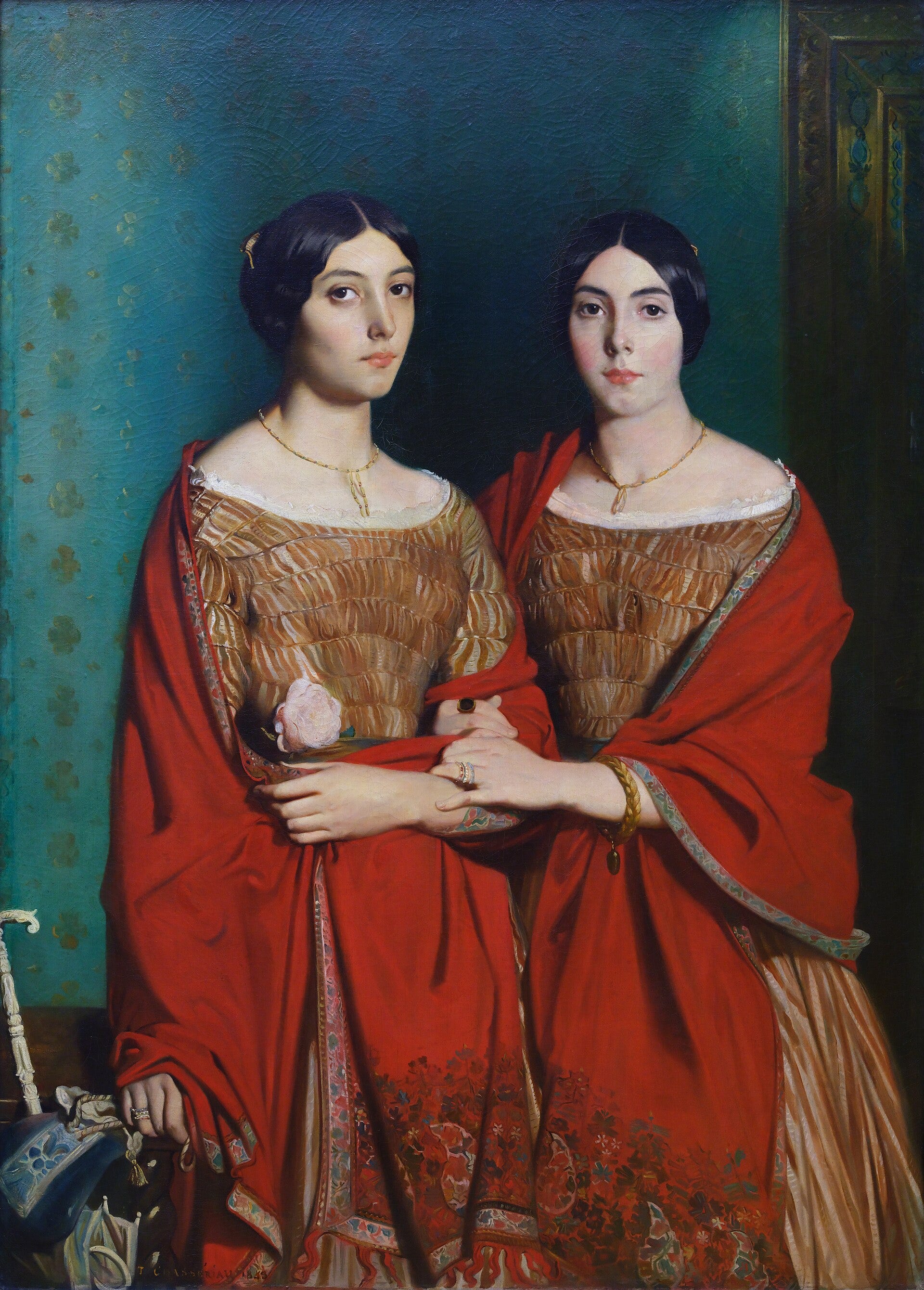
Théodore Chassériau (1819 to 1856) was a French painter of the Romantic era. He painted heroines of the Bible, portraits of his family and scenes of Algeria. His best-known works, The Toilette of Esther and The Two Sisters, hang in the Louvre in Paris.
Cool Stories About Art is a newsletter to learn art the fun way.
Join 200,000+ readers and get:
10 new art stories / month
The entire archive of content (140+ articles)
Comment, ask questions, and chat with other readers
In his short life, Théodore Chassériau covered church walls in Paris and the grand staircase of a government palace. Yet in 2002, when the Metropolitan Museum of Art in New York gave him his first large exhibition in the United States, the show was titled "The Unknown Romantic."
Théodore Chassériau was born on September 20, 1819, near Samaná, in what is now the Dominican Republic, on the Caribbean island of Hispaniola, which that country shares today with Haiti.
His father, Benoît Chassériau, was a French official. In 1802, he had come to the island as treasurer-general during the expedition that Napoleon Bonaparte sent to retake Saint-Domingue, the French colony in the west of Hispaniola, then governed by the formerly enslaved leader Toussaint Louverture.
Until 1807, Benoît Chassériau served the French colony of Santo Domingo, in the east of the island. The painter's mother, Marie-Madeleine Couret de la Blaquière, was the daughter of a wealthy landowner of Saint-Domingue, today's Haiti, who was of mixed African and European ancestry.
The family settled in Paris when Théodore was a small child. In 1830, at eleven, Théodore entered the studio of Jean-Auguste-Dominique Ingres, the most admired painter in France. A studio was the place where a master trained young painters at his side.
Ingres built his pictures on precise drawing and clean outlines. He soon saw the boy as his most faithful pupil. In 1834, Ingres left for Rome to direct the French Academy, a school for the best young French artists, and Chassériau, then fifteen, stayed in Paris.
Without his master, the teenager fell under the influence of Eugène Delacroix, Ingres's great rival. Delacroix was a Romantic painter. Like the other Romantics, he put feeling, strong color and bodies in motion ahead of the rules taught in the studios.
In 1836, Chassériau sent paintings for the first time to the Salon, the great official art exhibition in Paris, where a jury gave medals to the most promising artists. Chassériau won a third-class medal. He was sixteen.
Why did a painter rewarded at sixteen end up, a century and a half later, as "The Unknown Romantic"?
In the rest of the story
Who invited Chassériau to Algeria, and what the painter carried home.
Which Roman ruins he visited at twenty and painted at thirty-three.
Which younger painter dedicated a painting to him, the year he died.
What became of the largest commission of his life.