Thomas Cole: The Complete Story
Thomas Cole, an English mill town emigrant, hung three landscapes in a New York shop window in 1825 and was famous within the week. He founded America's first art movement, then spent five canvases warning the young republic how empires die.
The Hudson River School begins with a self-taught engraver who loved mountains and distrusted everything his adopted country was building toward.
Thomas Cole at a glance:
1801: born in Bolton, Lancashire; the family emigrates to Ohio when he is 17, chasing work.
1825: three landscapes in a New York shop window sell in a day; Trumbull, Durand and the press take notice.
1836: finishes The Course of Empire and publishes the Essay on American Scenery in the same year.
1844: takes on his only real student, a Hartford teenager named Frederic Church.
1848: dies at Catskill at 47; New York's artists wear mourning bands for a month.
From Lancashire to a shop window
Cole was born in Bolton-le-Moors, Lancashire, on February 1, 1801, and emigrated with his family in 1818, working as an engraver in Ohio and Philadelphia.
In 1825 he took a steamboat up the Hudson, sketched the Catskills, and put three resulting landscapes in a New York dealer's window.
The painters John Trumbull, Asher Durand, and William Dunlap each bought one; Trumbull declared the young man had achieved untaught what he himself had attempted all his life. American landscape painting dates from that window.
The Course of Empire, 1833-1836
For the merchant Luman Reed, Cole painted five canvases tracing one harbor from wilderness through pastoral calm to imperial glut, fiery destruction, and silent ruin.
The Course of Empire, now at the New-York Historical Society, was read at once as a warning to Jacksonian America, boom-drunk and expanding.
Cole meant it: his letters and his 1836 Essay on American Scenery mourn the axe and the railroad cutting through what he called the wild garden.
More incredible painter stories
If Thomas Cole pulled you in, you will love these too:
The Oxbow and the Voyage of Life
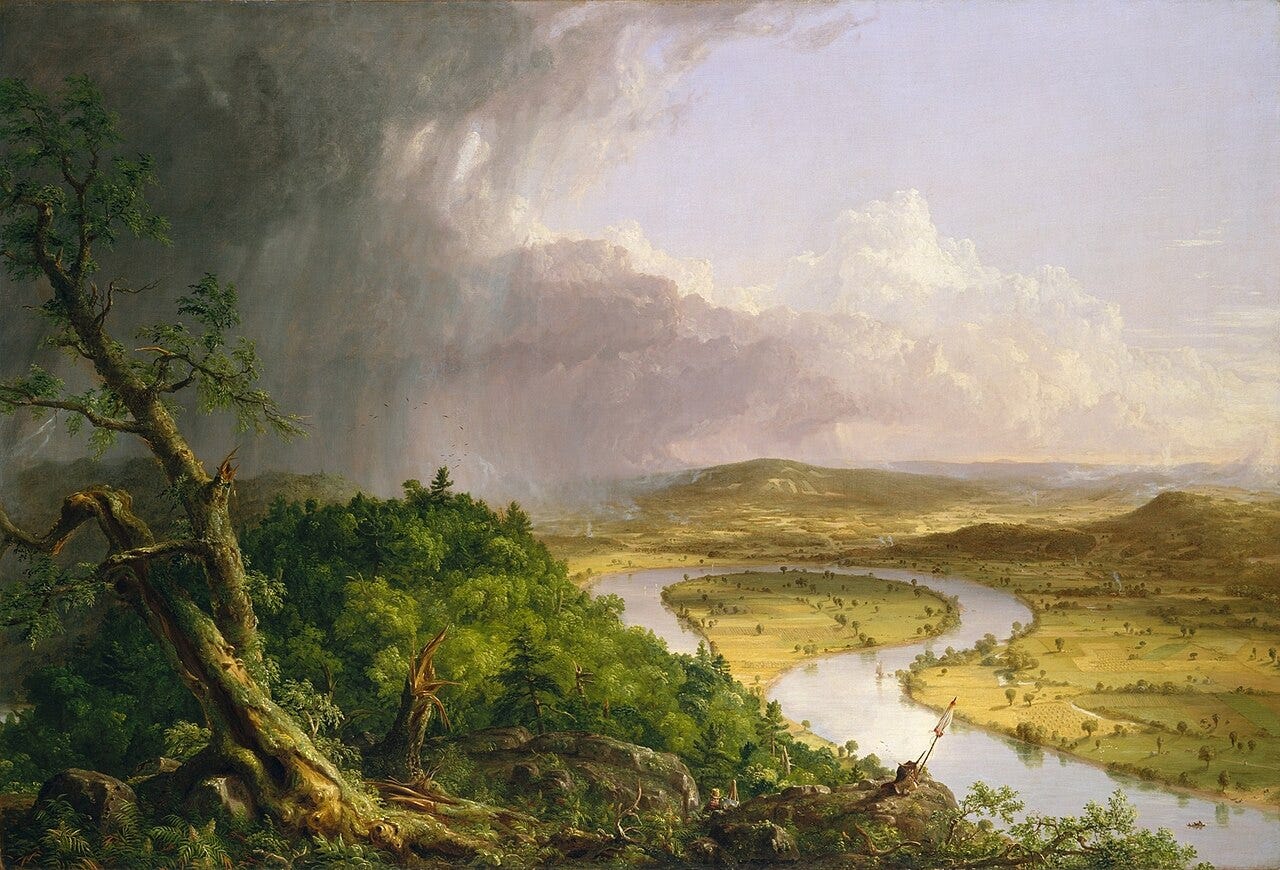
His 1836 View from Mount Holyoke, universally called The Oxbow and now at the Met, splits one canvas between storm-dark wilderness and sunlit farmland, with the painter tiny in the middle, looking back at us and asking which future we choose. The four-part Voyage of Life of 1840, childhood to old age on a symbolic river, exists in two full sets, at Utica and at the National Gallery in Washington, and was the most reproduced American religious image of its century.
The myth of the innocent romantic
Cole reads at first as a rapturous nature poet, but the pictures argue: The Course of Empire is political philosophy in paint, the Essay is proto-environmentalism decades before the word, and his lament for the Catskill railroad names the price of progress exactly. The founder of America's sunniest school of painting was its first, and darkest, critic of manifest destiny.
Catskill, Church, and where to see him
Cole died suddenly at Catskill on February 11, 1848, at 47, having taught exactly one important pupil, Frederic Edwin Church, from 1844 to 1846.
His home and studio, Cedar Grove, is now the Thomas Cole National Historic Site, facing the mountains he painted. The Met holds The Oxbow, the New-York Historical Society the Course of Empire, and Washington one Voyage of Life.
The architect's other drawer
Cole moonlighted as an architect: his design for the Ohio Statehouse won third premium in 1838, and elements of it were folded into the capitol as built.
He painted The Architect's Dream as the trade's daydream: a colleague reclining on a column above every style in history, part homage, part job application on a friend's behalf.
Landscape was his pulpit, but building was the tempting second language. Empires, after all, are made of architecture, and he had opinions.
The first environmentalist sermon
The Essay on American Scenery argues that wilderness is America's advantage over Europe, and that it was vanishing even as he wrote.
He watched the railroad cut through his Catskill valley and called the men who cleared it copper-hearted barbarians in his journal. The phrase has outlived every locomotive involved.
Modern readers take the Course of Empire as ecological prophecy as much as political. Cole would have accepted both readings and added a sermon.
Etna, and the poems
He crossed to Europe twice, sketching from London to Sicily; the climb up Etna in 1842 fed views he repainted for the rest of his life.
He wrote poetry seriously, thousands of lines, some published. The Voyage of Life is a poem's architecture transferred to canvas.
Friends called him a divided man, pulled between the sublime and the sermon. The division is exactly what keeps the pictures from going quaint.
The Thomas Cole questions that keep coming up
What is the Hudson River School? America's first native art movement: landscape painters led by Cole from 1825, treating the Hudson valley and the wilderness as national subject matter.
What is The Course of Empire? Five canvases of 1833-36 showing one place rising from wilderness to empire and falling to ruin, Cole's warning to expansionist America.
Who discovered Thomas Cole? Trumbull, Durand, and Dunlap, who bought the three canvases he displayed in a New York shop window in 1825 and spread the word within days.
Where can I see Cole? The Met for The Oxbow, the New-York Historical Society for the Course of Empire, Washington and Utica for the Voyage of Life, and Cedar Grove at Catskill.
How much does a Cole cost? Majors are museum-locked; the rare significant canvas that surfaces brings single-digit millions, modest for his importance, because so little remains private.
Can you visit his studio? Yes: Cedar Grove in Catskill is the Thomas Cole National Historic Site, looking across the Hudson toward Church's Olana. Teacher and pupil face each other over the river.
More secrets to unlock
A heron on the last column
The founder of America's first art movement was English, self-taught, and dead at 47, and his real monument is a warning nobody heeded: the empire cycle ends with a single broken column and a heron nesting on it.