Time in Art: 12 Famous Paintings of Clocks and Skulls
Paintings about time use clocks, hourglasses, watches, and skulls to warn that life is short. The message is called memento mori, remember you must die. It runs from Renaissance allegories through Dutch vanitas still lifes to Dali melting clocks in 1931.
A clock in a painting is rarely just a clock. It counts down. Beside a skull or a snuffed candle, it tells you that the hour is passing while you look. Here are twelve works where time itself is the subject.
Memento mori: the Latin phrase means remember you must die, and it is the core idea behind almost every clock in art.
The hourglass: sand running out is the oldest and clearest symbol of a life ticking away.
The watch and the skull: pairing a costly timepiece with a skull says that wealth cannot buy more hours.
Father Time: in allegories, an old winged man with a scythe or a lyre stands in for time itself.
If these draw you in, you will also love what a vanitas painting really means, what memento mori means in art, and 7 secrets hidden in famous paintings.
1. Salvador Dali, The Persistence of Memory
Soft watches droop over a branch, a block, and a strange sleeping face. A hard orange watch crawls with ants. A still bay lies behind.
People love to say the melting clocks came from Einstein and relativity. Dali said the real source was a wheel of Camembert cheese melting in the sun.
The tiny canvas is about the size of a sheet of paper. On it, Dali made time itself go soft and lose its grip.
2. Hans Holbein the Younger, The Ambassadors
Two rich young men stand beside a shelf of instruments. Between them, a smear floats over the floor. Viewed from the side, it becomes a skull.
The instruments include a sundial and clocks, and several are set to different times. The scholar Susan Foister has traced the readings, and the hidden skull turns all of it into a memento mori.
Stand square to the picture and the skull is a blur. Step to the right and death snaps into focus, hidden in plain sight.
3. Titian, Allegory of Prudence
Three human heads face different ways above three animals, a wolf, a lion, and a dog. A faint Latin motto runs across the top.
The three heads are the three ages of man, and the motto reads that the present acts with care so it will not harm the future. Some believe the faces are Titian, his son Orazio, and his young relative Marco.
The picture is a small clock made of faces. Past, present, and future line up across one wooden panel.
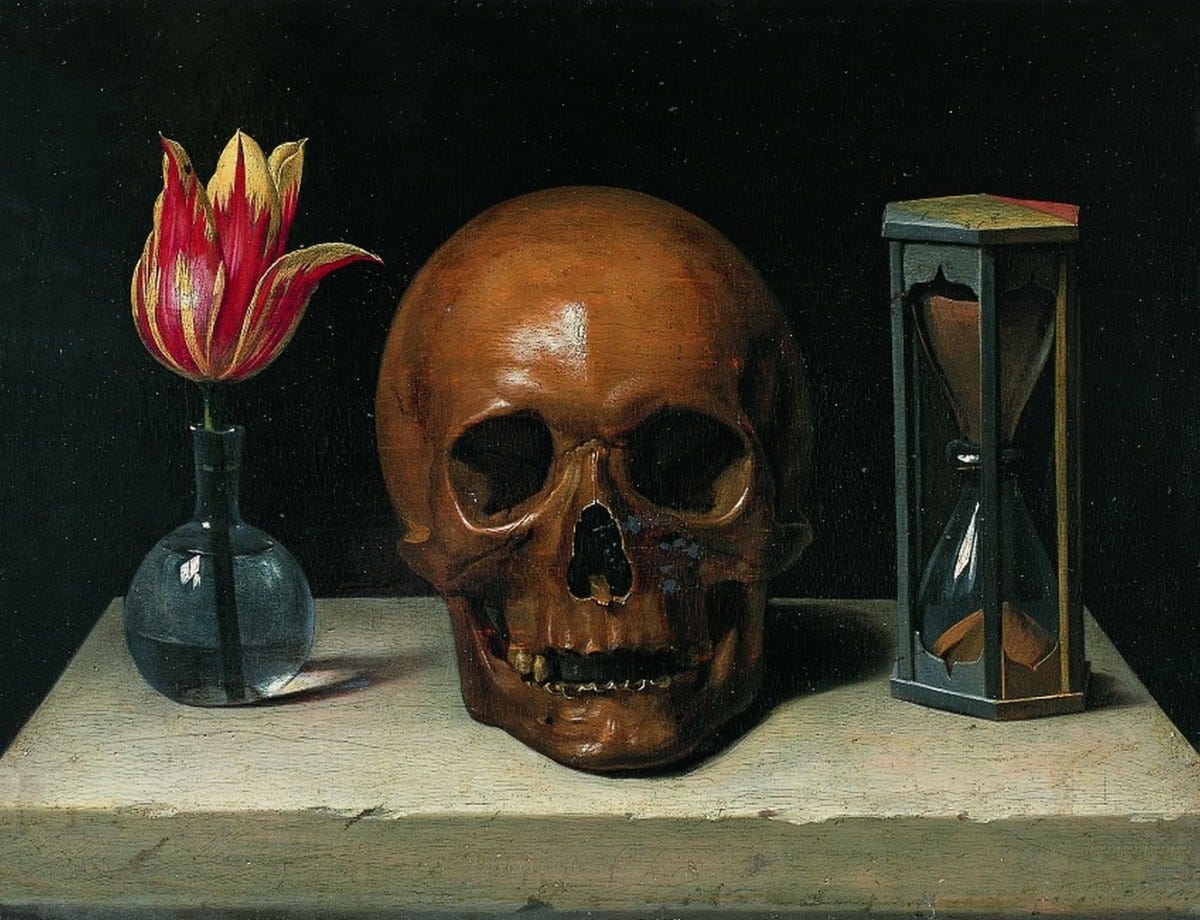
4. Philippe de Champaigne, Still Life with a Skull
Three objects sit on a stone ledge. A tulip in a glass, a skull, and an hourglass with the sand running through it.
There is nothing extra. Champaigne strips the vanitas down to three signs, life, death, and time, and lets them speak alone.
Read left to right it is a sentence. The flower blooms, the sand falls, the skull waits at the end.
5. Harmen Steenwyck, An Allegory of the Vanities of Human Life

A skull rests among books, a flute, a shell, and a sword. A watch lies open on the table. A thin shaft of light crosses the scene.
Each object stands for a pleasure or a pursuit, music, learning, wealth, power. The watch and the guttering lamp remind you that time is spending all of them.
The beam of light is a clock too. It falls across the skull and marks the exact moment you are looking.
6. Pieter Claesz, Vanitas Still Life
A skull tips over a stack of papers. Beside it lie an overturned glass, a snuffed candle, and a gold pocket watch on a blue ribbon.
Claesz worked in a narrow range of brown and green and added just one dash of blue, the watch ribbon. The whole staged scene is built to look like a real desk.
The candle has just gone out and the watch keeps ticking. Together they say the same thing, your time is already running.
7. Giorgio de Chirico, The Melancholy of Departure

An empty station square runs back to a train on the horizon. Long shadows stretch across the ground. A large clock sits on a tower above.
The clock reads 1:27, a precise time with no reason given. De Chirico painted these still, dreamlike squares in Paris just before the First World War, and they shaped the Surrealists who came after.
The clock is fixed and the train is leaving. Time stops in the square while the world moves off without you.
8. Nicolas Poussin, A Dance to the Music of Time
Four figures join hands and dance in a ring. An old winged man plays a lyre for them. Two small children sit nearby.
The old player is Father Time. One of the children blows soap bubbles and the other holds an hourglass, both signs of how briefly a life lasts.
The dancers are Poverty, Labor, Wealth, and Pleasure, turning in a circle. Time sets the tempo, and the wheel never stops.
9. Bronzino, An Allegory with Venus and Cupid
Venus and Cupid embrace in a crowded scene of figures. At the top, a bald old man reaches across to pull back a blue cloth.
That old man is Father Time. He is drawing the curtain to reveal the whole affair, so that nothing stays hidden for long.
Bronzino sent this cold, packed picture to Francis I of France. Above the tangle of love, Time waits to expose it all.
10. Antonio de Pereda, Allegory of Vanity
A winged angel leans on a table piled with coins, jewels, weapons, and a globe. One hand points to a clock among the riches.
A small portrait of the emperor Charles V sits in the pile. Even an emperor crown, Pereda says, gets measured out by the same clock as everything else.
The angel does not touch the gold. It points at the clock, the one object on the table that keeps taking.
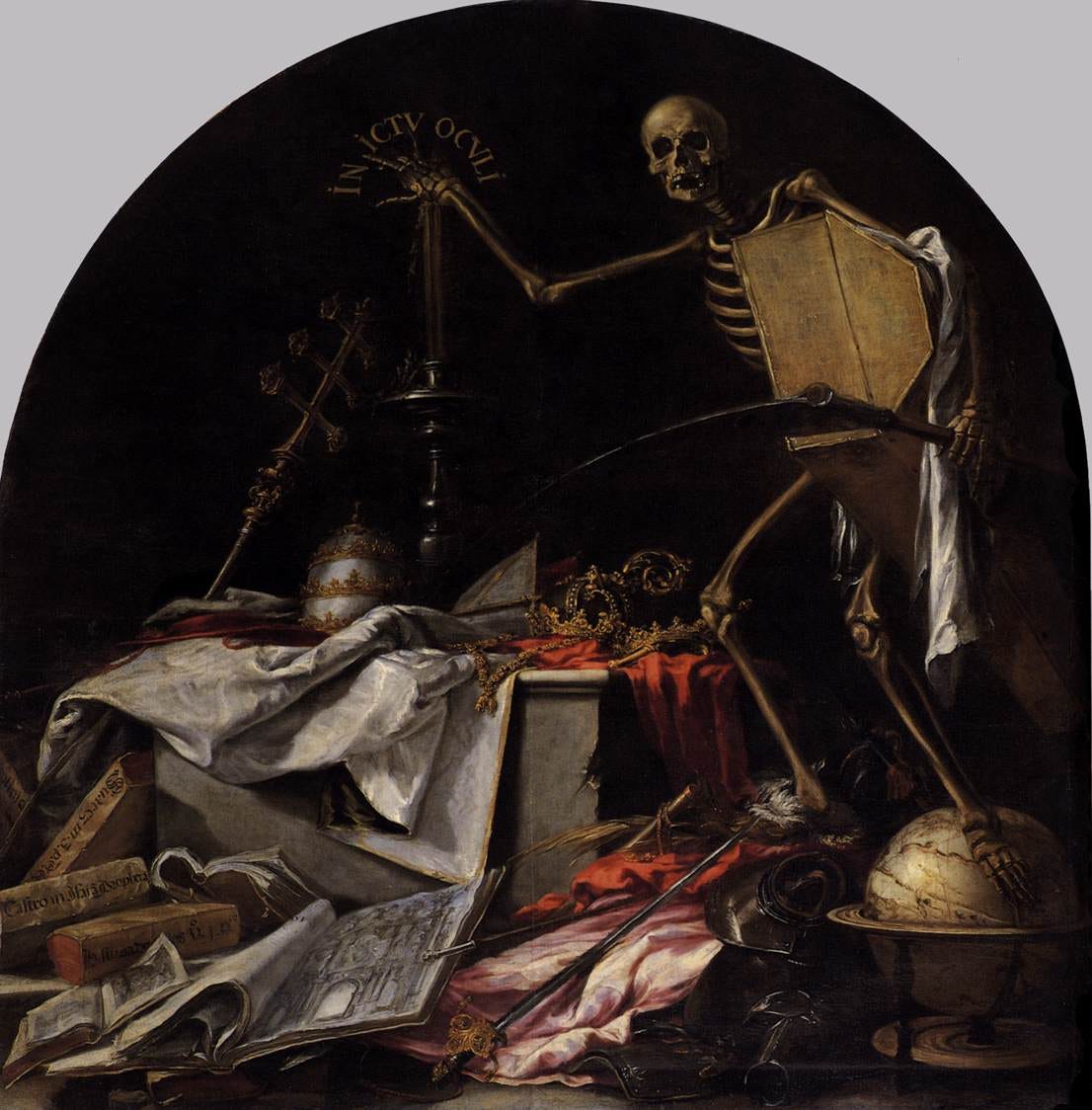
11. Juan de Valdes Leal, In Ictu Oculi
A skeleton strides in carrying a coffin and a scythe. It reaches out and snuffs a candle. Crowns, armor, and books lie trampled underfoot.
The title means in the blink of an eye. Death stands on the symbols of church and state, showing that power and rank end as fast as a flame goes out.
The painter Murillo reportedly said you had to hold your nose to look at it. Valdes Leal wanted death to feel that near.
12. Salvador Dali, The Disintegration of the Persistence of Memory

The old melting watches return, but now the ground has broken into floating blocks. Everything drifts apart over water. A fish swims through the ruins.
Dali made this more than twenty years after the first version. He was reading about atoms and nuclear physics, so he broke his own famous scene into particles.
The two Persistence paintings are a before and after. The first makes time go soft. The second blows it into pieces.
Where to see them
The National Gallery, London: Holbein The Ambassadors, Titian Allegory of Prudence, Steenwyck Allegory of the Vanities, and Bronzino An Allegory with Venus and Cupid.
Museum of Modern Art, New York: Salvador Dali The Persistence of Memory and Giorgio de Chirico Gare Montparnasse.
Mauritshuis, The Hague: Pieter Claesz Vanitas Still Life.
The Wallace Collection, London: Nicolas Poussin A Dance to the Music of Time.
Kunsthistorisches Museum, Vienna: Antonio de Pereda Allegory of Vanity.
How painters made time visible
Most of the still lifes are vanitas paintings, packed with a skull, a watch, and a snuffed candle to carry the memento mori warning.
The others are allegories, where Father Time steps in as a winged old man, and the two Dali works turn the whole idea into a Surrealist dream.
Time in art, questions people ask
What does memento mori mean? It is Latin for remember you must die. A clock, an hourglass, or a skull placed in a painting delivers that reminder.
Why did Dali paint melting clocks? He linked them to a wheel of Camembert cheese melting in the sun, not to Einstein, though many people assume otherwise.
What is hidden in Holbein Ambassadors? A skull, painted as a stretched smear that only reads correctly when you look at the picture from the side.
What is a vanitas painting? A still life packed with symbols of time and death, a skull, a watch, a snuffed candle, meant to show that worldly things do not last.
Who is Father Time in art? An old winged man, often with a scythe, an hourglass, or a lyre, used to represent time itself in allegories.
The clock that was always running
Four centuries apart, the message never changed. Champaigne hourglass, Holbein hidden skull, Pereda clock among the gold, and Dali soft watches all say the same thing in different centuries. Time is spending you while you watch. The painters simply made the countdown beautiful enough to stop and look at.