
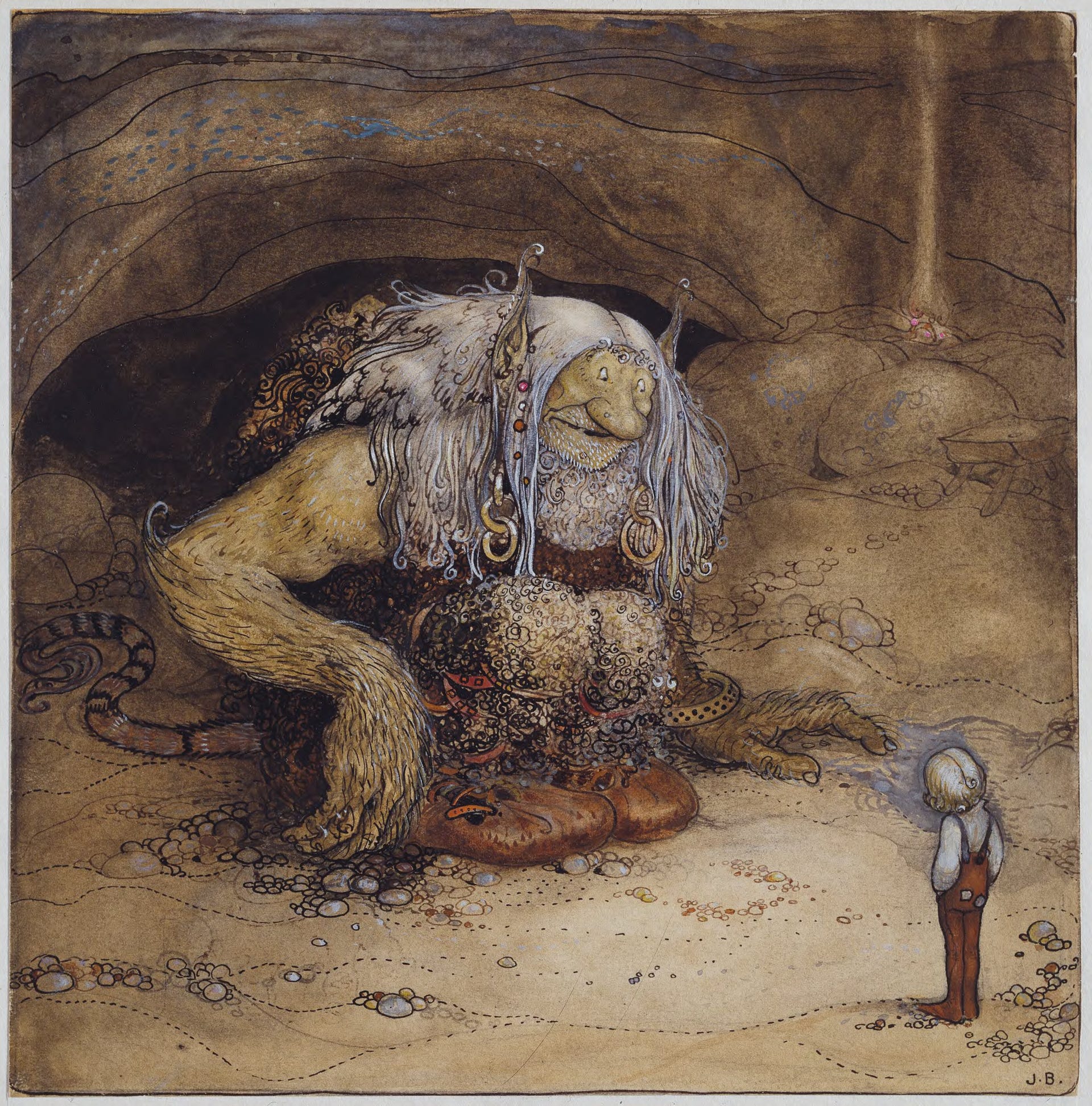
For centuries, trolls lived only in stories told aloud on the farms of Norway and Sweden, and each listener had to picture them alone. Then, in the late 1800s, a handful of painters and illustrators from the far north put them on paper. The faces they settled on still look out from souvenir shops and films, and these are the pictures behind that look.
Cool Stories About Art is a newsletter to learn art the fun way.
Join 200,000+ readers and get:
10 new art stories / month
The entire archive of content (140+ articles)
Comment, ask questions, and chat with other readers
Where the Northern Trolls Came From
Before anyone painted a troll, two Norwegian collectors wrote them down. In the 1840s, Peter Christen Asbjørnsen and Jørgen Moe recorded the folk tales of their country, and the trolls in those tales are huge, ugly and slow, sometimes with several heads. They live in the mountains or deep in the forest, and a poor, clever boy usually outwits them.
Those tales arrived at the right moment for painters in Norway and Sweden. In the late 1800s, many of them wanted subjects of their own, less indebted to Paris, and the tales offered trolls, giants, water spirits and the women of the woods, all from the farms and forests they had grown up with.
Every work on this list is Norwegian or Swedish, made by an artist raised on those stories, and each one takes a single creature as its subject. Read in order, they show how the troll got its face.
12. Erik Werenskiold, "Ugh! Ugh! Here I Smell the Blood of a Christian Man!" Roared the Troll (1884)
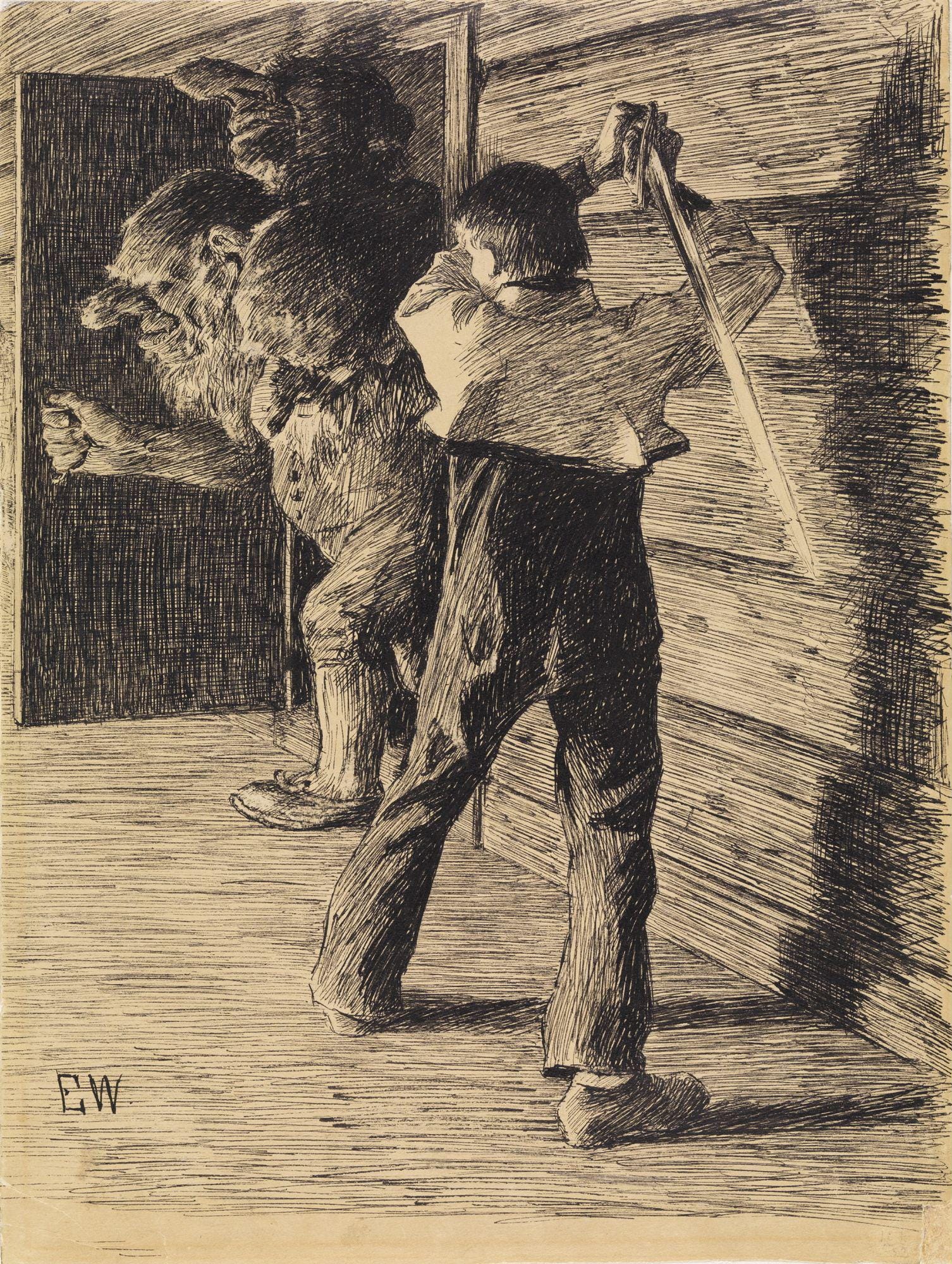
A troll with a huge nose and a tangled beard pushes through a door into a room with log walls, and a second troll follows close behind. He has not seen the boy pressed against the wall with a sword raised over his head. The caption gives the troll's words as he comes in: "Ugh! Ugh! Here I smell the blood of a Christian man!"
The boy is Halvor, the poor hero of Soria Moria Castle, one of the stories the two Norwegian collectors wrote down. This pen drawing was made for a children's edition of those tales, published in Copenhagen in 1884. Its author, Erik Werenskiold, was the first artist to give the trolls of the tales a face, and he owed the chance to the fatigue of other painters.
In 1878, the work of illustrating the tales had gone to established Norwegian painters, and they were tiring of it. One of them, Otto Sinding, showed Asbjørnsen some sketches by a young Norwegian then studying in Munich. Asbjørnsen was delighted and sent the student a long list of tales to draw.
So Werenskiold spent that winter in Munich drawing Norway largely from memory, while Asbjørnsen commented on every sheet by letter. The book came out for Christmas 1879 with a hundred illustrations, nearly a quarter of them his, and in them stood a new kind of troll, heavy and bearded, with a big nose. To me, these trolls look more like old farmers from a remote valley than like monsters, which may be why they stuck.
Three summers later, Werenskiold stayed near Kragerø, on the south coast, next door to another young painter, Theodor Kittelsen. When the children's edition was planned, he insisted that his neighbor draw it with him. Kittelsen took up that heavy figure with its big nose, and the makers of troll souvenirs later took it from both of them.
At a Glance
Artist: Erik Werenskiold (1855 to 1938)
Made: 1884
Medium: Pen over pencil on paper
Size: 31 x 23.2 cm (12 1/4 x 9 1/8 in)
Where to see it: Nasjonalmuseet, Oslo, Norway (works on paper, shown only from time to time)
11. Theodor Kittelsen, Pesta on the Stairs (1894 to 1896)
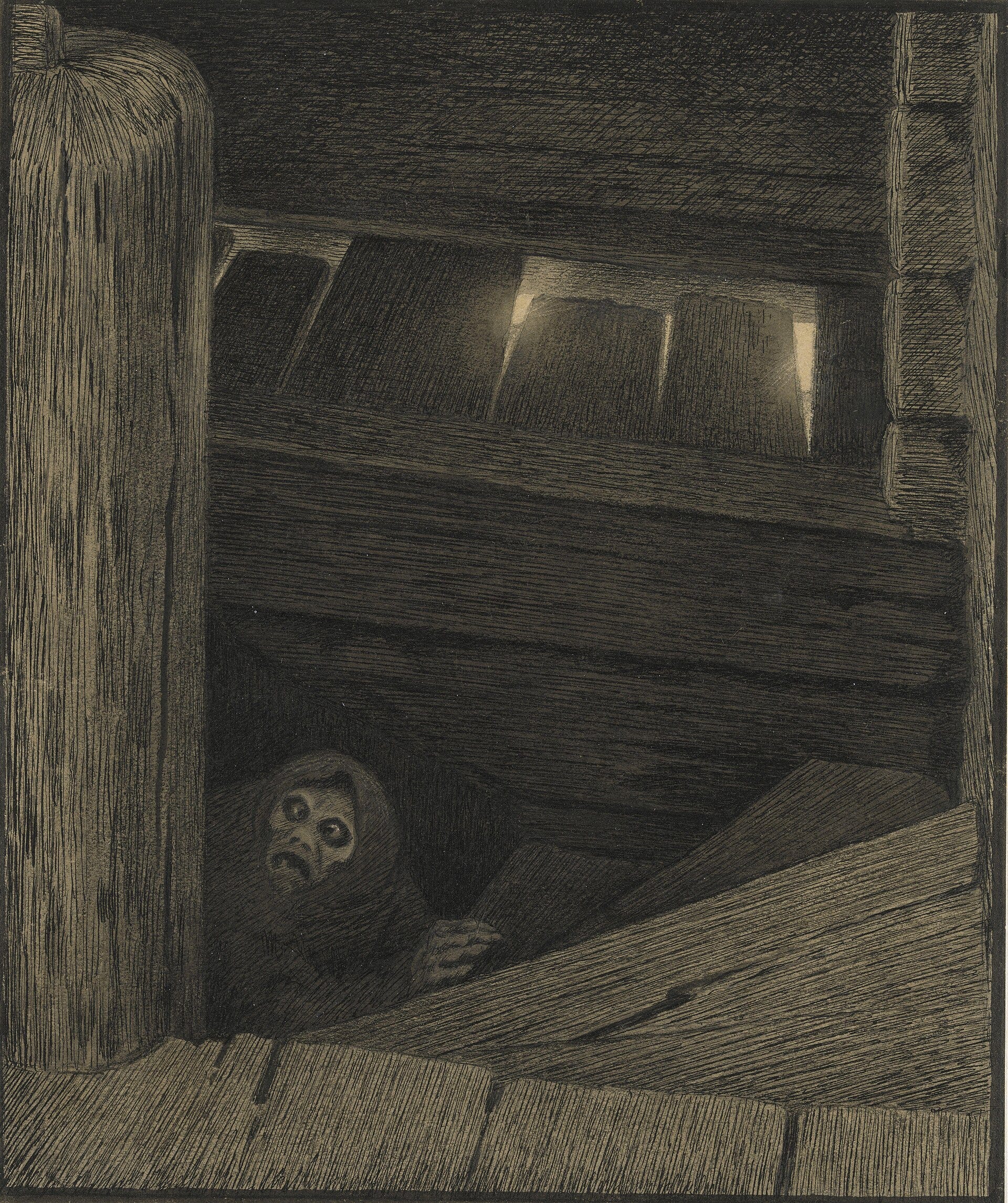
Her face is almost a skull. Hooded and bent, an old woman climbs the steep wooden stairs of a farmhouse toward the loft. In the Norwegian story behind this drawing, she goes from farm to farm, and what happens inside each house depends on what she carries in her hand.