Unicorns in Art: 12 Works and What They Really Mean

For a thousand years European art treated the unicorn as a real animal. It stood for Christ, for chastity and for a horn worth more than gold, and it slid into fairy tale only once naturalists stopped believing in it.

Tapestry of hunters carrying the dead unicorn to a castle
The Unicorn is Killed and Brought to the Castle, from the Unicorn Tapestries, about 1500

The one horned beast came into Europe through a mistranslated Hebrew word and a Greek doctor's travel notes, and painters ran with it.

Here are twelve works where it appears, from a Flemish tapestry to a Symbolist fever dream, and what people thought they were looking at.

All are in the public domain.


Learn art the fun way. Free stories every week, no boring lectures.


1. The Hunt of the Unicorn tapestries (about 1500)

Seven hangings, woven in wool, silk and metal thread, follow hunters through a wood until they kill the unicorn and carry it to a castle.

The animal is Christ, hunted and killed, and the mille fleurs background holds about a hundred plants, some eighty five of them identified.

The tapestries surfaced in a French chateau, were used at one point to cover potatoes against frost during the Revolution, and were bought by John D Rockefeller Junior in 1922.

They now hang in a purpose built room in New York.

2. The Unicorn Rests in a Garden (about 1500)

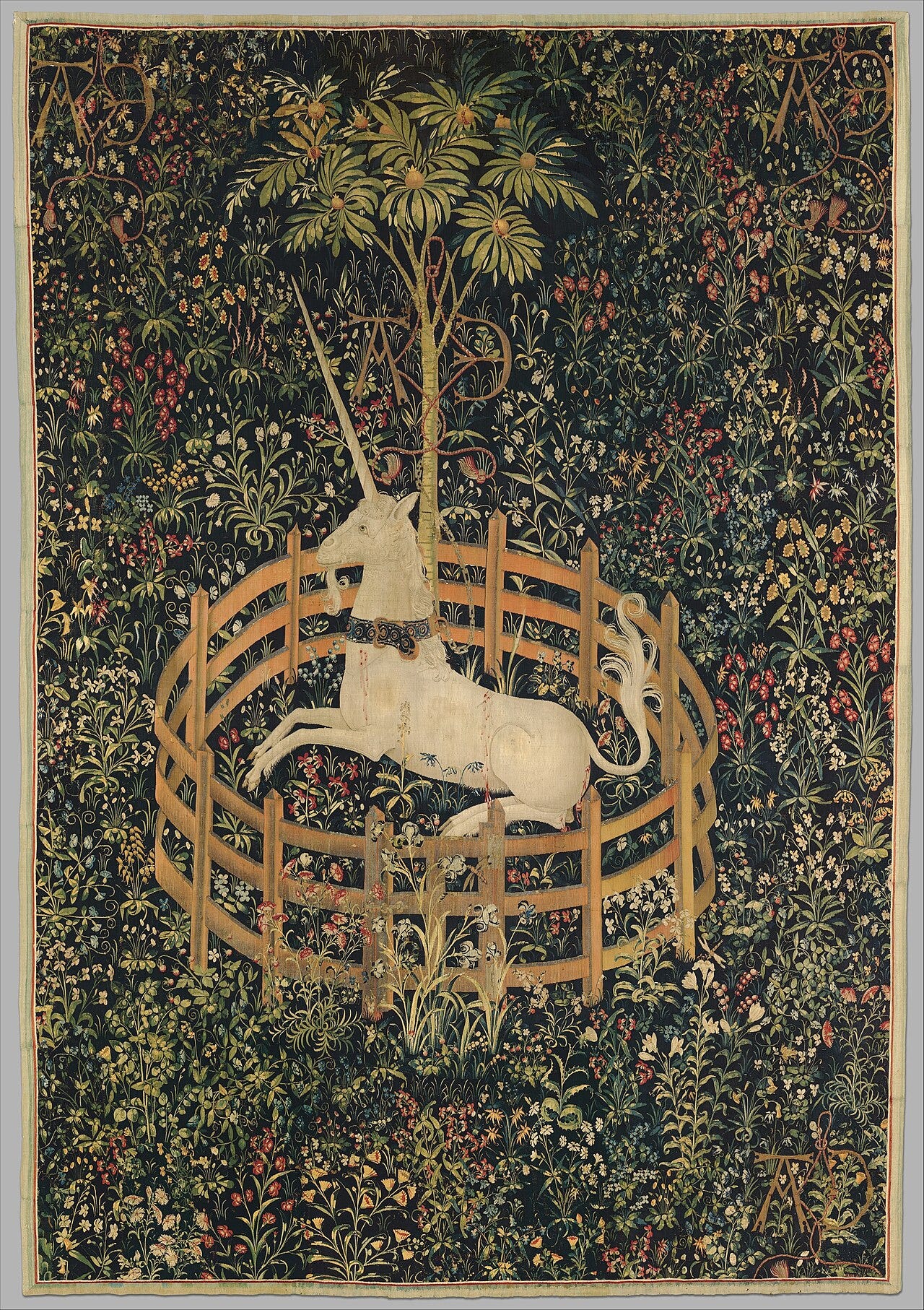
Unicorn chained to a pomegranate tree inside a low fence
The Unicorn in Captivity, from the Unicorn Tapestries, about 1500

The last of that series shows the animal alive again, penned inside a low fence, chained to a pomegranate tree, and apparently content.

Read one way it is the risen Christ; read another it is a bridegroom, tamed, and the iconography of the fence is marriage. The letters A and E are woven into the corners and nobody has explained them.

The red spots on its flank are usually read as juice from the pomegranates above, rather than blood.

3. The Lady and the Unicorn: A Mon Seul Desir (about 1500)

Lady before a tent flanked by a lion and a unicorn
The Lady and the Unicorn: A Mon Seul Desir, about 1500

Five of these six Paris tapestries stand for the five senses. In the one for sight, the lady holds up a mirror and the unicorn lays its forelegs in her lap to look at itself.

The sixth shows her before a tent inscribed with the words to my only desire, putting a necklace back into a casket, and scholars have argued about it since the 1840s.

Prosper Merimee reported the set rotting in a chateau in the Creuse and George Sand made it famous. Whatever the sixth tapestry means, the animal is not the subject.

4. Ashmole Bestiary, the unicorn and the maiden (about 1210)

Manuscript miniature of a hunter spearing a unicorn in a woman's lap
Unicorn and maiden, Ashmole Bestiary, about 1210

A hunter drives a spear into a unicorn that has laid its head in a woman's lap. The bestiaries taught that the beast could only be caught by a virgin, so the maiden was bait, and the whole scene was read as the Incarnation, with Christ subdued by the womb of the Virgin.

Illustrators drew the animal as a goat, a horse, a small deer, whatever they had seen, since none of them had seen this. Nearly every illuminated manuscript bestiary carries the scene.

5. Conrad Gessner, De Monocerote (1551)

Woodcut of a horse with a spiral horn
Conrad Gessner, De Monocerote, from Historiae animalium, 1551

Gessner was compiling the first modern encyclopedia of animals, and he put the unicorn in it. His woodcut shows a horse with a spiral horn, next to careful notes on where the beast lives and how the horn detects poison.

He was a serious naturalist who also recorded that he had never met a witness. The entry sits a few pages from the rhinoceros. In 1551 the two animals had exactly the same evidence behind them.

6. Raphael, Young Woman with a Unicorn (about 1506)

Young woman holding a small white unicorn in her lap
Raphael, Young Woman with a Unicorn, about 1506

For three centuries this was a picture of Saint Catherine holding a wheel. Restorers in the 1930s took off the wheel, the cloak and the palm and found a young woman with a small white unicorn in her lap; X rays later showed a dog beneath the unicorn.

The beast is a chastity token, painted for a Roman wedding. Raphael was in his early twenties. The sitter has never been identified with any certainty.


Join 130,000 readers who get the secrets behind the paintings. Free.


7. Albrecht Durer, The Abduction of Proserpine on a Unicorn (1516)

Etching of Pluto carrying Proserpine on a shaggy unicorn
Albrecht Durer, The Abduction of Proserpine on a Unicorn, 1516

Durer put Pluto on a shaggy, snub nosed beast that looks nothing like the elegant creature of the tapestries, and had it charge out of the underworld carrying a screaming woman.

By 1516 the unicorn could be used like this, as a mount for a rapist, with none of the sanctity the bestiaries gave it. This is one of his few iron etchings; iron rusts, so few good impressions survive.

He printed it a year after his rhinoceros, an animal he had also never seen, and made both of them ugly and convincing.

8. Jean Duvet, The Triumph of the Unicorn (about 1561)

Engraving of a unicorn drawing a triumphal chariot
Jean Duvet, The Triumph of the Unicorn, about 1561

Duvet was a goldsmith and engraver who made six plates telling the unicorn's story, and this last one puts the animal in a triumphal chariot pulled through a crowd.

The set is generally read as an allegory of the French king Henri II and his court. Duvet crammed every plate so full that the eye cannot rest, and later critics called him the Master of the Unicorn because nobody knew his name.

He was over seventy when he cut these.

9. Hieronymus Bosch, the Garden of Earthly Delights (about 1500)

Eden with animals drinking at a pool, including a unicorn
Hieronymus Bosch, the Eden panel of The Garden of Earthly Delights, about 1500

Bosch treated the unicorn as natural history rather than symbol, and put it in Eden among animals reported by travellers. It drinks from the pool in the left panel while a giraffe walks out of the water beside it.

Bosch gives a second, darker unicorn to the riders in the central panel. Nobody in his town had seen either creature, and he painted them as equally likely.

10. Narwhal tusk cup, Germany (late 1600s)

Mounted cup carved from a narwhal tusk with gilt silver
Cup and cover made from a narwhal tusk, Germany, late 1600s

The horns sold across Europe as alicorn, ground into powder to cure poison and plague, came from narwhals hunted in the Arctic and shipped south.

A whole tusk could be worth ten times its weight in gold. Elizabeth the First owned one valued at ten thousand pounds, about the price of a castle.

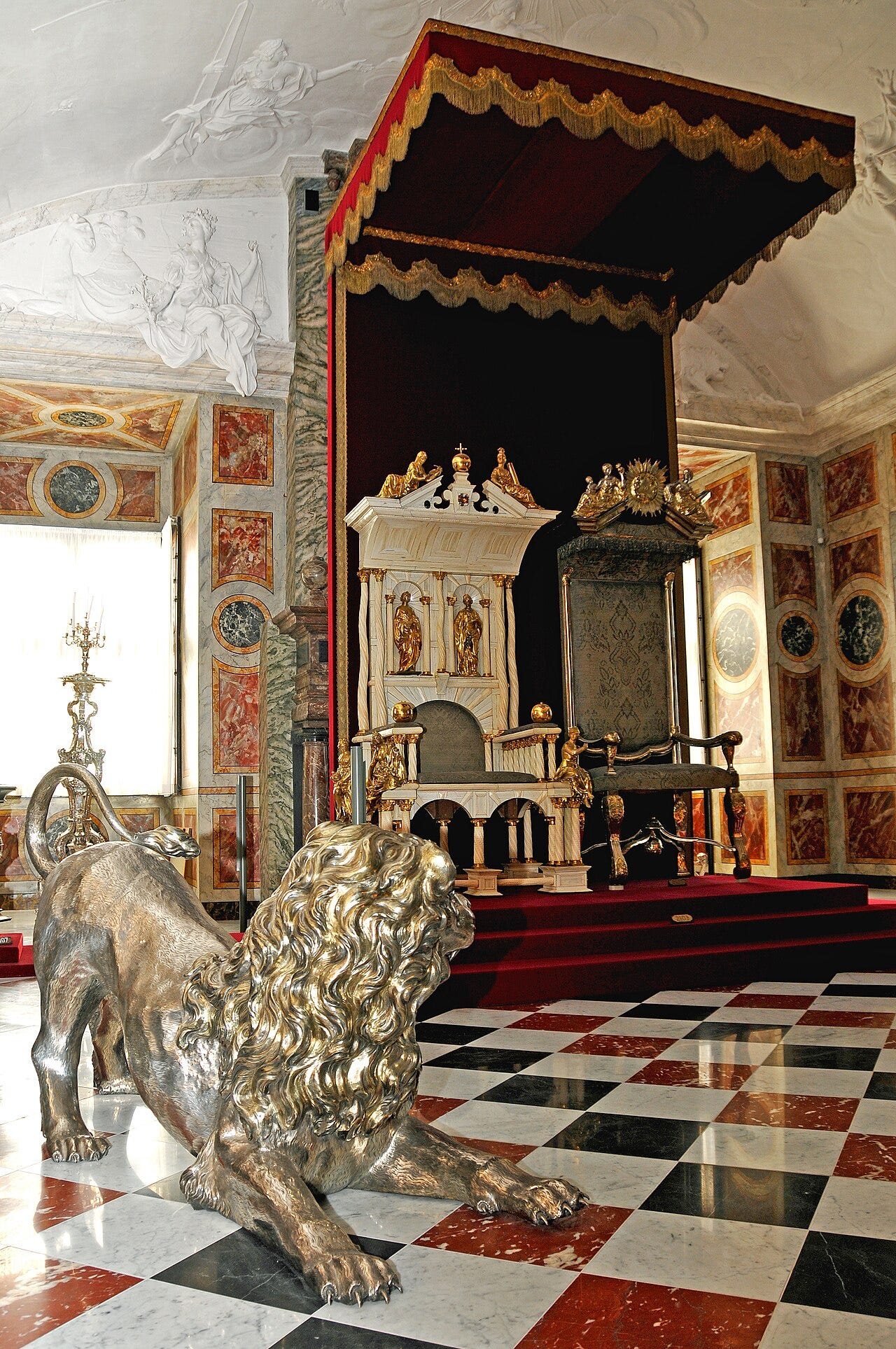
Danish kings had a throne built of them. This mounted cup in New York is what the trade produced once people had started to suspect where the horns really came from.

11. Domenichino, The Virgin and the Unicorn (1602)

Fresco of a young woman with a unicorn resting against her
Domenichino, The Virgin and the Unicorn, 1602

Domenichino painted this fresco in the Palazzo Farnese in his early twenties, working under Annibale Carracci, around 1604. A young woman sits under a tree with the unicorn's head against her, hunters watching from the trees.

By then nobody with an education believed the animal existed, and the picture is closer to a mythological allegory than to devotion.

The gallery was decorated for a wedding. The unicorn had become a decorative compliment.

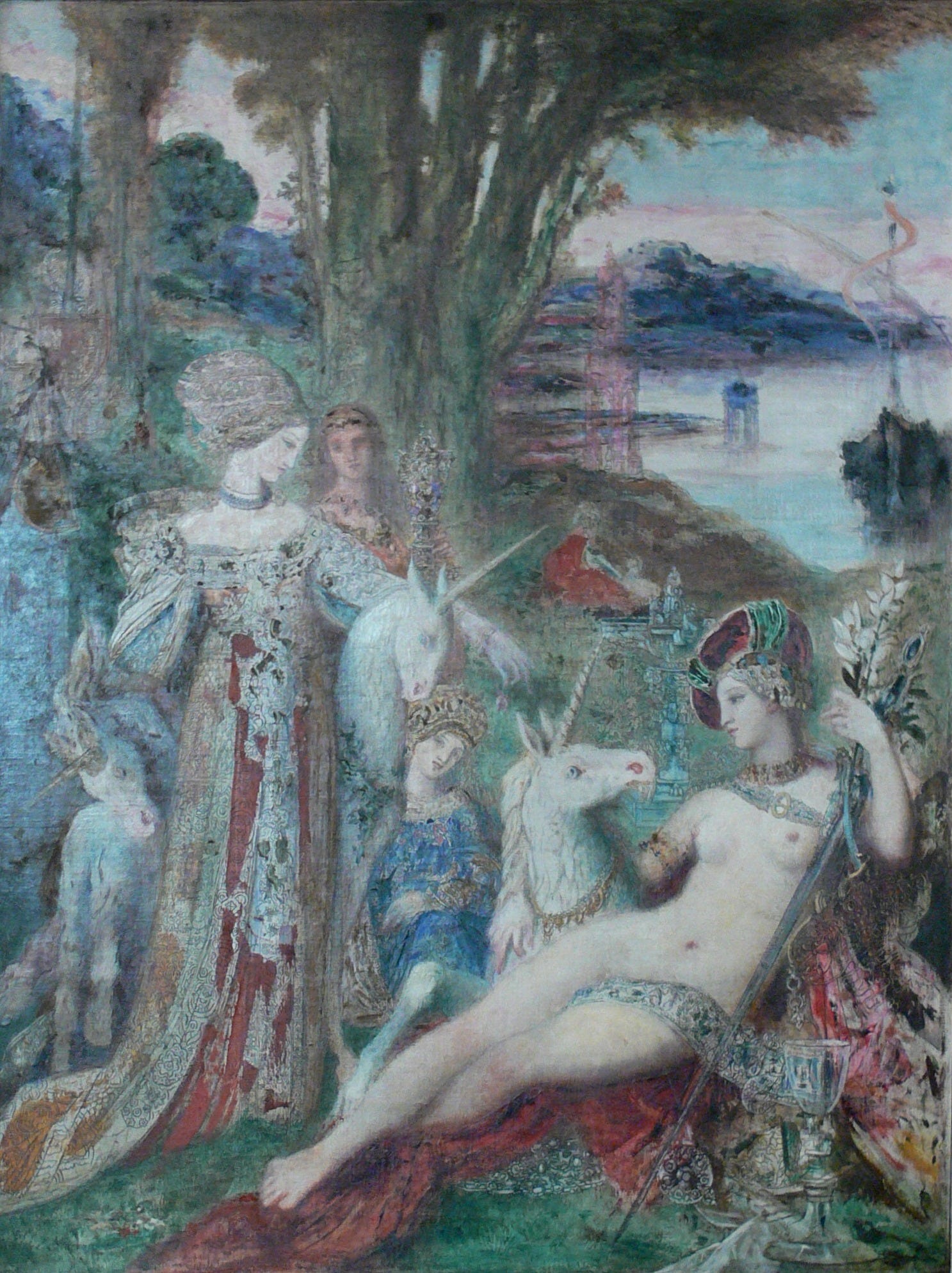
12. Gustave Moreau, The Unicorns (about 1885)
Women in jewelled headdresses leaning against unicorns
Gustave Moreau, The Unicorns, about 1885

Moreau kept the medieval symbolism of chastity and turned it drowsy: women in jewelled headdresses lean against unicorns in a hothouse landscape, and the animal guards nothing.

He had seen the Cluny tapestries. He taught Matisse and Rouault, told them to look at nature rather than at him, and left his house and roughly eight thousand works to France as a museum.

The unicorn ends here as pure atmosphere.


Unicorn questions, answered

  • What does a unicorn symbolise in art? Christ, chastity, and marriage. In a bestiary it is the Incarnation; in a portrait it usually means the sitter is a virgin bride.

  • Why is the unicorn always with a woman? Because the legend said only a virgin could catch one. The maiden in the picture is the trap.

  • Were unicorn horns real? They were narwhal tusks, sold as alicorn at enormous prices and believed to detect poison.

  • Where did the unicorn come from? From the Greek writer Ctesias, who described a one horned Indian ass, and from a Hebrew word mistranslated in early Bibles.

  • What are the famous unicorn tapestries? The Hunt of the Unicorn in New York and The Lady and the Unicorn in Paris, both woven around 1500.


If the unicorn pulled you in, you will love these too:


The animal everyone believed in

The unicorn survived so long because it was useful: it explained a Bible verse, it sold a medicine, and it flattered a bride. It only became a fairy tale once the trade in narwhal tusks was exposed and the naturalists dropped it from their books.

In 1638 the Danish scholar Ole Worm dissected a tusk still attached to a narwhal skull, and published it. The horn went on selling in apothecaries for another hundred years.


Two new stories a week, 130+ secrets unlocked. Start free.