
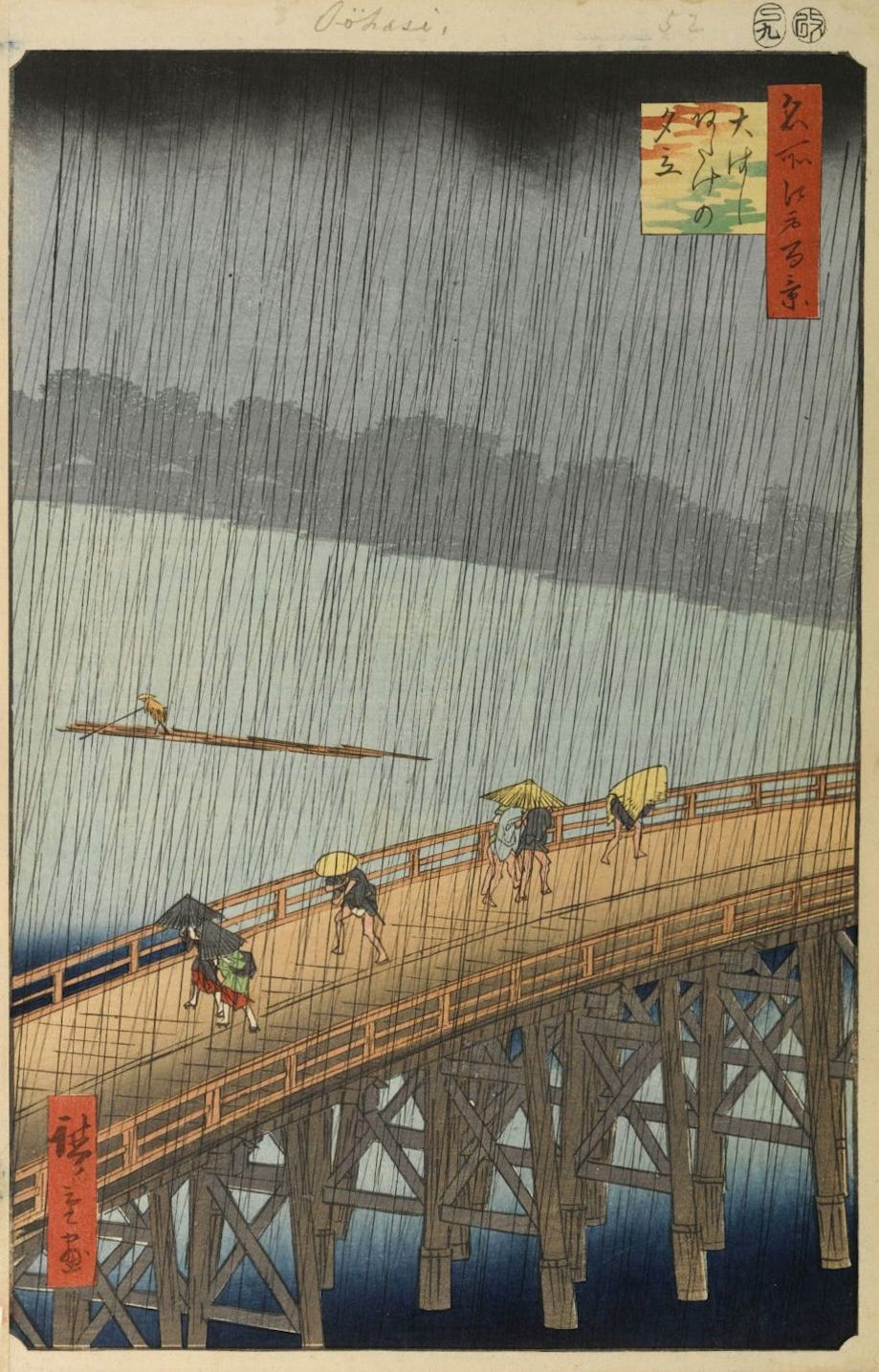
Utagawa Hiroshige was a Japanese printmaker, born in Edo (now Tokyo) in 1797 and dead in 1858, who turned rain, snow and the open road into art. He is known for two series, The Fifty-three Stations of the Tokaido and One Hundred Famous Views of Edo, and for a rainstorm over a bridge that Vincent van Gogh copied in oils.
Hokusai is the printmaker with the wave. Hiroshige is the one with the rain, the snow and the long road, and a generation after his death the painters of Paris fell for him.
Cool Stories About Art is a newsletter to learn art the fun way.
Join 200,000+ readers and get:
10 new art stories / month
The entire archive of content (1,000+ articles)
Comment, ask questions, and chat with other readers
Hiroshige earned his fame on a road. In 1832, the story goes, he joined an official party carrying the shogun's yearly gift of horses along the Tokaido, the highway from Edo to Kyoto, and the next year he began publishing the prints. There were 55 of them, one for each stop and the two ends of the road, and they were a runaway success.
That story was written down by one of his own followers, and nobody can prove it. Some researchers doubt he went farther than Hakone, in the mountains west of Edo, where the road is only beginning. A few suspect that parts of the series were not drawn from what he saw.
So the man remembered as the painter of the road may have drawn some of it from his desk. The pictures hold up anyway. The rain he printed in 1857 was still good enough, thirty years later, for a painter in Paris to trace it.
What You'll Discover
How a fireman became an artist.
What he really saw on that road.
How rain was cut into wood.
What Van Gogh did with his prints.
What he wrote before he died.