
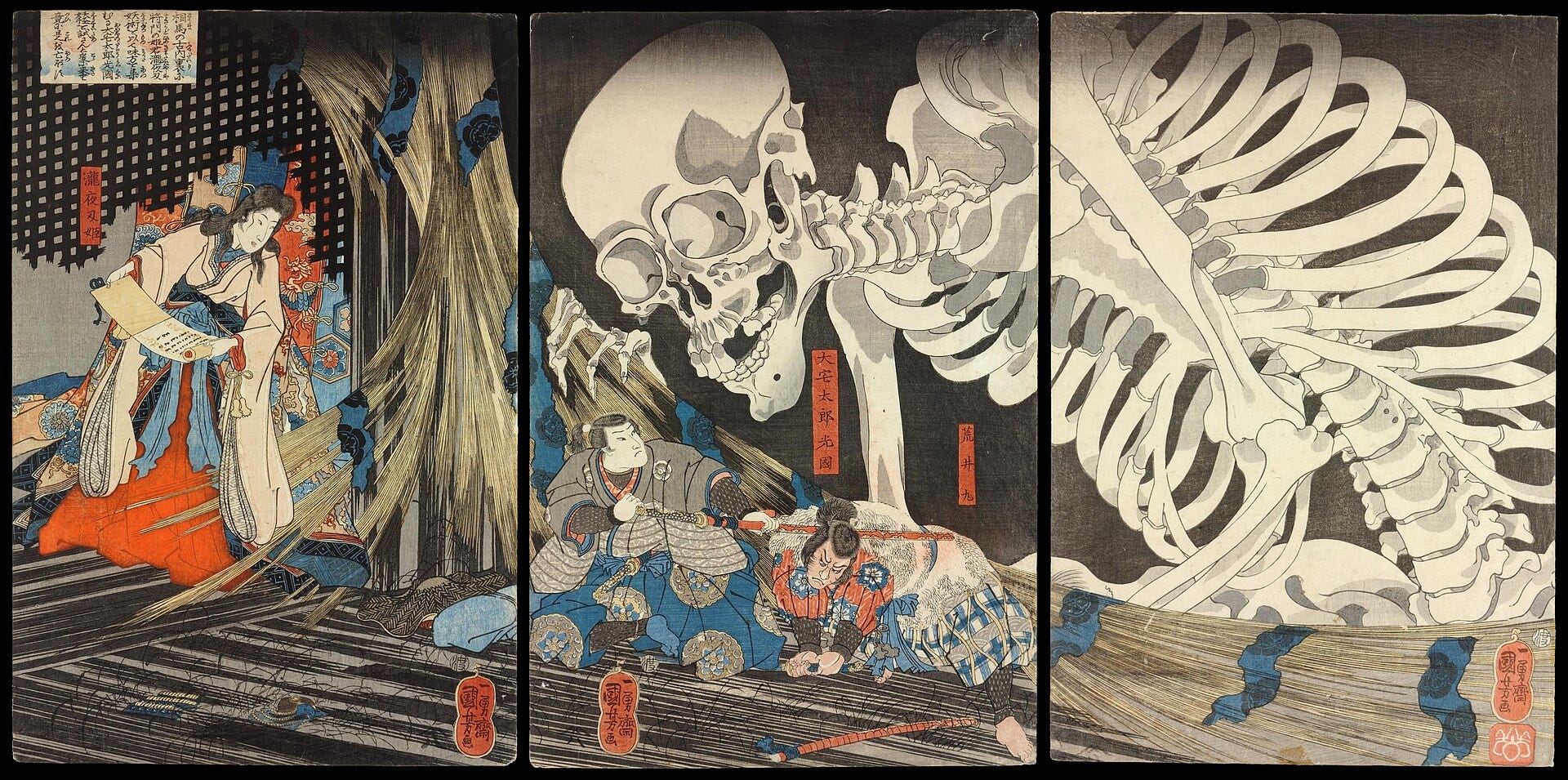
Utagawa Kuniyoshi (1797 to 1861) was a Japanese designer of ukiyo-e, the woodblock prints sold in Edo, today's Tokyo. He was famous for warriors, ghosts and monsters from old stories, like the giant skeleton of Takiyasha the Witch and the Skeleton Spectre.
Cool Stories About Art is a newsletter to learn art the fun way.
Join 200,000+ readers and get:
10 new art stories / month
The entire archive of content (140+ articles)
Comment, ask questions, and chat with other readers
In 1843, a year before the skeleton, Utagawa Kuniyoshi published another print: a sick warrior in bed, from a legend eight centuries old, with demons pouring into his room. Many buyers saw their own ruler in that warrior, and the publisher, afraid of punishment, destroyed the wooden blocks that printed it.
Kuniyoshi was born in Edo in 1797. Edo was the city of the shogun, the military ruler who governed Japan in the emperor's name. Kuniyoshi's father dyed silk, and the boy drew patterns for the cloth.
At seven or eight, the dyer's son fell in love with the ukiyo-e of Edo's shops, "pictures of the floating world," the pleasures of the city. He liked prints of warriors best and copied them on his own.
Each print was the work of four people. An artist drew the design in ink, and a carver cut it into wooden blocks. A printer inked the blocks, one per color, and pressed paper onto them. The publisher paid everyone and sold the prints.
In 1811, at thirteen, the boy became the apprentice of Utagawa Toyokuni, the most popular print designer in Edo. Toyokuni led the Utagawa school, the city's largest group of print artists, whose pupils took its name.
In 1814, Toyokuni gave his apprentice the name he is known by today, Kuniyoshi, borrowing the "Kuni" of his own. But the school was crowded with gifted pupils, and for over ten years publishers gave Kuniyoshi little work.
Around 1827, a publisher launched a series of Kuniyoshi's heroes from the Suikoden, the Japanese name of a Chinese novel of the 1300s about 108 outlaws who fight corrupt officials.
Kuniyoshi gave each hero a sheet of his own, caught in mid-fight, the hero's body covered in tattoos of dragons and peonies. The series became his best seller, and Edo nicknamed him "Kuniyoshi of the warrior prints."
The shogun's officials checked every print before it went on sale. So why did the people of Edo find their own government in a print of an old legend?
In the rest of the story
What became of the print once its publisher destroyed the woodblocks.
Which famous faces the buyers of Edo recognized among scribbles on a wall.
What Kuniyoshi used as a brush at a painting party in 1853.
What a pupil of Kuniyoshi did with a real battle he saw in 1868.