
Variety in art is deliberate difference: mixed shapes, colors, textures, and directions that keep the eye hunting. Too little and a picture bores; too much and it shatters. Here are ten works that pack in the maximum and still hold together.
Variety in 30 seconds
Variety is the spice; unity is the meal. Every strong picture negotiates between the two.
Variety differs from contrast: contrast is one sharp opposition, variety is many differences at once.
The masters of variety always hide a container: a grid, a color, a horizon, one thing that holds the riot.
Too much harmony and agreement turns to wallpaper; variety is the cure for the boring picture.
The test: count how many kinds of thing your eye finds in thirty seconds. Then notice you never felt lost. That is variety, managed.
Bosch, The Garden of Earthly Delights (c. 1495-1505): maximum everything
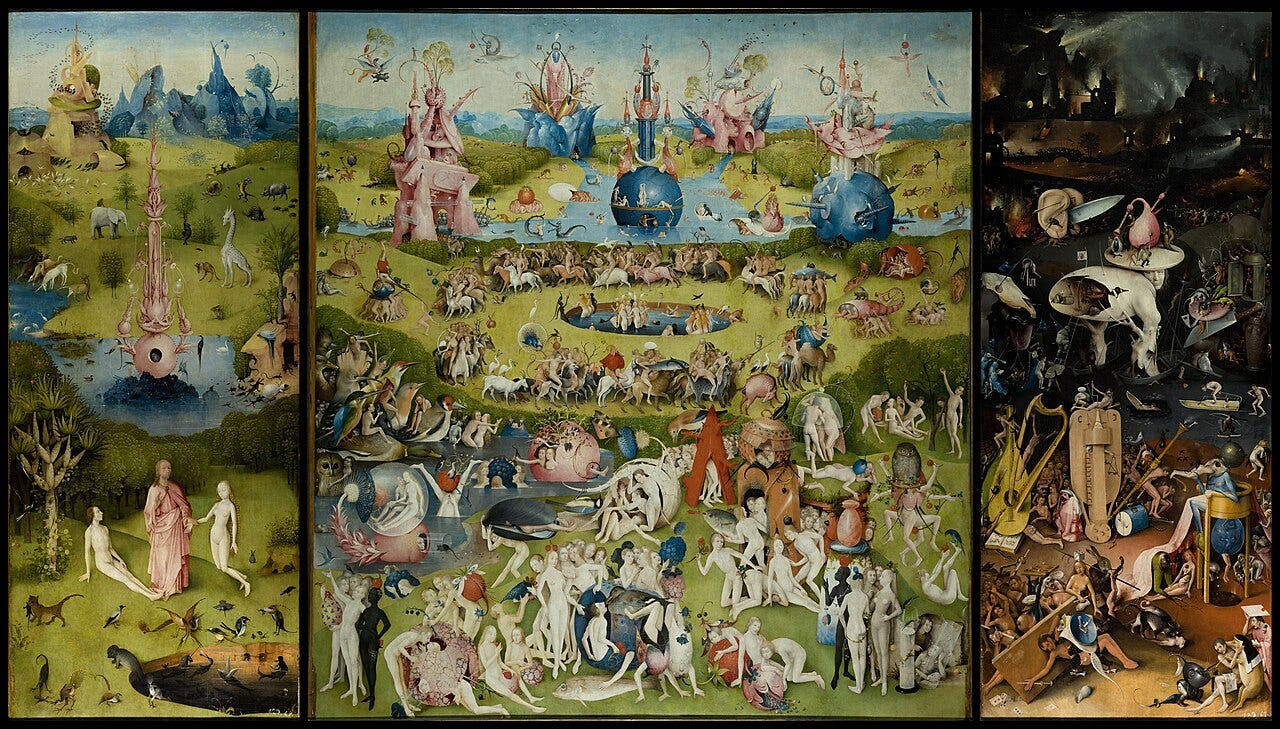
Hundreds of nudes, giant birds, glass tubes, hybrid demons, a tree-man: no painting holds more kinds of thing. Bosch controlled the riot with three panels, three horizons, and a pink-blue palette that never changes register.
Five centuries on, scholars still cannot agree what a third of the objects are. Variety this dense becomes a permanent puzzle.
Bruegel, Netherlandish Proverbs (1559): a hundred scenes, one village
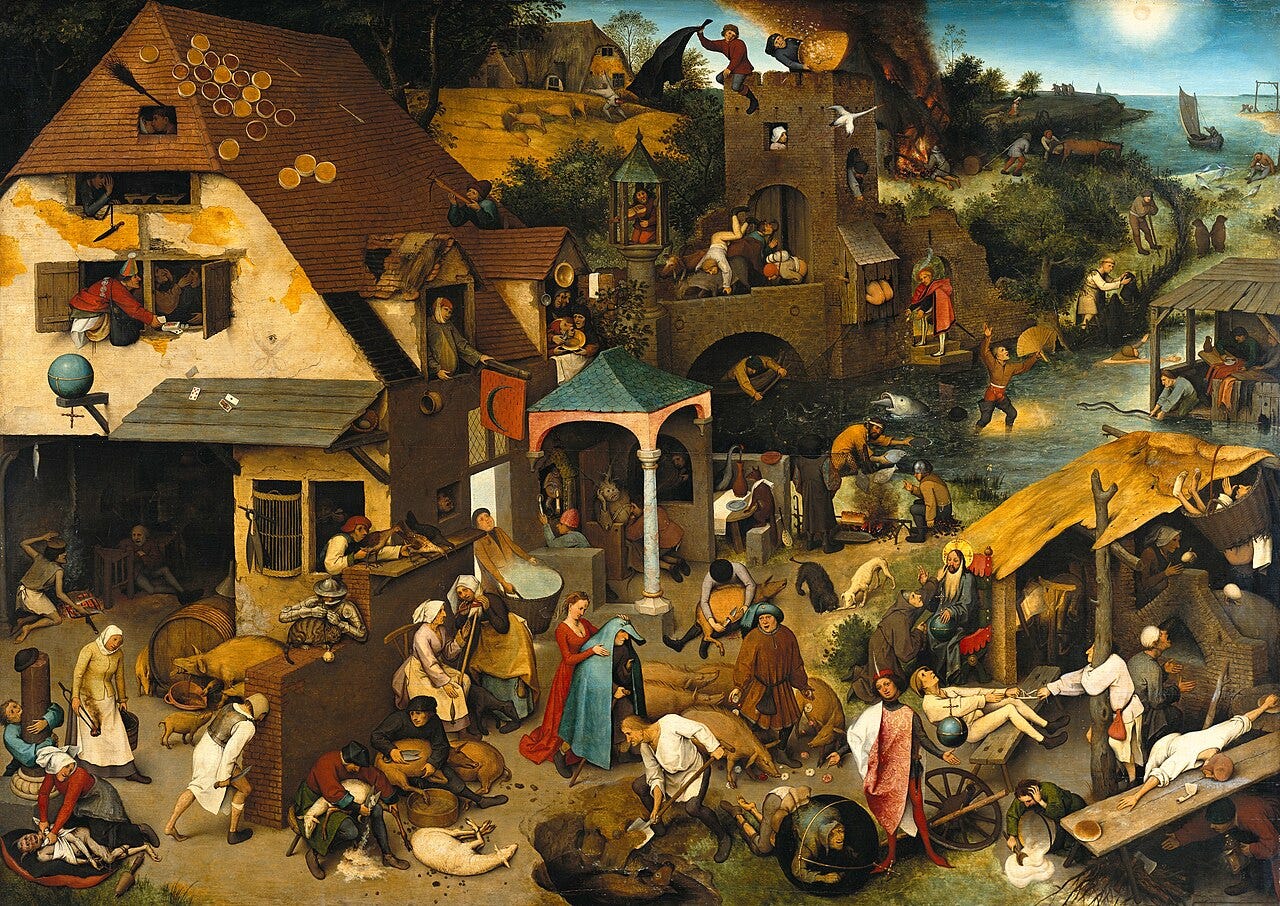
More than a hundred proverbs acted out in one village: a man banging his head against a wall, another roofing his house with tarts. Bruegel held the chaos together with one diagonal street and one earthy palette.
Bruegel, Children’s Games (1560): profusion with a floor plan
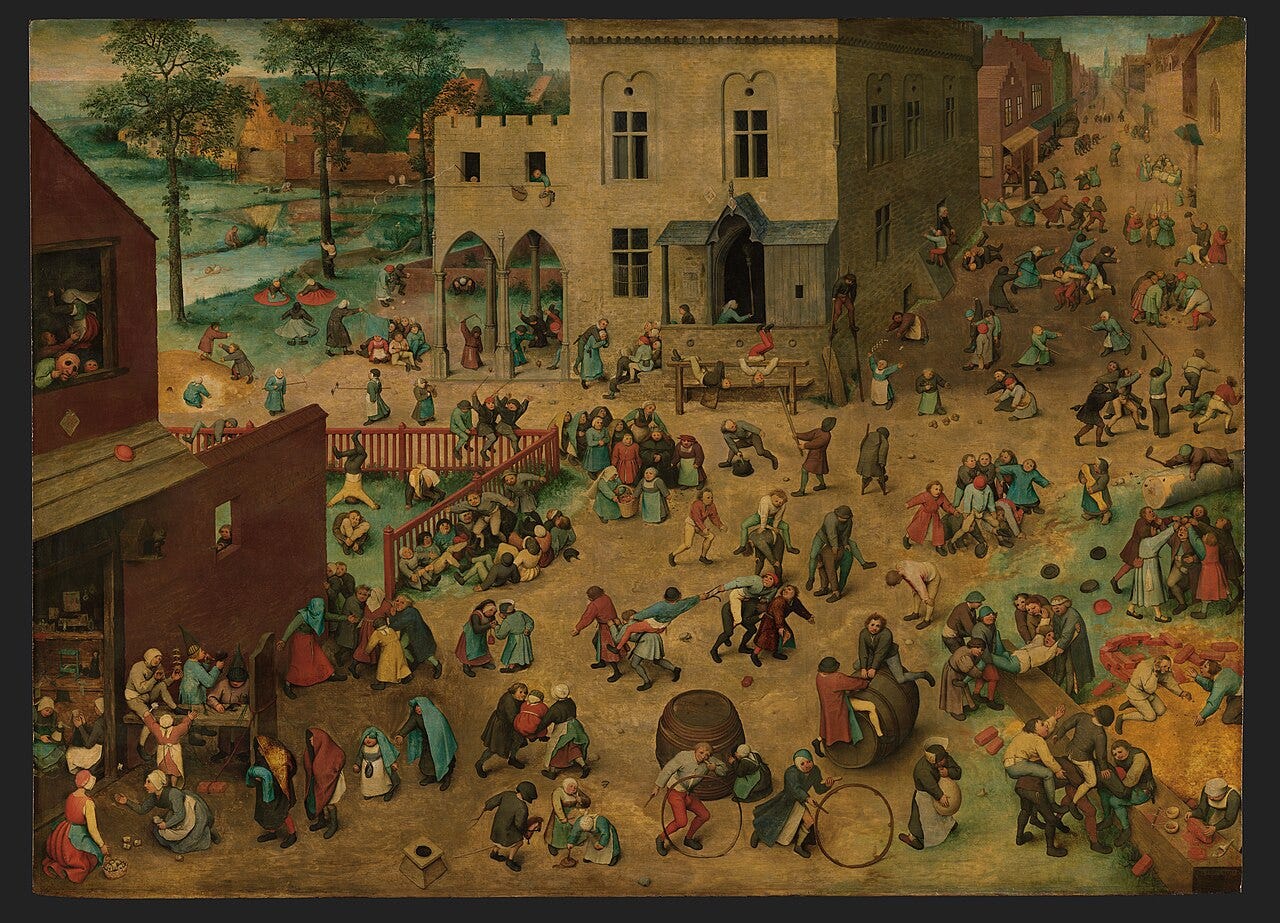
Around eighty different games, each its own little scene, all disciplined by the town square’s geometry. Bruegel proves the rule: the wilder the variety, the stronger the container must be.
Learn art the fun way


Arcimboldo, Vertumnus (c. 1590): variety that adds up to a face
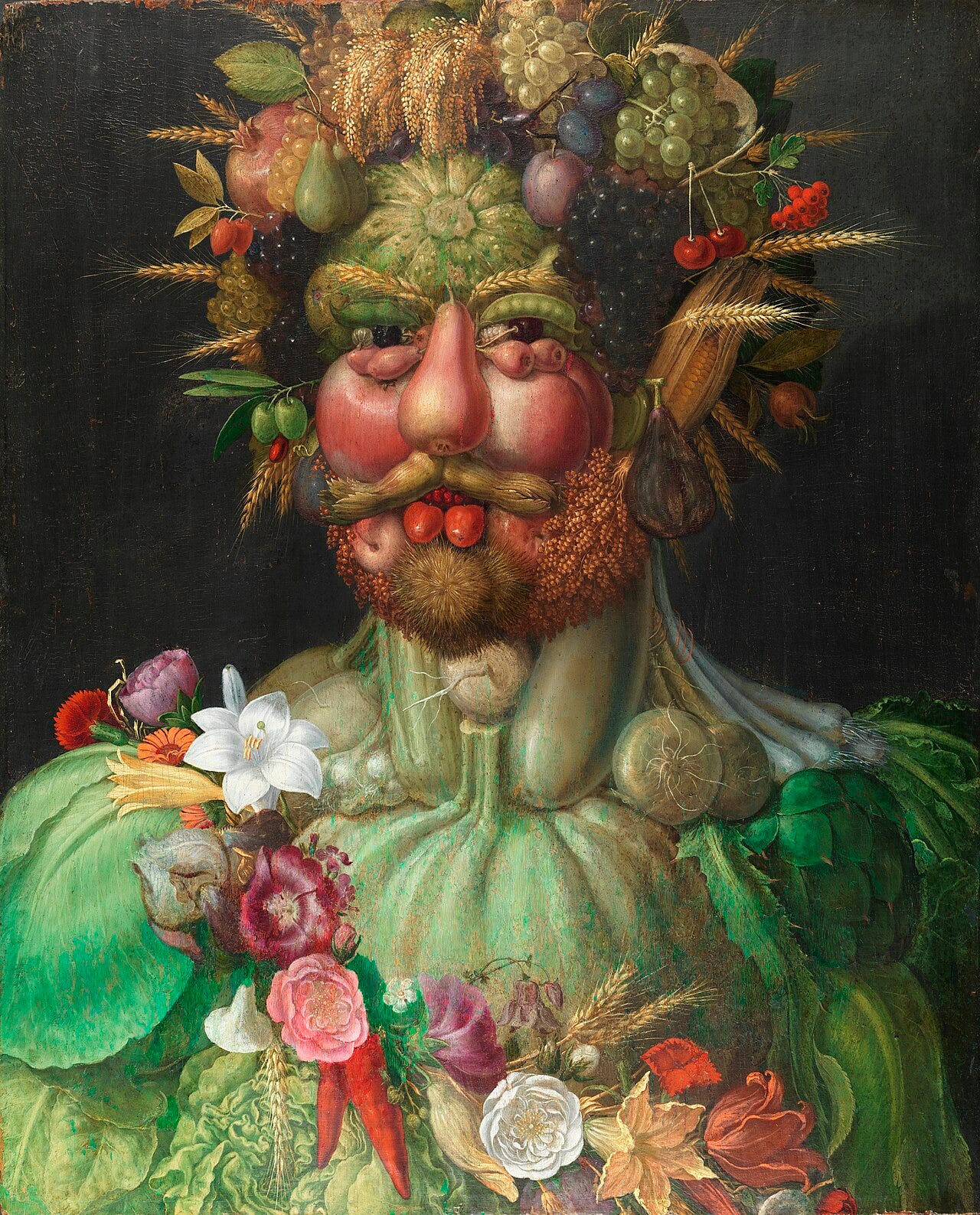
Pears, cherries, wheat, peapods, and cabbage leaves, dozens of species painted straight, and together they become the Emperor Rudolf II. Giuseppe Arcimboldo made variety itself the portrait.
The emperor loved it. Being shown as a pile of vegetables was, at his court, a compliment about abundance.
Kandinsky, Composition VIII (1923): many shapes, one conductor
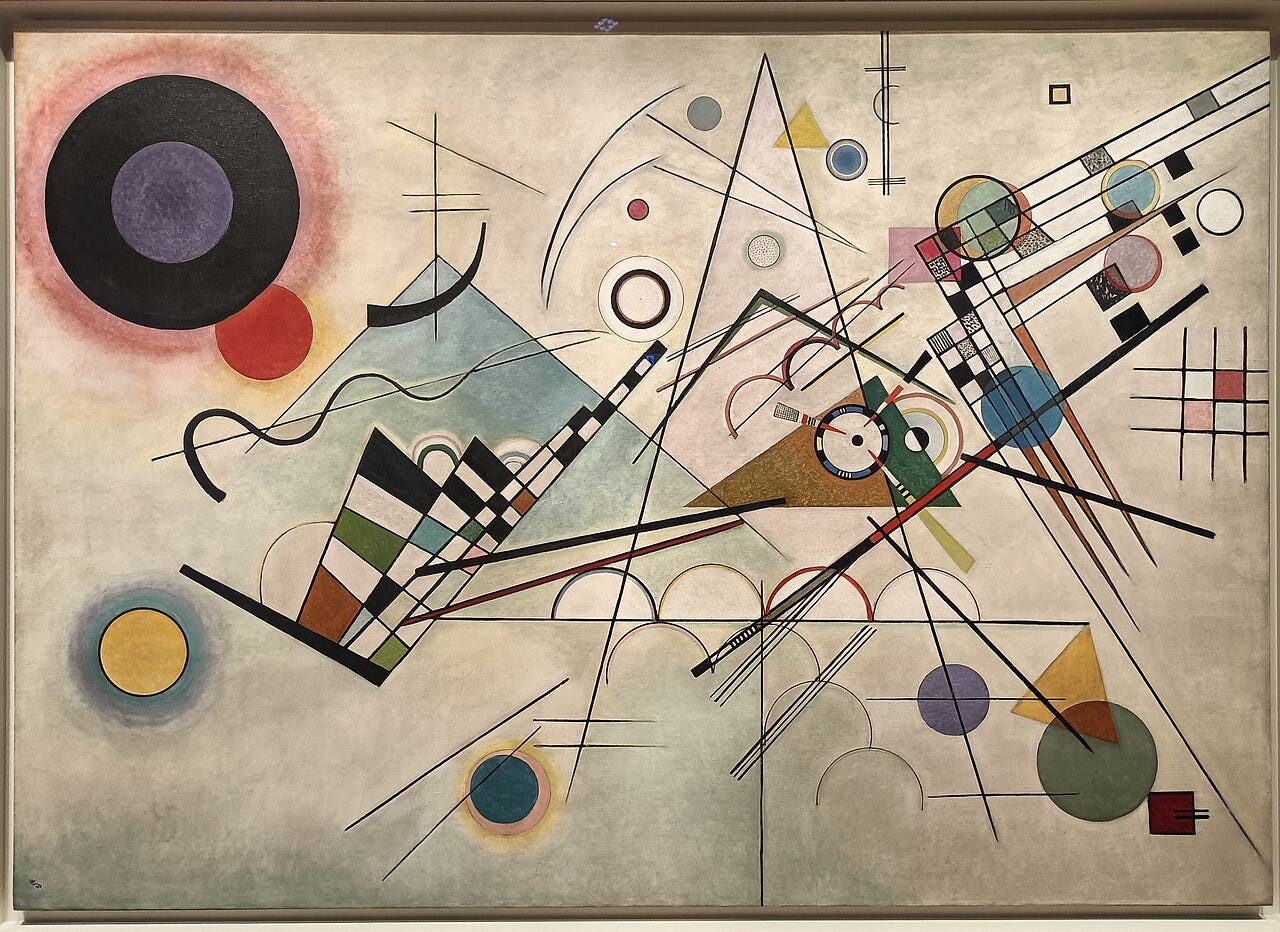
Circles, wedges, grids, and loose curves, every family of shape invited, and the composition still stands at attention. Kandinsky balanced maximum variety of form against strict placement, a crowd under a conductor.
Klimt, Adele Bloch-Bauer I (1907): a riot dipped in gold
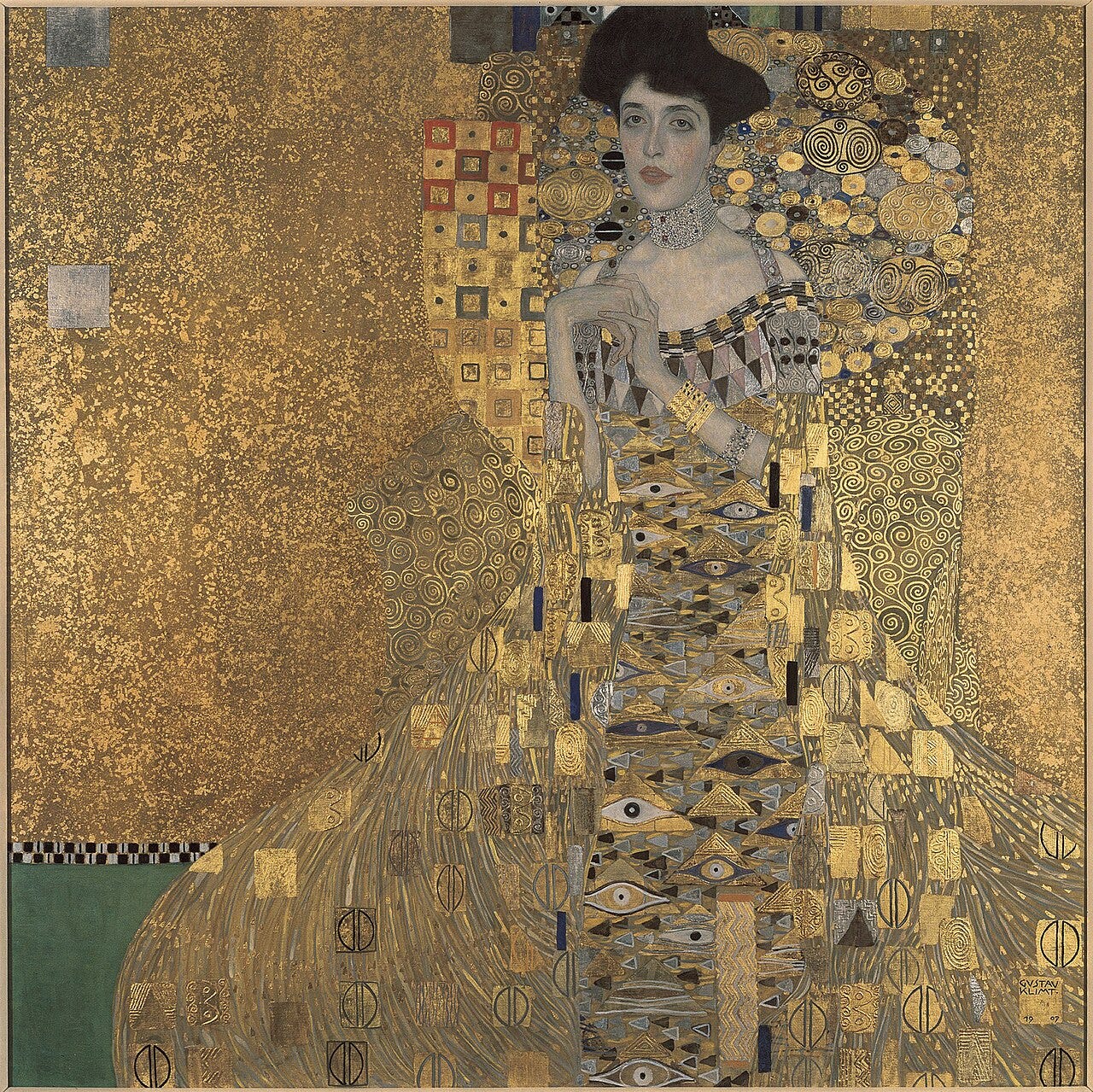
Spirals, eyes, rectangles, checkers: dozens of different motifs crowd the dress and the ground. Klimt unified the inventory the simplest way possible: he dipped all of it in the same gold.
Delaunay, The First Disc (1913): every color, one wheel
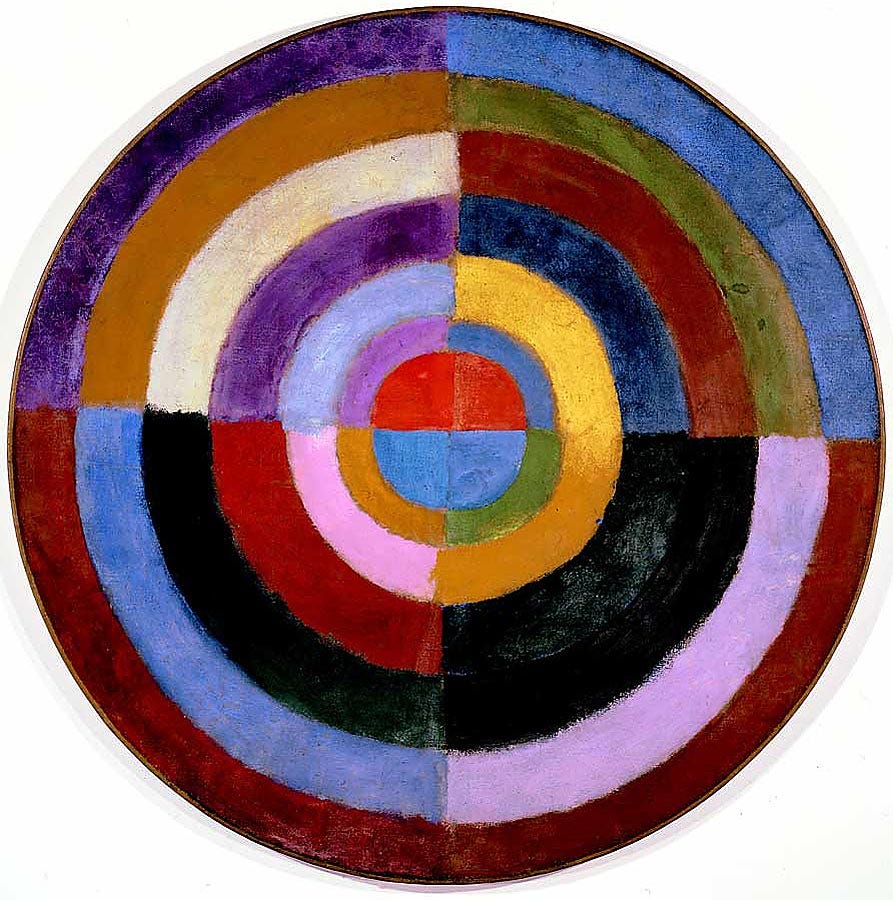
The palette is total, reds through violets, but the form count is exactly one. Delaunay shows the trade working in reverse: maximum variety of color, minimum variety of shape.
The floaters and the throwers: Chagall, Miró, Pollock
Marc Chagall filled skies with fiddlers, cows, brides, and rooftops, unified by dream logic and a dominant blue. Miró scattered unlike signs across single-color fields. And Jackson Pollock threw endless gestural variety onto the canvas, unified by the sheer evenness of the throwing. Rights are enforced in some countries, so words only.
Three different answers, one lesson: the more kinds of thing you admit, the stronger your one container must be.
Variety is one of eleven principles that organize a composition. See how it connects to the rest in the complete elements and principles of art guide. It connects closely to pattern in art.
You Might Also Like


Quick answers
What is variety in art? The deliberate use of difference, in shape, color, texture, size, or direction, to keep a composition interesting.
What is the difference between variety and contrast? Contrast is one strong opposition, light against dark. Variety is many differences distributed through the work. Contrast is a duel; variety is a crowd.
How do variety and unity work together? As a ratio. Unity holds the picture together, variety keeps it alive. Too much unity bores, too much variety shatters; every strong painting sits between.
What is an example of variety in a painting? The Garden of Earthly Delights: hundreds of unlike creatures and objects, held in order by three panels and one steady palette.
Where to see these works
The Garden of Earthly Delights is in the Prado, the Netherlandish Proverbs in Berlin’s Gemäldegalerie, and Children’s Games in Vienna. Vertumnus hangs at Skokloster Castle in Sweden.
Composition VIII is at the Guggenheim, Adele Bloch-Bauer I at the Neue Galerie in New York, and Chagall is best met at the Musée Chagall in Nice and MoMA.
One last fact
When Philip II of Spain, the most severe Catholic monarch of his age, went collecting, he acquired the Garden of Earthly Delights and installed it in the Escorial: the most extravagantly various picture ever painted, in the most austere palace in Europe. Even the king who ordered the world in black and white kept variety close.