
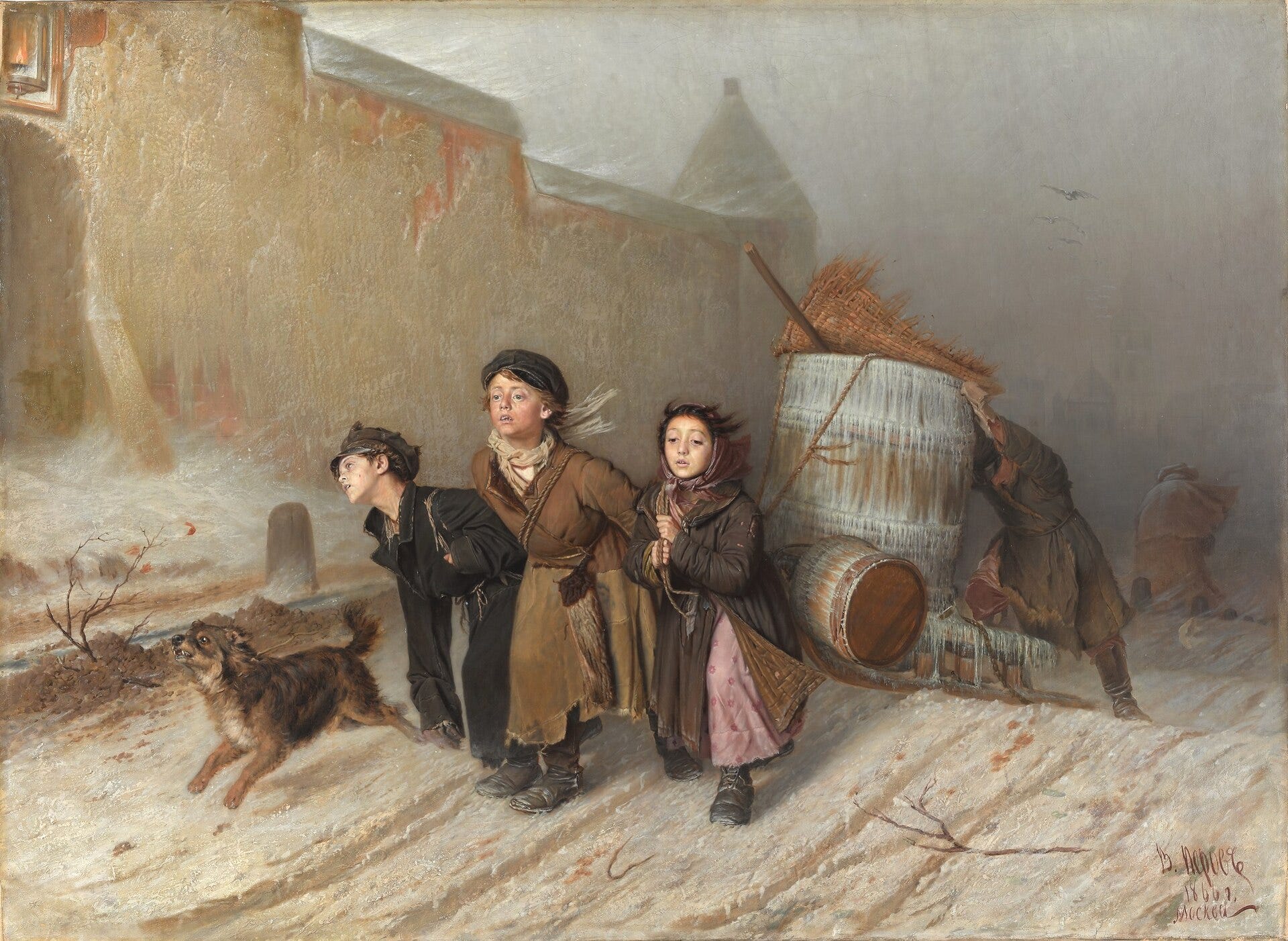
Vasily Perov (1834 to 1882) was a Russian painter of ordinary people. His best-known works hang in the Tretyakov Gallery in Moscow: Troika, three children hauling a frozen barrel of water, and a portrait of the novelist Fyodor Dostoevsky.
Cool Stories About Art is a newsletter to learn art the fun way.
Join 200,000+ readers and get:
10 new art stories / month
The entire archive of content (140+ articles)
Comment, ask questions, and chat with other readers
Vasily Perov signed his paintings with a name that was neither his father's nor the one he was registered under at birth. Under that name, he painted a picture that church authorities had taken off the walls of an exhibition, and eleven years later the novelist Fyodor Dostoevsky.
Vasily was born on January 2, 1834, in Tobolsk, the old capital of Siberia, far to the east of Moscow. His father, Baron Grigory Kridener, was the prosecutor of the province, the official who brought criminals to trial in the name of the state.
His mother, Akulina Ivanova, was a woman of Tobolsk of modest birth. Russia still used an older calendar, twelve days behind, so Russian records give the boy's birthday as December 21, 1833.
His parents married soon after he was born, but the wedding came too late for their son. Russian law did not allow a child born before his parents married to carry his father's name or title. So Vasily was registered under the family name of his godfather, the man who held him at his baptism: Vasilyev.
The name he would carry all his life came from neither man. A former church reader, who had once sung and read the prayers in a village church, taught the boy to write. The old man admired his handwriting and nicknamed him Perov, from pero, the Russian word for a pen. The nickname stuck.
In 1853, Perov entered the Moscow School of Painting, Sculpture and Architecture, the city's main school for young artists. He had no money and at first nowhere to sleep, until one of his teachers took him into his home.
In 1861, the student who had nowhere to sleep won the great gold medal of the Academy of Arts, the state school in Saint Petersburg that ruled official art in Russia. That same year, another of his paintings, an Easter procession in a village, caused a scandal.
How did that scandal lead Perov, eleven years later, to Dostoevsky's door?
In the rest of the story
Who posed for the middle boy in Troika, and what became of him.
Why a fellow painter feared Perov would end up in a monastery prison.
Why Perov, sent to study in Paris, begged to come home early.
How Perov prepared to paint Dostoevsky, a man wary of strangers.