
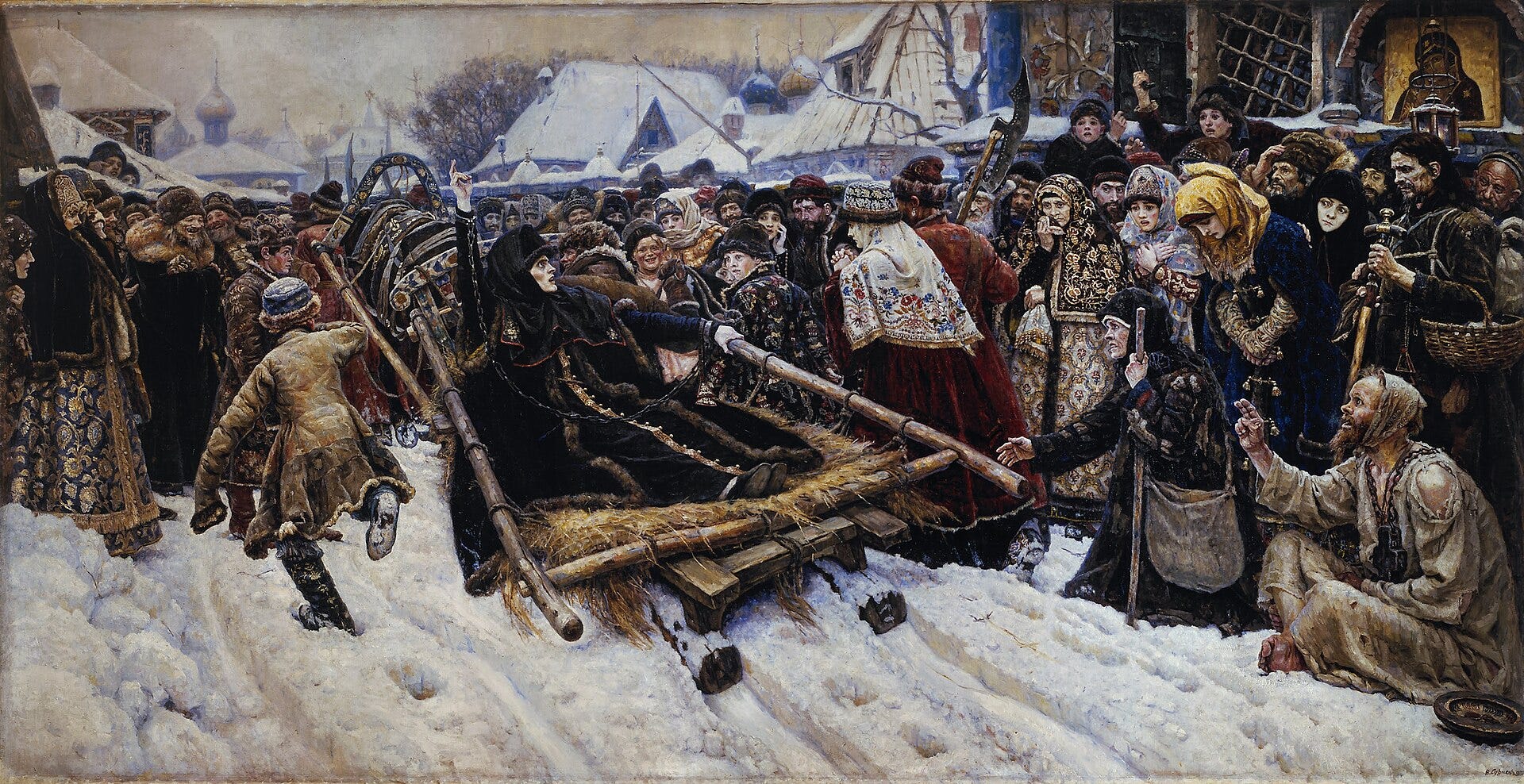
Vasily Surikov (1848 to 1916) was a Russian painter born in Siberia. He became famous for giant scenes of Russian history, like Boyarynya Morozova, the picture of a noblewoman carried off in chains through the snow, now at the Tretyakov Gallery in Moscow.
Cool Stories About Art is a newsletter to learn art the fun way.
Join 200,000+ readers and get:
10 new art stories / month
The entire archive of content (140+ articles)
Comment, ask questions, and chat with other readers
Vasily Surikov had lived in Moscow for ten years when, in the summer of 1887, he took his wife, Lisa, and their two daughters to Siberia. He had not been back in fourteen years.
A few months after the road back to Moscow, Lisa fell ill. She died in April 1888, at thirty. For almost two years, Surikov hardly painted.
Siberia was where his life had started, forty years earlier. Vasily Surikov was born on January 24, 1848, in Krasnoyarsk, a town on the Yenisei River in central Siberia.
Both his parents came from families of Cossacks, frontier horsemen who served the tsar, the emperor of Russia. "On every side, I am a born Cossack," Surikov said.
Vasily's father, a government clerk, died of tuberculosis in 1859. To get by, the family rented out the upper floor of their house.
At the district school, a drawing teacher, Nikolai Grebnev, encouraged the boy. There was no money for more school, so Vasily became a copyist, a clerk who copied official papers by hand, in the offices of the provincial government.
The governor of the province, Pavel Zamyatnin, sent the young copyist's drawings to the Imperial Academy of Arts in Saint Petersburg, then the capital of Russia.
The governor also found Vasily a patron: Pyotr Kuznetsov, a Krasnoyarsk merchant who owned gold mines. Kuznetsov paid for the journey and a yearly allowance.
In December 1868, Surikov, then twenty, left Krasnoyarsk with a convoy carrying Kuznetsov's fish west. The journey took two and a half months.
On the way, Surikov crossed Moscow and saw Red Square, the great square below the walls of the Kremlin, the old fortress of the tsars. Early in 1869, he reached Saint Petersburg.
In 1889, twenty years after he had left with Kuznetsov's convoy, Surikov took his daughters back to Siberia.
How could Siberia, where Surikov had taken Lisa on her last journey, give him back the strength to paint?
In the rest of the story
What Surikov first imagined on Red Square, twelve years before he showed it.
What sight in the snow Surikov could not forget for years.
Which boyhood game helped Surikov out of his grief.
What Surikov found at the gold mines that had paid his way west.