
Vasily Vereshchagin (1842 to 1904) was a Russian painter of war. He followed armies across Central Asia, India and the Balkans, and painted what he saw: the dead, the wounded and the frozen.
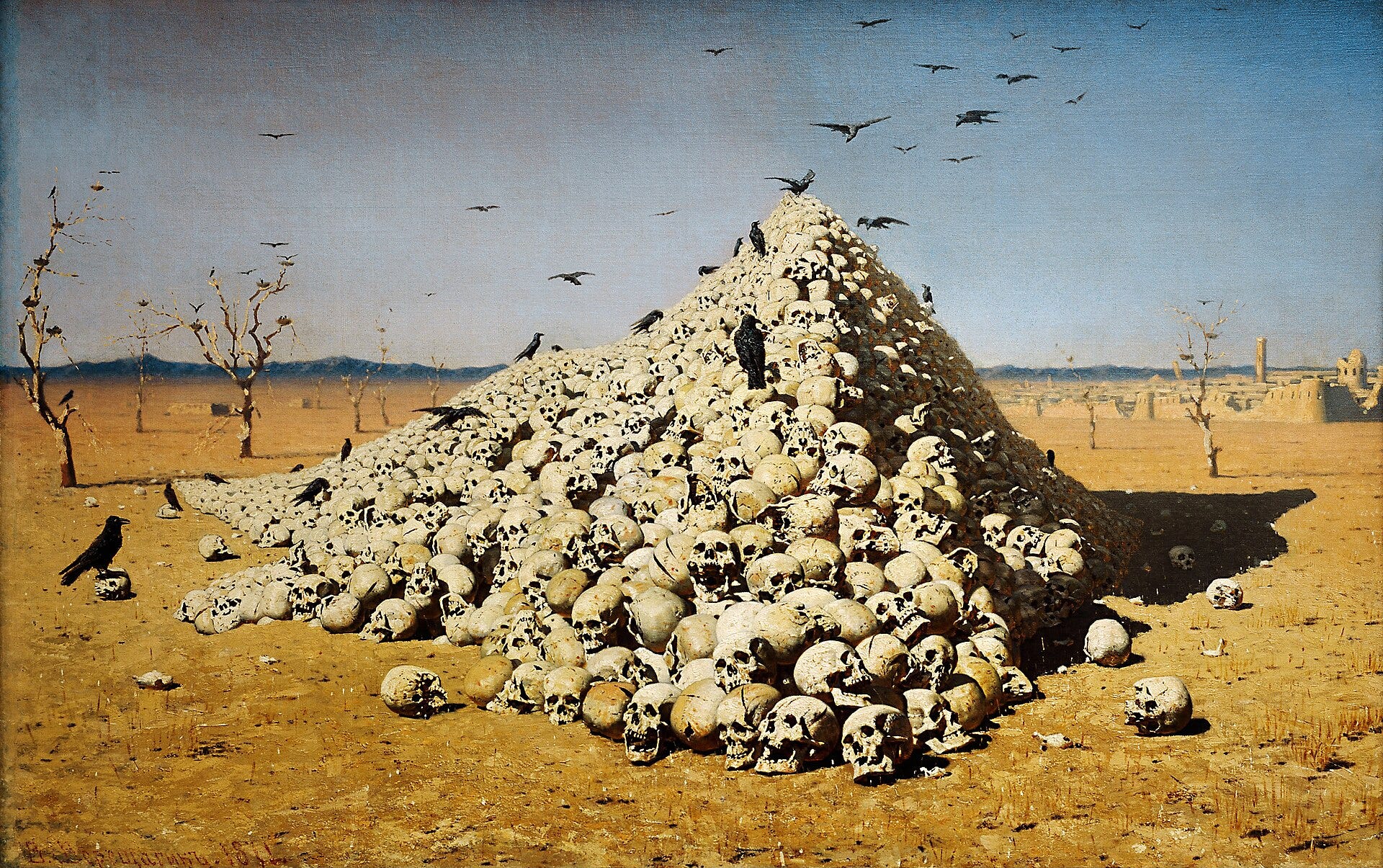
His most famous picture, The Apotheosis of War, shows a pyramid of human skulls in the desert, with crows circling above it. Its frame is dedicated "to all great conquerors, past, present and to come."
Vereshchagin had fought in a war himself and won the Cross of Saint George for courage. Then he painted war so truthfully that generals tried to keep people from seeing his pictures.
Cool Stories About Art is a newsletter to learn art the fun way.
Join 200,000+ readers and get:
10 new art stories / month
The entire archive of content (140+ articles)
Comment, ask questions, and chat with other readers
Vasily Vereshchagin was born in 1842 in Cherepovets, a small town north of Moscow, into a family of landowning nobles. He went to the naval cadet school in Saint Petersburg, the capital of Russia, and finished first in his class.
Then he left the navy to become a painter and studied in Paris with Jean-Léon Gérôme, a famous French painter.
In those years, Russia was pushing its empire south into Central Asia, the vast land of deserts and old trading cities between the Caspian Sea and China. In 1867, General Konstantin von Kaufmann, the Russian governor of the newly conquered lands, invited artists to travel with his army, and Vereshchagin went along.
In May 1868, the Russian army took Samarkand, one of the great cities of the Silk Road, the old trade route between China and the Mediterranean. Kaufmann marched on and left about 650 soldiers in the citadel, the fortress inside the city walls.
In June, tens of thousands of fighters from the tribes of the region, allies of the emir of Bukhara, the Muslim ruler who had lost the city, surrounded the citadel, and many people of Samarkand rose up with them. The fiercest fighting was at the Bukhara gate.
There, a Russian major fell wounded, and Vereshchagin carried him to the hospital. The next day, attackers broke in near the gate and seized a cannon. Vereshchagin, a painter with no military rank, charged first, and the soldiers followed him.
After a week, Kaufmann's army returned and the besiegers fled. Vereshchagin received the Cross of Saint George, one of Russia's highest military honors, and came home a hero of the army. How long would the army go on calling him a hero, once it saw what he painted?
In the rest of the story
Why Vereshchagin cut up and burned three of his own paintings.
The painting of India that turned the British press against him.
Why a German field marshal kept his soldiers away from Vereshchagin's exhibition.
Why Vereshchagin was aboard a battleship at sixty-one.